Monday, August 13, 2012

News from the Stores

Conservation work for the new museum is well underway, but with so many objects coming on display for the first time, there is a lot to do!  Although our conservator, Mary Macqueen, is getting help from external conservators for the specialist work, the enormous workload has given us a fantastic opportunity to also involve work experience students.   

This photograph shows Alice Galloway, a conservation student from Lincoln University, cleaning one of the objects which will be seen in the new museum.  Alice is working alongside Mary, gaining valuable real-life museum experience which will help her in her studies – and giving us an extra pair of hands at this very busy time!

Conservation student, Alice Galloway cleaning a 1960s Dansette record player for display in The Front Room.
Alice Galloway says:
“I have had a fantastic time working on the materials for the new museum, working under a very experienced conservator with a real sense of the value of the work being done. It will be great to be able to come back later and see the museum when it opens - and perhaps bring other students with me!”

Sue Thomas, Principal Lecturer in the School of Art and Design, Lincoln University, visited last week to assess the placement and said:
“It is really good to have the co-operation of a museum service such as Wakefield Council's, especially when they can still offer a student this very valuable experience during this period of change. We hope to continue with the links for the future.”

Alice has worked on a range of objects during her time with us, including the wonderful signed cricket bat we already reported on.  See the before and after photos and spot the difference!


Before cleaning
After cleaning by Alice, our work placement student

Monday, August 6, 2012

Rugby Legend Lends a Hand


We met record breaking rugby hero Neil Fox today to look through some of the objects he has amassed during his decorated and much celebrated career with Wakefield Trinity. Neil, originally from Sharlston and whose two brothers Peter and Don were also Trinity players,  played in the legendary team which won League, Challenge and Yorkshire cup finals throughout the 1960s. Over a career that spanned three decades he scored 6,220 points, more than any other player. He also played and toured with Yorkshire, England and Great Britain.

Neil is very kindly lending some of his hard won medals, his Lance Todd trophy and International caps. These items will help us create a rugby display which will celebrate Trinity’s 1960s golden age.

Neil Fox and Wildcats General Manager Davide Longo with some of the items to be displayed in Wakefield Museum

Tuesday, July 31, 2012

Sporting history comes to Wakefield Museum

When hostilities resume at Headingley this week, as South Africa try to replace England as the world’s top test cricket team, we might want to cast our minds back to a time when cricket was more of the fabled gentleman’s game.
Wm Sykes Cricket Bat
Wakefield Museum has acquired a cricket bat from match in 1935, in time for the test match between the same two teams this Thursday.
Signed by the 1935 test match teams


The cricket bat, recently acquired by The Friends of Wakefield Art Galleries and Museums for Wakefield Museum, was signed by all the players in the 1935 England-v-South-Africa test match,  including Herby Wade, Dudley Nourse, Jock Cameron, R.E.S.Wyatt, Herbert Sutcliffe and Hedley Verity. Signed and endorsed on front by Jock Cameron, who tragically died of typhoid fever shortly after returning to South Africa. 


The bat was made locally by William Sykes Ltd.of Horbury, a world leader in the production of high quality sports equipment. The company went on to build a worldwide reputation for excellence producing high quality sports equipment including the footballs used for cup finals in the 1940s.


The bat is a great asset for Wakefield Museum and will be a proud product displayed in the Work section as it was 'Made in Wakefield'.


And the winners of the 1935 test series? South Africa sneaked it 1-0!

Tuesday, July 24, 2012

Museum Engagement Event

Today saw people from a range of organisation across the district invited to the first of a new series of engagement events planned by the museum service. Initially aimed at those with an interest in local history and heritage, it was an opportunity for the attendees to find out more about the museum service and some of the exciting new developments. 

The group met today to hear about developments in the museums
Museums are undergoing major change in how we deliver our services particularly with the transfer of Wakefield Museum to Wakefield One and the building of a new museum as part of The Forum, Castleford.  The meeting outlined how these two new museums will offer the opportunity to reinvigorate our displays and how people will be able to access collections and information in different ways. Other exciting developments were also discussed, including work on the future development of our collections, plans for community led exhibitions and displays, and how we will further develop our learning and outreach work. 

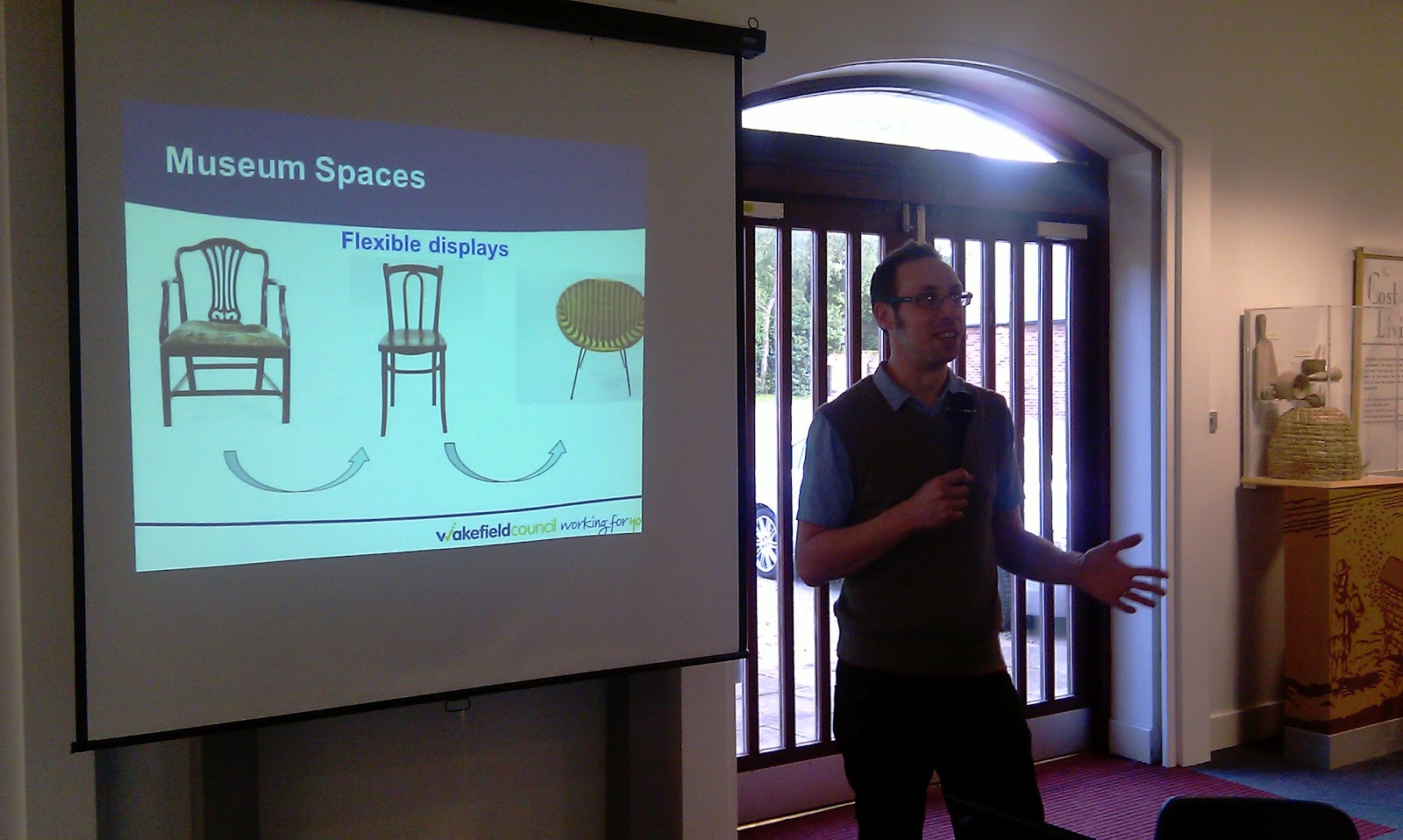
Curator, John Whitaker, explaining how the new museums are being designed to allow for changing displays
With so much going on it was an ideal time to kick of these engagement sessions with a chance to meet with our museum team.  The event included staff from the collections, exhibitions and learning teams doing a series of short presentation highlighting current projects and outlining future plans. Needless to say the sessions generated much interest. We see them as an opportunity for the service get feedback and how we are doing and to find out how local people might want to become more involved in what we do.

Thanks to everyone that came!

.

Monday, July 16, 2012

'Doing a turn' in The Front Room

Time for another sneaky preview of the new museum.
We will have a gallery exploring the home which we are calling The Front Room.  This will be a very interactive space, and we are even planning some performance spaces in it.  These areas will be perfect for costumed role-play.
Layout design of The Front Room with raised platform as a performance space

Here is an initial view within the gallery, looking towards one of these performance spaces - a Victorian kitchen.  

The table at the front of the picture will be used for object handling, and to house interactives for families to enjoy.  

It's a space the Learning Team can't wait to get their hands on!


Monday, July 9, 2012

Charles Waterton celebrated in new BBC series

200 years ago this year local naturalist Charles Waterton set off on the first of his celebrated ‘Wanderings’ in Guyana in South America. He made three trips into the rainforests and brought back many specimens of bird and animal, which he preserved and displayed in the museum at his home at Walton Hall, near Wakefield.  It was his first trip in which he made one of his most important achievements, bringing back a sample of wourali poison (known today as curare).  

This poison was prepared by the Macusi, an Amerindian tribe, for use on their blow pipe arrows when hunting.  Curare paralyses the body of the victim leaving them unable to breathe for themselves. 

Physicians in Europe were keen to learn more about the poison because of its potential use in medicine but few samples were available to perform tests, and most samples which had previously come into Europe were weak. In 1812, Waterton not only brought back a powerful sample but also observed how it was prepared.  He was even able to perform an experiment with it: he gave some to a female donkey (which he named Wouralia) and using bellows to keep her breathing, he showed that she made a complete recovery, living for another 24 years.
Waterton's experiments on the donkey with curare were detailed in this booklet, published in 1839.  
Although a powerful and controllable substance, curare didn't have a proper role in medicine until the 1940s when it was used with anaesthetics to perform operations. The curare keeps the body of a patient calm and relaxed whilst the anaesthetic makes them unconscious. Without curare a higher dose of anaesthetic is needed which can be dangerous for the patient.

So today Waterton is recognised as bringing curare to Europe to be used in operating theatres around the world.


His discoveries are to be part of a new BBC series on the History of Medicine which Wakefield Museum is helping to research.

A quiver of curare tipped arrows and a bowl used by the Macusi tribe to prepare the poison will be on display in the new Waterton gallery at Wakefield Museum.

Bowl used by the Macusi tribe to prepare curare

Monday, July 2, 2012

Ideas and plans are coming to life!

Here is a quick preview of the layout of one of the sections of the new museum.  This section uses the decorative carved beams in the collection to show how some of the now long-gone Tudor architecture of Wakefield looked. (The beams are represented here by simple brown blocks, but they are beautiful really!).  See this posting for more details.


Design ideas for the Tudor Wakefield section of the museum
It is really exciting for us to see the progress from ideas, concepts and lists to 3D drawings like this.  Can't wait to see it for real!