As part of our series of blog posts exploring Black history in the Wakefield district, Hannah Taylor, Research Volunteer, has researched and written a blog post about Charlie Williams.
Charlie Williams was one
of Britain's most loved and well-known comedians in the latter half of the
twentieth century. He is known for his strong Yorkshire accent and has working
roots in the Wakefield district. He became the first Black British comedian to
reach a mainstream audience.
Williams
was born in 1927 in Barnsley. His father was from Barbados and had come to
Britain to fight for King and Country in World War I; his mother was a South
Yorkshire lass. After finishing school at 14, Charlie worked as a miner in
Upton Colliery during World War II and the immediate post-war period. During
this time, he played football for the colliery team, building on the skills
that would later pave the way for his professional football career.
Upton Colliery was a coal mine based near the village of Upton, in the south-west of the Wakefield district. It had a short working lifespan of only 40 years, due to geological issues and a significant explosion, which caused the mine to ultimately close down.
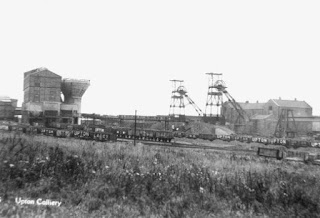 |
| Upton Colliery, early 20th century |
Despite its short tenure, the mine’s football team, Upton Colliery FC, produced notable later-to-be professional footballers, including Joe Shaw, George Ashall and, of course, Charlie Williams.
Williams left the colliery team in 1948 after being scouted by Doncaster Rovers during an Upton match. He made his mark on history in the football world by becoming one of the first post-war Black British players.
 |
Charlie Williams playing football in the 1940s. Image courtesy of Barnsley Museums and Archives |
His professional footballing career started at Doncaster Rovers, where he had significant and notable success. Local newspapers, such as The Star Green' Un and the Yorkshire Post, repeatedly credit Williams as the 'Man of the Match' and account for his brilliant skill.
However, it was not uncommon for Williams' race to be mentioned in these articles. This highlights the challenges that Black British people faced to be accepted as equals in society. Sadly, Williams certainly experienced racism and discrimination during his footballing career. He was not mentioned in the 1956 Encyclopaedia of Association Football despite having established himself as a regular first team player that season.
Williams was also frequently subjected to racist abuse whilst playing, particularly from opposition players and fans. His former teammates remember that he responded to this with dignity and by "upping his game" on the pitch but reflect that it must have been painful for him. Williams’ successful football career featured 171 appearances with Doncaster Rovers between 1948 and 1959. Following his retirement in the early 1960s, Williams went on to sing at northern working men's clubs.
During these gigs, he found that his comedic chat between songs was more popular, so he pursued a career in comedy instead. A key reason for Williams' popularity among the audience was his strong Yorkshire accent. It allowed the predominately white audience to relate to him – a working-class, Yorkshire-born-and-bred man. |
 |
Charlie Williams in the 1960s. Image courtesy of Barnsley Museums & Archives |
His Yorkshire accent later became a hit on TV shows with Granada and the BBC, with notable catchphrases such as 'Hello, me old flower', 'Na then, Blossom' and 'Na then, 'old on'.
The 1970s-1990s was Charlie Williams' era: he received an MBE for his charity work in Yorkshire and was featured repeatedly on the hit TV show 'The Comedians'. He was even given the title 'the Uncrowned King of Batley', a reference to the famous Batley Variety Club! 1972 was a pivotal year for Williams as he had his own television show and a six-month season at the London Palladium.
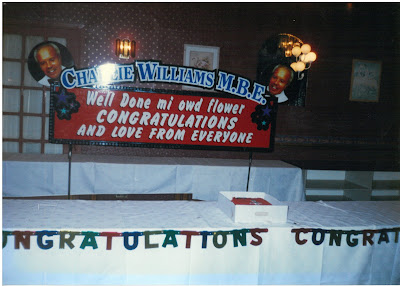 |
Photo from a party thrown to celebrate Charlie Williams' MBE
Image courtesy of Barnsley Museums & Archives
|
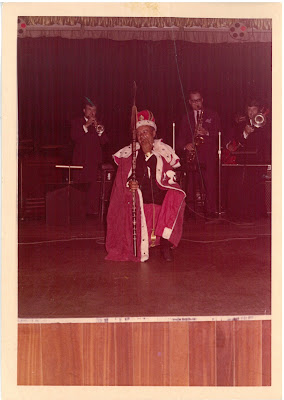 |
Charlie Williams on stage, dressed in royal regalia with a spear, at the party to celebrate his MBE
Image courtesy of Barnsley Museums & Archives |
Some Black British comedians,
such as Lenny Henry, argue
that Charlie Williams' popularity at least partly derived from the racist
society at the time. In the 1970s, the BBC
still produced television shows where ‘blackface’ was a key feature of comedy,
adding to racial hostilities in Britain. In Henry’s view, Williams often told jokes at
the expense of Black people to get laughs from the white audience.
Due to changing attitudes and
societal progression about what should be accepted in the entertainment
industry, Williams' career as a comic subsided. Nevertheless, upon reflection
on his fame and comedy success, Williams articulated, “I don't have any regrets…I
told jokes that I thought would suit the audience”.
Charlie Williams died in September 2006, having
lived with Parkinson's disease and dementia. Williams had an extraordinary
life: one of the first Black post-war professional footballers and the
first famous Black British television comedian.
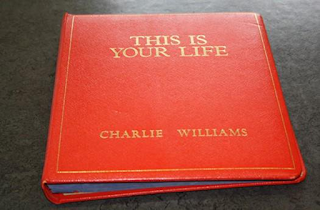 |
| The "This is Your Life" book Charlie Williams received after going on the television programme |
He is fondly remembered by his former
neighbours:
“He was a terrific singer…He’d always got a
smile… He were a grand fella…People used to come for his autograph and he never
turned them away…He talked in broad Yorkshire.”
[Extracts from an oral history interview with Harry
Godber, Upton, May 2017]
His Yorkshire identity was essential for his
popularity, and thus he is seen by many as a local hero. But his legacy is
complicated. Williams' comedy about his race was 'of its time' and would likely
be felt inappropriate or offensive today.
However, some argue that Williams
bridged a gap between Black and white communities through the skill of comedy
and entertainment.
He endured racism and prejudice during his career but paved
the way for Black Britons to make appearances on national TV.
With thanks to the Wakefield Council BAME Forum for their comments and feedback, and Barnsley Museums and Archives for their help and providing permission to use their photos.
For other blog posts in our Black History Month 2022 series, see:


