Showing posts with label Second World War. Show all posts

Thursday, August 14, 2025

Chloe: what I did on my work placement with Wakefield Museums and Castles

Chloe recently did a work placement with us as part of her university course. She's kindly written this guest blog about her experience. 

Read on to discover some of the interesting objects she catalogued for us!

During my work placement I was based in the museum store. I catalogued a small collection of items from the Sykes / Slazenger factory. The Sykes / Slazenger factory is mainly known for manufacturing sports items and equipment.

When I first started my work placement I was given a tour of the museum store. I was shown some of the objects and items they have and told about their significance. I was then shown the objects I would cataloguing throughout the eight weeks of my placement. I was also shown the history file. This contains everything needed to be kept with the collection, like the forms to say what needs to be catalogued or just used for reference. It also says how they got the items as well as the ownership of the items.

A table featuring a pile of photographs, photo album, racket head press, tennis racket and rifle furniture
The objects I catalogued

The items I was to catalogue were:

  • a pile of black and white photographs

  • a photo album with more black and white photographs

  • a head press (this was used to help make sure the tennis racket kept its shape)

  • a tennis racket with a head press

  • some rifle furniture (the wooden parts of a rifle) produced in the Sykes / Slazenger factory during the Second World War

The photographs

After looking through the objects, I decided I would start by cataloguing the black and white photographs. I started by putting the photographs into groups. I wanted to keep and catalogue the ones that were similar together.

A lot of the photographs were quite similar in nature. Cataloguing them was difficult, as it was hard to tell the difference between them.

Some of the photographs were pictures of some of the different manufacturing processes. These included how a tennis racket or a golf club was made. Others were of people using the machine, or just of the machines themselves.

This was very similar when I had catalogued the photo album. Some of the photographs were similar or the same to the ones I had already catalogued.

A man in an overcoat closely studying a golf club in the Sykes factory
 This photograph shows a man looking over a finished golf club. He is making sure that everything has been done correctly. He is also putting on the final touches to the golf club.

Cataloguing the 3D objects

Cataloguing the rifle parts, tennis racket, head presses and the film reel was different. These objects have depth, whereas the photographs do not.

When measuring the length of the objects, I had to use a tape measure. They were quite long and it would have been difficult to do so without. I also had to look closely at the objects to make sure the condition they were in was fine. 

I was also looking to see if there was anything that was engraved or marked on to the objects.

A vintage wooden racket with a head press attached
The racket, still in its head press

The Sykes factory started to manufacture the wooden rifle parts during the Second World War. They would have slowed down the manufacturing of the sports items they produced, along with some of the machines in the photographs.

Various parts to construct a rifle made out of smooth polished wood
Pieces of wooden rifle furniture made by Sykes

There were some books amongst the items within the collection I was able to use for referencing. This was useful as I was able to match the photographs to the pictures of the machines within the books. 

There were some small pieces of paper that also had the name and description of what the machine was used for and how it worked. I was able to match the pieces of paper to the photographs as some of the machines had their names engraved on the front.

A book titled Sykes and the War and a printed thesis
'Sykes and the War' and a thesis I used to research the objects

I had lastly catalogued some letters within the collection. They were in correspondence with the Sykes / Slazenger factory (more importantly the people within the factory). The majority of them had the dates in which they were sent. This made it easier for me to catalogue them in time order.

A lot of the letters were in response to Briggs receiving the British Empire Medal that was awarded by the King. This was due to his hard work in the war effort. Briggs sent letters back saying that it was a joint effort with the people he was working with and only done with the support of others.

This small collection I have catalogued is a part of a bigger collection Wakefield Museums and Castles has. There is loads more to find out about other sports items and equipment that were made at the factory. There's also lots to learn about the history behind the factory and how they stepped in to help with the war effort.

Wednesday, May 7, 2025

Pontefract's civic fundraising in the Second World War - VE Day 80

The Second World War was incredibly expensive, both in terms of human lives and monetary cost. People across Britain and the Empire dug deep to help out. 

Read on to discover the fantastic contributions of the people of Pontefract, in this special blog for VE Day 80.

Civic fundraising

2025 is the 80th anniversary of the end of the Second World War. The war in Europe ended on 8 May 1945, VE Day. In Asia it ended on 15 August 1945, VJ Day.

This was the largest war in history. The human tragedy was terrible. Around 80 million people died.

It was also expensive. By 1945 52% of the British economy was devoted to the war. Today’s equivalent is 2.5%.

This huge cost had to be paid. Ordinary people were one source of money. At the start of the war people across Britain and the Empire gave generously to campaigns like the Spitfire Fund. Jamaica gave so much an RAF squadron was named for it, and it was one Pontefract was later linked to.

A poster featuring an illustration of a determined looking soldier and the words 'he's got 'em on the run, keep 'em running with more savings'
A civic fundraising poster from the Second World War

The war cost over £100 million every week. The government needed a continuous supply of money. Compulsory methods, like higher taxes or forced saving, were considered. They were discounted as they could have damaged morale.

Instead, in 1941, the government introduced National Savings. Rather than giving their money, people lent it. They bought small bonds that would be repaid (with interest) after the war.

Local areas organised savings campaigns. Communities had targets and competed to save the most. Individuals and businesses bought bonds. Saving like this rather than spending money also kept inflation low, which was another government goal.

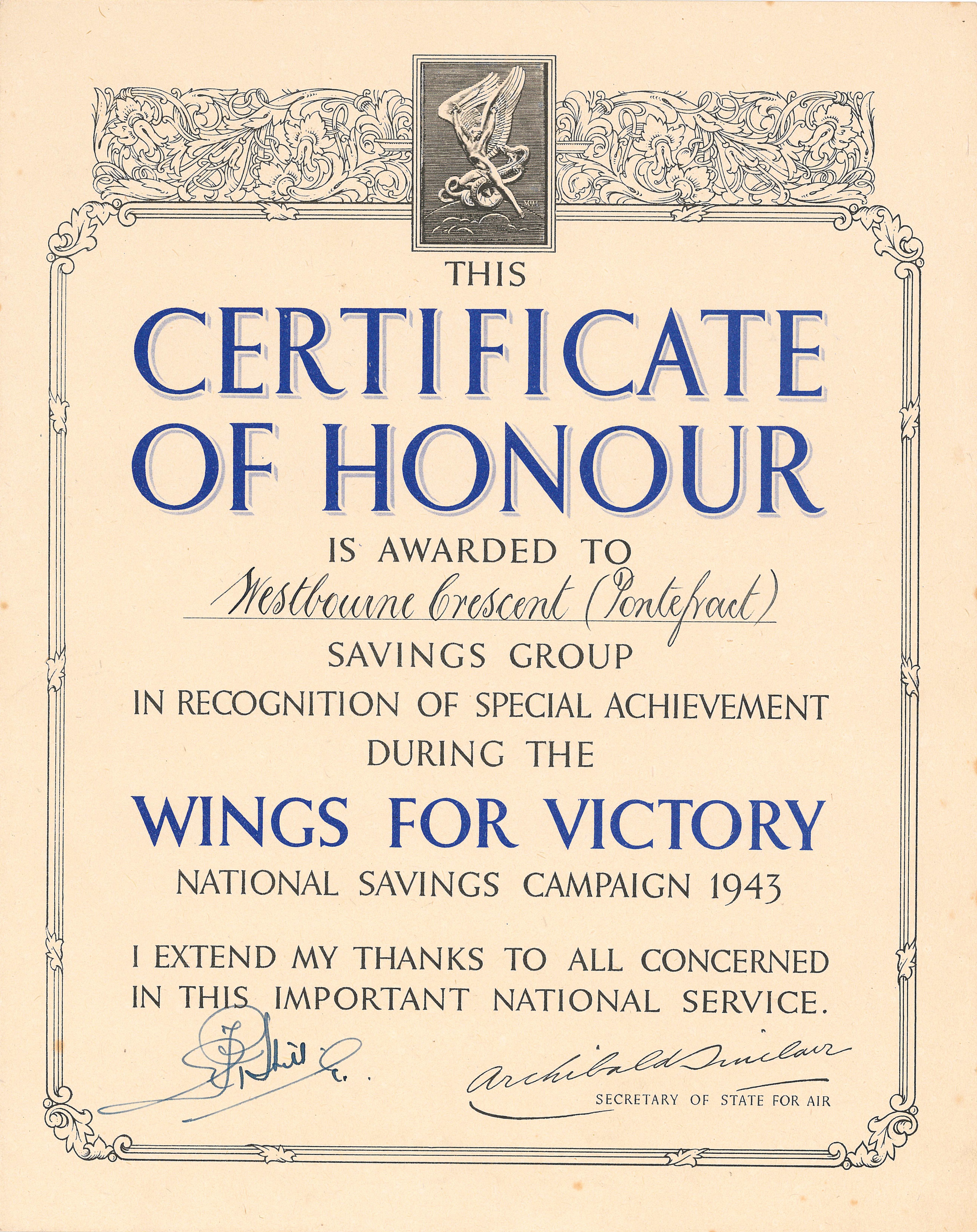
A certificate reading 'This certificate of honour is awarded to Westbourne Crescent (Pontefract) savings group in recognition of special achievement during the Wings for Victory National Savings Campaign 1943. I extend my thanks to all concerned in this important national service.' It is signed by Archibald Sinclair
A Certificate of Honour awarded to Westbourne Crescent in Pontefract, in recognition of their fundraising efforts. It is signed by Archibald Sinclair, Secretary of State for Air.

Fundraising each year focussed on a ‘War Week’. Towns concentrated their efforts on a national theme. These included ‘Wings for Victory’ or ‘Warship Week’. Targets were linked to specific aims. This made the saving more real and meant people felt more involved.

Places that met their targets were given commemorative plaques to celebrate their achievements. Smaller groups could also be recognised with certificates.

Pontefract's fundraising weeks

Pontefract’s 4 ‘special weeks’ raised over £1 million.

10-17 January 1941 – ‘War Weapons’

Target £300,000. 

Raised £409,338.

14-21 February 1942 – ‘Warship Week’

Target £200,000, to adopt HMS Unique (a submarine). 

Raised £217,976.

5-12 June 1943 – ‘Wings for Victory’

Target £160,000, for 8 Mosquito bombers. 

Raised £205,263, enough for 10 bombers.

8-15 July 1944 – ‘Salute the Soldier’

Target £167,373, to equip 1 infantry and 1 parachute battalion.

Raised £206,600.

A poster featuring a futurist-style illustration of a soldier, and the words 'Pontefract, July 8 - 15, 1944. Target: £167,373 (to make £1,000,000). Salute the soldier with a salvo of savings'
A poster for Pontefract's 'Salute the Soldier' civic fundraising week

Warship Week

Part of a programme with an illustration of a submarine and the words 'official programme, Pontefract's Warship Week, February 14 to 21, 1942'
Part of the official programme for Pontefract's Warship Week, 1942

The fundraising focus for 1942 was the Navy. Pontefract’s Warship Week was held 14 - 21 February. Pontefract’s target was £200,000. The total raised was £217,976.

Pontefract adopted HMS Unique, a serving submarine. Seven members of the crew came to visit. They went to the races, saw Pontefract Castle, had tea with the fundraising committee, and went to a civic reception with the mayor.

HMS Unique had been in service since September 1940. She spent most of her time patrolling in the Mediterranean, sinking Italian merchant ships.

On 7 October 1942 she left Holy Loch for her 22nd wartime patrol. She was to search the Bay of Biscay for German blockade-runners, in particular the minesweeper Belgrano. The patrol was due to end in Gibraltar on 23 October.

HMS Unique in harbour, image from the Submariners Association

By 24 October she was overdue and reported missing. At the time it was unclear what had happened. Recent research suggests that on 13 October she attacked a damaged German tanker, the Spichern, heading for the French port of St Nazaire. The tanker reported seeing torpedo tracks. Both the Spichern and another British submarine, HMS Ursula, reported hearing explosions.

It seems most likely that one of HMS Unique’s torpedoes was faulty and exploded too soon. This damaged the submarine so badly that it sank, killing all 34 crew.

Pontefract later adopted another submarine, HMS Upstart. This survived the war and was passed to the Greek navy in August 1945.

HMS Unique - names and ages of the crew killed 13 October 1945

Wings for Victory

Part of the official programme with a photo of a mosquito bomber, and the words 'Pontefract Wings for Victory Week, June 5 to 12 1943, target: £160,000 for 8 Mosquito Bombers'
Part of the official programme for Pontefract's 'Wings for Victory' civic fundraising week

The fundraising focus in 1943 was the Air Force. Pontefract held a Wings for Victory week 5-12 June. The target was £160,000, but the total raised was £205,263. 

The goal had been for people in Pontefract to save enough to pay for 8 Mosquito Bomber aeroplanes. They raised enough for 10.

Page from a log book which reads 'this log book which will record the operational activities of an Aircraft is a tribute to the success acheived by Pontefract Savings Committee in the Wings for Victory National Savings Campaign, 1943'. Then handwritten is 'target: £160,000, achievement: £205,263. Representing the cost of 10 Mosquito (two-engined bombers)'
Page from the Wings for Victory Savings Committee log book

The new Mosquitoes were sent to 139 (Jamaica) Squadron to equip them as Pathfinders. The squadron was named in recognition of the remarkably generous donations from Jamaica in 1940.

Pathfinders used radio beams to find targets. They could either drop bombs far more accurately than normal bombers, or coloured flares. These flares meant ordinary, less accurate bombers could find also targets, even at night.

A dozen Mosquito Bomber aeroplanes on the ground in a row, surrounded by RAF pilots getting kitted up
Mosquitos of 139 Squadron at an RAF base

New foyer display at Pontefract Museum

We're paying tribute to the incredible fundraising efforts of the people of Pontefract in a new foyer display at Pontefract Museum. It has been specially installed in time for VE Day 80. The display will be here until September 2025.

A display case containing fundraising posters, plaques and a certificate of honour from the Pontefract civic fundraising effort
The display case at Pontefract Museum

Pontefract Museum is open Monday to Friday, 10am to 4:30pm and Saturdays, 10:30am to 4:30pm. It is free entry.

Wednesday, May 29, 2024

D-Day 80 Display

Malcom Patterson, Chairman of the Horbury, Sitlington and Ossett branch of the Royal British Legion, contacted us to ask if we could help with a special display to commemorate the 80th anniversary of D-Day. 

The display, featuring objects loaned by Gavin Cave, will be in the shop window of Grooms Rooms Menswear in Horbury from 1 to 17 June 2024.

A soldier's uniform and a dispatch rider's uniform from the D-Day landings on display on mannequins, with a wreath of poppies and a note commemorating the names of those who died in the Second World War by the Horbury Sitlington and Ossett Royal British Legion
The D-Day display in Grooms Rooms Menswear

D-Day display

D-Day was on June 6, 1944. It involved the simultaneous landing of tens of thousands of troops on five separate beaches in Normandy. 

It was the largest military naval, air and land operation ever attempted. It marked the start of the campaign to liberate Nazi-occupied north-west Europe.

Local collector, Gavin Cave, has worked with the Wakefield Museums and Castles team to create a display of some of his collection. 

This includes the uniform of a ‘typical’ British soldier and sailor landing on the Normandy beaches on D-Day, and the uniform of a dispatch rider. Dispatch riders were one of the many specialist troops involved in supporting the landings.

Gavin has said that he’s really enjoyed the opportunity to display some of his collection, though some of it has been a bit of a project to get it ready for display!

The D-Day uniforms 

The uniforms are all original, possibly unissued items.

The 'typical’ uniform includes a MkII steel helmet, which has a net attached to afford camouflage and concealment. The steel dispatch rider helmet is designed to also give protection whilst riding a motorcycle.

Gavin holding up a helmet in each hand. He is looking towards the dispatch rider helmet, which is a dome-shaped khaki helmet with leather straps hanging down over the ears. The 'typical' helmet on the right is a similar shape but a darker khaki, with a net attached.
Gavin holding the two helmets - the dispatch rider helmet is on the left, and the 'typical' one on the right.

The clothing is different too. 

The ‘typical’ soldier and sailor wears a woollen battledress jacket (late 1940 austerity pattern) and battledress trousers (1939 pattern). The trousers are much higher waisted than modern trousers, in keeping with the fashion of the day. They also had the added advantage of keeping the lower back warm! 

He also wears 1937 pattern webbing. This has two ammo pouches at the front, large enough to take the magazines for a Bren gun.

The brown woollen shirt and battledress trousers worn by a 'typical' soldier on D-Day, with multiple pockets, and accompanying boots
The 'typical' soldier / sailor uniform, ready for display

He carries a water bottle, entrenching tool and his small pack. This would contain his 24-hour rations. He also had a waterproof cape, jumper, mug, mess tins and spare socks. On his feet he wears regulation ammunition boots.

The dispatch rider wears a rubberised coat over his battledress jacket. The coat straps over the legs of his jodhpur-like trousers, allowing for easy riding.


A long brown rubberised overcoat, partially opened to show the brown jodphur-like trousers designed to provide comfort when riding a motorbike
The dispatch rider's uniform, with coat opened to show the jodphur-like trousers

A pair of dispatch rider boots (bought and worn by Gavin's wife in the ‘90s!) were in particularly poor condition. They have been painstakingly restored to prevent further deterioration of the leather. Many layers of polish had to be removed, so that the leather could be conditioned and consolidated.


Leather boots that reach up to the mid calf, with buckles and laces up to the top.
The dispatch rider boots, now restored

June 6, 1944 – A Big Day (for other reasons!)

Irene Winifred Cheshire was born in Horbury in 1924. During the Second World War, she was a ‘Private’ (cook) in the Auxiliary Territorial Service (A.T.S.), stationed at Pontefract barracks.

Here she met Harry Patterson. Harry was born in Co. Durham in 1914. He had joined The Green Howards before switching to become a ‘Private’ (cook) in the Army Catering Corps (A.C.C.) on its formation. He was then sent to Pontefract.

Harry and Irene were granted Special Leave to get married on June 6, 1944. The wedding took place at St. Peter & St. Leonards church in Horbury.

Harry, in uniform, and Irene, in a white wedding dress with veil, with their family on their wedding day


Operation Neptune (the D-Day landings) was top secret. The couple will have been unaware that their wedding was to be on the same day as the largest military naval, air and land operation ever attempted!

Horbury’s role in WW2

Many British manufacturers switched to producing equipment to help the war effort. This included Sykes of Horbury, the famous local sports manufacturers. 

By the Second World War, Sykes employed a thousand local people. As they had in the First World War, the Sykes workers produced an array of equipment for the Second World War. 

A group of Sykes workers, all women, making wooden rifle furniture. One is holding her piece up and looking down it to check its quality.
Workers making rifle furniture at Sykes' Albion Mill in the Second World War

These ranged from bayonets and ammunition boxes to sand goggles and snow shoes - made using the same techniques as their tennis rackets!

A wooden oval-shaped snow shoe, with rope attached to a piece of fabric where the foot would be, and straps across the top.
A Sykes' Second World War snow shoe, made using their steam bending tennis racket technique.


Other local people were also involved in the war effort leading up to the D-Day landings. 

With thanks to the Royal British Legion for their support with this display.

Royal British Legion logo

Friday, September 1, 2023

The story of Jack and Marie

Our Collections Volunteer Sue has recently transcribed a collection of over 40 letters from the Second World War. 

She uncovered a beautiful story of love and resilience during very difficult times.

Read on as Sue pieces the letters together to tell the story of Jack and Marie.

A photograph of two men and two women on a pier, probably at the end of the second world war. Jack is a taller man in uniform, and Marie is smartly dressed with her auburn hair up
We believe Jack is the man in uniform, and Marie is the woman to his right

Introducing Jack and Marie

Jack and Marie were a young couple, very much in love. 

They got married in May 1939, and moved into a house together on the Lupset Estate in 1940. This estate was developed by Wakefield Corporation in the 1920-30s. 

At the time it was much admired as the largest local government housing scheme in Europe. Jack and Marie were very proud of their home.

A black and white postcard showing an aerial view of Lupset Council Housing Estate in the 1930s. Townley Road can be seen running through from right to left.
The Lupset Estate in the 1930s - photo copyright of Wakefield Libraries

Their married bliss was soon interrupted by the outbreak of war. In May 1941 Jack was called up. He trained in North Wales and was posted to the Middle East.

Jack was homesick and missed Marie very much. He wrote to her every weekend, sometimes more often. Marie kept his letters.

In 2016 Wakefield Museums and Castles purchased a collection of over 40 letters written between 1941 and 1943. 

These were Jack's letters to Marie, lovingly kept. 

We don't have Marie's responses, but we can learn a lot about what she must have been telling Jack about life back home in wartime Wakefield from his letters.

Jack's letters

Like all wartime letters, Jack's were censored. They contained little information about locations and manoeuvres in case they fell into enemy hands. 

However, this isn’t what Jack wanted to write home about anyway! 

Much of each letter was taken up with reminiscences of his life with Marie in Wakefield, and how much he loved her and was missing her.

On the first anniversary of his call up he wrote a moving description of the morning he left her, echoing the experiences of many a conscript:

Jack's letter on the first anniversary of his call-up - transcribed below
"It tells me that almost twelve months ago, months of pain suspence [sic] and darkness, I had the utter misfortune to be ripped from the arms of a girl in a million."
Jack’s letters contain fascinating snippets about his life in the army. 

His replies to Marie’s letters also talk to the living conditions and cultural attitudes of 1940s Wakefield.

Life in the army

In August 1941, soon after arriving in the Middle East, Jack was injured in an accident. He broke his toe, which failed to mend properly causing him to limp slightly. Because of this he was rated ‘unfit to serve’ at the front, where he would have earned promotion. Instead, he had to settle for a more mundane (but much safer) post behind the lines.

Jack was assigned to duties in the stores, collecting, stocking and distributing uniforms, ammunition, and other equipment. He also opened and ran a canteen which also acted as a shop.

The horrors, death and destruction of the Second World War are rightfully widely reported.

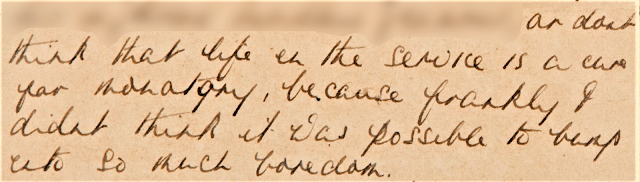
Jack's letters give detailed insight into another, sometimes overlooked element - the sheer 'monotony' of war:

A letter from Jack referring to his boredom - transcribed below
"Don't think that life in the service is a cure for monotony, because frankly I didn't think it was possible to bump into so much boredom." 
Some of Jack's letters suggest he was a bit fed up with his life in the army. He and his fellow soldiers were at the beck and call of their senior officers. 

His letters record the following unenviable tasks:
  • They were required to thoroughly spring clean their billet each week, making a special effort before a visit by a VIP;
  • One time they were marched to the beach for a 'dip in the ocean' at 6 in the morning
  • They were sent without notice on a long journey on Boxing Day 1942, hangovers notwithstanding;
  • Another time, Jack was left to mind the stores for 3 days and nights, with a long to-do list, while the Quartermaster was away.
Thankfully for Jack, there were some better moments. 

High points included visits to the cinema – Jack recommends several popular favourites to Marie, and especially enjoyed watching Carmen Miranda in ‘Weekend in Havana’. He also fondly records trips down-town with his mates Montey and Kenny.

Christmas 1942 was a ‘jolly’ time - the men were granted a day off! Jack organised and sold tickets at an extra 2/3 (2 shillings and threepence, or 12p) for a full traditional meal of turkey with pork stuffing and apple sauce, baked potatoes, cabbage, parsnips, Christmas pudding and sauce, mince pie, and fruit and nuts.

The height of joy was the arrival of the post - especially when it contained a letter from Marie. 

Frequent delays in the erratic postal service were much bemoaned, and Jack began keeping a (handwritten) spreadsheet to record the despatch and arrival times of their letters. 

Looking after family - from afar

Jack would have dearly loved to go home on leave. 

However, when he was given a precious week off in October 1942, he used it to go and find his brother Harry who was stationed not far away:

A letter from Jack telling how he was going to find his brother soon - transcribed below

"I am making an all out, all in bid to locate our Harry, whom you will know by now, that he is only about 50 miles from here. 
He told me in his last letter that he could fix me up with a bed and some food so in that line I have nothing to fear, the biggest proposition being, getting there, it will mean hitch hiking, as there is no bus service."
Jack was sending part of his army pay home to Marie to support her. 

He was careful with his money and didn’t draw much of his pay, leaving 10 shillings (50p) a week to accumulate against “a rainy day”. 

While he was in hospital in 1941 his pay was docked to 1/3 (6p) a day, or 8/9 (44p) per week. In September 1942, he discovered that, although he had resumed full duties in March, the army was still paying him the reduced rate. They restored his back pay but underestimated the amount he had saved, so he no longer trusted the army to look after his money. 

He arranged to send £10 from his savings to Marie, plus some of his back pay. 
By April 1943 his pay had risen to 6/4 (32p) a day, of which he sent around half home to Marie.

The Middle East

Jack generally did not enjoy his living conditions in the Middle East. 

Mosquitos were a constant problem, and he also met scorpions, ‘great big’ spiders and ants. The climate could be very hot with endless blue skies, or surprisingly cold with storms, wind and even snow. The desert had “blinding dust”.

Despite this, he clearly appreciated being billeted next to the “beautiful blue Mediterranean [Sea]
”. 

A letter from Jack talking about the Mediterranean Sea - transcribed below

"As I look to my right I have in front of me the Mediterranean Sea looking dark, oily, and full of mystery. What a great change this sea provides, it was yesterday that a few of us boys, remarked how beautiful this sea looked. 
The sun was beating down onto the almost stagnant surface, transforming into a bed of myriad coloured diamonds..."
He also writes that “I thought Palestine was beautiful in parts, but honestly I take my hat off to the scenery [Syria] can produce.” 

Olive groves, pomegranate trees, banana plants and especially date palms all produced magnificent fruit which was piled up in the local shops and sold very cheaply.

His encounters with the local people were limited but were always a source of interesting observations. 

He noted the poverty – people going out without socks or shoes in the cold and rain, when boots cost £2/10/- (£2.50) and a man’s wages were just 3s 4d (17p) a day. Infrastructure was sadly lacking and there was no public transport. 

There were a wide variety of shops, from ones selling jewellery, clothes and handbags, to those selling ice cream and ‘excellent’ rice puddings. At one point Jack says he wants to buy Marie some jewellery, but doesn’t know which to get her.

After the first year Jack started taking Arabic lessons and could chat with the boys in town.

Marie's story - back home in Wakefield

Jack comments frequently in reply to the news Marie sends to him. Through this we can learn about Marie’s life in wartime Wakefield.

By winter 1942 she was unfortunately in poor health and struggling financially. She moves back in with her parents for a spell. She lost her job, but in February 1943 she got a new job at Clayton Hospital.

Marie also took in lodgers, including a family from London with whom she became very friendly.

She was good friends with her neighbours on either side, Mary and Vi, and a photo found with the letters show a group of 4 girls on a day out at the seaside:
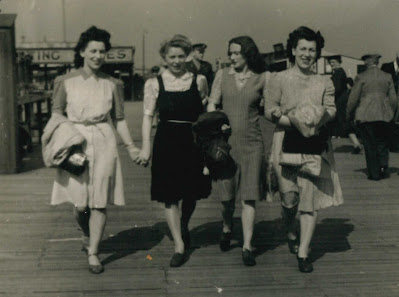
Four young women walking hand-in-hand along a pier, all smartly dressed, from the 1940s
Marie (we think she's second from the left) with her friends at the seaside

From the letters we also get glimpses of their life together before the war. Jack worked as a painter and decorator, like Marie’s brother Harold. 

Maybe this was how they met?

Until January 1943 Marie was working at Webster Bros. This may have been in the grocery store on the corner of Cheapside and Westgate, which had a pie shop above, or possibly in the café in Cross Square.

A black and white photograph of Cross Square, Wakefield, with Wakefield Cathedral centre
Cross Square, Wakefield, in the 1940s.
Webster Bros is on the right, towards the Cathedral.

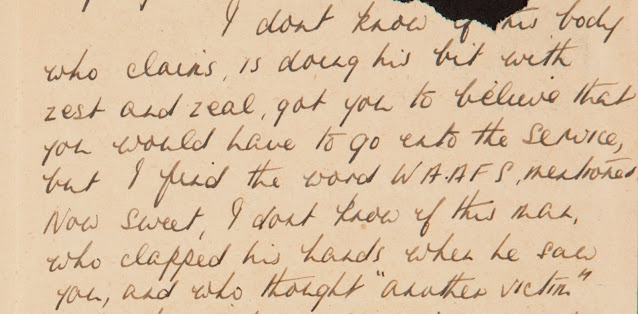
After she lost her job, Marie almost signed up to the Women’s Auxiliary Air Force (WAAF). She told Jack that she had been challenged by a recruiter who accused her of occupying a “hiding place” and told her that if she didn’t volunteer she would be forced into the service.

Jack was horrified. His reply to her reassured her that this was untrue, and pleaded with her not to become another victim”:

A letter from Jack replying to Marie's near recruitment experience - transcribed below
"I don't know of this body who claims, is doing his bit with zest and zeal, got you to believe that you would have to go into the service, but I find the word W.A.A.F.S mentioned. Now sweet, I don't know of this man, who clapped his hands when he saw you, and who thought "another victim" "
In reality, Marie seems very resilient. Like many women, she took advantage of the opportunity the war presented to assert some independence. She went out to work despite some reservations from Jack. 

She took the initiative in writing about her difficulties in dealing with their long separation, which Jack then echoed.

Jack was particularly keen to hear news about what family and friends were up to. 

He was dismayed at the way the “wicked war” had deeply affected his younger brother Albert:

A letter from Jack reflecting on his brother's experience - transcribed below
"It's a bad show Marie, I don't know, life in the service seems to have an uncanny way of pulling a chap down like this..."
Jack even tried match-making between Albert and Marie’s friend Mary from afar!

After the war

Thankfully for this story, there was a happy ending. 

Jack returned home to Marie when the war ended. Sometime in the mid-1950s they moved from the Lupset estate but appear to have stayed in the Wakefield area. No children have been traced.

They stayed together and grew old together. 

Jack died in 2002 aged 89, and Marie in 2011 aged 94.

We'll let Jack sign off:

A sign-off from Jack that reads 'goodnight angel, your always, forever thinking of you, sweetheart Jack', surrounded by kisses


Looking for more local wartime stories? 

Wednesday, October 19, 2022

Black History Month 2022 - St George's Hospital 1966

October is Black History Month, and over a series of four blog posts we will be highlighting new discoveries in our collections, local heroes and the findings of ongoing research relating to Black History in the Wakefield district.

Today, we're starting with this fantastic photo of staff at St George's Hospital, Rothwell, on prize-giving day in April 1966.

Photo of a large gathering of staff for prize-giving day at St George's Hospital, Rothwell. Many are dressed in nurse's uniforms, some appear to be doctors, and others are in smart plain-clothes. There are several nurses who are Women of Colour and a male doctor who is potentially also a Person of Colour


This photograph shows how diversity was of increasing importance to the hospital and its workforce in the 1960s, with several People of Colour being chosen to receive awards for their work.

In 1948, the National Health Service (NHS) was established. It brought access to hospitals, doctors, nurses and dentists together under one service which was free at the point of delivery for the first time. It was very ambitious, and Britain, bombed-out and bruised by the Second World War, needed a huge injection of skilled workers to rebuild and make the NHS work. 

Citizens from across the Commonwealth answered the call for help. The first boat of workers arrived in Britain from Jamaica on the passenger ship Empire Windrush in 1948.

Many of the staff members at St George's Hospital lived in the Wakefield District, however we do not have names or information for most of the people in this photo! Can you help - do you recognise anyone? Did your relatives, friends or neighbours work at the hospital in the 1960s?

Comment below or drop us an email at museums@wakefield.gov.uk - we'd love to hear from you!

Friday, June 6, 2014

D-Day landings, Wakefield, George Kellett & Peggy Taylor

We've revisited this blog ahead from 2014 ahead of the 80th anniversary of the D-Day landings!

Discover Wakefield's role in the D-Day landings. Learn about the part played by local people Peggy Taylor and George Kellett, among others.

6 June was the 70th anniversary of the Second World War Normandy landings, known as D-Day.

Despite being far from the action Wakefield played a crucial role in the success of the operation.  

Drake & Warters

Some of the landing craft used in the D-Day landings were built in Wakefield.  The Landing Craft Assaults were made at joinery & shop fitters company Drake & Warters Ltd in 1943.

The first LCA to be made at the factory was the 1144.  This is an image of it being launched:

A large crowd watching on as dignatries launch LCA 1144


Peggy Taylor

Drake & Warters also employed 800 women and girls to enable them to meet the order.  


Three young women working at Drake and Warters to help build the LCAs for D-Day


One of the girls working at the factory and who features in the newsreel was Peggy Taylor, a former cinema usherette.

We'd love to know if Peggy Taylor or her family are still living in Wakefield.  If you think you know Peggy then please contact us at museums@wakefield.gov.uk.

George Kellett

George Kellett was born in 1894 in Wakefield. He worked as a joiner, and served in the Duke of Cornwall regiment in the First World War. 


After the First World War, George returned to his work as a carpenter and joiner. At some point he became a Drake & Warters employee. He was still working there in 1943 when the company were busy producing the landing craft, and so it is very likely he was also involved in their production. 

George Kellett was a trusted and longstanding employee of Drake & Warters and is mentioned in a Wakefield Express newspaper article dating from April 1950, celebrating the firm's Silver Jubilee:

'Most of the people working there are local and many have been there since its formation.  “They are the people that made the business” says Mr Drake.  Six of them, Fred Mundy, George Kellett, Joseph Trantor, Ernest Blakey, John Beck and Edwin Thresh were presented with silver tankards…The firm’s employees are proud of their efforts in the Second World War… These included the building of 72 invasion craft in as many weeks'

This is an image of Drake & Warters staff from around 1930 - we believe that George Kellett is on the middle row, eighth in from the left.

A group of around 35 men stood outside the Drake & Warters firm, and next to a delivery van. A few of the men are sat on top of the van, which has 'shop and store fitters' painted onto it.

Click here to read through George Kellett's First World War diary.