Showing posts with label industry. Show all posts

Friday, March 1, 2024

Pontefract's Victorian businesswomen

Women are often overlooked in economic history. We tend to think of women in the 19th century as working in factories or domestic service, but women ran all kinds of businesses in Victorian Britain. In fact, female entrepreneurs were more common then than they are now. 

Pontefract was no exception.

As today, setting up her own business gave a Victorian woman more control over where and when she worked. This made it easier to fit with their other 'traditional' responsibilities like childcare. 
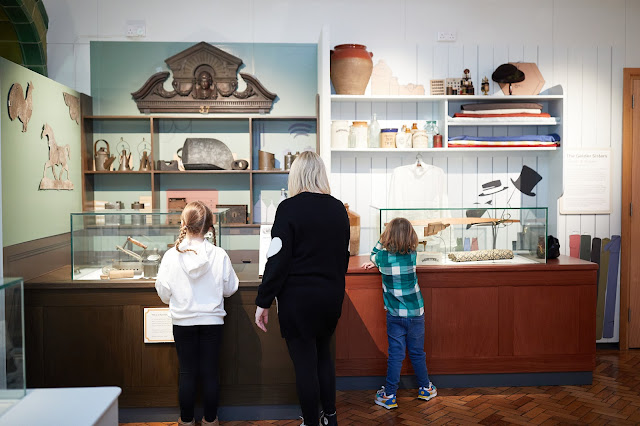
In our immersive and interactive exhibition Ladies who Launch: Celebrating Pontefract's Women in Business, we shine a spotlight on local women running businesses in sometimes surprising industries. 

Two children and an adult looking at recreated displays of a Victorian ironmonger and a drapers. There are lots of original objects on display.
Step back in time to Victorian Pontefract in Ladies who Launch

Probably the most famous historic local businesswoman is Ann Dunhill. She ran the iconic Pontefract business Dunhill's for nearly 20 years. Dunhill's are credited as the inventors of the liquorice Pontefract Cake.

But what other businesses were enterprising women running in 19th century Pontefract? 

A brilliant team of volunteers, supported by our curator, chose five Victorian businesswomen to research and write about. Read on to find out more about them!

Maria Taylor - watchmaker

Researched and written by Samuel Lou

A child pointing up at a large clock made by Taylor's of Pontefract and smiling back at the camera
"Look at this!" A clock made by Taylor's of Pontefract is one of the first things you see in the Ladies who Launch exhibition.

Maria Knight was born in Essex and moved to Pontefract in 1827 when she married Thomas Taylor. Country-wide networks were common for Quaker families. 

Thomas was a renowned watchmaker. When he died in 1844, Maria stepped up and continued the family business.

Maria ran a successful firm employing three skilled watchmakers and a shop assistant. She advertised using her son Joseph's name. However, Maria was really the head of the business and Joseph was her employee. 

Golden coloured back of a pocketwatch. The regulator is engraved with a swirling pattern, and the words 'Pontefract', 'Joseph Taylor', and the words 'slow' and 'fast' by the curved regulator scale.'
Back of a watch made by Taylor's of Pontefract, with 'Pontefract' and 'Joseph Taylor' engraved on it. This watch is on display in the Ladies who Launch exhibition.

Maria retired in 1861 but continued to live in Pontefract, wealthy enough to have a housekeeper. She died in 1893.

The mid 19th century was a peak for British clock and watchmaking. Industrialisation brought railways and fixed factory shifts so accurate timekeeping was important. Watches became fashionable items of jewellery. 

But it was not a common profession for Victorian women. Fewer than 4% of watchmakers at the time were women, so Maria's story is unusual.  

Sarah Winterburn - upholsteress 

Researched and written by Julia Webb

Sarah Winterburn was born in Tanshelf on 11 May 1808 into a typical working-class household. Her father Richard was a currier, working with leather hides. Her mother raised eight children.

Sarah remained single throughout her life. She started her upholstery business from her parents’ home. She likely picked up her craft from an early age as her elder sisters Ann and Matilda were dressmakers.

Sarah made home visits to her clients, repairing the upholstery on furniture along with other bits of sewing work. By running her business this way, she was able to make a decent living whilst supporting her elderly parents. She may also have financially supported her nephews to keep them out of the workhouse.

A display featuring a partially upholstered chair, tools, and a teapot with faux paper money in it, against a Victorian home inspired backdrop
A display representing Sarah Winterburn's home upholstery business - and her teapot full of money!

Sarah operated a successful business throughout her life. After her death on 25 June 1881, a teapot stashed with £150 was found in her house. She also had a personal estate of £247 and 17 shillings, worth more than £16,000 today.

This suggests Sarah had made a lot of money for a single, self-employed woman of the Victorian period.

A young visitor flicking through a book containing fabric samples related to the upholstery business
Get hands-on with trades from the past in Ladies who Launch

Ann England - ironmonger

Researched and written by Alice Sze

Ann Lilley was born in Pontefract in 1782 and married Joseph England, a tinner, in 1806. 

After Joseph's passing, Ann took over his ironmongery business and became a skilled brass and tin plate worker. 

The 1834 National Commercial Directory lists Ann’s business at Ropergate, Pontefract. By 1851, she lived in Baxtergate and was a retired tinner.

A display containing original objects made and sold by an ironmongers, and shelves full of iron objects
A display recreating Ann England's ironmongers in Ladies who Launch

During the Victorian age, it was unusual for women to work as tinners and braziers, which were traditionally male-dominated trades. Ann defied convention and became a skilled artisan. 

Ann used specialised tools like hammers and soldering irons to craft metal goods to sell. England’s Ironmongery sold household utensils, cookware, containers, decorative ornaments, and more.

Ann’s legacy continued through the generations. Her son William and his descendants became well-known ironmongers in Pontefract. 

England’s legendary shop at Market Place was fondly remembered in the community until its closure in 1979.

A large shop window full of ironmonger-related objects for sale, including a poster advertising rawplugs
Shop window of England's Ironmongers, dating to between 1930 and 1950

Shop counter with an old-fashioned till, and floor-to-ceiling shelves full of supplies and items sold at the ironmongers
Inside of England's Ironmongers in the 1970s, providing inspiration for the recreated display in Ladies who Launch

The Gelder Sisters - grocers and drapers

Researched and written by Jennifer Machin

Sisters Mary, Ann and Sarah Gelder were born in Pontefract between 1843 and 1847. Their father, Joseph, was a successful local farmer and Alderman for Pontefract. 

Kelly’s Directory of West Riding of Yorkshire 1881 lists the 3 sisters under the commercial section as grocers and drapers in North Baileygate. They were listed as ‘misses’ and so were unmarried.

Sarah Gelder was a draper and Mary Gelder was a grocer. They were wealthy enough to have a servant and younger relatives living with them. 

Sarah Gelder and Ann Gelder died in the 1890s. Mary Gelder then took over her sister's draper’s business.

A display in the style of a Victorian drapers shop, with fabric, weights, scissors and pots
A recreation of the Gelder sisters' drapers shop in Ladies who Launch

Drapers sold cloth. They were common in the Victorian period when many people made their own clothes. Sewing and making clothes were generally seen as women’s work, but being a draper was not typically a woman’s job. 

Sarah and Mary were clearly successful though, extending the business into selling costumes alongside the usual drapery. 

Being a grocer was also not typical for Victorian women. However, it was a good trade and a successful business decision for the sisters. Like many businesses at the time, they were probably helped by family support. Their father’s farm would have been a useful supplier.

Mary Gelder continued to live in Pontefract until at least 1901. She is listed on the 1901 census as living in North Baileygate. She was head of the household, and had two servants and her niece (Mary Wood) living with her.

Hannah Lindley - laundress

Researched and written by Dave Evans, Curator

Hannah was born in Thorpe Audlin in 1831. Her father, Richard Brewster, was a farmworker, moving between Ackworth, Badsworth and Darrington. 

Hannah was a domestic servant in Hemsworth by the age of 18. In 1856 she married garden labourer John Lindley and they began a family in a small yard in Pontefract.

John did well at work and by 1871 the family of five lived in a larger house on Ropergate along with a lodger. 

A display including a large Victorian mangle, barrel and washboard
A display inspired by Hannah Lindley's home laundress business in Ladies who Launch

John died in 1873, leaving Hannah to support her growing family on her own. Hannah moved to Sessions House Yard, then Crab Hill, and set up as a laundress.

Being a Victorian laundress was hard work, especially wringing out wet linens. It wasn’t just washing but also drying and ironing, the whole process taking days. However, it could be done at home alongside caring for children. 

Poorer widows like Hannah often became laundresses. As women running their own lives and businesses, laundresses were known for their independence.

Visiting Ladies who Launch: Celebrating Pontefract's Women in Business

The exhibition is at Pontefract Museum until 19 October 2024. Entry is free. 

It's not just Victorian businesswomen we explore! We bring it into the 21st century with displays co-created with four businesses being run by local women today. 


Photos of the exhibition in this blog are by Nick Singleton.

Thursday, April 27, 2023

Knottingley: Fire & Water - Interview with David Appleyard

On 23 November 2022, we celebrated the industrial heritage of Knottingley through a commissioned artwork by David Appleyard. The project was funded by Arts Council England and was designed to celebrate the industrial heritage of Knottingley.

Knottingley: Fire & Water was an innovative artwork, with illuminations, projections, and local community responses. 
 It was an evening of wonder, celebration, and community spirit. Over seven months, David immersed himself in the community, working closely with local people to reflect on the Knottingley of the present, as well as the Knottingley of the past. More than 200 people took part. 

We've been reflecting on the legacy of the project, and went back to David to capture his thoughts and feelings about Knottingley: Fire & Water, ahead of more digital community resources being released later this year.

Read on to learn about his tips for community engagement and advice to aspiring artists!

David Appleyard in his studio, reviewing colourful alternative Knottingley town crests made by local school children under a large panel of glass. There are lots of various pieces of artmaking equipment behind him.
David Appleyard in his studio, reviewing alternative Knottingley town crests created by local schoolchildren. Photo by Nick Singleton.

Interview with artist David Appleyard


Q: How did you become aware of the Knottingley: Fire & Water project? What was the application process like, and do you have any advice on how to succeed at the application stage?

David: The application process followed an open call that was advertised on various national arts websites. As application processes go it was fairly straight-forward. I sent an initial expression of interest and made the shortlisting. I was then given time to develop my approach before being interviewed. The interview itself was friendly and informal and I was given plenty of opportunity to present ideas and working methods.

Advice on applications?

The application process is never as daunting as it might sound, it just takes time. You’ve got to be in it to win it - so just give it a go.


Q: The Knottingley: Fire & Water project was rooted in the local community – how did you get to know the community and build up trust with different individuals and groups?

David: I made a lot of visits to Knottingley and worked with specific groups to make sure that a broad range of people knew about the project.

I was visiting every two to three weeks so I got to know people quite well. The only way to build trust is to maintain communication with them, whether it be in person or online.


Q: What research did you carry out to understand the history and industrial heritage of the town?

David: Initially, I spent time researching Knottingley’s history using various web sources. However, this quickly progressed into the archives at Pontefract Museum where a fantastic collection of archive photographs are held. From the archives I moved out into the community to show people what I had found and to gain feedback.


Black and white photo of two workers at Bagley's Glassworks pouring molten glass from a gathering rod into a large mould
One of the archive photographs held by Wakefield Museums and Castles, showing two Bagley & Co workers pouring molten glass from a gathering rod into a mould.
Copyright Wakefield Museums and Castles.


Q: How did your artwork evolve throughout the process? How did your community engagement work shape the final piece?

David: The project developed quite a lot from my initial proposal and was entirely shaped by the stories that were shared, the comments that people added to response cards and the many conversations I had with people living locally.

The most important part of the project was to bring people together in the same way that the glass industry had done years before.


Q: What is the most important element to you: the process, the final outcome, the medium? Or something else?

David: Definitely the process, I never know what I’m going to get as a response and its exciting to work with unknowns. Most of the projects I’ve worked on in the last 15 years have been very different in terms of the outcome and medium. Everything has been driven by research and community involvement.


David Appleyard in a primary school classroom, showing an old photo of a barge on the canal to pupils watching on.
David at St Botolph's School in Knottingley, working with local schoolchildren to design their own Knottingley town crests.
Photo by Nick Singleton.


Q: Would you have done anything differently?

David: I’m happy with the way the project evolved. There were a couple of technical hitches on the night but other than that the research and engagement evolved neatly into the final work.


Q: What was the highlight of the project for you, as the artist?

David: There were a number of highlights to the project:

  • Witnessing the passion and belief that people can have towards the place where they live.
  • Seeing people come out on a cold November night to celebrate their local community.
  • The Silver Band performing Ultra Vox's Vienna!
  • Having the privilege of working with a really committed team!

Part of the Stoelzle Flaconnage glassworks lit up in blue, green and pink against the dark November night's sky. Steam is coming out of the large chimney.
Stoelzle Flaconnage glassworks in Knottingley on the night of the Knottingley: Fire & Water event

Part of the Allied Glass site lit up in red, orange and yellow against the dark November night's sky. Archive photos from Knottingley's heritage are projected onto one of the large square walls, this one is of a canal barge taking off.
An Allied Glass building in Knottingley on the night of the Knottingley: Fire & Water event.
Copyright Andrew Benge.


Monday, November 21, 2022

Knottingley: Fire & Water - 23rd November 2022

On 23 November 2022, Wakefield Museums & Castles are celebrating the industrial heritage of Knottingley through a commissioned artwork by David Appleyard.

Knottingley: Fire & Water is an innovative artwork, with illuminations, projections, and local community responses. It will be an evening of wonder, celebration, and community spirit.


But why Knottingley, why now, and why should you come to see it?

A black and white image of two glassworkers pouring molten glass at Bagley's glassworks is projected onto a building in Knottingley, lit up in red and blue
A concept design preview of the Knottingley: Fire & Water event

Knottingley – Industria Ditat

The coat of arms of the town of Knottingley has the Latin motto ‘Industria Ditat’, which means ‘Progress through Industry’. It was an appropriate motto for a town so strongly defined and shaped by industry. This industry was made possible by the town’s position on the River Aire and the Aire & Calder Navigation.

Knottingley's coat of arms. Arms: Azure issuant from Water barry wavy in base a Bridge of two arches proper in chief a Lacy Knot Or between two Roses Argent barbed and seeded also proper. Crest: On a Wreath Argent and Azure a cubit Arm holding an ancient Glass Bottle proper. Motto: industria didat - progress through industry
Knottingley's coat of arms, also used by the town's Rugby Union club, cricket club and Silver Band.
Image from Heraldry Wiki.com.

Shipbuilding, glassmaking and coal mining became the dominant industries. The town’s shipyards built and maintained both inland and seagoing vessels. The glass factories – the most notable being Bagley and Co – were at the forefront of glass production and the development of new machinery. Kellingley Colliery, just two miles away from Knottingley, employed over 2000 miners in its heyday. Ships, goods, and coal were transported along Knottingley’s waterways, out to the Humber and beyond, and the town thrived.

Wakefield Museums & Castles wanted to celebrate this strong industrial heritage by commissioning an artist to develop a digital artwork, inspired by the town’s heritage, the museum’s collections, and the stories of former employees. After a competitive process, they appointed Yorkshire-based artist David Appleyard, well-known for his community-based approach and his focus on industrial heritage.

For more about David's appointment, click here


‘My home, my life, my community’

As with many northern industrial towns, Knottingley is navigating a transition and finding a new identity. Although it has retained its glassmaking industry, with Stoelzle Flaconnage and Allied Glass remaining large employers in the town, the closure of Kellingley Colliery and reduction in community facilities have left some in the town feeling “forgotten” and left behind.

What does Knottingley mean to you? I have friends from London. When visiting Knottingley, they summed it up in one - "everyone knows each other, it's crazy. It's not often you come across a place that even in 2022 there's such a sense of community!" "You don't even use contactless in the pubs!" - they thought that was crazy!


What does Knottingley mean to you? Originally from Castleford. Memories of Knottingley Sports Centre and Swimming Baths as a child. Then all of a sudden seemed to disappear. Currently live in Pontefract. Apart from the Addy I don't know anything that Knottingley now has to offer which is such a shame for the community & surrounding areas.
Two of the postcards filled out by members of the community as part of the project
(full transcription in alt text)

Over the past seven months, David Appleyard has immersed himself in the community, working closely with local people to reflect on the Knottingley of the present, as well as the Knottingley of the past. Local people have responded to the question ‘What does Knottingley mean to you?’ on postcards and beermats, and local schoolchildren have redesigned the Knottingley coat-of-arms. A mixture of positive, negative, and indifferent responses has been received. More than 200 people have taken part.

What does Knottingley mean to you? Growing up in Knottingley I've felt bad about being from here, because of other people's opinions. As I have gotten older and I have seen Knottingley grow and I can now appreciate Knottingley for what it is. A lot of families with a lot of backgrounds. The people pull together to make it a better place. I am now proud to be from Knottingley.
Another postcard from David's community project (full transcription in alt text)

What does Knottingley mean to you? Home, family, friends. Lost town (doubly underlined). Sad (drawing of a sad sighing face)

A beermat with a response to the question 'What does Knottingley mean to you?'
(full transcription in alt text)


Light Up

The culmination of David’s work exploring Knottingley, both past and present, is the Knottingley: Fire & Water event on Wednesday 23 November, 5pm - 8pm.

The event will see some of Knottingley’s iconic industrial buildings illuminated with light, colour, and historic photographic images. Community responses to Knottingley today, on postcards and beermats, will be on display in the Town Hall. There will be free refreshments, entertainment, and performances from Knottingley Silver Band.

The event is designed to bring the people together in an evening of celebration, reflection, and community spirit.


Map of the Knottingley: Fire & Water event. Event features Knottingley's iconic industrial buildings illuminated, "What does Knottingley mean to you?" display at the Town Hall, free refreshments, Knottingley Silver Band & Entertainers.
Map of the Event

So come along for:

  •          Illuminated buildings
  •          Projections of historic photographs showing Knottingley’s industrial past
  •          Knottingley Silver Band
  •          Glow entertainers
  •          Free refreshments

Monday, October 3, 2022

#CleverClogs - New Display at Wakefield Museum

Sarah Verreault, a student at the University of Leicester’s School of Museum Studies, has completed an audit of the museum’s shoe collection over the past eight weeks. She has chosen the story of British clogs, locally worn and produced, to highlight in a new display at Wakefield Museum

Learn more about these #cleverclogs in her blog below!

Sarah Verreault with her Clogs display at Wakefield Museum


What are British clogs?


A British clog has a leather upper, a wood sole, and irons nailed into the heel and sole.

They first appear in written accounts in the 1600s in Lancashire, Cheshire and Cumbria, then spread to the rest of the north of England. They reached peak popularity in the second half of the 19th century. They declined in the first half of the 20th century as other types of shoes became more affordable and fashions changed. Clogs then became a symbol of poverty and charity. Some industries, such as heavy engineering and farming, continued to use clogs. Today, they remain popular for certain kinds of dances such as Morris dancing and clog dancing. Other styles of wooden soled shoes still come in and out of fashion.

Clog making is now on the Heritage Craft Association’s Red List of Endangered Crafts with only five registered full-time makers.

A child's pair of red-brown leather clogs with a nailed wooden sole. They have an ankle bar with a small brownb button, and a small decorative steel buckle. There is brass on the toe tip. They have horseshoe irons on the sole and heel.
A child's pair of leather clogs, with horseshoe irons on the sole and heel, dating between the 1920-1950s


How are clogs made?


The leather uppers were made in the same way and styles as other types of shoes. New and old shoes could be clogged to make them more hard-wearing. A pair of uppers could be re-ironed and reclogged many times, so the leather was well cared for.

The clog-block maker would harvest the wood, preferably alder, and cut it into blocks to sell to the clogger. The clogger carved the blocks into a sole. Like other shoes, until the middle of the 19th century, they were made on straight lasts, meaning that the left and right were the same shape. If the clogger was skilled enough, the sole could be fit to the foot of the customer.

Earlier clogs were bound around the edges with hoop-iron. The familiar grooved horseshoe irons became more common in the early 19th century. The local blacksmith or the clogger would fit the irons. Extra protection like iron plates and leather pads could also be added.

A pair of child's clogs made from black-brown leather, with a square wooden toe
A pair of child's clogs, with leather upper and a square upturned toe, dating likely from 1850-1900

Where were they worn?

Clogs were particularly present in the north of England and the south of Scotland but do also feature elsewhere. They are well suited to the landscape and weather in this region. Clogs require a special rocking or rolling movement to walk because they are much heavier and stiffer than shoes.

They were worn by women and men, adults and children, in the country and cities. They were worn at work and in everyday life including to church. Crimp clogs, called ‘dandy’, ‘Sunday’ or ‘neat’ clogs, would have elaborate designs cut into the upper. Children used to play at making sparks fly by hitting their irons on stone. The wood sole wore through stockings quickly so many people wore clogs bare foot. With or without stockings, they were often lined with straw, hay or bracken.

They were worn in mines, quarries, pits and kilns, in building trades, docks and wharfs, agriculture, transport, brewing, mills and factories. Different styles of uppers were associated with different occupations such as the miner’s blutcher clog whose upper only has two pieces or brewer’s clogs with watertight tongues and very square toes. How long a pair would last depend on who wore them and where. Pit clogs would last a little over a year, but in a mill, they could last 20 years with care.


Local Connections: Wm. Lamb Clog Manufacturer

Based in Bottomboat, Stanley, West Yorkshire, the company began in 1887 when William Lamb began producing clogs for miners. It then expanded to supplying shoes for women working in cotton mills. They became one of the biggest British clog manufacturers.
Seven male workers stood outside the Wm Lamb Clog Manufactuers Shop. There is a horse and cart with an array of clogs on display, and one of the men is stood on the cart holding a pair for sale. The other workers hold an array of tools and clogs, and one has his hand petting a dog.
Workers stood outside Wm. Lamb Clog Manufacturers' shop, c.1900-1920

In the 1920s, the company started making work boots, and army boots during the First and Second World Wars. Later in the century, they manufactured football boots and trainers. Today, they have stopped manufacturing and are focused on importing footwear.

Black and white photo of the outside of Wm. Lamb Clog Manfuacturer, a rectangular brick building, two floors high, with large windows. There is a clogger stood at the first floor opening, a mustachioed man in a car loaded presumably with clogs, and three other workers in flat caps stood outside posing for the camera
Wm. Lamb Clog Manufacturer in Bottomboat, c.1910-1925


The Clogs - Dress to Impress exhibition is now on display at Wakefield Museum in the main gallery. For opening times and access information, click here

Looking for a soundtrack for your clog-tastic reading? We've put together a Spotify playlist inspired by Sarah's shoe audit here!

To learn about another important industries in the Wakefield area, Ossett's shoddy and mungo trade, click here.

Wednesday, August 24, 2022

Ossett's Shoddy and Mungo Trade

 
In this special post, our Research Volunteer, Sarah Hulme tells us about her experience looking into the mungo and shoddy industry in Ossett. Ossett was once home to over forty mills and its production of mungo and shoddy shaped the town as we know it today.

A black and white photograph of two men sat on a delivery truck, which has 'Edward Clay & Sons, Mungo Manufacturers, Ossett' written on it. Behind the truck is a low brick wall with iron railings and trees behind.
Photograph of Edward Clay, from Edward Clay & Sons, Ossett
                                        with his delivery van (image courtesy of John  Clay)

Where does the word shoddy come from?

Today the word ‘shoddy’ refers to a job poorly done or something of poor quality. Did you know that the origins of this word actually come from the textile industry in the Heavy Woollen District (Batley, Dewsbury, Morley and Ossett and some surrounding towns in the mid-19th century)?
 
An image of a piece of brown-coloured rough looking cloth, with a light blue background
A piece of undyed shoddy
(image courtesy of
Kirklees Museums and Galleries)

In the 1990s, travelling by train from Leeds to Huddersfield every day for work, I would see a beautiful, Victorian mill building from Dewsbury Station. Painted on to the front of this in white antique lettering were the words ‘Established. 1856, Machell Brothers Limited, Shoddy and Mungo Manufacturers’. I always wondered what this meant but, rushing to work, I never took the time to look it up.

Looking into Wakefield District’s textile heritage, I’ve had the pleasure of meeting experts in Ossett’s textile heritage.  From our conversations I discovered more about what these textiles are and why their production in Ossett from the mid-19th century was so hugely important to Ossett’s history, architecture, economy and people.


What are Mungo and Shoddy?  

What is Shoddy?

Shoddy is the production of a recovered or recycled inferior quality yarn or fabric. It is made using the shredded fibres of woollen knitted cloth (cardigans, sweaters) rags or tailors’ clippings that gave a length of threaded material to be mixed with new wool and formed into reclaimed cloth. The negative association to the word ‘shoddy’ has arisen because shoddy was a low status fibre that poor people wore and was made into overcoats, military uniforms, blankets, and horse rugs.  Rags that weren’t mixed with new wool became flock and ended up being used for upholstery or to stuff mattresses or saddles. Shoddy production created a wide range of associated trades from rag and bone men, to rag merchants, rag sorters and packers, dyers, rag traders and mill owners.

What is Mungo?

Mungo was a different material from shoddy because it was made up of shorter and very fine fibres.  It was made by shredding felted or woven items like hats, worsted suits and woollen material. 


Mungo and Shoddy in Ossett

The Latin phrase 'Inutile Utile Ex Arte', on the unofficial coat of arms of Ossett means 'Useful things made useful by skills. This is said to refer to the mungo and shoddy heritage of the town. 
The unofficial coat of arms of Ossett 
(image courtesy of www.ossett.net)
 
In the early 19th century, the Napoleonic Wars led to a shortage of wool imports and woollen products. Clever business owners repurposed wool out of waste wool. Shoddy was first made in Batley by Benjamin Law in 1813.  Between 1800 and 1850 the mungo and shoddy trade led to a tripling of the populations of the towns of Batley and Dewsbury.  This expansion led mungo and shoddy producers to look to neighbouring towns for new mill sites.


Why Ossett?

Ossett’s location on the river Calder and its new railway station led to it becoming home to over forty mills, numerous dye sheds and rag warehouses in the 1850s.

The Calder and Hebble Navigation was finished in 1770 providing waterways to transport mungo and shoddy.  The river Calder was also used by Ossett’s mills in the recovered wool production process.

In 1848, railway stations opened across Batley, Dewsbury, Morley and Ossett.  Huge bales of rags could be brought in from all over the UK and Europe. Finished mungo and shoddy was easily exported by rail from these towns. 

Rag merchants at the time organised huge rag auctions at train station forecourts that were incredibly popular.

A journalist described dealers overcome by “visions of filthy rags being transmitted into shining gold” at the train depots of Batley and Dewsbury, as the thousands of bales arrived at the station from abroad. (From Devil’s Dust To The Renaissance of Rags, Shoddy, by Hanna Rose Shell.)

A black and white photograph showing several groups of women walking between mill buildings
Victoria Mill, 1950s, female staff leaving for home after work.
(Image courtesy of Neville Ashby, www.ossett.net)

From Rags to Riches

The mungo and shoddy industry brought huge wealth to the mill owners in Ossett. These industrialists were able to buy land and build detached Victorian villas in Ossett with their newfound wealth.

John Clay spoke of the number of these families that bought second homes in Runswick Bay on the North Yorkshire Coast and how it became referred to as ‘Ossett by the Sea’. 

The descendants of several mungo and shoddy mill owning families in Ossett remain in the town today.  

Image of a poster with text reading 'Ossett Street Side, Near Dewsbury, Valuable Freehold Mill, Dwelling Houses & Land, To Be Sold by Auction, by Messrs Cullingworth & Son'
Poster for the sale of Flushdyke Mill, Ossett 
(image courtesy of Kirklees Museums & Galleries)


19th Century Recycling to 20th Century Industrial Decline

How did this great idea to recycle wool from leftover rags not become a green recycling industry today?

Repurposing wool was a great example of recycling. Leftovers of textile waste and dust from the mungo and shoddy process were even spread over soil in the nearby rhubarb growing fields as fertiliser!  Whilst the idea of recycling woollen rags and reusing them was a great idea, the working conditions in the 1800s in the mills and rag warehouses were poor.   

Breathing in textile dust all day caused ‘shoddy fever’. Women often worked as rag sorters and children fixing broken looms.  There were several deaths due to accidents with poorly maintained machinery.

After the Second World War the mungo and shoddy industry fell into decline.  With the arrival of synthetic fibres and ‘off the peg’ suits, wool was less in demand. Surviving mills have diversified into producing other felt products using mungo and shoddy rather than products for the garment industry.  Products for mattress fillings, hanging basket liners and insulation are still produced using a similar process.  Today with the climate crisis, businesses are looking again at the processes of mungo and shoddy to see how they can be transformed into a safe modern business that is great for the environment.


Share Your Stories

People in Ossett are rightly very proud of their mungo and shoddy producing heritage. We're creating an exciting new Wakefield Library & Museum in the heart of Wakefield City Centre, and we need your stories.  

We would love for the people of Ossett and the surrounding area to add their memories, stories, photographs and objects from the mungo and shoddy industry as part of the new museum.  If you are interested in taking part, please email museums@wakefield.gov.uk


For more information about another important industry in the Wakefield district, clog manufacturing, click here


Friday, July 3, 2020

Pontefract Allsorts: How liquorice got its roots in Pontefract

Liquorice - whether you love or hate the taste, there's no denying the plant has long been synonymous with Pontefract. But how did a middle Eastern herb become embedded in our town's history? Where did liquorice originate from? We've had a root through our liquorice collection and dug up some treasures. 


Liquorice was probably first brought to Pontefract either by medieval knights returning to the castle from the Crusades, or by the Dominican monks who settled at the neighbouring priory. Pontefract proved to be fertile ground for liquorice, the plant's long roots thriving in the deep loamy local soil. 

Liquorice fields in the Nevison area

Liquorice growing and harvesting in the Friarwood area

A spoonful of sugar


Prized at first for its medicinal properties, liquorice began to be grown across the area. The sap was extracted from the root and used to treat coughs and stomach complaints. By the 1700s, there were liquorice garths springing up all around and even the castle yard was being cultivated. Local chemists, the Dunhill family, rented the land there and used the castle cellars to store their harvested roots. 

It is George Dunhill who is credited with first adding sugar to liquorice to transform the medicine into the sweet delicacy we still know today. He is believed to have pioneered the production and marketing of the now iconic Pontefract Cake as a commercial confectionery.

Handstamp for marking Pontefract Cakes, Dunhills Ltd, early 20th century
A worker stamping Pontefract Cakes at W. R. Wilkinson & Co. Ltd, 1950s


And so Pontefract became inextricably linked with liquorice. By the 1900s, treats made in one of Pontefract's many factories were enjoyed by those with a sweet tooth all around the world. At the industry's height there were 13 factories in the town. The rival companies all produced a wide array of different liquorice variations: 

Ewbanks

From 1887 Ewbanks' production was based at the Eagle Liquorice Works in Friarwood. The factory was surrounded by orchards. During the Second World War, Eagle Works suffered bad bomb damage and some production moved to other local companies.
 

Ewbanks advert from 1927
Reads: Make them laugh or cry - Liquorice Funny faces, 1/2D each. Ewbanks Ltd Pontefract.

Hillaby's

John Hillaby established his Lion Liquorice Works, a four storey steam-powered factory, in 1850. The company grew its own crops and by 1893 had become the largest producer in the world. In 1925 they achieved a further claim to fame, producing the liquorice boot eaten by Charlie Chaplin in the film, Goldrush.
 

Hillaby's delivery van outside the factory, 1930s
The van has the 'Hillaby's Pontefract Cakes' logo on its side, and a uniformed worker is loading large boxes of Hillaby's Promfret Cakes into the van. In the background there is a horse-drawn cart being led away from the van. Has this just delivered the cakes fresh from the factory behind?

J. H. Addingley & Sons

Baghill Refinery was a three storey building boasting steam-powered machinery, offices, a warehouse and packing room, and mechanics and joinery shops.
 
Addingley's sweet tin from the early 20th Century
The tin is painted with the red Addingley's logo and a picture of a crown with the word 'Imperial'. It reads 'Liquorice Confectionary, Baghill Refinery, Pontefract, England'. There are also some yellow flowers.

W. R. Wilkinson & Co.

Originally started in 1884 at a malt kiln in Southgate, Wilkinson's expanded several times. First, to the Britannia Works on Skinner Lane and then again in 1925 to a 'garden factory' in Monkhill. Here, employees enjoyed workers' housing, tennis courts and allotments, as well as outings to the seaside.


Workers packing sweets at the Wilkinson's factory, mid-20th century
All of the workers are women, dressed in long overcoats and white caps covering their tied-up hair. One of the workers, a young woman, is looking towards the photographer and smiling. All of the workers are weighing out the sweets before packing them into identical boxes. Each has a lot of boxes in front of her!


Wilkinson's specimen carton, early 20th century
The carton shows a drawing of the Wilkinson's Liquorice factory, a large rectangular building with big rectangular windows. In front of the factory, a male and a female worker are playing tennis on a perfect grass tennis pitch. There are also flower beds and benches, where other workers are reading the newspaper and having a chat. The sides of the carton read 'Wilkinson's Liquorice All-Sorts' and 'Manufcatured by Wilkinson & Co Ltd, Pontefract, England'

Robinson & Wordsworth

Founded in 1871, the company was based at Victoria Works. In 1893, the recently expanded factory welcomed the curator of Kew Museum, who visited to research liquorice cultivation. Robinson & Wordsworth also had a display at the Kew Botanic Gardens.
 

 A Robinson &Wordsworth's sweet tin from the early 20th century
The tin is pale green, with the words 'Robinson & Wordsworth's, wholesome & reliable, liquorice confectionary, Pontefract' on it. In the middle is a cartoon of a castle with the words 'castle brand', referring to Pontefract Castle.

'Spanish'


Eventually, Pontefract's prolific business began to exhaust the local crops. With supplies struggling to keep up with demand, the firms instead imported liquorice from Turkey and Spain. Liquorice is still affectionately known as Spanish by locals. By the end of the 19th century, most of Pontefract's liquorice fields were gone, although it continued to grow at Stump Cross until the mid 20th century. 

Liquorice growing near Stump Cross Lane in 1960s

Wooden spade for harvesting liquorice root


Liquorice legacy


Over time, Pontefract's confectioners began to close, merge with one another, or be acquired by their larger rivals. Today, there are two producers remaining in the town. The German giant, Haribo, arrived in Pontefract in the 1970s when they first acquired a stake in Dunhills Ltd, the original pioneer of the Pontefract Cake. Tangerine Confectionery's roots in the town can be traced back to W. R. Wilkinson & Co.


Pontefract Museum's liquorice displays, including scales used by liquorice growers in the early 20th century

Wakefield Museums & Castles are very privileged to care for our large liquorice collection. We proudly display a selection of highlights at Pontefract Museum but there is even more to enjoy on our online catalogue - why not have a root around today yourself? Or get your teeth into our liquorice inspired jigsaw: