Showing posts with label 100 Years of Collecting. Show all posts

Friday, May 10, 2024

100 Years of Collecting - Facebookers' favourite objects

We've loved seeing how much you have enjoyed our 100 Years of Collecting digital content over the past year!

As we bring our centenary celebrations to a close, we asked our Facebook followers to vote on their favourite of the 100 objects in the online exhibition.

Here's a spotlight on the objects you chose to round things up! The 100 Years of Collecting online exhibition will continue to stay live here on our blog.

Please note: one of the objects described in this article refers to the transatlantic slave trade, which uses an outdated historical term.

Madam Connie's wig

A fabulous dark red bobbed and voluminous wig on a bejewelled mannequin head on display against a yellow background
Madam Connie's wig as it was on display in the Moving Stories exhibition

Made in: the 2010s
Collected in: 2019
Associated place: Wakefield

Steven Ogilvie wore this wig as his fabulous drag queen persona, Madam Connie, at performances in Wakefield.

Steven donated the wig to the museum in 2019 along with other outfits after Madam Connie hung her up stilettos for the last time. Steven also recorded an oral history about his experiences performing as Connie. He says performing increased his confidence and helped him through difficult times.

We loved including the wig in our recent Moving Stories exhibition! It's now taking a well-earned rest back at our Museum Store.

It was Madam Connie's friends and followers that got her wig well and truly voted onto this favourites list!


Sandal Castle ring

A gold ring, delicately engraved with 'tout le vost're' and floral motifs
The Sandal Castle ring, which is on display at Wakefield Museum

Made in: between 1485 and 1600
Collected in: 1983
Associated place: Sandal / Sandal Castle

This beautiful gold ring was found by archaeologists at Sandal Castle during excavations in the 1960s. It is about 500 years old.

It is called a 'love ring' because it has a lovers’ promise on it. 

The wording on this one says ‘tout le vos’tre’, which means ‘I am all yours’ in medieval French (the language of the upper classes in the Middle Ages). 

It's one of our star objects in the permanent Wakefield Stories display at Wakefield Museum. 

It's perhaps unsurprising that such a beautiful and heartfelt object scored so highly with our Facebook followers!

Britain's oldest post box

A small square metal post box, engraved with the year 1809. It would have been fitted into the wall.
Britain's oldest postbox - on display at Wakefield Museum

Made in: 1809
Collected in: 1964
Associated place: Wakefield

Wakefield Museum has some quietly important objects such as this post box, the oldest in Britain! 

It was installed in Wakefield Post Office on Wood Street in 1809 and predates the Victorian Penny Post by 30 years.

Our objects and sites aren't just special because of their history. One Facebook user voted for the post box because "it reminds me of one of my delightful friends I made through the museum"! 

Another said "I'm voting for the post box because they used to be every day street furniture but now... they are little windows into our history."

Ballot Box 

A tall rectangular wooden ballot box with a slot on the top for posting votes. Remains of the liquorice seal on the lid.
One of the ballot boxes used in Britain's first ever secret ballot in 1872 - on display at Pontefract Museum

Made in: 1870s
Collected in: 1978
Associated place: Pontefract

From one groundbreaking box - to another!

On the 15 August 1872, the first ever secret ballot in Britain to elect an MP was held in Pontefract. 

This was the first time that people had voted in secret by placing an ‘X’ on a ballot paper next to the name of their choice. 

Before this, people voted openly and could be easily pressured and bullied. 

The ballot box was sealed with a liquorice stamp made from Frank Dunhill's factory to ensure it wasn't tampered with. There are still remnants of this seal on our box, which you can see on display at Pontefract Museum.

At this time, only men over the age of 21 who owned property could vote. Women couldn't vote until 1928, and the voting age was lowered to 18 only in 1969. 

It's a piece of national political history of which Pomfretians are rightly very proud!

Nymph Stone

Remains of a carved dedication stone to the Nymphs, featuring two female heads
The 'nymph stone' on display at Castleford Museum

Made in: Roman era
Collected in: 1990s
Associated place: Castleford

This carving of two female heads is dedicated ‘to the Nymphs’, nature spirits usually linked to springs and running water. 

Dedications to nymphs are often found near military sites like the Roman fort at Castleford. 

The fort at Castleford was known as 'Lagentium' to the Romans.

One Facebooker said they chose it because "this kind of artefact always benefits from re- examination and interpretation as time passes and knowledge expands".

What a brilliant sentiment about this special object! It's on display at Castleford Museum with lots of other ancient objects worthy of a closer look.

Anti-slavery lecture poster

Printed poster for W Howard Day's anti-slavery lecture. The text on the poster reads:    Slavery.   The Committee of the Wakefield Anti-Slavery Society have pleasure in announcing that W. Howard Day, Esq., M.A., A Coloured Gentleman, of Canada West, will deliver a Lecture in the Music Saloon, on Friday Evening, Dec. 7th, 1860,   Subject: "Slavery in the United States, and the Social & Moral Improvement of the 40,000 Fugitive Slaves in Canada."   The Chair will be taken at half-past Seven o'clock, by The Worshipful The Mayor.  Admission Free.   Posted by William Grace, Junr. Hon. Sec. Printed by Stanfield & Son, Printers and Lithographers, Wakefield.
A poster promoting W. Howard Day's anti-slavery lecture in 1860, on display at Wakefield Museum

Made in: 1860
Collected in: 1923
Associated place: Wakefield

This poster advertises a lecture given by William Howard Day from 'Canada West' in the Music Saloon on Wood Street in Wakefield in December 1860. 

The lecture took place at an important moment in the story of slavery, just a few months before the start of the American Civil War, a conflict based on the continued ownership and abuse of enslaved people by the plantation owners of the Southern States of America.

Several celebrated abolitionists such as Day visited this country and resonated with the working people in the North of England. 

Many towns like Wakefield had an active abolitionist campaign movement and invited speakers to venues such as the Music Saloon on Wood Street and the Corn Exchange on Westgate.

One Facebook user said they were voting for this because it is "an important part of the empathetic community spirit of the Wakefield district". Lovely words indeed.

It's also one of the earliest objects added to our collection, as it was collected in 1923!

Battle of Wakefield iron spearhead

A long pointed iron spearhead, which looks bumpy now due to corrosion before it was excavated
An iron spearhead dating to The Battle of Wakefield in 1460 - on display at Wakefield Museum

Made in: 15th Century
Collected in: 1959
Associated place: Sandal / Sandal Castle

This iron spearhead dates to the time of the Battle of Wakefield in 1460. The Battle was a major clash in the Wars of the Roses. 

Richard, Duke of York, leader of the Yorkist faction and his eldest son, Edmund, Earl of Rutland, were both killed along with hundreds or even thousands of their supporters. 

It is this event that likely lead to the rhyme 'Richard Of York Gave Battle In Vain', to remember the order of colours in a rainbow.

This spear head was found in the Portobello estate, the site of the battle, and was probably used by an infantryman at the battle.


Pontefract Castle Keirincx painting

A large oil painting of Pontefract Castle as it was in about 1640. It shows what a grand site it once was.
Pontefract Castle painted by Alexander Keirincx in the 1640s - on display at Pontefract Museum

Made in: 1640s
Collected in: 1965
Associated place: Pontefract

This is a large oil painting of Pontefract Castle as it was in about 1640. 

It was painted by the Flemish landscape painter Alexander Keirincx, at the request of Charles I. It shows what a grand site it was, and much larger than the standing remains today might suggest.  


Shared with thanks to The Hepworth Wakefield.

Thanks to everyone who voted! You can continue to explore the 100 objects in our online exhibition

Post a comment with what you think we should include in the next 100 objects we collect!

Thursday, February 1, 2024

How Wakefield’s Black Horse learned to gallop

Members of the Wakefield Word with Black Horse Poets writers' groups have kindly written this guest blog about their history. 

Read on to discover 'how Wakefield's Black Horse learned to gallop'!

6 members of the Wakefield Word Group, and Councillor Jack Hemmingway in the middle, smiling at the camera. Councillor Hemmingway is holding a trophy of a horse.
Members of the Black Horse Poets and Wakefield Word Group with their new patron, Councillor Jack Hemingway, in January 2024.
Left to right: Susan McCartney, William Thirsk-Gaskill, Jasmine King, Cllr Jack Hemingway, Angie de Courcy Bower, Lindsey Marie, Stefan Grieve

Michael Yates had been a newspaper journalist for a number of years, starting with the Wakefield Express series. After which he worked for the Sheffield-based evening paper The Star, commuting by bus every day from his Sandal home.

In 1996, he started teaching a Creative Writing class at Wakefield College and also became a part-time subeditor on the Huddersfield Examiner. One lunchtime he walked into Huddersfield’s Albert pub to see they had a poetry anthology on sale. He discovered it was produced by The Albert Poets, who met there regularly.

Roger Manns, a retired teacher of Modern Languages who taught at Wakefield’s St Thomas à Becket and Outwood Grange, had joined the Creative Writing class; and he shared Michael's interest in establishing a Wakefield poetry group. Roger’s cousin was then manager of Wakefield’s Black Horse pub in Westgate, so Roger and Michael went along to see him and secured a free meeting space in exchange for the promise of extravagant sums of money being spent at the bar. And in 1998 they wrote to all their Wakefield poetry pals begging them to join the newly created Black Horse Poets.

Over the years, there have been changes of venue and changes of officers, but the Black Horse Poets have always managed to hold regular monthly meetings of readings laced with thoughtful and friendly critique. They have also published three full-blown anthologies: 'Full Gallop' (2000), 'Front Runner' (2008) and 'Full Rein' (2013); issued pamphlets of poems every year between 2011 and 2019; produced a magazine called 'The Horse’s Mouth', and even made CDs and videos.

Members have held meetings or given public readings at such Wakefield locations as Drury Lane Library, Henry Boons pub, the Mocca Moocho coffee bar, the Orangery, the Black Rock pub, Wakefield Cathedral’s Treacy Hall, the Destiny Church, the Monkey Bar, Newmillerdam Country Park and Westgate Studios; also at Unity Hall as part of Wakefield ArtWalk.

In 2008, Wakefield MP Mary Creagh became the Poets’ patron and remained so until her election defeat in 2019. And she regularly judged their annual poetry competition.

In 2009, the 20-strong group was honoured with a civic reception. By 2016, the Poets had merged with prose group Wakefield Word, who hold separate meetings for writers of stories and plays.

Over the years, individual members have succeeded in publishing volumes of poetry, short story collections and even novels; and have had plays performed on stage and radio.

The Covid lockdown meant members had to meet by Zoom for two years and numbers fell. But now, in the year of their Silver Anniversary, Black Horse Poets and Wakefield Word meet at the Red Shed in Wakefield’s Vicarage Street with William Thirsk-Gaskill as president and Stefan Grieve as Chairperson, and their numbers have grown again.

Stefan Grieve has been chairperson of Wakefield Word since 2018, where he has led and organised meetings for the groups and been an active member in showcasing popular events and award ceremonies over the years.

Lindsey Marie is the newest member of the committee who covers all things publicity, so if you would like the group to be involved in any future events, performances or workshops, she would be delighted to hear from you, simply direct message the group’s Facebook page.

Even so, the group are always looking for new people. For further details contact group secretary Colin Hollis, cvhollis98@gmail.com or find them on Facebook.

Members of the Black Horse Poets and Wakefield Word Group have written a series of responses to objects in our 100 Years of Collecting Online Exhibition:

'Miss Gostick's Tea Set' by Susan McCartneyin response to the Alice Gostick pottery set 

'East End Town, West Side Face' and 'A Miner's Life for Me' by Jasmine King in response to our mining objects

A poem by Angie de Courcy Bower in response to the tulip vase

'The Snap Tins' by Angie de Courcy Bower in response to our mining objects

'Tale of the Celtic Stone Man' by Stefan Grieve (Chairperson), in response to the Celtic stone head

'The Asylum Whistle', also by Susan McCartney, in response to the West Riding Asylum nurse's whistle

'Liquorice Fields' by L. Marie, in response to the liquorice stamp.

Ken Hanson: A Mining Deputy's Story, also by L.Marie

Tuesday, January 23, 2024

100 Years of Collecting - new display with Wakefield Historical Society and Wakefield Civic Society (part 2)

2023 marks both 100 years since Wakefield Museum first opened, and the start of a century of collecting objects! 

To celebrate, our team have picked 100 objects that tell the rich heritage of our district

Most of them are already on display, so we asked our friends at Wakefield Civic Society and Wakefield Historical Society to pick a selection from our storeroom.

Their members have picked an interesting mix of objects. These cover work and industry, sports and leisure, entertainment and creativity, politics and protest, and law and order.

The objects are now on display in the 100 Years of Collecting case at Wakefield One. 

The 100 years of collecting atrium case at Wakefield One, containing a variety of objects chosen by society members.

This blog features the objects chosen by Wakefield Civic Society. It includes captions written by Kevin Trickett, society President. 

The Wakefield Historical Society captions are in this previous blog.

All of the full captions are available in the 100 Years of Collecting Online Exhibition (choose 'Objects on Display' and then 'Wakefield One'). 

Plaque from Sun Lane Baths, 1938

Written by Kevin Trickett, President of Wakefield Civic Society.

A rectangular plaque, with a lion's head and water pouring out into a body of water, and a fish swimming past


This plaque was rescued from the former Sun Lane Baths. Another decorative feature was the sculptured frieze on the exterior of the building which is now incorporated into the counter of the café in the new Baths built on the site.

Both the frieze, and the plaque exhibited here, are very typical of the Art Deco period when health and fitness were strongly promoted as key to a good life with an emphasis on exercise and access to sunshine. 
Buildings often had large windows to let light in and flat roofs or sun terraces where people could sunbathe.

They show stylised, geometric representations of people and animals such as the fish and lion’s head on the plaque. The lion’s head as well as giving forth water, can also be interpreted as representing the sun.

A lead panel of the same design as the plaque, with lion's head spouting water and fish swimming past
One of the painted lead panels in situ at Sun Lane Baths before demolition in 2006.
Photo courtesy of the Wakefield Express.

Wakefield city centre isn’t exactly known for its Art Deco buildings – and two buildings from the period (1920s - 30s) that stood in Sun Lane have been demolished. 

One was the ABC cinema buidling on the corner of Sun Lane and Kirkgate demolished in 2023 – the other was the former Sun Lane Baths demolished in 2006.

The Sun Lane swimming pool was designed in 1936-7 by Percy Morris, the then City architect. The Art Deco / Modern building provided slipper baths, a café and a terrace for sun-bathing as well as the competition-size swimming pool. 

A sculptured frieze on the exterior of the building was designed by Arnold Sharp, principal of Wakefield College of Art from 1927-1956. 

The facility was owned by and under the management of Wakefield Council.

Sun Lane Baths main swimming pool, with arched art deco roof.
Sun Lane Baths in 1963. Photo courtesy of the Wakefield Express.

In 2006, the Council made the decision to close the baths over fears about the structural integrity of the roof. The Society called for a new pool to be built on the same site and that the Arnold Sharp frieze be incorporated into the new building. Today, the frieze is situated along the counter front in the café area in the new Sun Lane Baths.

Flyer for a production of 'Bouncers' by John Godber, at Wakefield Theatre, 1994

Written by Kevin Trickett, President of Wakefield Civic Society.

A poster for Bouncers, with four men in black tie and arms folded but with women's legs wearing skirts and heels

Today’s Theatre Royal was designed by Frank Matcham (1854-1920) and opened in 1894. It stands on the site of an earlier theatre dating from 1776.

The original Theatre was declared unsafe by the West Riding County Council in 1892 and had to be demolished down to the foundations.

Front of the old Wakefield Theatre, a brick building with awning and painted signs that read 'royal theatre' and 'opera house'
The original Wakefield Theatre Royal on Westgate before demolition, around 1890

Other theatres are known to have existed in Wakefield, some pre-dating the 1776 one. For example, the Mayor of Beverley is known to have visited a theatre in the yard behind the Black Bull Hotel further up Westgate in 1774 and, behind today’s NatWest Bank at 56 Westgate is known to have stood the Corn Market Theatre, possibly dating back to to around 1755 but with a stage only 12 feet across (3.65 metres).

Unlike today’s theatre, which opens almost all year round, the original Wakefield Theatre opened just for for a few weeks in late summer – when people would come to Wakefield for the horse racing season (there was a course at Outwood close to today’s Grandstand Road).

Black and white photo of the current Wakefield Theatre Royal, a grand brick building taking inspiration from the old theatre
The Frank Matcham-designed Wakefield Theatre Royal in 1990

Whistle from West Riding Asylum, mid-1900s

Written by Kevin Trickett, President of Wakefield Civic Society.

Small metal whistle engraved with 'West Riding Asylum - Wakefield'. Has a metal loop to attach it to a chain.
As a result of campaigning by the likes of Samuel Tuke (1784 - 1857), legislation was introduced which made councils responsible for providing humane care of the mentally ill.

Stanley Royd Hospital, originally known as the West Riding Pauper and Lunatic Asylum, opened in 1818. It was one of a number of regional asylums being built around the country in the early part of the 19th century and which were intended to provide both care and, importantly, treatment for the mentally ill patients.


Negative still of West Riding Asylum in the background, a large building. There is a field with sheep in in the foreground
View of the West Riding Asylum in the late 1800s


The asylum was built to a design by architects Charles Watson (1771 - 1836) and his associate James Piggott Pritchett (1789 - 1868). Watson also designed the Court House in Wood Street, St John’s Square and, with Pritchett again, the Public Rooms (later the Mechanics’ Institute) in Wood Street.

Stanley Royd closed in 1995 and the site was redeveloped as housing. Watson and Pritchett’s building was preserved but converted into apartments.

Whistles such as the one exhibited would have been carried by hospital staff to summon help when needed.

Photo of boy jumping, taken by Jack Hulme in Fryston, 1940s

Written by Kevin Trickett, President of Wakefield Civic Society.

A black and white photograph of a young child jumping over a makeshift hurdle made out of some bricks and a stick in a street

Are our streets for parking – or for play?

Not too long ago, it was uncommon for most working class people to own a motor car. Industrial towns and cities in particular how rows and rows of terraced housing, sometimes with small back yards but seldom with what we would today recognise as a garden.

As well as providing access to people’s homes, streets were, therefore, spaces where children played and people met to chat, sometimes bringing chairs out onto the street and, at times of local and national celebration, holding street parties.

With the growth of car ownership, particularly since the 1950s onwards, many families now own cars and our streets are often busy with traffic – or jammed with parked cars.

But which would you prefer? Do modern housing developments being built today get the balance between motorists and pedestrians right? Are children provided with safe places in which to play?

Pens made from the mulberry bush at Wakefield Prison, 2010s

Written by Kevin Trickett, President of Wakefield Civic Society.

A set of wooden carved fountain pens and matching carry case, lined with blue felt


The children’s rhyme 'Here We Go Round The Mulberry Bush' is often said to have originated at Wakefield Prison where prisoners excercised by walking around a mulberry bush in the prison yard.

The prison, originally known as the Wakefield House of Correction, dates back to 1595 when a prison was built just off Westgate. This building was replaced by a newer building, a little further to the north and set further back from Westgate in 1770. This version was then replaced by another building in 1884.


Inside Wakefield Prison - shows a view down on of the wings with an arched ceiling and rooflights, cell doors, railings and walkways.
Inside Wakefield Prison in the late 1800s


At the beginning of the 17th century, King James I of England (formerly King James VI of Scotland) aspired to creating a British silk industry to rival those of France and Italy and started planting mulberry trees in large numbers, encouraging landowners across the country to do so. The mulberry tree is the sole food of the silkworm.

Unfortunately, it seems that the wrong sort of mulberry trees were planted – black mulberries instead of white mulberries and the silkworms failed to thrive in sufficient numbers.

A sprig of a mulberry tree from Normanton is said to have been planted in the prison yard where it grew into a full-sized tree.

Large mulberry bush in the grounds at Wakefield Prison
The mulberry bush at Wakefield Prison, 2011

Sadly, the tree died in 2017 although the intention was to replant a mulberry tree from one of the cuttings taken from the tree.

Monday, January 22, 2024

100 Years of Collecting - new display with Wakefield Historical Society and Wakefield Civic Society (part 1)

2023 marked both 100 years since Wakefield Museum first opened, and the start of a century of collecting objects! 

To celebrate, our team picked 100 objects that tell the rich heritage of our district

Most of them are already on display, so we asked our friends at Wakefield Civic Society and Wakefield Historical Society to pick a selection from our storeroom.

Their members have picked an interesting mix of objects. These cover work and industry, sports and leisure, entertainment and creativity, politics and protest, and law and order.

The objects are now on display in the 100 Years of Collecting case at Wakefield One. 

Members of Wakefield Historical Society and Wakefield Civic Society, and curator John Whitaker, looking into the display case and discussing its contents
Members of Wakefield Historical Society and Wakefield Civic Society at the display's unveiling, with curator John Whitaker

This blog features the objects chosen by the Wakefield Historical Society, along with the captions they wrote. The Wakefield Civic Society captions are in this blog.

All of the full captions are available in the 100 Years of Collecting Online Exhibition (choose 'Objects on Display' and then 'Wakefield One'). 

Dress from the Wakefield Pageant, 1933

Written by Deborah Scriven, member of the Wakefield Historical Society
An ornate green and gold pageant dress in an Elizabethan style, with a wide boned frame and cap

Historical pageants were popular in the 1920s and 1930s. 
Not to be outdone, Wakefield staged its own in 1933. 

Mrs Mabel Crook wore this costume as one of Queen Elizabeth I’s ladies-in-waiting during the scene in which the Queen granted a charter to Wakefield for a free grammar school.

After more than four centuries, the school continues to flourish. The dress is a fascinating link between two very different periods in the city’s history.

Queen Elizabeth I and her ladies-in-waiting at the 1933 Wakefield Pageant. They are all in elaborate Elizabethan costumes, including the one in our collection.
Photograph courtesy of the Wakefield Express.

Mabel Crook (seated at the bottom left) as one of Queen Elizabeth I’s ladies-in-waiting wearing the dress. This photograph is from a series taken by the Wakefield Express showing the 1933 Wakefield Pageant.

'Snooker for Women' campaign t-shirt, 1970s-80s

Written by Olivia Rowley, council member of the Wakefield Historical Society

White women's fit t-shirt with 'Snooker for Women' and illustration of two snooker balls headed for the pocket on it

I have to choose the snooker campaign t-shirt, being involved in the campaign. It was an exciting time.

Sheila Capstick innocently joined her Dad to play snooker one afternoon at the City Working Men’s Club in Kirkgate.

The local committee, the Club and Institute Union determined that women couldn’t play snooker.

The t-shirt symbolizes the power that certain males own.

Although so many women now participate in all sorts of sports, the sexism hasn’t ended!

The struggles of so many women throughout history must not be forgotten.

Olivia at a Snooker for Women demonstration, with her baby daughter in a pram. Other people around her are wearing the iconic t-shirts and have placards

'Me with our pram containing our now 44-year-old daughter on her first demonstration, but not her last'
Photo courtesy of Olivia Rowley

Lead weight, 1300s - 1400s

Written by Richard Knowles, Vice-President of the Wakefield Historical Society


A small shield-shaped lead weight featuring a fleur de lys motif


A lead merchant weight, known as a Lys and Crown type, weighing 1lb and believed to date from the 14th / 15th century.

Their specific use remains uncertain, but they may be wool weights.

This example is illustrated in J.W. Walker’s ‘Wakefield Its History and People’ 2nd edition (1939). Walker states it was ‘dug up in a garden on the Eastmoor housing estate’.

Walker was also the founding President of the Wakefield Historical Society, established in 1924.

The suggested location of the find site and presence of a fleur-de-lys, may lead one to speculate on a Wakefield connection. This is perhaps understandable as there was, at this time (1930s) a lack of other archaeological examples. However, a number of very similar examples have now been found in North and East Yorkshire.

Drawing of a lead weight very similar to the one in our collection, shield-shaped featuring a fleur de lys design
Illustration of the weight in J.W. Walker's 'Wakefield: Its History and People' (1939 edition)

Weight and height scale from Wakefield's Hornsea Seaside School, 1930s

Written by Pete Taylor, member of the Wakefield Historical Society

Tall, thin weighing scales designed for children. There is a hook sticking out of the scales that weights can be added on to


These were used to monitor children’s health and physical development, a growing concern in the early 20th century.

From 1906 local authorities took steps to record the height, weight and chest measurements of children attending elementary school.

From 1921 they were empowered to provide children with vacation schools. 

Wakefield’s Hornsea Seaside School opened in 1938, operating as a residential elementary school for 24 weeks a year and a holiday camp during the summer break.

Mrs Paterson the matron weighing a young child on the weighing scales. She has a very stern expression as she reads the child's weight.
Weighing in: Mrs Paterson, the matron at the Wakefield Seaside School in Hornsea, weighing a new arrival.
Photo copyright of Hulton Archive / Getty Images.

Dunlop 200G Max Pro tennis racket, 1980s

Written by Jean Broadbent, member of the Wakefield Historical Society

Dunlop 200G Max Pro tennis racket, purple frame with orange handle

William Sykes, a leather worker, started a business making footballs but quickly moved into tennis rackets and other equipment.

After mergers with Slazengers (1942) and Dunlop (1959) they became well known particularly for tennis.

I loved playing and watching tennis but was never fortunate enough to own a Dunlop 200G Max Pro like this one.

It is evidence that this Wakefield company was at the forefront of scientific advances.

Horbury has an interesting history in sport, unusually in equipment rather than participants.

Steffi Graf and Virginia Wade posing with a framed 200G max pro racket, with Dunlop banners behind them

1980s Women’s tennis legend Steffi Graf presenting the millionth injection moulded 200G Max Pro racket to 1977 Wimbledon champion, Virginia Wade.
Photo taken at the factory in Horbury.

The display is at Wakefield One until end of May 2024.


Tuesday, October 31, 2023

100 Years of Collecting: Amazing Archaeology (Prehistoric to Roman)

Our 100 Years of Collecting Online Exhibition spans thousands of years of human history. We’ve got a little bit of everything, from a prehistoric hand axe to a Prime Energy drink!

This month, we’re focusing on some of our amazing archaeology collection highlights. We’ve got so much we’ll post it over two parts.

For part 1, join us on a whistle-stop tour from prehistory through to the Romans:

Prehistoric tools and technology

Did you know that some of the oldest evidence of human life in Britain comes from Wakefield?

It includes this hand axe, on display at Wakefield Museum. 
It was originally made between 500,000 and 200,000 years ago when humans first settled in Britain.

A brown and yellow mottled flint hand axe. It is in a sort of teardrop shape.
A Palaeolithic hand axe - on display at Wakefield Museum


It might not look like much today, but flint hand axes like this were crucial multipurpose tools. They were useful for skinning and cutting up large mammals such as mammoths or Irish elk. They were a key invention for human evolution.

These earliest humans were forced out during a long period of Ice Ages and only occasional traces of them can be found today. Our hand axe was found at Lee Moor near Stanley in 1889.


15,000 years ago

The next people to settle in Britain came after the end of the last Ice Age, 15,000 years ago. They followed the migration of large mammals into Britain’s cold, dry climate and open landscapes.

As the climate warmed, trees and forests formed. These were better suited to smaller mammals. Humans had to adapt their hunting techniques and technologies. The new settlers began to use composite tools like harpoons. These harpoons used lots of tiny flints called microliths, moving on from the single large pieces of flint used for the hand axe. 

A series of small pieces of flint, in shades of pale grey and brown, and various sizes - but much smaller than the handaxe
A selection of microliths on display at Wakefield Museum

The Bronze Age - around 5,000 years ago

By 5,000 years ago, communities were working together to clear forests and begin farming. People were beginning to live in permanent settlements rather than moving around the landscape with the seasons. 

New technologies also reached Britain, like pottery and metalwork. Metal was helpful for the new styles of shafted axes needed to clear woodlands for farming. 

One of our beautiful bronze axe heads features in the Online Exhibition. It was found as part of the Smalley Bight Hoard.

Small bronze axe head, with three raised ribs running along the blade. Well preserved.
The bronze axe head - the loop would have helped fix it to a (probably wooden) handle.

You can see more on display at Wakefield Museum and Castleford Museum!

Burials: bronze and bones

As people settled into permanent homes, different social classes began to form. The emerging differences in wealth and power become visible in the archaeology.

People who had become wealthy and powerful began to bury their dead in individual graves. This was a change from the shared communal graves that had typically been used. Wealthy people were often buried with very expensive belongings.

Display case containing bronze age burial finds, some ceramic and some metal
Display case containing local Bronze Age burial goods at Castleford Museum

These very fine Bronze Age burial goods are on display at Castleford Museum. They include a bronze dagger and stone wrist guard. 

These came from burials in the landscape around Ferrybridge Henge, which was an important settlement for hundreds of years.

The most important finding from the Ferrybridge Henge is the incredible chariot burial from Ferry Fryston. Chariot burials are very rare, and this one was even more unusual because the chariot was buried whole alongside the rider.

The remains of an Iron Age chariot, displayed - 2 iron tires, 4 nave hoops, 2 linch pins and 2 horse bits
The Ferry Fryston chariot burial at Castleford Museum

Normally, chariots were taken to pieces before burial. To bury it whole meant digging a very large hole for it! 

This chariot is also unusual in that it couldn’t have actually been used for moving around. The wheels are different sizes and some of the bronze fittings were just for show - they are hollow and not nearly strong enough. 

However, it still taught us a lot about how chariots were made and how they worked.

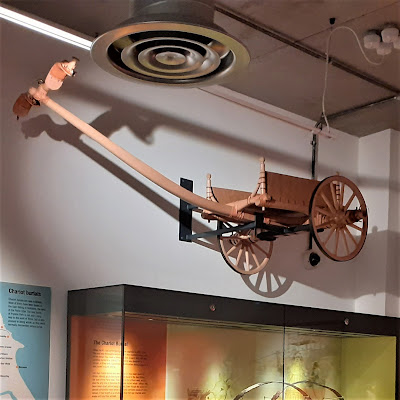
A modern-day reconstruction of the chariot, with two large wheels connected to a square sided seat, and a long bar reaching out to be connected to two horses
A representation of what experts think the chariot would have looked like

Studying the bones of the body in the chariot has revealed that they belonged to a 30 to 40-year-old man. He would have been about 1.70 metres or 5 feet 7 inches tall. 

Modern archaeological scientific techniques have revealed even more about the burial. Radiocarbon dating has shown that the chariot was buried about 200BC, and isotope analysis tells us that the man buried in the chariot was not originally from the Castleford area.

You can see the chariot burial in all its glory at Castleford Museum!


Roman Castleford - just under 2,000 years ago

The Ferrybridge Henge area stopped being as important when the Ancient Romans came to Yorkshire.

In 71 AD the Romans built a fortress at York and a road linking it to another fortress at Lincoln. Around the same time, they built a fort at Castleford, where this road crossed the Aire.

The Roman army is known for marching great distances along the roads they built. This was possibly in part because of the hob-nailed sandals the soldiers wore. Examples of these sandals were found during excavations in Castleford. 

Some of the sandals were so well preserved that re-enactors use replicas based on them and call them ‘Castlefords’!

The remains of a leather ancient Roman sandal, remarkably preserved. It has straps going across the foot and around the ankle
The well-preserved remains of an Ancient Roman leather sandal found in Castleford

The Roman way of life was adopted by many people in the areas they conquered. However, the Romans also keenly took on elements of those local cultures, particularly their gods and spirits.

One example is the altar to Brigantia, the goddess of the defeated tribe on display in Wakefield Museum. 

We also have a stone dedicated to the nymphs, local water spirits of the Aire. It features in the Online Exhibition and is on display at Castleford Museum:

Remains of a carved dedication stone to the Nymphs, featuring two female heads
The stone dedicated to the nymphs, on display at Castleford Museum

More on Roman Castleford


We hope you enjoyed this trip back in time through our amazing archaeology!

Ready to carry on the adventure? Click here for Amazing Archaeology (Anglo-Saxons to English Civil Wars)