Showing posts with label 1940s. Show all posts

Wednesday, May 7, 2025

Pontefract's civic fundraising in the Second World War - VE Day 80

The Second World War was incredibly expensive, both in terms of human lives and monetary cost. People across Britain and the Empire dug deep to help out. 

Read on to discover the fantastic contributions of the people of Pontefract, in this special blog for VE Day 80.

Civic fundraising

2025 is the 80th anniversary of the end of the Second World War. The war in Europe ended on 8 May 1945, VE Day. In Asia it ended on 15 August 1945, VJ Day.

This was the largest war in history. The human tragedy was terrible. Around 80 million people died.

It was also expensive. By 1945 52% of the British economy was devoted to the war. Today’s equivalent is 2.5%.

This huge cost had to be paid. Ordinary people were one source of money. At the start of the war people across Britain and the Empire gave generously to campaigns like the Spitfire Fund. Jamaica gave so much an RAF squadron was named for it, and it was one Pontefract was later linked to.

A poster featuring an illustration of a determined looking soldier and the words 'he's got 'em on the run, keep 'em running with more savings'
A civic fundraising poster from the Second World War

The war cost over £100 million every week. The government needed a continuous supply of money. Compulsory methods, like higher taxes or forced saving, were considered. They were discounted as they could have damaged morale.

Instead, in 1941, the government introduced National Savings. Rather than giving their money, people lent it. They bought small bonds that would be repaid (with interest) after the war.

Local areas organised savings campaigns. Communities had targets and competed to save the most. Individuals and businesses bought bonds. Saving like this rather than spending money also kept inflation low, which was another government goal.
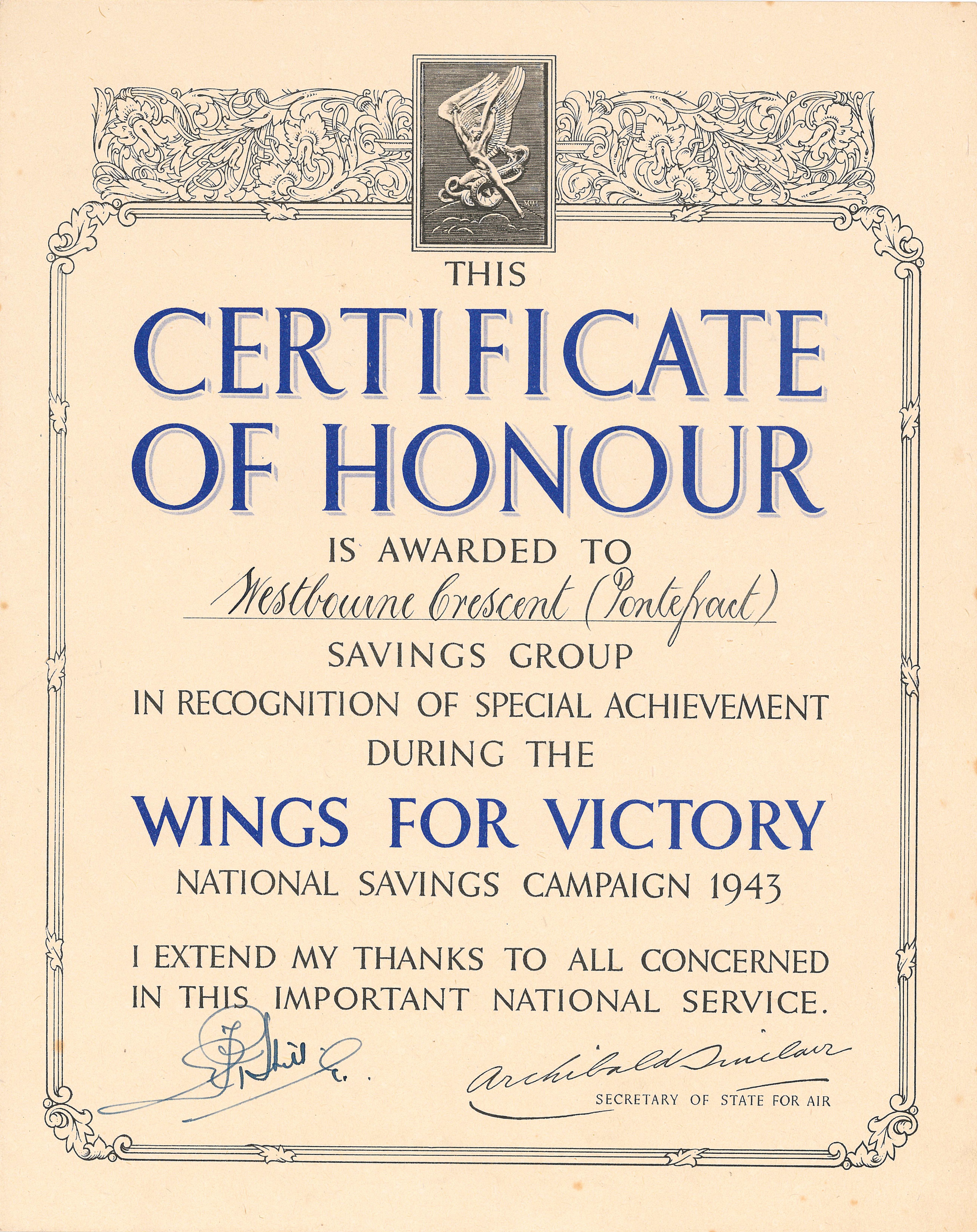
A certificate reading 'This certificate of honour is awarded to Westbourne Crescent (Pontefract) savings group in recognition of special achievement during the Wings for Victory National Savings Campaign 1943. I extend my thanks to all concerned in this important national service.' It is signed by Archibald Sinclair
A Certificate of Honour awarded to Westbourne Crescent in Pontefract, in recognition of their fundraising efforts. It is signed by Archibald Sinclair, Secretary of State for Air.

Fundraising each year focussed on a ‘War Week’. Towns concentrated their efforts on a national theme. These included ‘Wings for Victory’ or ‘Warship Week’. Targets were linked to specific aims. This made the saving more real and meant people felt more involved.

Places that met their targets were given commemorative plaques to celebrate their achievements. Smaller groups could also be recognised with certificates.

Pontefract's fundraising weeks

Pontefract’s 4 ‘special weeks’ raised over £1 million.

10-17 January 1941 – ‘War Weapons’

Target £300,000. 

Raised £409,338.

14-21 February 1942 – ‘Warship Week’

Target £200,000, to adopt HMS Unique (a submarine). 

Raised £217,976.

5-12 June 1943 – ‘Wings for Victory’

Target £160,000, for 8 Mosquito bombers. 

Raised £205,263, enough for 10 bombers.

8-15 July 1944 – ‘Salute the Soldier’

Target £167,373, to equip 1 infantry and 1 parachute battalion.

Raised £206,600.

A poster featuring a futurist-style illustration of a soldier, and the words 'Pontefract, July 8 - 15, 1944. Target: £167,373 (to make £1,000,000). Salute the soldier with a salvo of savings'
A poster for Pontefract's 'Salute the Soldier' civic fundraising week

Warship Week

Part of a programme with an illustration of a submarine and the words 'official programme, Pontefract's Warship Week, February 14 to 21, 1942'
Part of the official programme for Pontefract's Warship Week, 1942

The fundraising focus for 1942 was the Navy. Pontefract’s Warship Week was held 14 - 21 February. Pontefract’s target was £200,000. The total raised was £217,976.

Pontefract adopted HMS Unique, a serving submarine. Seven members of the crew came to visit. They went to the races, saw Pontefract Castle, had tea with the fundraising committee, and went to a civic reception with the mayor.

HMS Unique had been in service since September 1940. She spent most of her time patrolling in the Mediterranean, sinking Italian merchant ships.

On 7 October 1942 she left Holy Loch for her 22nd wartime patrol. She was to search the Bay of Biscay for German blockade-runners, in particular the minesweeper Belgrano. The patrol was due to end in Gibraltar on 23 October.

HMS Unique in harbour, image from the Submariners Association

By 24 October she was overdue and reported missing. At the time it was unclear what had happened. Recent research suggests that on 13 October she attacked a damaged German tanker, the Spichern, heading for the French port of St Nazaire. The tanker reported seeing torpedo tracks. Both the Spichern and another British submarine, HMS Ursula, reported hearing explosions.

It seems most likely that one of HMS Unique’s torpedoes was faulty and exploded too soon. This damaged the submarine so badly that it sank, killing all 34 crew.

Pontefract later adopted another submarine, HMS Upstart. This survived the war and was passed to the Greek navy in August 1945.

HMS Unique - names and ages of the crew killed 13 October 1945

Wings for Victory

Part of the official programme with a photo of a mosquito bomber, and the words 'Pontefract Wings for Victory Week, June 5 to 12 1943, target: £160,000 for 8 Mosquito Bombers'
Part of the official programme for Pontefract's 'Wings for Victory' civic fundraising week

The fundraising focus in 1943 was the Air Force. Pontefract held a Wings for Victory week 5-12 June. The target was £160,000, but the total raised was £205,263. 

The goal had been for people in Pontefract to save enough to pay for 8 Mosquito Bomber aeroplanes. They raised enough for 10.

Page from a log book which reads 'this log book which will record the operational activities of an Aircraft is a tribute to the success acheived by Pontefract Savings Committee in the Wings for Victory National Savings Campaign, 1943'. Then handwritten is 'target: £160,000, achievement: £205,263. Representing the cost of 10 Mosquito (two-engined bombers)'
Page from the Wings for Victory Savings Committee log book

The new Mosquitoes were sent to 139 (Jamaica) Squadron to equip them as Pathfinders. The squadron was named in recognition of the remarkably generous donations from Jamaica in 1940.

Pathfinders used radio beams to find targets. They could either drop bombs far more accurately than normal bombers, or coloured flares. These flares meant ordinary, less accurate bombers could find also targets, even at night.

A dozen Mosquito Bomber aeroplanes on the ground in a row, surrounded by RAF pilots getting kitted up
Mosquitos of 139 Squadron at an RAF base

New foyer display at Pontefract Museum

We're paying tribute to the incredible fundraising efforts of the people of Pontefract in a new foyer display at Pontefract Museum. It has been specially installed in time for VE Day 80. The display will be here until September 2025.

A display case containing fundraising posters, plaques and a certificate of honour from the Pontefract civic fundraising effort
The display case at Pontefract Museum

Pontefract Museum is open Monday to Friday, 10am to 4:30pm and Saturdays, 10:30am to 4:30pm. It is free entry.

Monday, September 30, 2024

Sporting Heritage Day 2024: A Reight Yorkshire Affair

Every year, September 30 is National Sporting Heritage Day. The Wakefield district has a wealth of sporting heritage! 

While the likes of Rugby League, Sykes and Slazenger are pretty well known, here we're shining a light on two of our region's more unusual sporting events.

They feature in our latest displays at Castleford Museum and the new Ossett Library Museum Hub - and have suitably Yorkshire names!

Ah’ll race thee!

We're celebrating the World Coal Carrying Championships in the newly refurbished and reopened Ossett Library in Ossett Town Hall.

 
A tall display case containing a mannequin wearing World Coal Carrying Championship competitor's clothing and carrying a bag of coal, and surrounded by memorabilia. There is also a screen playing a video and some leaflets.
The 'Ah'll race thee!' display at Ossett Library

Every Easter Monday the village of Gawthorpe comes together to stage the World Coal Carrying championships.

What could be more Yorkshire than running up a steep hill with a heavy bag of coal on your back after making a bet in a pub?

That pub bet in the 1960s has turned into a Guiness World Record annual sporting event!

The main adult race is a gruelling challenge. Contestants carry a bag of coal from the Royal Oak pub on Owl Lane in Ossett to the Maypole Green in Gawthorpe. 

The route covers 1012 metres. Men carry 50 kilograms of coal and women carry 20 kilograms. Each year a pigeon clock records the official race times.

The race is much more than a sports competition. Athletes take part for lots of different reasons. They run for charity, personal improvement, or on behalf of a loved one who no longer can.

David Jones’ Guinness World Record time of four minutes and six seconds was set in 1995 and still stands today!

See what happened in the 2022 event, the first after the COVID-19 lockdowns, in our video:


A Reight Neet Aht! at Castleford Museum

Between 1936 and 1957 Castleford held a star-studded sporting event.

Since 1932 the game of marbles has been officially classified as a sport. Local journalist Sid Colclough got the community together to host an annual marbles (or taws) tournament each year as a charity event.

The event was the talk of Yorkshire. The cinema and music hall star, Gracie Fields was a patron. In 1940, the star guest was entertainer, George Formby. 

In 1955 Chairman of the Daimler motorcar company, Sir Bernard and Lady Docker, attended the event, arriving in a golden car. They played marbles, resting their knees on golden cushions. Lady Docker became Women’s world taws champion, and they donated £1000 towards cancer relief.

Find out more about the fabulous 1955 event in this video:


In 1956 the event was given a ‘zebra’ theme, some marbles even had zebra stripes. Even cars arrived reupholstered with zebra skins!

Explore more about A Reight Neet Aht in our dedicated blog, or visit the new display and get your gladrags on at Castleford Museum.

The Reight Neet Aht display, with a display case containing trophies, marbles and memorabilia from the event, an information panel, a basket with dressing up clothes and a mirror
The 'Reight Neet Aht' display at Castleford Museum


Tuesday, September 17, 2024

A Reight Neet Aht: Castleford’s famous fundraiser

The Reight Neet Aht was a unique charity gala with a distinctly Yorkshire flavour that put Castleford on a global stage.

From 1936 to 1957, the star-studded annual marbles contest attracted famous faces and international media interest. 

Read on to discover how appearances from stage, screen and sporting stars brought the glitz and glamour to Cas.

Explore each event in more detail with our interactive timeline!

A group of ten young women wearing elegant evening dresses, all sat around a marble ring and ready to roll their marbles
Participants in the first All-Ladies Reight Neet Aht in 1955
Image courtesy of the Wakefield Council Libraries Photographic Collection

Knuckling off

Local journalist Sid Colclough started the Reight Neet Aht in 1936. Sid wrote a regular column inspired by the grumblings of a group of former miners known as the ‘Fed Ups’. One of the group joked about challenging councillors to a marbles match so Sid made it happen! He turned it into a charity fundraiser and added other games and entertainment for a full night out.

A worn white ribbon with the words 'Castleford's first Reight Neet Aht - 1936' on it, and a safety pin to attach it to your clothes
Souvenir ribbon from the first Reight Neet Aht in 1936

He held the event at the Cooperative Ballroom in Castleford. Guests were invited to come in their “glad-rags” and were treated to a packed programme. The marble contest “knuckled off” at 7:30pm. 

There were also contests in shuttlecock, skipping and whip and top, plus hours of dancing. 

Guests bought slices of a giant pie for supper and there were clay pipes for the gentlemen.

A white marble with blue patterns swirling across the surface
Marble used by 90-year-old William Furniss in the first Reight Neet Aht in 1936. William won the 1937 tournament.

Patrons and prizes

Over the years, Reight Neet Aht supported a number of local charities and good causes. Sid set himself a fundraising target of £50 for the first ever Neet Aht with the proceeds going to Leeds Infirmary.

Reight Neet Aht raised money through ticket sales and selling refreshments on the night. Reight Neet Aht often took place on Shrove Tuesday and organisers prepared piles of pancakes! 

Local companies and celebrity patrons also helped the fundraising by donating trophies, souvenirs and prizes for auction. 

Bagley's Glass in Knottingley made a special marble for the first competition in 1936:

A glass marble with 'Castleford, Reight Neet Aht, April 21st 1936' painted on it
Bagley's Glass special marble for the first Reight Neet Aht

They also supplied the trophy for the final event in 1957:

A large golden ceremonial marble on a black circular mount which is embossed with 'Reight Neet Aht - 1957'
The trophy for the 1957 Reight Neet Aht, also made by Bagley's Glass

Singer, actor and comedian, Gracie Fields, was a huge star in the 1930s. She never made it to Castleford but she was a key supporter of Reight Neet Aht, putting her name to the prizes and donating memorabilia. 

A matt grey-green marble with Gracie Field's signature on in gold
A special commemorative marble decorated with the signature of Reight Neet Aht's celebrity patron Gracie Fields

Star signings

Sid Colclough was the driving force behind the success of Reight Neet Aht. He had a flair for publicity and turned the event into a national occasion. 

Famous cameos added glitz and glamour. Newspapers, radio and even cinema newsreels reported from Castleford. 

George Formby preparing to roll a marble onto the board, watched by his wife Beryl and a crowd of well-dressed attendees
George Formby and his wife Beryl were the special guests at the 1940 Reight Neet Aht - the only wartime edition of the event.
Image courtesy of the Wakefield Council Libraries Photographic Collection

Star entertainer George Formby came to the 1940 Reight Neet Aht with his wife Beryl. The couple had met in Castleford. 

The George Formby Society have kindly lent this signed banjolele to Castleford Museum, where it is currently on display:

A well-loved banjolele, a type of small four-stringed instrument with the neck attached to a tambourine-style drum, signed by George Formby
A banjolele signed by George Formby, currently on display at Castleford Museum

George Formby also signed Reight Neet Aht’s special visitor book along with other famous faces.

This page is signed by lots of people from the world press. The guest book is kindly lent by Wakefield Council Libraries.

A lined guestbook open on a page featuring lots of signatures from members of the world press
A page in the Reight Neet Aht guestbook signed by members of the world press

Three photographers crouched by the marble ring taking photos as competitors play a marbles match
Photographers capture the action. Image courtesy of the Wakefield Council Libraries Photographic Collection

Councillor Ezra Taylor crouched down rolling a marble as a crowd watches on, and a camera operator films the marble action from close-up
A cameraman films as Councillor Ezra Taylor plays his match at the 1953 event. 
Image courtesy of the Wakefield Council Libraries Photographic Collection

Twists and turns

Sid kept interest high by adding a new twist to each year’s event. 

When the Reight Neet Aht restarted after the Second World War, each year had its own theme. 

One year was America vs Yorkshire with the U.S. Army playing in the marbles matches. Another year was an All-Ladies contest.

A long thin poster advertising the 1955 event, reading 'The world-famous Yorkshire Reight Neet Aht, established 1936. Annual Charity Ball and the World's First All Ladies Marbles tournament.  Lady Docker's Team versus Castleford Factory Girls.
Advertising poster for the 1955 All-Ladies Reight Neet Aht event. Image courtesy of the Wakefield Council Libraries Photographic Collection

Here, the 1956 zebra-striped Reight Neet Aht event is captured on canvas by H.J.S. Henson. The glamorous socialite Lady Docker is once again the star guest - she is pictured in the centre, in a white dress:

A painting of the 1956 Reight Neet Aht zebra-stripe themed event, with a large crowd watching on from the floor and balcony as Lady Docker plays marbles
H.J.S. Henson's painting of the 1956 A Reight Neet Aht. 
Image courtesy of the Wakefield Council Libraries Photographic Collection

Lady Docker in an elegant evening dress, holding aloft a large ceremonial marble, with an arm around Sid Colclough, who is dressed in black tie and smiling
Lady Docker with Reight Neet Aht's mastermind, Sid Colclough. Image courtesy of the Wakefield Council Libraries Photographic Collection

Interactive timeline

Explore our Timeline of the Tournaments to discover all of the themes, guests and highlights of the Reight Neet Aht events! You can view it below, or launch the timeline in a new window here


Castleford on the map

The last Reight Neet Aht took place in 1957. Sid invited a team of international students from Leeds University to play in the tournament as Yorkshire took on the world. 

It was a fitting final outing. For 20 years, Reight Neet Aht had put Castleford on the global map.

Three university students crouched around a marbles board decorated with a world map, ready to roll their marbles, as a crowd watches on
University of Leeds students played on special marble boards decorated with world maps at the 1957 Reight Neet Aht. 
Image courtesy of the Wakefield Council Libraries Photographic Collection

Nearly 70 years after the last Neet Aht, we're proud to celebrate this surprising local claim to fame. 

Visit Castleford Museum to uncover more of this fascinating, unexpected tale. 

You can even revive the spirit of the Reight Neet Aht with your own game of marbles. 

And we’d love you to leave us a message in our special replica guest book!

A museum display with a case containing commemorative marbles, George Formby's signed banjolele, a signed cricket bat and photos. There is a dressing up box and guest book to sign.
The Reight Neet Aht interactive display at Castleford Museum

Visitor information for Castleford Museum

The 1957 Reight Neet Aht trophy marble was one of our 100 Years of Collecting objects! Browse the 100 Years of Collecting online exhibition here.