Announcement: Our new website has just launched! It will be taking over from this blog. No new content will be posted on our blog.
Please see the top article on our home page for more information.
This year's theme is journeys, so we're digging deeper (get it...?) into our fantastic Ferry Fryston Iron Age chariot burial, on display at Castleford Museum.
The chariot was
found when the A1 road at #Ferrybridge was being upgraded in 2003-2006.
It had been used
for a burial, and a man's body had been carefully buried inside the chariot.
Radiocarbon dating
suggests he was buried around 200 BC.
Iron Age chariot
burials are rare, and only 21 have been found in Britain so far. This makes our
Ferry Fryston one very special!
Even though the
wood had almost completely rotted away and only corroded pieces of metal
remain, it has taught us a lot about how Iron Age chariots were made and how
they worked.
So, who was the man buried in the Ferry Fryston chariot?
Image shows part of the Ferry Fryston chariot display at Castleford Museum, with the skull of the man buried on the left, the brooch from his cloak second from left, and nave hoops from the chariot wheels
Archaeologists
studied his skeleton and were able to find out the following things:
🧍 The man was aged
30-40, and had been buried lying on his back with his legs folded under him
🦷 Chemical analysis of his teeth
suggests he was not local, but from East Yorkshire or even Scotland
💍 He was wearing a cloak pinned at the
left shoulder by a brooch, with a round glass head that was originally red
[this is the object second from the left]
🛡 Pieces of corroded metal suggest he
may also have had a shield
What journeys do
you think he would have taken to get here? What journeys was he being prepared for in both life and death?
The Chariot
Burials of Iron Age chariots like this are very rare, so ours is really important!
The chariot would
have been mainly made out of wood, and even though this had almost completely
rotted away and only corroded pieces of metal remain, it has taught us a lot
about how Iron Age chariots were made and how they worked.
1) The large iron
tyres would have given the wooden wheels strength to drive over rough ground.
Chariots like these certainly weren't driving over planned tarmac roads like
the A1 in Ferrybridge today where it was found!
2) These four
strong iron bands are called nave hoops, and they would have held together the
wheel hubs
3) These are linch
pins, which stopped the wheels from falling off.
4) These wooden
chariots were pulled by horses, which were controlled by a 'bit' in their
mouths. This would have been attached to reins which ran through these terret
rings to stop the reins from getting tangled.
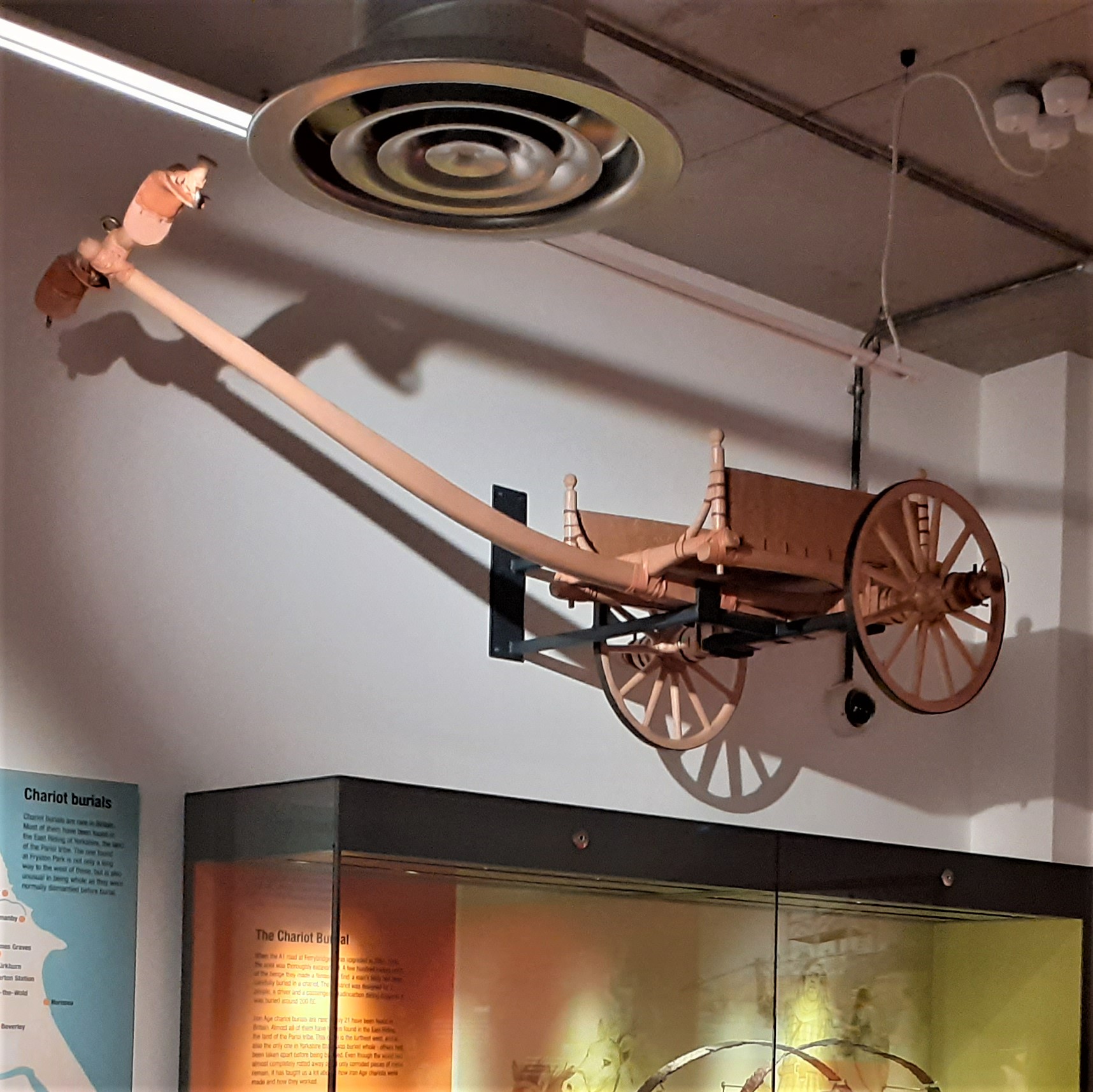
What might the full chariot have looked like?
Well our experts think it would have looked like this...
What did you think? Were you close?
It would have been
mostly made out of wood, likely with a square seat attached to the two large
wheels where the rider would have sat.
This then had a
long wooden beam stretching up to where two horses would have been attached to
pull the chariot along.
The Burial
This picture shows
a drawing of the Excavation Plan of the chariot, which is carefully drawn
showing what was found and exactly where it was found.
This is important,
as it helps archaeologists to fill in the gaps of what hasn't survived in the
ground (particularly the wood of the chariot) to build the bigger picture! Down the middle of
the diagram you can see the remains of and the indentation made by the original
chariot. This is what was used by our experts to design what the full chariot
might have looked like. At the bottom, in
the middle, you can see how the man's skeleton was found, with his legs bent
behind him. It also shows you
where our items in the display case were found: wheel rings (1), the nave hoops
(2-3 and 9-10), the linch pins (6), the terret rings (13 - 17), the horse bit
(20) and the brooch would have been on/within the skeleton. Can you imagine
what it must have felt like to find this? Have you made any of your own
archaeological discoveries?
Come and see the chariot in all its glory for yourself at Castleford Museum!
Opening hours (FREE ENTRY)
Monday
9:30am - 5pm
Tuesday
9:30am - 5pm
Wednesday
Closed
Thursday
9:30am - 5pm
Friday
9:30am - 5pm
Saturday
9:30am - 4pm
Sunday
Closed
For lots more information about Roman Castleford. click here
Bathing was an important part of Roman life. Rome itself had nearly a thousand bath houses in the 4th century AD, the largest of which had room for 3,000 bathers. The Romans took this enthusiasm for bathing all across their Empire, including to Castleford.
Roman forts had a standard layout, from Hadrian’s Wall to the deserts of Egypt. And wherever possible this design included a bath house just outside the main fort for the soldiers to use. Hygiene was a key part of keeping them healthy and fit to fight. The leisure element was also important, especially for morale. The troops in Castleford had signed up for 25 years’ service and were hundreds of miles from home; many would never have returned home or seen their families again.
After the fort was demolished, the bath house was left standing and then kept running for over 200 years, becoming a valued asset for the new Roman town.
Artist's impression of Romans inside a bath house
Revealing the bath house
Castleford’s bath house was discovered in 1978 by Ron Jeffries, an enthusiastic local amateur archaeologist. It is next to (and partly underneath) the Savile Road / Church Street roundabout, so it couldn’t be completely excavated, but enough was found to be sure of its layout.
Amateur archaeologist, Ron Jeffries, at a dig in Castleford
Digs revealed the almost complete ground plan of the Castleford bath house
It was in an annexe to the main fort and was originally built by and for the army. The whole building was built of brick and stone and probably decorated with statues. It would have been one of the more impressive buildings in town.
Clever engineering
Roman soldiers usually built their own barracks and forts but the bath house was a specialist project, probably built by professional engineers, not the local troops. We think this because the tiles in it are stamped with the mark of the 9th Legion Hispania, the main legionary unit based in York, rather than the 4th Cohort of Gauls, the unit based at Castleford.
The building itself was about 25 metres long and followed a standard design. Roman baths were more like Turkish baths than modern swimming pools, based on relaxation and perspiration. The first room you entered was the changing room. There were then three rooms that got hotter as you went on. The last of these probably had a hot bath in it. Finally there was a much larger cold water plunge pool after you left the hot room, made of a special concrete that looked like marble.
The rooms were heated by large furnaces, which piped hot air through a clever series of ducts under the floors and in the walls. Fresh water probably came from a spring, and the dirty water could be piped away to the nearby River Aire. A stone tablet dedicated to water nymphs suggests that the local spring was special, maybe having magical healing powers, making the baths even better.
Bathing and beauty
To get clean in a Roman bath you would have rubbed oil into your skin. Then as you got hotter and hotter, and started sweating, the dirt and sweat would have mixed with the oil. This mix of oil, dirt and sweat would then be scraped off with a special curved blunt blade. At the same time you could have other cosmetic and beauty treatments. These tweezers for plucking hairs were found in the bath house.
Fun and games
Roman bathing was about far more than just getting clean. It was also for relaxation and especially for socialising. There would have been drinks and snacks available while you chatted with friends, or networked and did some business with associates. A gaming counter found in the bath house shows you would also have played games and gambled.
Roman gaming counters and die, made from bone
You can have a go at bathing like a Roman at home! Join archaeologist, Sally Pointer, to find out how to make your own rose scented bathing oil, inspired by the Lagentium bath house.
Can you recreate the scene from inside the bath house? How long will it to take you to complete our Rome From Home jigsaw?
This week we are celebrating the fascinating story of Castleford’s past as the Roman fort and settlement, Lagentium, and sharing many of the treasures from our Roman Castleford collection.
But how did these ancient objects come to be in Castleford Museum today?
And, given that the modern town has been built on top of the Roman remains, how do we even know about Lagentium?
Archaeologists arrive
Although people had taken an interest in Castleford’s Roman origins as early as the 16th century, it wasn’t until the mid 20th century that any modern archaeological excavations took place. However, some chance finds were presented to the museum collection, then part of Castleford Library, in the 1920s and 1930s. This roof tile found on Carlton Street and an oil lamp discovered at Albion Street were some of the first Roman objects to be preserved in the collection.
In the 1960s significant redevelopment work in the town led to the discovery of many more Roman objects. Finds made during work to build a new bus station and bowling alley prompted a new interest in Castleford’s Roman heritage and the first systematic excavations took place. Initially these were mainly carried out by amateur archaeologists such as the Castleford and District Historical Society, until the late 1970s when their valuable work was continued by full time archaeologists from the West Yorkshire Archaeological Unit.
Volunteers excavating in Castleford
The excavations in the second half of the 20th century revealed the remains of Roman buildings and structures and uncovered many Roman items and thousands of further fragments of objects. These allowed experts to piece together a plan of what Roman Castleford had looked like and helped to build a picture of what life was like at the time. They revealed the existence of two forts and a nearby town. The finds were donated to the museum collection to be preserved. Many are on display today and allow us to tell the story of life in Lagentium.
The first fort, AD 71-86
Whilst the exact footprint of the first fort is still unknown, excavations have uncovered the remains of several buildings from inside the fort’s defences.
The discovery of leather fragments believed to be from soldiers’ tents suggests that the first Romans in Castleford didn’t have permanent sleeping areas. However, there is evidence in the form of foundations and post-holes to suggest that the army did go on to construct barracks and other timber buildings, including a granary to store the vital supplies of grain needed to feed the troops.
Archaeologists excavating near Back Bank Street discovered a large building believed to be at the centre of the fort. It had several rooms arranged around a central courtyard. A building of this size in a key location could have been the army’s local headquarters but the mix of military and domestic items found at the site suggest it was more probably the house of an army commander.
Foundation trenches for the timber walls of the house
A load of rubbish?
We owe lots of what we have learned about the first fort at Lagentium to a rubbish dump! Near to Church Street, a pile of Roman waste had been preserved due to waterlogging. Normally, organic material would have rotted away but here archaeologists found leather remains, including these remarkably well preserved shoes.
The volume of leather offcuts discovered here along with metal remnants suggests it may have been the site of an army workshop or fabrica.
The many other finds also provide an invaluable insight into life in the fort. There is evidence also of medical provision, army administration and soldiers’ leisure time.
A scoop or probe, possibly used in the fort's hospital
The second fort, c. AD 86
The first Lagentium fort was eventually demolished and the ground at the site levelled in preparation to build a new set of defences. Archaeologists have been able to identify the size, layout and location of the second fort at Lagentium because their excavations in the 1980s uncovered evidence of the fort’s defences, including ditches, ramparts, a gate and parts of the Roman road network. From this they have worked out that the fort stretched 8.4 acres from Back Bank Street in the north to Carlton Street in the south, and from Bradley Street in the east to Church Street in the west. Within these defences, they have identified the site of barrack blocks, warehouses and stables.
Artist's impression of how the gate and defences may have looked
Archaeologists studied the pattern of post-holes for the timber uprights.
The excavations revealed the existence of many timber buildings but also showed signs of a move within the second fort to more substantial structures, including stone foundations, tile roofs and even a large granary with stone walls.
Excavating the vicus
As well as the two forts, archaeological excavations have also revealed the existence of a nearby civilian town, or vicus. The town would have provided the soldiers of the army garrison with goods and leisure services. Over time though, it grew into a significant trading centre and an important staging post on the Roman Empire’s message network. It seems to have been ideally located for this, focused mainly on the road leading to the River Aire crossing point.
Plan showing the vicus to the south west of the fort on the Roman road
Archaeologists have discovered that the vicus appears to have been arranged according to a planned regular layout. The buildings were constructed in rows to a standard size and floorplan, probably decided by the army. In these uniform buildings were workshops for craftsmen and shops for traders.
Life of luxury
There is evidence of significant redevelopment work in the vicus following the army’s eventual exit from the fort. The original timber buildings were replaced with larger premises and sometimes stone structures. Archaeologists have been able to identify gravel pathways that linked the buildings to each other and to the main road, and have even uncovered rut marks from the cartwheels that travelled over them.
Unlike other Roman settlements, Lagentium continued to develop after the garrison left, thriving as a manufacturing and commercial centre in the early 2nd century. Excavations of the vicus produced large quantities of luxury items. The high standard of the finely crafted jewellery and metalwork, and imported glassware, kitchenware and tableware paints a picture of a civilised population that had embraced Roman lifestyles. The discovery of many fragments of vessels known as amphorae tells us that the townspeople were enjoying food and drink from the continent. Amphorae would have been used to import fish sauce and olive oil from Spain and wine from France.
An example of an amphora
It is also clear that Castleford had extensive trading links. Over 700 fragments of samian ware, a shiny red glazed crockery from France, were found in a single location. The sheer size of this find makes it one of the most important discoveries of samian ware in Britain and suggests that the excavated building was most probably a shop or warehouse, from which the surrounding area acquired its sophisticated tableware for impressing dinner guests at special occasions.
Examples of samian ware reconstructed from excavated fragments
Thanks to the excavations of the late 20th century, we are able to better understand life in Castleford at the height of its Roman history. At Castleford Museum today we are proud to tell this story and to display objects that our predecessors in Lagentium crafted, bought and sold - items that they wore, used for eating and drinking, for bathing and cosmetics, or for fun and relaxation.
Only some of the Roman area has been excavated so far and there is yet more to discover in future.
Even many hundreds of years before the Industrial Revolution, Castleford was an important manufacturing centre.
In this blog, we explore the many things Made in Castleford by the Romans!
Made for the military
Roman Castleford began in about 71 AD as a fort built as part of the violent invasion and conquest of northern England. A garrison of 600 soldiers was based in the fort and very quickly their money attracted local traders. This usually happened at Roman forts - a small settlement grew up nearby that provided the troops with food, drink, entertainment and so on.
When the civilian area outside the Castleford fort was excavated, it revealed a number of hearths, lots of remains from smelting, and bits of military kit. This clearly suggests that there were workshops making and repairing equipment for soldiers. They would certainly have been doing this for the local garrison but maybe also for the army supply network more widely.
Illustration showing how the inside of a Roman military workshop or fabrica might have looked.
Flourishing after the fort
These workshops were probably why the town continued to thrive after the fort was abandoned around 100 AD. It was perfectly normal for the Roman army to build forts and then demolish them when the area around was pacified and a large occupying garrison was no longer needed. But when this happened, the settlements alongside the forts usually disappeared too, as there was no more need for their shops and services.
Castleford is unusual because, when the fort was vacated, the town continued to prosper and even flourish. Wooden buildings were replaced with stone ones and expensive statues were placed in the town. Part of this success may have come from its handy location; it was a port trading with the wider Empire including the Mediterranean, and a convenient stop on the main road between London and York. But it was also an important manufacturing centre.
Mass production
Fragments of spoon moulds found in Castleford
One specialist industry in Roman Castleford was spoon-making. Hundreds of bits of moulds made from local clay have been found. These moulds would have been bundled together so that up to 16 spoons could be made at once by pouring molten bronze into them. Once the metal had cooled, the clay moulds were broken open to get at the spoons, and the broken pieces of the moulds thrown away. Castleford is the only place in Britain where this kind of complex mould has been found, and the only spoon-making centre in the Western Roman Empire.
Castleford was also a centre for making enamelled metal objects, often objects connected to the army. The bronze objects were cast in distinctive clay moulds which left depressions in the metal. These depressions were then filled with a special paste which turned into a glassy enamel when heated. The things made were a fusion of Roman metalwork with British decoration, producing a striking, colourful look.
Souvenir shopping
Bronze fibula brooch
This half-finished brooch found by archaeologists gives us evidence about some of the objects made in Castleford. For the Romans brooches were functional, used by everyone, including soldiers, to fasten clothing before buttons and zips were invented. But brooches were also decorative and some were even souvenirs. The bright colours of the enamel would have been very striking. Another brooch found recently in Lincolnshire had an inscription on it saying it came from Lagentium, the Roman name for Castleford.
The Romans liked these sort of souvenirs, and we know of some unusual cups and bowls with the names of forts on Hadrian’s Wall on them. One example found recently was the Staffordshire Moorlands Pan.
Portable Antiquities Scheme from London, England / source https://commons.wikimedia.org/wiki/File:Staffordshire_Moorlands_Pan_(1284837406).jpg
Interestingly these too are enamelled metal objects - were they made in Castleford? We know the Romans were definitely making similar things in Castleford because, as well as spoon moulds, the moulds for elaborate enamelled bronze water flasks have also been found. You can see a complete flask of this type in a museum in Vienna. It’s fascinating to think that products made in Roman Castleford may have travelled to the continent.
If you have enjoyed finding out about Roman Castleford's manufacturing heritage, why not have a go at recreating the fabrica scene in our digital jigsaw below?