Showing posts with label Castleford. Show all posts

Thursday, October 31, 2024

Lighting up Wakefield: guide to The Timekeepers by Illuminos

This year's Light Up Wakefield (part of Our Year - Wakefield District 2024) invites you to see spectacular digital installations and experience the city in a whole new light!

One of the 2024 installations is The Timekeepers by Illuminos, which will be projected onto County Hall. 

It is a projection mapping piece based on the 300-year old story of Wakefield-born genius John Harrison. Harrison set his mind to the great mystery of the age – the perfect measurement of time and space. 

The Timekeepers celebrates the great variety of heritage, culture and arts that can be discovered across the Wakefield district.

The installation flies through time and tells stories, large and small from the Wakefield district. 

We're extremely excited, as our collections play a big part in telling the story! It sees some of our tiniest objects made gigantic on the beautiful facade of County Hall.

So what objects can you expect to see in The Timekeepers? Here's a guide to some of the highlights - some you might be familiar with, and others you might not!

The Waterton Clock, 1670s

An ornate lantern clock from the seventeenth century, about 40 centimetres tall, featuring silver nature designs, a domed top, and a swinging pendulum

This is a gorgeous lantern clock which was owned by the Waterton family for generations. 

Charles Waterton (1782 - 1865) of Walton Hall thought that the clock was once owned by Sir Thomas More (1478 - 1535). Waterton believed he was a descendant of More. 

More was Lord High Chancellor to Henry VIII - until he had him executed!

However, the clock was actually made over 100 years after the death of More. Nevertheless, it is a beautiful piece and lends itself brilliantly to The Timekeepers! It's also the oldest clock in our collection.

The 'Castleford Pig', around 1910

A tiny black wooden carved pig, with a looking glass in its belly containing tiny replications of photos of Castleford

The 'Castleford Pig' is literally a window through time! 

Inside this tiny carving of a pig is a looking glass. When you hold the object up to the light, you can see six pictures of Castleford from the early 1900s. 

It's an example of a Stanhope picture viewer, and novelty versions were very collectable. They came in many shapes and sizes, and could feature lots of pictures.

The Timekeepers is about incredible, huge visuals projected onto one of Wakefield's most spectacular buildings. 

So it's absolutely delighted us that our tiny pig, which is only about the size of a £1 coin, is going to be the size of County Hall! 

Glassware made by Bagley and Co Ltd in Knottingley, 1930s

A bright yellow glass vase with four handles and four little koalas on the handles
Although originally started as a bottle factory, Bagley's also made decorative glass. It became especially known for its vibrantly coloured glass developed in the 1930s.

However, there's a hazardous reason behind some of these brilliant colours - some were created using uranium, a radioactive element!

Coloured glass production ended in the 1940s when uranium was needed for atomic bomb development in the Second World War.

After the war, Bagley's went on to create a very dark black glass, known as 'jetique'. 

The eyepopping colours of Bagley's glassware makes it perfect to be projected in The Timekeepers. 

If you'd like to see more, there's a whole Glass Room at Pontefract Museum (don't worry, these ones aren't radioactive!) 

Yorkshire Forced Rhubarb

Inside of a forced rhubarb shed, a dark room with lots of stalks of bright pink rhubarb reaching to the sky

A celebration of Wakefield's heritage wouldn't be complete without rhubarb!

Thanks to good soil mixed with lots of ashes, horse manure and textile waste, and just the right amount of rain, Wakefield specialises in 'forced rhubarb'. The city forms part of the 'Rhubarb Triangle' with Leeds and Morley.

There's a display about the history of growing rhubarb at Wakefield Museum, where you can even hear it growing. The sound might surprise you!

You can also find out more about why Wakefield roots for rhubarb in this blog post.

Phenakistiscope discs, 1880s

A circular wooden phenakistiscope disc with illustrations of a horse and rider on the outer ring, and a jumping dog on the inner ring

They might be a bit of a mouthful to pronounce, but phenakistiscope discs are actually an early type of animation.

They were invented in the early 1800s, long before film or even photography as we know it. 

Our collection of phenakistiscope discs, including this one pictured, belonged to the Farrers. The Farrers were a famous clock-making family from Pontefract. Hence the link to The Timekeepers

The Illuminos team bring these discs to life through digitally replicating their analogue animation.

Playmakers - Sykes and Slazenger

A blue quiver with a leather strap, containing wooden arrows with coloured feathers
A Slazenger quiver of arrows, 1950s

Wakefield has quite the sporting heritage! Our Playmakers collection tells the story of how, for more than a century, Horbury was a centre of sporting excellence and innovation.

The factory at Horbury was first founded by William Sykes, and then became Slazengers during the Second World War.

Horbury-made sporting equipment supplied the World Cup, Challenge Cup, and was endorsed by sports stars including Steffi Graf and Don Bradman.


Commemorative marbles from A Reight Neet Aht, 1930s to 1950s 

A large glass marble with 'Castleford, Reight neet aht, April 21 1936' painted on it

Prepare yourself for a torrent of marbles to cascade down County Hall! And no, it's not just because we've lost ours... 

A game of marbles was a big deal in Castleford! From 1936 an unlikely and flamboyant charity event called 'A Reight Neet Aht' created a buzz at the Castleford Co-Operative Hall. 

Known as 'taws', these marbles contests raised money for Leeds Infirmary over the next 20 years.

The marbles for the tournament, along with glass trophies, were made in and around Castleford. They all look mighty impressive projected large in The Timekeepers!

You can don your gladrags for a glamorous game of marbles in A Reight Neet Aht at Castleford Museum.

The Wakefield Pageant, 1933

A photograph of a long chain of girls in matching outfits, with the girls on the outer sides of the 'train' carrying wheels, and a torch at the front
A group of girls from Thornes House Secondary School and Ings Road Central School acted as a 'ballet' steam train in the 1933 Wakefield Pageant!

The Pageant of Wakefield and the West Riding took place in June 1933 in Thornes Park, Wakefield. It celebrated Wakefield's past and present, and imagined the city's future.

A whole cast of schools and societies took part, each playing different roles from Wakefield's proud history. They also helped to make the costumes and lavish backdrops.

More than 2,000 performers took part in the Pageant over 10 performances. Thousands of people turned out to enjoy the spectacle.

Objects and photographs from the 1933 Pageant are projected alongside The Hatchling in The Timekeepers. The Hatchling was an amazing event during the summer of Our Year - Wakefield District 2024, which saw a dragon hatch in Wakefield.

The Wakefield Pageant was very much the 'Our Year' of 1933!

You can see a special art display inspired by the Wakefield Pageant by artist Louise Goult in the lower atrium of Wakefield One.

Anglo-Saxon cross, around 900 to 1000 AD

The remains of a decorated Anglo-Saxon cross shaft, topped and tailed by reconstructions of what the rest of the originally brightly painted cross might have looked like

This stone cross is the first evidence of a settlement in modern Wakefield. 

The cross was probably used for preaching, and it stood in Wakefield's marketplace until 1546. It then disappeared until 1861, when Edmund Waterton (son of Charles Waterton) rescued it from the demlotion of an old butcher's shop. The cross shaft had been used as a doorstep to the butcher's!

Not only is this object important in telling us about the creation of Wakefield, it was once a vibrant and colourful creation. 

The cross is on display at Wakefield Museum - it is on loan courtesy of York Museums Trust.

Monday, September 30, 2024

Sporting Heritage Day 2024: A Reight Yorkshire Affair

Every year, September 30 is National Sporting Heritage Day. The Wakefield district has a wealth of sporting heritage! 

While the likes of Rugby League, Sykes and Slazenger are pretty well known, here we're shining a light on two of our region's more unusual sporting events.

They feature in our latest displays at Castleford Museum and the new Ossett Library Museum Hub - and have suitably Yorkshire names!

Ah’ll race thee!

We're celebrating the World Coal Carrying Championships in the newly refurbished and reopened Ossett Library in Ossett Town Hall.

 
A tall display case containing a mannequin wearing World Coal Carrying Championship competitor's clothing and carrying a bag of coal, and surrounded by memorabilia. There is also a screen playing a video and some leaflets.
The 'Ah'll race thee!' display at Ossett Library

Every Easter Monday the village of Gawthorpe comes together to stage the World Coal Carrying championships.

What could be more Yorkshire than running up a steep hill with a heavy bag of coal on your back after making a bet in a pub?

That pub bet in the 1960s has turned into a Guiness World Record annual sporting event!

The main adult race is a gruelling challenge. Contestants carry a bag of coal from the Royal Oak pub on Owl Lane in Ossett to the Maypole Green in Gawthorpe. 

The route covers 1012 metres. Men carry 50 kilograms of coal and women carry 20 kilograms. Each year a pigeon clock records the official race times.

The race is much more than a sports competition. Athletes take part for lots of different reasons. They run for charity, personal improvement, or on behalf of a loved one who no longer can.

David Jones’ Guinness World Record time of four minutes and six seconds was set in 1995 and still stands today!

See what happened in the 2022 event, the first after the COVID-19 lockdowns, in our video:


A Reight Neet Aht! at Castleford Museum

Between 1936 and 1957 Castleford held a star-studded sporting event.

Since 1932 the game of marbles has been officially classified as a sport. Local journalist Sid Colclough got the community together to host an annual marbles (or taws) tournament each year as a charity event.

The event was the talk of Yorkshire. The cinema and music hall star, Gracie Fields was a patron. In 1940, the star guest was entertainer, George Formby. 

In 1955 Chairman of the Daimler motorcar company, Sir Bernard and Lady Docker, attended the event, arriving in a golden car. They played marbles, resting their knees on golden cushions. Lady Docker became Women’s world taws champion, and they donated £1000 towards cancer relief.

Find out more about the fabulous 1955 event in this video:


In 1956 the event was given a ‘zebra’ theme, some marbles even had zebra stripes. Even cars arrived reupholstered with zebra skins!

Explore more about A Reight Neet Aht in our dedicated blog, or visit the new display and get your gladrags on at Castleford Museum.

The Reight Neet Aht display, with a display case containing trophies, marbles and memorabilia from the event, an information panel, a basket with dressing up clothes and a mirror
The 'Reight Neet Aht' display at Castleford Museum


Tuesday, September 17, 2024

A Reight Neet Aht: Castleford’s famous fundraiser

The Reight Neet Aht was a unique charity gala with a distinctly Yorkshire flavour that put Castleford on a global stage.

From 1936 to 1957, the star-studded annual marbles contest attracted famous faces and international media interest. 

Read on to discover how appearances from stage, screen and sporting stars brought the glitz and glamour to Cas.

Explore each event in more detail with our interactive timeline!

A group of ten young women wearing elegant evening dresses, all sat around a marble ring and ready to roll their marbles
Participants in the first All-Ladies Reight Neet Aht in 1955
Image courtesy of the Wakefield Council Libraries Photographic Collection

Knuckling off

Local journalist Sid Colclough started the Reight Neet Aht in 1936. Sid wrote a regular column inspired by the grumblings of a group of former miners known as the ‘Fed Ups’. One of the group joked about challenging councillors to a marbles match so Sid made it happen! He turned it into a charity fundraiser and added other games and entertainment for a full night out.

A worn white ribbon with the words 'Castleford's first Reight Neet Aht - 1936' on it, and a safety pin to attach it to your clothes
Souvenir ribbon from the first Reight Neet Aht in 1936

He held the event at the Cooperative Ballroom in Castleford. Guests were invited to come in their “glad-rags” and were treated to a packed programme. The marble contest “knuckled off” at 7:30pm. 

There were also contests in shuttlecock, skipping and whip and top, plus hours of dancing. 

Guests bought slices of a giant pie for supper and there were clay pipes for the gentlemen.

A white marble with blue patterns swirling across the surface
Marble used by 90-year-old William Furniss in the first Reight Neet Aht in 1936. William won the 1937 tournament.

Patrons and prizes

Over the years, Reight Neet Aht supported a number of local charities and good causes. Sid set himself a fundraising target of £50 for the first ever Neet Aht with the proceeds going to Leeds Infirmary.

Reight Neet Aht raised money through ticket sales and selling refreshments on the night. Reight Neet Aht often took place on Shrove Tuesday and organisers prepared piles of pancakes! 

Local companies and celebrity patrons also helped the fundraising by donating trophies, souvenirs and prizes for auction. 

Bagley's Glass in Knottingley made a special marble for the first competition in 1936:

A glass marble with 'Castleford, Reight Neet Aht, April 21st 1936' painted on it
Bagley's Glass special marble for the first Reight Neet Aht

They also supplied the trophy for the final event in 1957:

A large golden ceremonial marble on a black circular mount which is embossed with 'Reight Neet Aht - 1957'
The trophy for the 1957 Reight Neet Aht, also made by Bagley's Glass

Singer, actor and comedian, Gracie Fields, was a huge star in the 1930s. She never made it to Castleford but she was a key supporter of Reight Neet Aht, putting her name to the prizes and donating memorabilia. 

A matt grey-green marble with Gracie Field's signature on in gold
A special commemorative marble decorated with the signature of Reight Neet Aht's celebrity patron Gracie Fields

Star signings

Sid Colclough was the driving force behind the success of Reight Neet Aht. He had a flair for publicity and turned the event into a national occasion. 

Famous cameos added glitz and glamour. Newspapers, radio and even cinema newsreels reported from Castleford. 

George Formby preparing to roll a marble onto the board, watched by his wife Beryl and a crowd of well-dressed attendees
George Formby and his wife Beryl were the special guests at the 1940 Reight Neet Aht - the only wartime edition of the event.
Image courtesy of the Wakefield Council Libraries Photographic Collection

Star entertainer George Formby came to the 1940 Reight Neet Aht with his wife Beryl. The couple had met in Castleford. 

The George Formby Society have kindly lent this signed banjolele to Castleford Museum, where it is currently on display:

A well-loved banjolele, a type of small four-stringed instrument with the neck attached to a tambourine-style drum, signed by George Formby
A banjolele signed by George Formby, currently on display at Castleford Museum

George Formby also signed Reight Neet Aht’s special visitor book along with other famous faces.

This page is signed by lots of people from the world press. The guest book is kindly lent by Wakefield Council Libraries.

A lined guestbook open on a page featuring lots of signatures from members of the world press
A page in the Reight Neet Aht guestbook signed by members of the world press

Three photographers crouched by the marble ring taking photos as competitors play a marbles match
Photographers capture the action. Image courtesy of the Wakefield Council Libraries Photographic Collection

Councillor Ezra Taylor crouched down rolling a marble as a crowd watches on, and a camera operator films the marble action from close-up
A cameraman films as Councillor Ezra Taylor plays his match at the 1953 event. 
Image courtesy of the Wakefield Council Libraries Photographic Collection

Twists and turns

Sid kept interest high by adding a new twist to each year’s event. 

When the Reight Neet Aht restarted after the Second World War, each year had its own theme. 

One year was America vs Yorkshire with the U.S. Army playing in the marbles matches. Another year was an All-Ladies contest.

A long thin poster advertising the 1955 event, reading 'The world-famous Yorkshire Reight Neet Aht, established 1936. Annual Charity Ball and the World's First All Ladies Marbles tournament.  Lady Docker's Team versus Castleford Factory Girls.
Advertising poster for the 1955 All-Ladies Reight Neet Aht event. Image courtesy of the Wakefield Council Libraries Photographic Collection

Here, the 1956 zebra-striped Reight Neet Aht event is captured on canvas by H.J.S. Henson. The glamorous socialite Lady Docker is once again the star guest - she is pictured in the centre, in a white dress:

A painting of the 1956 Reight Neet Aht zebra-stripe themed event, with a large crowd watching on from the floor and balcony as Lady Docker plays marbles
H.J.S. Henson's painting of the 1956 A Reight Neet Aht. 
Image courtesy of the Wakefield Council Libraries Photographic Collection

Lady Docker in an elegant evening dress, holding aloft a large ceremonial marble, with an arm around Sid Colclough, who is dressed in black tie and smiling
Lady Docker with Reight Neet Aht's mastermind, Sid Colclough. Image courtesy of the Wakefield Council Libraries Photographic Collection

Interactive timeline

Explore our Timeline of the Tournaments to discover all of the themes, guests and highlights of the Reight Neet Aht events! You can view it below, or launch the timeline in a new window here


Castleford on the map

The last Reight Neet Aht took place in 1957. Sid invited a team of international students from Leeds University to play in the tournament as Yorkshire took on the world. 

It was a fitting final outing. For 20 years, Reight Neet Aht had put Castleford on the global map.

Three university students crouched around a marbles board decorated with a world map, ready to roll their marbles, as a crowd watches on
University of Leeds students played on special marble boards decorated with world maps at the 1957 Reight Neet Aht. 
Image courtesy of the Wakefield Council Libraries Photographic Collection

Nearly 70 years after the last Neet Aht, we're proud to celebrate this surprising local claim to fame. 

Visit Castleford Museum to uncover more of this fascinating, unexpected tale. 

You can even revive the spirit of the Reight Neet Aht with your own game of marbles. 

And we’d love you to leave us a message in our special replica guest book!

A museum display with a case containing commemorative marbles, George Formby's signed banjolele, a signed cricket bat and photos. There is a dressing up box and guest book to sign.
The Reight Neet Aht interactive display at Castleford Museum

Visitor information for Castleford Museum

The 1957 Reight Neet Aht trophy marble was one of our 100 Years of Collecting objects! Browse the 100 Years of Collecting online exhibition here.

Tuesday, October 31, 2023

100 Years of Collecting: Amazing Archaeology (Prehistoric to Roman)

Our 100 Years of Collecting Online Exhibition spans thousands of years of human history. We’ve got a little bit of everything, from a prehistoric hand axe to a Prime Energy drink!

This month, we’re focusing on some of our amazing archaeology collection highlights. We’ve got so much we’ll post it over two parts.

For part 1, join us on a whistle-stop tour from prehistory through to the Romans:

Prehistoric tools and technology

Did you know that some of the oldest evidence of human life in Britain comes from Wakefield?

It includes this hand axe, on display at Wakefield Museum. 
It was originally made between 500,000 and 200,000 years ago when humans first settled in Britain.

A brown and yellow mottled flint hand axe. It is in a sort of teardrop shape.
A Palaeolithic hand axe - on display at Wakefield Museum


It might not look like much today, but flint hand axes like this were crucial multipurpose tools. They were useful for skinning and cutting up large mammals such as mammoths or Irish elk. They were a key invention for human evolution.

These earliest humans were forced out during a long period of Ice Ages and only occasional traces of them can be found today. Our hand axe was found at Lee Moor near Stanley in 1889.


15,000 years ago

The next people to settle in Britain came after the end of the last Ice Age, 15,000 years ago. They followed the migration of large mammals into Britain’s cold, dry climate and open landscapes.

As the climate warmed, trees and forests formed. These were better suited to smaller mammals. Humans had to adapt their hunting techniques and technologies. The new settlers began to use composite tools like harpoons. These harpoons used lots of tiny flints called microliths, moving on from the single large pieces of flint used for the hand axe. 

A series of small pieces of flint, in shades of pale grey and brown, and various sizes - but much smaller than the handaxe
A selection of microliths on display at Wakefield Museum

The Bronze Age - around 5,000 years ago

By 5,000 years ago, communities were working together to clear forests and begin farming. People were beginning to live in permanent settlements rather than moving around the landscape with the seasons. 

New technologies also reached Britain, like pottery and metalwork. Metal was helpful for the new styles of shafted axes needed to clear woodlands for farming. 

One of our beautiful bronze axe heads features in the Online Exhibition. It was found as part of the Smalley Bight Hoard.

Small bronze axe head, with three raised ribs running along the blade. Well preserved.
The bronze axe head - the loop would have helped fix it to a (probably wooden) handle.

You can see more on display at Wakefield Museum and Castleford Museum!

Burials: bronze and bones

As people settled into permanent homes, different social classes began to form. The emerging differences in wealth and power become visible in the archaeology.

People who had become wealthy and powerful began to bury their dead in individual graves. This was a change from the shared communal graves that had typically been used. Wealthy people were often buried with very expensive belongings.

Display case containing bronze age burial finds, some ceramic and some metal
Display case containing local Bronze Age burial goods at Castleford Museum

These very fine Bronze Age burial goods are on display at Castleford Museum. They include a bronze dagger and stone wrist guard. 

These came from burials in the landscape around Ferrybridge Henge, which was an important settlement for hundreds of years.

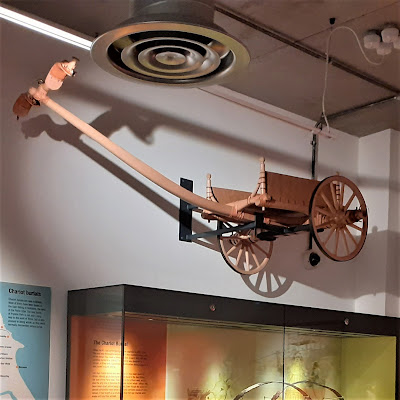
The most important finding from the Ferrybridge Henge is the incredible chariot burial from Ferry Fryston. Chariot burials are very rare, and this one was even more unusual because the chariot was buried whole alongside the rider.

The remains of an Iron Age chariot, displayed - 2 iron tires, 4 nave hoops, 2 linch pins and 2 horse bits
The Ferry Fryston chariot burial at Castleford Museum

Normally, chariots were taken to pieces before burial. To bury it whole meant digging a very large hole for it! 

This chariot is also unusual in that it couldn’t have actually been used for moving around. The wheels are different sizes and some of the bronze fittings were just for show - they are hollow and not nearly strong enough. 

However, it still taught us a lot about how chariots were made and how they worked.

A modern-day reconstruction of the chariot, with two large wheels connected to a square sided seat, and a long bar reaching out to be connected to two horses
A representation of what experts think the chariot would have looked like

Studying the bones of the body in the chariot has revealed that they belonged to a 30 to 40-year-old man. He would have been about 1.70 metres or 5 feet 7 inches tall. 

Modern archaeological scientific techniques have revealed even more about the burial. Radiocarbon dating has shown that the chariot was buried about 200BC, and isotope analysis tells us that the man buried in the chariot was not originally from the Castleford area.

You can see the chariot burial in all its glory at Castleford Museum!


Roman Castleford - just under 2,000 years ago

The Ferrybridge Henge area stopped being as important when the Ancient Romans came to Yorkshire.

In 71 AD the Romans built a fortress at York and a road linking it to another fortress at Lincoln. Around the same time, they built a fort at Castleford, where this road crossed the Aire.

The Roman army is known for marching great distances along the roads they built. This was possibly in part because of the hob-nailed sandals the soldiers wore. Examples of these sandals were found during excavations in Castleford. 

Some of the sandals were so well preserved that re-enactors use replicas based on them and call them ‘Castlefords’!

The remains of a leather ancient Roman sandal, remarkably preserved. It has straps going across the foot and around the ankle
The well-preserved remains of an Ancient Roman leather sandal found in Castleford

The Roman way of life was adopted by many people in the areas they conquered. However, the Romans also keenly took on elements of those local cultures, particularly their gods and spirits.

One example is the altar to Brigantia, the goddess of the defeated tribe on display in Wakefield Museum. 

We also have a stone dedicated to the nymphs, local water spirits of the Aire. It features in the Online Exhibition and is on display at Castleford Museum:

Remains of a carved dedication stone to the Nymphs, featuring two female heads
The stone dedicated to the nymphs, on display at Castleford Museum

More on Roman Castleford


We hope you enjoyed this trip back in time through our amazing archaeology!

Ready to carry on the adventure? Click here for Amazing Archaeology (Anglo-Saxons to English Civil Wars)

Tuesday, July 25, 2023

Castleford Community Cases - New Displays at Castleford Museum

Castleford Museum’s latest exhibition honours inspiring local women from the worlds of education, art, politics and sport. 

Four new family-friendly and interactive displays showcase historic pioneers and the stars of the future!

Making their Mark display, with different styles of colourful painted pottery

Making their mark reveals how the influential art teacher Alice Gostick sparked a passion for pottery painting across the country. 

Following her example, talented craftswomen led Castleford’s proud tradition of hand decorating ceramics. 

The display focuses on the intricate work of five painters: Eva Arundel, Mrs England, Vera Ward, Ida Woodward, and Alice herself. 

The women’s beautiful pots are a rainbow of colour and pattern, each signed with their own unique maker’s mark.

A large fabric hand stitched and drawn banner. Large text:Fryston Branch, N. U. M, Can, shall and must! Oppose Pit Butchery.
Fryston Flying Pickets banner, on display in Joining ranks. 

Joining ranks pays tribute to the women who rallied together during the 1984-85 miners’ strike. Discover how they protected communities and often changed their lives in the process.

The display features key objects such as the hard-hitting ‘A-Z of a Miner’s Wife’ poster sold in aid of the Normanton and Altofts Miners’ Support group, which is kindly lent by the National Coal Mining Museum

It sits alongside a banner, handmade for two of Fryston’s flying picketers by their sister, and proudly adorned with Women Against Pit Closures stickers. The banner was donated to the Wakefield Museums & Castles collection in 2018 and is displayed here for the first time.  


Black satin fitted blazer with silver collar and pockets
Meg's fabulous black and silver Lee Bender jacket, on display in Degrees of style

Degrees of style tells the story of a miner’s daughter turned stylish socialite, who reinvented her life. Fashion follower Meg returned to education later in life and swapped glamorous parties for university and a career in design. 

Meg’s story is told by a close friend and the display centres on one of her prized fashion staples, a distinctive black and silver jacket by Lee Bender at Bus Stop, worn on the local 1980s dinner party circuit. 

You can also try on a range of vintage jackets for size!  


Castleford Academy girls rugby league team photo
Castleford Academy girls rugby league team

Raising champions features some of the many girls’ rugby league cups and medals in Castleford Academy’s impressive trophy cabinet. Marvel at the school’s honours board, hear from former students who have made it to the sport’s highest level, and see the current stars in action. 

Former students who have made it to the sport’s highest level share their stories in their own words and explain what rugby league means to them, whilst training footage shows the Academy’s current stars in action. 

Young visitors inspired to follow in their footsteps can find out how to get started in the game, and take their celebration selfie with our museum trophy!

Share your story  

We also want to hear your stories! We are especially keen to hear about any women who were involved in the miners’ strike or worked in the pottery industry. Story sheets are available in the Museum for you to fill in with details of the amazing women in your lives.


The hand-painted coffee set by Alice Gostick and the Fryton Flying Pickets banner both also feature in our 100 Years of Collecting Online Exhibition.

Thursday, June 8, 2023

Albert Wainwright: Pride Month 2023

This Pride Month, we are proud to share a fantastic new addition to our collection!

We have recently acquired a small number of sketchbook pages by Albert Wainwright (1898-1943), an influential artist from Castleford.

A friend and contemporary of Henry Moore, Wainwright produced a large and varied body of work. This included ceramics, theatrical design and book illustrations, as well as watercolours and drawings. 

Although he didn’t reach Moore’s commercial success or recognition during his sadly short lifetime, Wainwright’s reputation has deservedly increased in recent years. 

His work is also significant in its depiction of gay love at a time when homosexuality was still illegal in Britain.

A sketch depicting two seated schoolboys by the riverbank, with further studies of male figures reclining on one another. The seated schoolboys are in colour, wearing navy blue blazers and shorts, and pale green caps and socks.
Sketch by Albert Wainwright, recently acquired by Wakefield Museums & Castles. Features drawings of schoolboys, including a pair where one is tenderly reclining on the other.

Wainwright was born and brought up in Castleford. He attended Castleford Grammar School and was taught by the inspirational artist Alice Gostick

Gostick encouraged Wainwright’s artistic potential and her support helped him to secure a place at the Leeds School of Art in 1914. 

Gostick’s influence on Wainwright’s art continued. He became a regular at her renowned pottery painting classes, hand-painting ceramics in a traditional style known as Castleford ‘Peasant Pottery’. 

In 1927, Wainwright returned to Castleford Grammar School as an art teacher, temporarily taking Gostick’s place after she became ill. 

A tall, thin cylindrical vase, made and hand-painted by Albert Wainwright. The painting style is abstract, with purples, reds, yellows, greens and black swirls painted onto the white base.
Hand-painted vase by Wainwright in the style of Alice Gostick

Base of the same vase, with Wainwright's monogram, a capital A in a circle
Base of the same vase above, marked with Wainwright's monogram.

Gostick also encouraged her pupils to design costume, stage sets and programmes for school productions. 

The experience was invaluable for Wainwright, who went on to work as a theatrical designer. He received over a hundred costume and scenery commissions. 

His intricate watercolour designs spanned a wide range of productions.

Portrait poster for exhibition of Wainwright's work. Reads 'Albert Wainwright, 1898 - 1943. Artist, illustrator, theatre and costume designer of Castleford.' Includes a large illustration by Wainwright of a costume design for  an Ancient Greek female character in art-deco style
Poster for an exhibition of Wainwright's work at Wakefield Art Gallery in the 1980s. It features an example of his costume design.

As well as his commercial work, Wainwright was a prolific draughtsman. 

He filled many sketchbooks with illustrations and watercolours of local landmarks and characters, capturing a snapshot of industrial Castleford in the 1920s and 1930s. 

Sketch by Wainwright of the cemetery at Red Hill. To the right of the main sketch are the words 'Red Hill', 4 tall narrow buildings with billowing chimneys, and 'October 25th' in a stylised circle
Page from the 'Castleford Notebook', 1928 by Albert Wainwright. Sketch of the cemetery on Red Hill.
With thanks to The Hepworth Wakefield.

Sketch by Wainwright of large, busy factories and mining activity at Castleford. The chimneys are billowing black and white fumes. The miners in the foreground are small, almost stick figures
Page from the 'Castleford Notebook', 1928 by Albert Wainwright. Sketch of factories and mines in Castleford.
With thanks to The Hepworth Wakefield.

His personal sketchbooks also include many studies of people, including androgynous figures, young men and depictions of male intimacy. 

Wainwright was gay but homosexuality remained illegal in Britain during his lifetime. It was not decriminalised until 1967, 24 years after his premature death. 

Although Wainwright’s sketchbooks were not originally intended for public view, they are a rare record of gay love in the early 20th century.

We are very pleased to have acquired some examples of these sketchbook pages at auction earlier this year. They are a valuable addition to our collection. In addition to examples of Wainwright’s ceramics, theatre work and industrial sketches already in our collection, these sketches of male intimacy will help us to tell a fuller story of his life and career. 

They reveal a sometimes hidden LGTBQ+ history. 

Sketch of two schoolboys, one reclining on the other, and a third schoolboy looking at his reflection in the water.
Sketch by Albert Wainwright, recently acquired by Wakefield Museums & Castles. Features drawings of schoolboys, including a pair where one is reclining on the other.

Albert Wainwright sadly died from meningitis aged just 45 in 1943. 

He was living in and teaching in Bridlington at the time and had achieved a name for himself within his native Yorkshire. 

Today, his artistic achievement is increasingly recognised and we are proud to celebrate his work in our displays at Castleford Library & Museum.

Click here for more LGBTQ+ stories in our collections

Click here to read more about Alice Gostick

Click here for visitor information at Castleford Museum (opens in new page)