Showing posts with label Wakefield Museum Stores. Show all posts

Thursday, May 29, 2025

Wayne: My Work Placement with Wakefield Museums and Castles

This blog has been written by Wayne who has been volunteering with us at the museum store since 2021. He has also been doing a university course on preventative conservation. Wayne has been looking at how museum objects can be stored, displayed, and generally looked after in ways that protect them from damage.

As part of Wayne’s course, he had to do a student placement where he would put some of what he has learned into practice. He chose to do his student placement with us! Read on to find out what he's been up to.

Wayne concentrating on dusting the rim of a blue felt uniform cap with a paintbrush and small Museum vacuum
Wayne lightly dusting a uniform cap with a paintbrush and the Museum Vac at the Museum Store

My Work Placement with Wakefield Museums and Castles

I'm Wayne. I have just completed my university student placement module with Wakefield Museums and Castles at the museum store. I have also been a volunteer here for a long time now and so it was nice to take on a different role.

During my placement I worked closely with various members of the Museums and Castles Team on different projects. The guidance and generosity of the staff played a crucial role in my development. They helped me expand my knowledge further by putting into practice what I have been learning.

My first project was to look at light levels. I was checking if the light in the museum and the museum cases was too bright for the objects on display. Different types of objects have different reactions to brightness levels. Some of these reactions can cause permanent damage or colour fading to the object. Light levels are checked with a light meter. This measures the brightness of light in lux, or by the amount of light that falls on a surface, which is measured in lumens per square metre.  

Ceiling-height shelves stretching into the distance filled with shallow carboard boxes
Rows of boxes of carefully stored objects in the Museum Store

I started the project by locating light-sensitive objects (objects most likely to fade or become damaged) that are on display in the museums, using the collections database. I then checked how long they had been on display for. Damage caused by light can also be affected by how long an object has been exposed to light.

To prevent light damage from happening, it is important to regularly test, monitor, and set light brightness. We also calculate how long the object can be displayed for before it becomes at risk of light damage. When an object reaches its display time limit, it should be moved to dark storage where it can “get some rest”. 

The next stage of my work was to identify which of the museum objects on display have reached their display limit so that they can be swapped and moved to dark storage.

Food collections

Now this may sound strange to many people that already know food and museum collections don’t go together normally! Food can rot or attract pests like mice and insects. These may then damage other objects as well.

However, there are some food objects in the museum collection. They can tell us a great deal about the past. One such object is a hot cross bun from the Crimean War. This bun is nearly 200 years old. It is said to have survived inside a pocket of a soldier because he forgot it was there “like you do”.

A very old, crusty, shrunken and hard hot cross bun
The hot cross bun that survived the Crimean War!

This brings me to my next project, which I also decided to base the written part of my student placement on. Before I could start the project, I had to locate all the food objects in the museum collection. This was not easy! A lot of the object records on the collections database describe the wrapping, or box, but not always whether the food itself was still in the packaging.

Once I identified the food, I looked at its condition and whether it was in sealed packaging and whether it had dried out or started to rot or fall apart. I then looked at how these food-based objects could be stored and displayed in a way that would prevent or stop any deterioration.

After I started to research this, I soon realised that there was a gap in information in this area. The information I did find included protecting the food from the threat of pests by keeping them in sealed containers. These will keep out even the smallest insect.


A large plastic tub with individually packaged food items including an old carton of tea, with humidity indicator and silica gel packets
A freshly repacked box with food collection objects - not to be mistaken for your lunch...

The food was also placed inside separate plastic bags. This meant that more than one object can be packed in a box, but each object is still sealed and separate. I also placed a humidity strip and silica gel into the boxes. The humidity strip monitors how much moisture is in the box and the silica gel absorbs it.

Once everything was repacked into plastic boxes, I put all of the food objects into the same storage area. This will make it easier to check them, as this will need to done regularly.   

Working with the museum team, we did make the decision to remove some of the food from its packaging and dispose of it. Some of these objects included food that were in open packets, like some crisps from 1981 that really did smell bad!

A brown crisp packet with 'Royal Wedding 1981 - Smiths Crisps - Bovril Flavour' printed on it
Out-of-date commemorative Bovril Flavour crisps, anyone?

There were also some bonbons that had turned brown in colour. We did keep the packaging for the museum collection, however.

A jar containing a dark brown substance with a label that reads 'plums bottled on the first day of the Great War, 1914 - 1918'
A jar of plums 'bottled on the first day of the Great War, 1914-18'

I would like to thank all the staff at the museum store and many others that made my work placement an enjoyable experience.

Friday, July 7, 2023

100 Years and Counting!

Decorative asset and logo for W M and C 100 - 100 Years of Collecting

2023 marks the centenary of the Wakefield Museums & Castles collection. We have been collecting objects and telling stories for 100 years!

We are celebrating our centenary throughout 2023 and into 2024 with new displays, digital content and events. 

We're launching the celebrations with a new Online Exhibition showcasing 100 objects that represent our 100 years of collecting. Click here to explore! 

But first, let's go back to the the very beginning...

10 July 1923 - Our first official objects 

The first ever entry in our accession books (the early handwritten records of all objects entering the collection) was on 10 July 1923. It was for 'One Mahogany Cabinet' containing 'Mosses' and 'Lichens', as well as 'Three Madonna Pictures from Board' 'and 14 cases of Birds'. 

An eclectic selection that paved the way for the 100 years of wonderful and weird objects to come!

Handwritten accession book entry for July 1923. In addition to the objects on July 10, a large oil painting of 'The Village Christening' was accessioned on July 12 and 'four etchings and two watercolours' on July 27.
The first ever entry in our accession books on 10 July 1923

A large, tall mahogany cabinet, with double doors and three large drawers below these
The mahogany cabinet in question, our first ever officially accessioned object

Wakefield's first civic museum and art gallery

The doors of Wakefield’s first civic museum and art gallery opened at Holmfield House in Thornes Park in 1923. 

The first curator, Harold Parkin, had gathered a small but impressive collection for display. It included bullets and cannon balls found at Sandal Castle, Ancient Roman coins, and a night watchman’s Waits badge. There were also donations and loans of furniture, paintings and armour.

More on the first Wakefield Museum

Holmfield House situated in Thornes Park, a pretty but relatively small building surrounded by plants and shrubs
Holmfield House, circa 1940s.

Two women and two young boys, all very smartly dressed, viewing a photography exhibition. Lots of framed photographs are hung together very closely, completely covering the walls. We do things a bit differently today!
Visitors to a photography exhibition at Holmfield House in the 1930s - we do things a bit differently today!

From then - to now

Since then, our collection has grown and grown! We’ve opened new museums and moved between different sites. 

In 1934, Wakefield Corporation opened a dedicated art gallery on Wentworth Terrace. It was open until 2009. Today, the fine art collection is managed and cared for by The Hepworth Wakefield. 

In 1956 Wakefield Museum left Holmfield House for the former Mechanics Institute on Wood Street, where the displays included popular recreated room scenes from history. 

In 2012, we moved to the city’s newest civic building, Wakefield One, where you can find us today!

The exterior of Pontefract Museum, an art nouveau building that used to be a library, built in 1904
The beautiful art nouveau building housing Pontefract Museum

Pontefract and Castleford

In 1974 Wakefield Council began caring for and developing the collections from Pontefract Museum and Castleford Library. 

Pontefract Museum moved to our current home in the former Carnegie Library in 1978. We’re very proud to continue to care for the beautiful art nouveau building. 

In 2013, we opened Castleford Forum Library & Museum, sharing the history of the town’s origins as Roman Lagentium, its proud industrial past and present, as well as changing displays produced with our local communities.


From 1 to over 100,000 objects

We now look after over 112,000 objects that tell the story of our district from the distant past to the present day. We programme exhibitions and displays at Castleford, Pontefract and Wakefield Museums, Pontefract Castle Visitor Centre and our Museum Hubs across the district. 

Any objects that are not currently on display are cared for at our Museum Store, ready for future exhibitions and research. 


Online Exhibition - 100 Years of Collecting


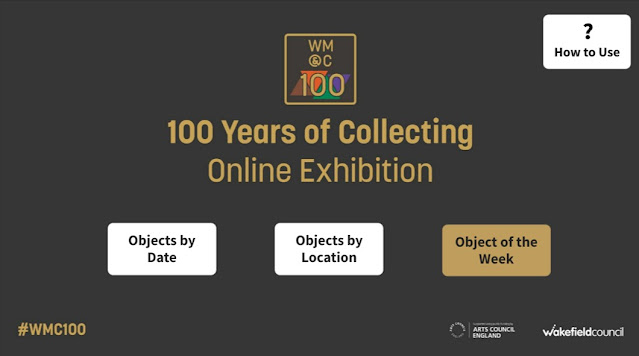
Front page of our 100 Years of Collecting Online Exhibition. Click the image to go to the exhibition page.

Check back on our blog over the coming weeks and months for more about our centenary, and object highlights compiled by our team and volunteers! 

You can also follow the project on social media with the hashtag #WMC100.

Monday, September 27, 2021

Cleaning up history

We're very lucky to have lots of brilliant volunteers help us with our projects. In this special post, Kylie tells us about her recent experience as a conservation volunteer and explores one object she found especially interesting during her time with us.


This summer preparations began for the Wakefield Museums & Castles partial store move, which meant dusting and packing objects that are not currently on display at any of the museum locations. Together as volunteers, under supervision, we were able to help review shelves of objects so that their documentation would be up to date and their condition for moving would be improved.

Objects kept at the store will typically have significance to Wakefield and the surrounding area. There were many interesting objects for us to clean. For example, typewriters could have dust settle under the keys whilst on open shelves. Using brushes, microfibre cloths, smoke sponges, or museum vacuums, they were returned to a clean state. These dry-cleaning methods will not always cause drastic changes in appearance, but it is still satisfying to know objects are cleaner and protected from damage by dust.

Old typewriters on the shelves in the Museum Store
Some of the typewriters before we dry cleaned and repacked them.

An object of particular interest was a black case of entomology equipment, used to study insects. The donor information named Walter Fletcher as the former owner, which is corroborated by the ‘WF’ scratched into a magnifying lens in the kit. Unfortunately, not much else is recorded about him, but it is clear he had a passion for entomology and took time to curate the required supplies over a long period of time. 

Walter Fletcher's entomology kit, a black wooden case, around the size of a laptop
Walter Fletcher's entomology kit

Inside there were 44 small empty boxes, some made of metal but most were paper. The majority also had labels for tablets from chemists. The size of these must have been perfect for storing insects. Discerning the exact date of the supplies and owner is difficult, but the labels of the various pill boxes  inside the case suggest it is from 1935-1968 due to the company name, Timothy Whites & Taylors. There are no objects made of plastic in the box, which may suggest earlier than the 1960s.  

The repurposed pill boxes are small circular boxes, made out of cardboard. They are originally from Timothy Whites & Taylors Dispensing Chemists, from 66 Kirkgate, Wakefield.
Pill boxes from local chemists seem to have been repurposed to store insect specimens.

There were also wooden blocks with string wound around them that would have been used to hold insects in place while drying them. There were metal tools, scalpel blades and packages of pins to assist in this process. A large net that could be dissembled was also able to fit in one compartment of the case. Everything needed for this hobby or passion to be fulfilled.

There was care to detail in so much of what Fletcher kept. He had nine glass slides with different insects, each carefully labelled.


Some of Fletcher's insect specimens in handmade specimen cards. These are all small types of fly.

In conserving this case, all objects were removed and the interior cleaned by brushes and a museum vacuum. Some objects required wrapping in acid free tissue, which will help stop any reactions between materials. This included the metal boxes because they react to relative humidity more than other organic materials like paper. Objects that were loose, like two large feathers, were also wrapped in tissue. Other objects were put into zip sealed plastic bags. This included loose pins and other sharp hazards. The goal is that all the different parts of the kit would stay together if the case was moved and it would be unlikely for damage to occur.

There are many more interesting objects to be found in the store. Dry cleaning and improving packaging for storage is helpful so that the objects will remain conserved for study or display in the future.


Special thanks to Kylie and all our conservation volunteers for their help preparing objects for the move. To keep up to date with this project and see what other treasures we discover, follow us on social media. Look out for updates on the hashtag #WFWhatsInStore.


Thursday, September 9, 2021

Collections on the Move

At Wakefield Museums & Castles, we hold over 110,000 objects, which tell the story of our district from prehistory to modern day. As with most museums, we only have space to display a small proportion of these objects in our museums – the rest are carefully looked after in our museum store. You can go behind the scenes at the museum store here.

A photo of several of the Museum Store tall shelves full of interesting objects
Racking in the store, with furniture and larger social history objects

In the autumn and winter of 2021, we will carry out a partial move of our stored collections. We need to move around half of our collections to a new building. Thankfully, this new building is on the same site as our existing store, so we don’t have far to move. However, it’s vital that we protect our objects during the move, so that nothing gets damaged.

Shelves full of boxed objects
Racking in the store, with boxed objects

To protect our objects, we are currently re-packing them, using conservation-grade materials such as acid-free tissue paper. This involves making lots of tissue puffs and tissue sausages, which we can use to pad out the box, making sure that the objects don’t move around when the box is lifted or carried. This also prevents the objects from touching or rubbing against one another, which can cause damage.

A repacked box with two glass objects inside, wrapped in acid-free tissue
A re-packed box, containing glass bottles

Larger objects need to be wrapped in acid-free tissue paper and bubble wrap, or secured in crates for moving. We’re also taking the opportunity to give everything a good clean. Conservation students Kylie and Zoe, from Lincoln University, have been helping us to clean our objects, using conservation cleaning methods.

All of this work takes a lot of time and effort. Our Collections team are working on this project almost full-time and we also have five amazing volunteers who are supporting us. 

It is our responsibility to care for our collections so that generations of people can enjoy, learn from, and be inspired by their heritage. Please bear with us while we work on this important project and stay tuned for more updates.  

Tuesday, July 20, 2021

Volunteer with us!

Our volunteers are vital in supporting our work. We have a range of exciting opportunities for you to get involved, both with the public and behind the scenes.

All our opportunities have flexible commitment requirements and aim to provide a rewarding and enriching experience.

If you're passionate about culture and heritage and have some free time to offer, why not volunteer with us and be part of something extraordinary? Take a look at our current opportunities:


Collections Move Volunteer

We are looking for volunteers to
assist us with a large-scale project to move our collections into a new storage facility. 

The project will involve helping our team to carefully pack objects, move them to the new extension, and keep accurate records of movement, ensuring that all objects remain safe at all times. 

This is an exciting opportunity to work within a friendly and supportive team on a major project, getting hands-on with a variety of objects and contributing to the important behind-the-scenes work of our museum service.

This opportunity is based at our museum store in Ossett. The museum store is a COVID-secure site. 

For more information about this opportunity, please email Leah Mellors, Collections & Exhibitions Manager, on lmellors@wakefield.gov.uk.  


Exhibition Invigilation Volunteer

We are looking for Exhibition Invigilation Volunteers to invigilate ‘Bracing Air, Abundant Amusements: The Travel Posters of Charles Pears’, our new exhibition at Pontefract Museum. 

You will welcome visitors to the exhibition space, provide information about the objects on display, and help our Visitor Experience Assistants to monitor the security of the exhibition, which includes a number of loaned objects from national museums. You will help us to ensure that every visitor to the exhibition feels welcome, learns something new, and has an enjoyable visit.

This opportunity is based at Pontefract Museum, 5 Salter Row, Pontefract, WF8 1BA. Pontefract Museum is a COVID-secure site. 

For more information about this opportunity, please email Leah Mellors, Collections & Exhibitions Manager, on lmellors@wakefield.gov.uk.  

Charles Pears exhibition, with thank to the Royal Society of Marine Artists


Thursday, September 10, 2020

Heritage Open Days: Behind the scenes at the museum store

The Wakefield Museums & Castles collection contains more than 111,000 objects that tell the story of our district from the distant past to the present day. Today, we can only display a small proportion of the collection at any one time. But even if they're not on show, all the objects are kept safe for future use. To celebrate Heritage Open Days 2020, we thought we'd give you a sneak peek behind the scenes at the museum store, sharing some highlights of the collection and how we care for them.


A century of collecting


Our collection has been in development for over a century and continues to grow today. The first museum in Pontefract was established by volunteers at Pontefract Castle in the 19th century. In Wakefield, Holmfield House in Clarence Park opened its doors as the city's first museum and art gallery in 1923. And by the 1930s, objects were also being collected in Castleford, originally by the local library. 

An advertisement for Pontefract's first museum in 1892
Pontefract's first museum opened at the castle on 29th April 1892 with 256 objects.

Younger and older visitors exploring a jam-packed exhibition of paintings and framed illustrations on the walls
Visitors enjoying an exhibition at Holmfield House, 1930s


In 2020, our social history and archaeology collections are a treasure trove of fascinating stories that form the basis of our main museum galleries, our special exhibitions, and many displays in our communities across the district. We regularly update our displays to showcase as many different objects as possible. Those that are not currently on display are looked after at the museum store.

From the very small...

A small wooden pig-shaped Stanhope viewer
This tiny pig shaped Stanhope viewer contains six early 20th century images of Castleford and measures just 16 x 21 x 10mm!

Demonstration of viewing the images in the pig Stanhope viewer


... to the very large! 

A bright red old fire engine inside the Museum Store
Dennis Big Four fire engine

The Dennis Fire Engine being used by the City of Wakefield fire brigade. The firefighters are in full protective equipment of the time, including gas masks.
The engine was used by the City of Wakefield fire bridge, 1935-1954, before being acquired by the museum in 1968.

And the very old...

An Ancient Egyptian clay mould in the shape of an eye
Ancient Egyptian clay mould for jewellery manufacture, c. 1200-1400 BC


... to the very new.
Child's bowl and cup set decorated with cartoon of Peppa Pig
Child's Peppa Pig bowl and cup set, 2018


All shapes and sizes


In the collections store, we organise objects according to a variety of criteria, including size, shape, material or theme. This makes the best use of our space, allows us to meet the varied conservation needs of different kinds of objects, and helps us to find things more easily. Our objects are packed using inert materials that won't cause their condition to deteriorate and will help protect them from dust and dirt, changes to the environment, or damage by movement and vibration.

Here's a whistle stop tour!

Rows and rows of boxed objects on shelves at the store
These archive boxes contain our photographic and ephemera (paper based) collections, organised by theme.

An open ephemera box showing old theatre programmes
Ephemera is kept flat in conservation grade polyester sleeves and supported by acid free cardboard.

Several old typewriters on shelves at the store
A selection of typewriters in one of our small social history aisles

Larger boxed objects on shelves at the store
Most small social history objects are wrapped in acid free tissue and boxed.

Plastic draws full of various objects in the plastics collection
These drawers contain some of our large plastics collection. Plastic requires specialised care and, unlike other objects, these need air circulation and so are not stored in sealed boxes. We store plastics according to their type (e.g. PVC) and they are supported on inert Plastazote. 


A series of old tennis rackets mounted on wire mesh
Storing suitable objects on wall mounted wire mesh allows us to save shelf space for bulkier items.

A series of walking sticks and canes mounted on wire mesh
More than you can shake a walking stick at


A series of large old tools mounted on wire mesh
The right tool for the job

Shelves full of items from our furniture collection at the store
Our large social history racking includes our furniture collection.

Shelves full of boxes at the store

Shelves full of archaeology collection boxes
Our archaeology aisles contain many thousands of finds from local excavations.

Shelves full of large archaeology and stonework pieces
Larger archaeology such as stonework is kept on wooden pallets on stronger shelving, which can support heavy objects. 

A case full of various-sized cannon balls
Like these cannon balls!


Hive of activity


As well as our weird and wonderful objects, there's often a few members of the collections team to be found at the store - our natural habitat! This is where we add new objects to the collection and prepare for exhibitions, amongst many other tasks.

Every object is given a unique identification number on our collections database. After a new acquisition has been accepted into the collection, we create a record that tells us what it is and what it looks like, how and when we acquired it, and what's special or interesting about it. During the object's lifetime in the collection, its record is updated to document when it is exhibited or used, any change in its condition or any conservation work, or if we find out any new information about it. 

Once we have catalogued the object, it will be marked with its unique number. We use materials that won't damage the object and write the label somewhere where we can find it but that won't be visible on display. All labelling is semi-permanent - we don't want the number to come off so that we can't match it to its record but we also don't want to permanently change the object's appearance.

Cataloguing kit, including the SHIC guide (social history & industrial classification), purple latex free gloves, a zip lock bag, pencil, and computer
Cataloguing kit


After labelling, the object goes for photography. Good images help us to identify objects in future and keep a track of their condition. It also means that we can share our collections online - whether in our searchable databases, on our social media, or here on this blog!

An object set up ready to be photographed
A new acquisition ready for its close up!


Finally, the object is carefully packed and put away, making sure to record the location on its catalogue record so that we can find it in future, for example if we want to include it in an exhibition.

When we're choosing objects for exhibitions, we need to check their condition to make sure that it won't cause them any damage. Sometimes, we need to send items for conservation before we can display them. 

We often use the space at store to practise our exhibition layouts and test what will fit in our cases and which arrangements look best. 

An array of Sykes and Slazenger objects

An array of diaries and handwritten notes


We hope you've enjoyed this special Heritage Open Days glimpse into our store. For more behind the scenes content and collections stories, stay tuned to the blog and our social media. 

And if this has whet your appetite, you'll find some of our collections available to browse online.


Visit our Heritage Open Days: Hidden Histories of Wakefield Museums & Castles page for more from our weird and wonderful collections and sites.

Monday, November 25, 2019

Much Ado About Nothing?


This is the second blog from our brilliant Volunteer Cataloguing Assistants. Angie has recently finished cataloguing a fascinating local theatre collection.

Much Ado About Nothing?

At first glance, what may seem like simple personal memorabilia, upon closer inspection reveals a record of people, pride, respect and a rich engagement with the arts in Castleford and Glass Houghton during the post war years. This is what I have learned from cataloguing a collection of around 40 programmes, tickets and photographs of amateur dramatic and musical performances carefully kept by a Castleford resident and kindly donated to Wakefield Museums & Castles by his daughter.

The productions included works by Gilbert and Sullivan, Noel Coward, J.B. Priestley and G. B. Shaw and were mainly the work of Castleford Dramatic Society, The Old Legiolians Dramatic and Operatic Society and the Castleford Grammar School Dramatic Society, and span the decade 1946-56.

As I’ve worked through the collection, I’ve been struck by the detail and respect in each one; being sure to thank every member of the production and support, giving information about how to get home on the bus, remembering past productions and looking forward to forthcoming shows, providing story lines or potted histories of the productions, all of which gives a lasting impression of a huge pride and enjoyment of being part of a community organisation and a dignity in offering quality information and entertainment for the local area. Even the production of each programme is impressive with front page designs and boxes for hand written row and seat numbers. An intriguing element about the collection is that most programmes have been folded in the same way, making me wonder if the collector always wore the same jacket when he went out and popped the programme in his top pocket to be stored away later.


The programme for Mr Cinders by Normanton and District Amateur Operatic Society in February 1949 is a historic record in itself.

It contains over 60 advertisements from local business mainly centred on High Street, Wakefield Road and Castleford Road in Normanton, including numerous butchers, drapers, florists and grocers. A picture of a pre-supermarket, pre-chain-store and pre-retail park era is conjured up with a bustling town where people bumped into neighbours and friends as they did their daily shop.


Another diversion was provided by the programme for The Lady’s Not For Burning.

With no date or society name or location, I was interested to dig around to try to establish some information. Inside the programme, the name Fothergill Hall was mentioned as the location of the play so after a little internet research I discovered that Ackworth School, founded in 1779 by Dr John Fothergill and local Quakers, had a 400 seater hall built in 1899 and named after their esteemed founder. A connection between the dramatic society and Ackworth seems likely, although not proven. Whilst reading the programme, one name jumped out at me as unusual for the local area, Casto V. Alonso. Spurred on by the discovery of the site of the hall, I googled this name and came across a published memoir written by a former post-war pupil of Ackworth School, Joe Frankl. Mr Frankl remembers a temporary Master of Spanish, Casto V. Alonso, appearing at the school (hardly unimaginable that this is not one and the same person that appears in the programme). Mr Frankl recounts a wonderful story around this teacher who, appearing exotic and being accomplished at almost every endeavour, including beginning a drama club, turned out to have come from London’s East End and not to have escaped the Spanish Civil War, according to popular reputation! After his 25 year sojourn in Ackworth, Mr Alonso’s rich story ends in a headship in Lahore, Pakistan. Aside from his role as a teacher, in the programme he is listed as a cast member, producer and tutor of drama appreciation classes in the local vicinity which seemingly paints him as a local cultural beacon. (Joe Frankl, Under the Castle: Growing Up Between the Swastika and the Cross, p.185-186)

It only begs the question, how many other fascinating personal stories, perhaps wartime, perhaps local mining stories, are woven into this wonderful, unassuming collection of local amateur productions?