Showing posts with label pontefract. Show all posts

Wednesday, July 9, 2025

MHG Volunteer Blog 27: Liquorice

It's the return of Pontefract Liquorice Festival this weekend (Sunday 13 July)! 

So, we're afraid there's no prizes for guessing our Medieval Herb Garden volunteers' Plant of the Week this week...

Well, after the much longed-for heavy downpour at the weekend, the ground was still too wet to walk on today. Any weeding had to be done at the edges of the MHG.

We took some rose cuttings from the front garden. We put out some motherwort, angelica and goat’s rue plants on the sales barrow. Carole also made sure that there are plenty of liquorice plants available for the Liquorice Festival this weekend.

Whilst carrying out the flower count, Carole decided which plants to include in this Saturday’s free talk (1pm – 3pm). The plant list is always changing, so it’s never exactly the same talk twice.

Plant of the Week: Liquorice (Glycyrrhiza glabra)

Liquorice is more than 30 times sweeter than sugar! It derives its name from the Greek words 'glycys' (sweet) and 'rhiza' (root). This Greek term was Latinized as 'liquiritia', from which came the Anglo-French 'lycorys'. 'Glabra' means smooth (relating to the seed pod). It was sometimes known as sweetwood.

Liquorice is native to West Asia, North Africa and Southern Europe. It is a bushy, deciduous, herbaceous, leguminous, perennial. It will not grow well on clay. It prefers rich, fine soil, where there is a lot of moisture during the growing period.

A tall thin green stem with purple flowers on thinner stems sprouting out of it
Liquorice in flower growing in the Medieval Herb Garden

It prefers full sun, facing South or West, where the ground bakes hard. Normally, liquorice doesn't show any growth until late May. It then grows to a height of 4ft with a width of 3ft. Liquorice has pinnate leaves about 7-15cm long, formed of 9-17 opposite pairs of leaflets.

The roots are deep, soft, flexible, fibrous and stoloniferous. Stoloniferous means the roots grow stolons. Stolons are creeping horizontal plant runners that take root at points along its length to form new plants. Liquorice runners can grow up to 20ft in length! It is a mix of the root and runners which are harvested as “liquorice root”.

Liquorice flowers in June to July. It has purple to pale whitish-blue pea-like flowers. The flowers are 8-12mm long produced in a loose inflorescence (cluster). The fruit is a pea-like, oblong pod, 20-30mm long, containing several seeds. New plants can be raised from either seed or root cuttings. 

There are various types of liquorice grown around the world. Glycyrrhiza glabra is the type that was (and still is) grown at Pontefract Castle. This type is considered to have a more delicate flavour than the types later imported into Britain.

Culinary uses of liquorice

Before the 1200s, liquorice was most commonly brewed into a stout beer. At the time of the Renaissance (starting around the 1400s), it began to be added to sweets. Liquorice was also used as a flavouring for bread and other baked goods.

Liquorice has also been used to flavour tobacco, ice-cream and medicines. It is marketed as a dietary supplement. In some parts of the Arabic world, the root of the liquorice plant is used to make a cold drink with a sweet and mildly bitter taste. This is called Erk al-sous.

And, of course - liquorice is still today made into the world-famous Pontefract Cakes!

Jars of Pontefract Cakes for sale on a shelf with Pontefract Castle branding
Pontefract Cakes for sale at Pontefract Castle

Liquorice in Pontefract

Camden's 'Britannia' of 1607 noted that liquorice was growing in Worksop and Pontefract. By 1614, Pontefract was producing small, round lozenges that could ease coughs and stomach complaints. These were hand-stamped with a design to show their quality and authenticity.

In Pontefract liquorice was often grown in people’s 'gardens'. On a map of the 1648 Siege of Pontefract, liquorice is marked as being grown in 'garths' either side of Micklegate.

Soon, liquorice was being grown all over the town to supply the liquorice industry. The Castle was planted with liquorice after the English Civil Wars. The dungeon was used to store the root. Beds of liquorice lined Southgate and Micklegate, and there were plantations in the Friarwood Valley. By 1750, there were 47 growers in Pontefract. These met the increasing demand for liquorice.

In 1760, George Dunhill (an apothecary) created the first liquorice confectionery by adding sugar to the liquorice root extract. Dunhill called them Pomfret Cakes. These cakes were stamped with an image of Pontefract Castle. They were also widely known as Yorkshire Pennies.

A shallow rectangular cardboard box with 'Dunhill's original Pontefract Cakes, established 1760' on it, and a green design with illustrations of the black circular sweets
A Dunhill's Pontefract Cakes box in the Wakefield Museums and Castles collection

At the liquorice industry's height there were 13 factories in the town, each with their own 'authenticity stamp'. On the 1933 Town Map there are 7 liquorice factories shown within a radius of a few hundred yards of the Buttercross.

Over time, Pontefract's confectioners began to close, merge with one another, or be acquired by their larger rivals. Today, there are only two manufacturers remaining in the town.

Folklore and other facts about liquorice

Roman soldiers chewed liquorice root as a medicinal stick for its thirst-quenching qualities and benefits for sore throats. Liquorice root has been found in excavations along Hadrian’s Wall.

The first secret ballot in a parliamentary election was held in Pontefract on 15 August 1872. The ballot boxes were sealed using a Pontefract Cakes stamp from Frank Dunhill's factory.

The waste root is now being made into a chemical wood pulp. This is pressed into a board and used to make boxes.

Objects made from Pontefract liquorice have appeared many times in films. In the 1979 Bond film 'Moonraker', Jaws is seen biting through a thick electric cable. This was a prop made out of liquorice from Pontefract!

In 1899, Bassett’s salesman Charlie Thompson visited a wholesaler in Leicester with his samples case of liquorice and cream paste specialities. The wholesaler initially refused each item offered. However, the items were accidentally spilled and got jumbled together. The wholesaler liked what he saw and placed an order for a ‘mixed’ delivery. Bassett agreed to this order. He asked Charlie Thompson to give the new assortment a name. Thompson called them 'Liquorice Allsorts'.

Medieval uses*

The earliest documented medicinal use of liquorice can be traced back to ancient Assyrian, Egyptian, Chinese and Indian cultures. Ancient Greek sources provide the first use of liquorice as a drug in Europe.

Liquorice is anti-inflammatory. It was used for asthma, diseases affecting the voice, mouth ulcerations, dry cough and hoarseness, wheezing and shortness of breath and for pains in the chest and lungs.

It was also used for the burning sensation of the stomach, diseases of the liver, bladder and kidney pain, kidney stones, artery diseases, heart palpitations, angina, skin lesions, ulcers, thirst, fever, neuralgia, hair loss, and menopausal symptoms. Liquorice was also used to make a tea which could mask the taste of other bitter medicines.

Liquorice is considered safe as a food ingredient - in moderation. Excessive consumption of liquorice can lead to lowered potassium levels in the blood, increased blood pressure, and to kidney and heart failure.

So, maybe don't devour all your Liquorice Festival goodies at once!

*As always, this isn't to be considered medical advice today. Please don't use any plants mentioned in these blogs as medicine without advice from a doctor.

Browse more weekly blogs from the Medieval Herb Garden

Wednesday, May 7, 2025

Pontefract's civic fundraising in the Second World War - VE Day 80

The Second World War was incredibly expensive, both in terms of human lives and monetary cost. People across Britain and the Empire dug deep to help out. 

Read on to discover the fantastic contributions of the people of Pontefract, in this special blog for VE Day 80.

Civic fundraising

2025 is the 80th anniversary of the end of the Second World War. The war in Europe ended on 8 May 1945, VE Day. In Asia it ended on 15 August 1945, VJ Day.

This was the largest war in history. The human tragedy was terrible. Around 80 million people died.

It was also expensive. By 1945 52% of the British economy was devoted to the war. Today’s equivalent is 2.5%.

This huge cost had to be paid. Ordinary people were one source of money. At the start of the war people across Britain and the Empire gave generously to campaigns like the Spitfire Fund. Jamaica gave so much an RAF squadron was named for it, and it was one Pontefract was later linked to.

A poster featuring an illustration of a determined looking soldier and the words 'he's got 'em on the run, keep 'em running with more savings'
A civic fundraising poster from the Second World War

The war cost over £100 million every week. The government needed a continuous supply of money. Compulsory methods, like higher taxes or forced saving, were considered. They were discounted as they could have damaged morale.

Instead, in 1941, the government introduced National Savings. Rather than giving their money, people lent it. They bought small bonds that would be repaid (with interest) after the war.

Local areas organised savings campaigns. Communities had targets and competed to save the most. Individuals and businesses bought bonds. Saving like this rather than spending money also kept inflation low, which was another government goal.

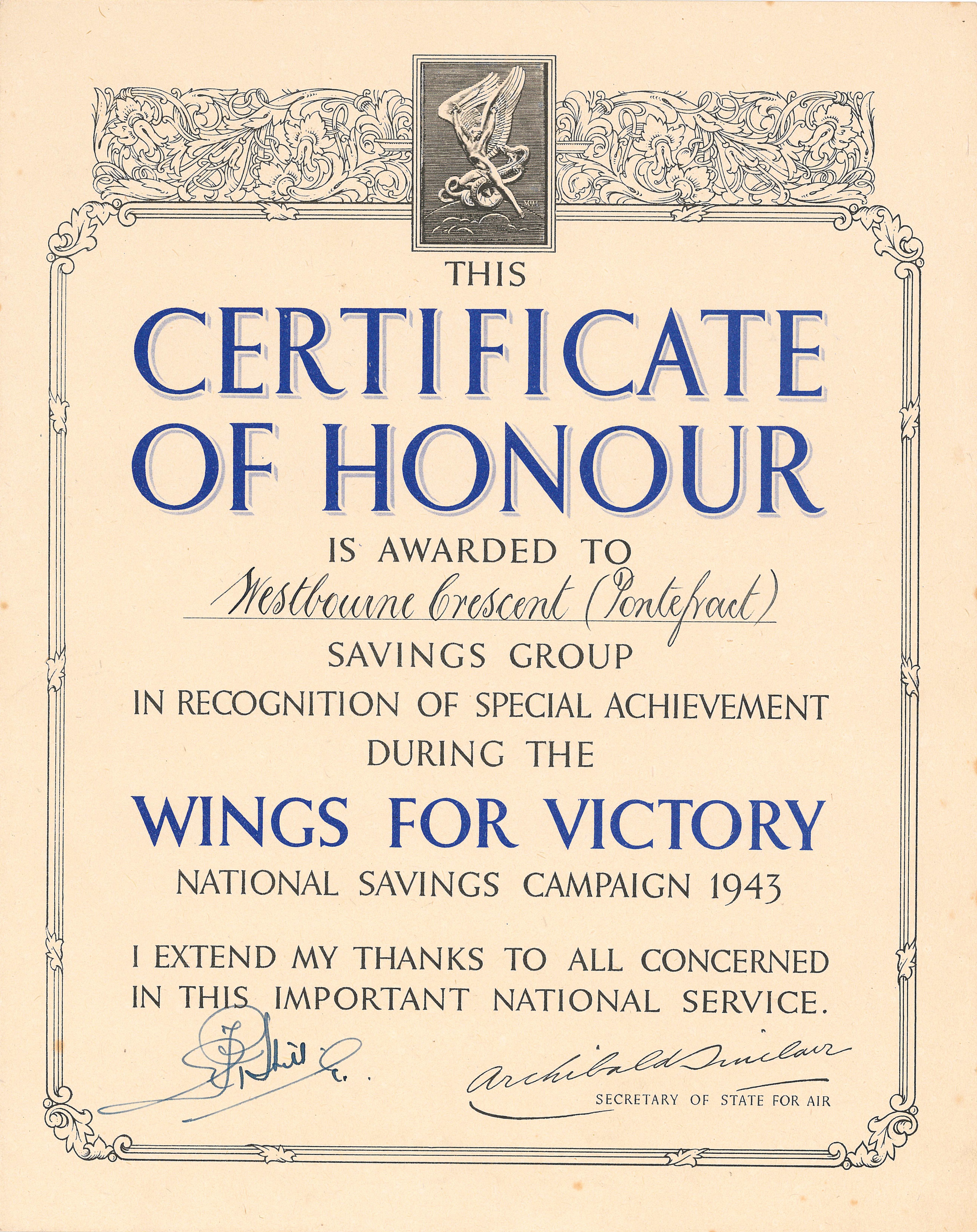
A certificate reading 'This certificate of honour is awarded to Westbourne Crescent (Pontefract) savings group in recognition of special achievement during the Wings for Victory National Savings Campaign 1943. I extend my thanks to all concerned in this important national service.' It is signed by Archibald Sinclair
A Certificate of Honour awarded to Westbourne Crescent in Pontefract, in recognition of their fundraising efforts. It is signed by Archibald Sinclair, Secretary of State for Air.

Fundraising each year focussed on a ‘War Week’. Towns concentrated their efforts on a national theme. These included ‘Wings for Victory’ or ‘Warship Week’. Targets were linked to specific aims. This made the saving more real and meant people felt more involved.

Places that met their targets were given commemorative plaques to celebrate their achievements. Smaller groups could also be recognised with certificates.

Pontefract's fundraising weeks

Pontefract’s 4 ‘special weeks’ raised over £1 million.

10-17 January 1941 – ‘War Weapons’

Target £300,000. 

Raised £409,338.

14-21 February 1942 – ‘Warship Week’

Target £200,000, to adopt HMS Unique (a submarine). 

Raised £217,976.

5-12 June 1943 – ‘Wings for Victory’

Target £160,000, for 8 Mosquito bombers. 

Raised £205,263, enough for 10 bombers.

8-15 July 1944 – ‘Salute the Soldier’

Target £167,373, to equip 1 infantry and 1 parachute battalion.

Raised £206,600.

A poster featuring a futurist-style illustration of a soldier, and the words 'Pontefract, July 8 - 15, 1944. Target: £167,373 (to make £1,000,000). Salute the soldier with a salvo of savings'
A poster for Pontefract's 'Salute the Soldier' civic fundraising week

Warship Week

Part of a programme with an illustration of a submarine and the words 'official programme, Pontefract's Warship Week, February 14 to 21, 1942'
Part of the official programme for Pontefract's Warship Week, 1942

The fundraising focus for 1942 was the Navy. Pontefract’s Warship Week was held 14 - 21 February. Pontefract’s target was £200,000. The total raised was £217,976.

Pontefract adopted HMS Unique, a serving submarine. Seven members of the crew came to visit. They went to the races, saw Pontefract Castle, had tea with the fundraising committee, and went to a civic reception with the mayor.

HMS Unique had been in service since September 1940. She spent most of her time patrolling in the Mediterranean, sinking Italian merchant ships.

On 7 October 1942 she left Holy Loch for her 22nd wartime patrol. She was to search the Bay of Biscay for German blockade-runners, in particular the minesweeper Belgrano. The patrol was due to end in Gibraltar on 23 October.

HMS Unique in harbour, image from the Submariners Association

By 24 October she was overdue and reported missing. At the time it was unclear what had happened. Recent research suggests that on 13 October she attacked a damaged German tanker, the Spichern, heading for the French port of St Nazaire. The tanker reported seeing torpedo tracks. Both the Spichern and another British submarine, HMS Ursula, reported hearing explosions.

It seems most likely that one of HMS Unique’s torpedoes was faulty and exploded too soon. This damaged the submarine so badly that it sank, killing all 34 crew.

Pontefract later adopted another submarine, HMS Upstart. This survived the war and was passed to the Greek navy in August 1945.

HMS Unique - names and ages of the crew killed 13 October 1945

Wings for Victory

Part of the official programme with a photo of a mosquito bomber, and the words 'Pontefract Wings for Victory Week, June 5 to 12 1943, target: £160,000 for 8 Mosquito Bombers'
Part of the official programme for Pontefract's 'Wings for Victory' civic fundraising week

The fundraising focus in 1943 was the Air Force. Pontefract held a Wings for Victory week 5-12 June. The target was £160,000, but the total raised was £205,263. 

The goal had been for people in Pontefract to save enough to pay for 8 Mosquito Bomber aeroplanes. They raised enough for 10.

Page from a log book which reads 'this log book which will record the operational activities of an Aircraft is a tribute to the success acheived by Pontefract Savings Committee in the Wings for Victory National Savings Campaign, 1943'. Then handwritten is 'target: £160,000, achievement: £205,263. Representing the cost of 10 Mosquito (two-engined bombers)'
Page from the Wings for Victory Savings Committee log book

The new Mosquitoes were sent to 139 (Jamaica) Squadron to equip them as Pathfinders. The squadron was named in recognition of the remarkably generous donations from Jamaica in 1940.

Pathfinders used radio beams to find targets. They could either drop bombs far more accurately than normal bombers, or coloured flares. These flares meant ordinary, less accurate bombers could find also targets, even at night.

A dozen Mosquito Bomber aeroplanes on the ground in a row, surrounded by RAF pilots getting kitted up
Mosquitos of 139 Squadron at an RAF base

New foyer display at Pontefract Museum

We're paying tribute to the incredible fundraising efforts of the people of Pontefract in a new foyer display at Pontefract Museum. It has been specially installed in time for VE Day 80. The display will be here until September 2025.

A display case containing fundraising posters, plaques and a certificate of honour from the Pontefract civic fundraising effort
The display case at Pontefract Museum

Pontefract Museum is open Monday to Friday, 10am to 4:30pm and Saturdays, 10:30am to 4:30pm. It is free entry.

Tuesday, January 7, 2025

MHG Volunteer Blog: week one - snow

Welcome to the first of our new weekly Medieval Herb Garden (MHG) volunteer blogs! Our dedicated team of volunteer gardeners meet regularly on Mondays at Pontefract Castle.

Find out more about their new blog series here.

However, things aren’t kicking off quite as we inteded thanks to a belated white Christmas…

Week one: 6 January 2025

The Medieval Herb Garden in the snow over the weekend

The snow is still lingering this bright Monday morning. That stops us doing any work in the Medieval Herb Garden today. 

This week we will be doing more research on the plants in the garden instead. 

Fortunately, the snow doesn’t seem to have badly damaged any plants on the MHG. Nine plant varieties are still hanging in there, with flowers poking through the snow. 

Two large orange flowers hanging over the side of a planter, with snow on top
Callendulas (often known as marigolds) in the snow

See how many plant varities you can find on a walk around the castle this week!

Visitor information for Pontefract Castle

More about the Medieval Herb Garden volunteer blog series

Monday, August 12, 2024

Welcoming Pontefract: accessibility at Pontefract Museum

Following on from our blog about how accessibility matters at Wakefield Museum, let's have a look at how we make Pontefract Museum welcoming and accessible for all! 

The exterior of Pontefract Museum, an art nouveau building with arched entranceway, with floral planters either side of the entrance
Pontefract Museum, a beautiful art nouveau building built in the early 1900s

We believe strongly that making our visitor experience more accessible for one group of people makes it more accessible for everybody. 

We are constantly working to improve and enhance the accessibility of all of our sites, and working with local groups and experts by experience to do this.

Read on to explore just some of what we've done to make Pontefract Museum more welcoming and representative for all:

Audio description guides

David in uniform, wearing headphones and a PenFriend device on a lanyard around his neck, and carrying the audio guide booklet. He is smiling at the camera.
Our Visitor Experience Assistant David modelling the PenFriend audio description guide

We now have audio description guides for the main gallery at Pontefract Museum! These are designed with our blind and partially sighted visitors in mind but are free to be used by anybody.

We have built a strong working relationship with our local Sight Loss Council members to inform these and future resources.

The audio descriptions are accessed using one of our PenFriend devices. You tap the coloured stickers in a handheld booklet. The PenFriend then reads aloud the description. They can also be used with headphones.

The audio description guide describes and provides more information about a range of star objects on display. It also guides you around the main gallery space.

Our Visitor Experience Assistant John holding a PenFriend device and going tapping a large yellow square sticker in the audio guide booklet.
Tap the stickers in the booklet, and the PenFriend will describe what's on display

Relaxed openings

Two adults and a teenager reading information panels about liquorice at Pontefract Museum

Every Tuesday from 2pm to 4pm at Pontefract Museum is a relaxed opening session. You can explore the Museum in a quieter, more relaxed setting.

Everybody is welcome! And you are welcome to be your full self.

Any loud noises from videos and interactives are turned down or turned off. Lighting levels are kept low and consistent. This all works to reduce sensory overload and generate a relaxed atmosphere.

There is also a pop-up tent quiet space for anyone who needs it. 

We don't book groups during this session to help keep the museum quieter.

Pick and Mix station

Two children and an adult exploring the objects in the Pick and Mix station, which is a green unit with four drawers and two shelves.
A family exploring the Pick and Mix station

We have Pick and Mix stations at all three of our museums. They are full of beautiful tactile tools and resources to support our visitors to get the most out of their visit.

The 'Explore' drawer contains a variety of things to explore our displays in lots of different ways. These include tools to match different shapes, colours, materials and sounds to our objects.

The 'Touch' drawer has a range of fun colourful fidget toys. Perfect if keeping your hands busy helps you to stay calm or to concentrate!

A child grinning and holding a magnifying glass, with her arm around another child wearing ear defenders and holding a squishy fidget toy

The 'See' drawer is full of different lenses, magnifying glasses and frames. These can help you to look at our objects in another way, and support dyslexic and partially sighted people to change the colour contrast.

The 'Sound' drawer has a number of ear defenders available in child and adult sizes. These are great for visitors who are sensitive to loud or sudden noises. 

You can also fill up one of our backpacks with a range of items for easy carrying around the galleries!

Makaton signage

The Makaton sign for 'market stall' next to our play market stall, stocked with lots of fake fruit and veg

Makaton is a unique language programme that uses symbols, signs and speech to enable people to communicate.

We have Makaton signage next to star objects and interactives around the museum, showing you how to sign that word. 

Most of our Visitor Experience Assistance have had Makaton Awareness training, and we are busy arranging training sessions for our lovely new starters!

Sensory maps and visual stories

The sensory map for the Ladies who Launch exhibition, showing where different sensory elements are around the space

We have lots of opportunities to use your senses around the museum. We also know it helps some visitors to know what to expect, and where to expect it, to avoid sensory overload.

Our sensory maps are available to view online before your visit, and to carry with you around the galleries once you're here. 

Tactile objects in the main gallery and our temporary exhibition, Ladies Who Launch, help you to get hands-on with history by touching real-life historical objects. 

There’s also lots of dressing-up to do and our squidgy, colourful Liquorice Allsorts soft play in the main gallery!

Our smell cubes in the Ladies Who Launch exhibition contain smells that bring the past to life, like leather, a flower shop, and an old 'smithy'!

Two children holding sensory cubes and giving them a good sniff

We also have a visual story for the main gallery available on our Access page to browse before your visit.

Easy Read guide

Easy Read symbols, showing a person smiling, giving a thumbs up and holding a booklet that says 'easy read', and a book with the word 'information' on it
Image copyright of Leeds and York Partnership NHS Foundation Trust

We now have an Easy Read guide for the main gallery at Pontefract Museum

Easy read information is presented in a certain way to help people understand information more easily. Photos and illustrations help to explain the information provided.

It is especially useful for learning disabled people and people with low reading ages. It is also helpful for people for whom English is a second language. It can be used by anyone who wants bite-sized information about the museum's main themes.

Telling everyone's stories

We tell a wide range of local people's stories and experiences in our museum and exhibition programme. We are always looking to use our platform to showcase the stories that are sometimes missing from 'traditional' museum and gallery spaces. 

We have worked closely with local people to help them tell their own stories through different mediums.

Here's a snapshot of two recent co-produced exhibitions: 

Fern Woodhead: Boxed In (From Whence You Came)

Fern stood next to their finished exhibition, which contains their artwork, chest binder, Grayson's Art Club exhibition catalogue and their crocheted Lesbian Pride flag
Fern with their finished exhibition at Pontefract Museum

In 2022 Pontefract teen Fern Woodhead featured on the Channel 4 TV show 'Grayson’s Art Club', presented by Grayson Perry. Fern submitted an artwork to the show in response to the theme ‘Inside my head.’

Wakefield Museums & Castles commissioned Fern to produce a new piece about their gender identity for display at Pontefract Museum.

'Boxed In (From Whence You Came)' explores Fern’s feelings about “being a queer person in an inherently non-queer society”. We worked with Fern to install their artwork in the foyer space at Pontefract Museum, and they have also kindly lent some objects from their gender identity journey for the display. 

Fern hopes that the exhibition will raise awareness and start conversations around sexuality and gender identity. As Fern says, "all of us have an identity, so why shouldn’t we talk about it?"


Fern’s artwork will be on display in the museum until November 2024. We're delighted to have acquired the artwork for our permanent collection.


Ladies who Launch: Celebrating Pontefract's Women in Business

An adult holding part of the hi-ves Yonder Events vest their child is wearing, to make the logo stand out
Kitting out the potential events organisers of the future in Ladies who Launch

Our current temporary exhibition at Pontefract Museum is a celebration of Pontefract’s businesswomen. 

We worked with four sets of local female entrepreneurs to share their stories of launching and running successful businesses in our area. 

The exhibition challenges some of our preconceptions about business owners, both in the Victorian period and today. 

Read more about Ladies who Launch: Celebrating Pontefract's Women in Business

Access information for Pontefract Museum

We always welcome feedback on how we can make our sites more accessible! You can drop us an email at museumslearning@wakefield.gov.uk


We look forward to seeing you soon!

Friday, June 7, 2024

Robert Waterton of Pontefract Castle

You’ve probably heard of Charles Waterton of Walton Hall. But have you heard of Pontefract Castle’s 14th century Robert Waterton?

Charles Waterton

Most people in the district will associate the name Waterton with Charles Waterton of Walton Hall.  Waterton was a naturalist, plantation manager and explorer. 

He’s best known for his conservation work, building the world’s first nature reserve at Walton Hall in the 1820s. This was the subject of our A World of Good exhibition in 2021 - 2022.

Painting of Charles Waterton, dressed in a navy blue velvet jacket, cream/gold waistcoat and white ruffled shirt with a navy cravat. He is a white man with short dark brown hair, and has a serious expression on his face. He has a taxidermied red bird resting on his finger, and the head of a taxidermied cat sat atop a book
Charles Waterton painted by Charles Willson Peale in 1824. On display at the National Portrait Gallery.

But there were many more Watertons before Charles. The Watertons can trace back their ancestry for hundreds of years in the Wakefield area. 

Introducing: Robert Waterton, one of Charles Waterton's historically important ancestors.

Robert Waterton (1360 - 1425)

Robert Waterton was appointed to the post of Master Forester of Pontefract Castle in 1391.  He also served in the household of Henry Bolingbroke. 

In 1391 Pontefract Castle was a Lancastrian castle owned by John of Gaunt, Henry Bolingbroke’s father. Upon John’s death and the confiscation of the castle by Richard II, Robert Waterton remained loyal to Bolingbroke. 

He became Constable and Steward of Pontefract Castle. Waterton was later also appointed Master of the King’s Horses in 1399 when Bolingbroke returned from his banishment. Henry Bolingbroke became King Henry IV and took back all the possessions Richard II had confiscated from him.


Henry the fourth as a middle aged man, with curly brown hair and beard, wearing a crown, blue robe and holding a sword
Illuminated initial letter showing Henry IV from the records of the Duchy of Lancaster (Wikimedia Commons)

The new king needed to be sure that Richard II was kept safe and securely out of the way. 

Where better to send him, then, than to Pontefract Castle and his long-term supporter Robert Waterton?

Whilst staunchly loyal to Henry, Waterton was no fool. He gave up his own lodgings at the castle to accommodate the deposed Richard. He didn’t want to lock him in a dark cell somewhere just in case Richard returned to the throne..!

A gilded, larger-than-life portrait of Richard II, sat on his throne in full royal regalia.
Richard II, probably painted between 1385 and 1390. (Wikimedia Commons)
 

Richard II died at Pontefract Castle on 14 February 1400. Waterton was called to parliament to give evidence attesting to his death. He is also mentioned in William Shakespeare's 'Richard II'.

Later Watertons of Pontefract Castle

In later years, Pontefract Castle was responsible for many other famous prisoners. These included Charles Duc of Orleans.

The Waterton family continued to enjoy royal backing under Henry IV, Henry V and Henry VI. They racked up a prestigious list of titles up until the reign of Henry VIII.

When Henry VIII broke with the Catholic Church in the 1530s, the head of the Waterton family (another Robert) stayed true to his Catholic faith.

Henry VIII was so enraged with Robert. He wrote to him stating: “Waterton, I will take thy estate, but I will save thy life. Henry Rex”. The Watertons lost much of their land and money.

Despite this, the Watertons remained Catholic right through to Charles Waterton. Charles was widely known as a keen supporter of the Catholic faith. 

Want to discover more about the history of Pontefract Castle? View our interactive painting!

Friday, May 10, 2024

100 Years of Collecting - Facebookers' favourite objects

We've loved seeing how much you have enjoyed our 100 Years of Collecting digital content over the past year!

As we bring our centenary celebrations to a close, we asked our Facebook followers to vote on their favourite of the 100 objects in the online exhibition.

Here's a spotlight on the objects you chose to round things up! The 100 Years of Collecting online exhibition will continue to stay live here on our blog.

Please note: one of the objects described in this article refers to the transatlantic slave trade, which uses an outdated historical term.

Madam Connie's wig

A fabulous dark red bobbed and voluminous wig on a bejewelled mannequin head on display against a yellow background
Madam Connie's wig as it was on display in the Moving Stories exhibition

Made in: the 2010s
Collected in: 2019
Associated place: Wakefield

Steven Ogilvie wore this wig as his fabulous drag queen persona, Madam Connie, at performances in Wakefield.

Steven donated the wig to the museum in 2019 along with other outfits after Madam Connie hung her up stilettos for the last time. Steven also recorded an oral history about his experiences performing as Connie. He says performing increased his confidence and helped him through difficult times.

We loved including the wig in our recent Moving Stories exhibition! It's now taking a well-earned rest back at our Museum Store.

It was Madam Connie's friends and followers that got her wig well and truly voted onto this favourites list!


Sandal Castle ring

A gold ring, delicately engraved with 'tout le vost're' and floral motifs
The Sandal Castle ring, which is on display at Wakefield Museum

Made in: between 1485 and 1600
Collected in: 1983
Associated place: Sandal / Sandal Castle

This beautiful gold ring was found by archaeologists at Sandal Castle during excavations in the 1960s. It is about 500 years old.

It is called a 'love ring' because it has a lovers’ promise on it. 

The wording on this one says ‘tout le vos’tre’, which means ‘I am all yours’ in medieval French (the language of the upper classes in the Middle Ages). 

It's one of our star objects in the permanent Wakefield Stories display at Wakefield Museum. 

It's perhaps unsurprising that such a beautiful and heartfelt object scored so highly with our Facebook followers!

Britain's oldest post box

A small square metal post box, engraved with the year 1809. It would have been fitted into the wall.
Britain's oldest postbox - on display at Wakefield Museum

Made in: 1809
Collected in: 1964
Associated place: Wakefield

Wakefield Museum has some quietly important objects such as this post box, the oldest in Britain! 

It was installed in Wakefield Post Office on Wood Street in 1809 and predates the Victorian Penny Post by 30 years.

Our objects and sites aren't just special because of their history. One Facebook user voted for the post box because "it reminds me of one of my delightful friends I made through the museum"! 

Another said "I'm voting for the post box because they used to be every day street furniture but now... they are little windows into our history."

Ballot Box 

A tall rectangular wooden ballot box with a slot on the top for posting votes. Remains of the liquorice seal on the lid.
One of the ballot boxes used in Britain's first ever secret ballot in 1872 - on display at Pontefract Museum

Made in: 1870s
Collected in: 1978
Associated place: Pontefract

From one groundbreaking box - to another!

On the 15 August 1872, the first ever secret ballot in Britain to elect an MP was held in Pontefract. 

This was the first time that people had voted in secret by placing an ‘X’ on a ballot paper next to the name of their choice. 

Before this, people voted openly and could be easily pressured and bullied. 

The ballot box was sealed with a liquorice stamp made from Frank Dunhill's factory to ensure it wasn't tampered with. There are still remnants of this seal on our box, which you can see on display at Pontefract Museum.

At this time, only men over the age of 21 who owned property could vote. Women couldn't vote until 1928, and the voting age was lowered to 18 only in 1969. 

It's a piece of national political history of which Pomfretians are rightly very proud!

Nymph Stone

Remains of a carved dedication stone to the Nymphs, featuring two female heads
The 'nymph stone' on display at Castleford Museum

Made in: Roman era
Collected in: 1990s
Associated place: Castleford

This carving of two female heads is dedicated ‘to the Nymphs’, nature spirits usually linked to springs and running water. 

Dedications to nymphs are often found near military sites like the Roman fort at Castleford. 

The fort at Castleford was known as 'Lagentium' to the Romans.

One Facebooker said they chose it because "this kind of artefact always benefits from re- examination and interpretation as time passes and knowledge expands".

What a brilliant sentiment about this special object! It's on display at Castleford Museum with lots of other ancient objects worthy of a closer look.

Anti-slavery lecture poster

Printed poster for W Howard Day's anti-slavery lecture. The text on the poster reads:    Slavery.   The Committee of the Wakefield Anti-Slavery Society have pleasure in announcing that W. Howard Day, Esq., M.A., A Coloured Gentleman, of Canada West, will deliver a Lecture in the Music Saloon, on Friday Evening, Dec. 7th, 1860,   Subject: "Slavery in the United States, and the Social & Moral Improvement of the 40,000 Fugitive Slaves in Canada."   The Chair will be taken at half-past Seven o'clock, by The Worshipful The Mayor.  Admission Free.   Posted by William Grace, Junr. Hon. Sec. Printed by Stanfield & Son, Printers and Lithographers, Wakefield.
A poster promoting W. Howard Day's anti-slavery lecture in 1860, on display at Wakefield Museum

Made in: 1860
Collected in: 1923
Associated place: Wakefield

This poster advertises a lecture given by William Howard Day from 'Canada West' in the Music Saloon on Wood Street in Wakefield in December 1860. 

The lecture took place at an important moment in the story of slavery, just a few months before the start of the American Civil War, a conflict based on the continued ownership and abuse of enslaved people by the plantation owners of the Southern States of America.

Several celebrated abolitionists such as Day visited this country and resonated with the working people in the North of England. 

Many towns like Wakefield had an active abolitionist campaign movement and invited speakers to venues such as the Music Saloon on Wood Street and the Corn Exchange on Westgate.

One Facebook user said they were voting for this because it is "an important part of the empathetic community spirit of the Wakefield district". Lovely words indeed.

It's also one of the earliest objects added to our collection, as it was collected in 1923!

Battle of Wakefield iron spearhead

A long pointed iron spearhead, which looks bumpy now due to corrosion before it was excavated
An iron spearhead dating to The Battle of Wakefield in 1460 - on display at Wakefield Museum

Made in: 15th Century
Collected in: 1959
Associated place: Sandal / Sandal Castle

This iron spearhead dates to the time of the Battle of Wakefield in 1460. The Battle was a major clash in the Wars of the Roses. 

Richard, Duke of York, leader of the Yorkist faction and his eldest son, Edmund, Earl of Rutland, were both killed along with hundreds or even thousands of their supporters. 

It is this event that likely lead to the rhyme 'Richard Of York Gave Battle In Vain', to remember the order of colours in a rainbow.

This spear head was found in the Portobello estate, the site of the battle, and was probably used by an infantryman at the battle.


Pontefract Castle Keirincx painting

A large oil painting of Pontefract Castle as it was in about 1640. It shows what a grand site it once was.
Pontefract Castle painted by Alexander Keirincx in the 1640s - on display at Pontefract Museum

Made in: 1640s
Collected in: 1965
Associated place: Pontefract

This is a large oil painting of Pontefract Castle as it was in about 1640. 

It was painted by the Flemish landscape painter Alexander Keirincx, at the request of Charles I. It shows what a grand site it was, and much larger than the standing remains today might suggest.  


Shared with thanks to The Hepworth Wakefield.

Thanks to everyone who voted! You can continue to explore the 100 objects in our online exhibition

Post a comment with what you think we should include in the next 100 objects we collect!