Tuesday, May 20, 2025

MHG Volunteer Blog 20: Sweet Rocket

It's time for the latest blog from our dedicated team of volunteer gardeners at Pontefract Castle.

Find out more about their blog series here.

Today, the Medieval Herb Garden is looking really good! We have over 50 different varieties in flower.  

No weeding today! Caroline and Louis turned over the soil on the dry-stone wall (in case it rains) and then swept the wall and the drainage channel. They then tided-up around the lavender hedge. 

Carole gave the prostrate rosemary one of its regular 'haircuts'. She then topped up the sales barrow with more welsh onions, pink mop-head hydrangeas and houndstongue.

With the help of volunteer Callum, Carole then potted-on some more houndstongue seedlings.

A large, blooming prostrate rosemary bush overhanging a drystone wall
The rosemary halfway through its regular 'haircut'

Plant of the Week - Sweet Rocket (hesperis matronalis)

Hesperis matronalis was given its modern scientific name by Carl Linnaeus in his book Species Plantarum in 1753. The name, Hesperis, means "of the evening", referring to the strong fragrance of the flowers late in the day. 

In the past, this species was known as "Damask violet" in English and "Viola Damascena" in Latin. These both refer to the city of Damascus in Syria. The French name "Violette de Damas" also refers to Damascus.

Damas was possibly mistaken for "dames", giving rise to the common name "dame's violet” and "dame’s rocket".

A large shrub of sweet rocket, with clusters of small, bright purple flowers at the end of thin green stems
Sweet rocket in flower in the Medieval Herb Garden

Originally from Italy, sweet rocket is a biennial, erect, multi-stemmed, herbaceous plant. It will grow in any alkaline to neutral soil, and in any aspect, in full or partial shade. It grows to a height of 3ft and a width of 2ft.

The leaves are alternately arranged on upright stems and are oval-shaped. They have short hairs on the top and bottom surfaces which give the leaves a somewhat rough feel.

The flowers appear in late Spring of the plant's second year. They are various shades of mauve and purple and sometimes white. They are up to 2cm across and have 4 petals.

Sweet rocket later produces 2–4 inch seed pods, similar in shape to pea pods. It will readily self-seed.

Culinary uses of Sweet Rocket

The young leaves are slightly bitter. Despite this, they can be eaten in salads or cooked, if picked before the plant flowers. The leaves are available in the winter months when few other greens are available.

The flower buds are eaten for their spicy flavour and bright colour.

The seeds of the plant can also be sprouted and eaten in salads.

Folklore and other facts about Sweet Rocket

Sweet rocket was a favourite flower of the French Queen, Marie Antoinette.

In the Victorian language of flowers, it stood for deception. It gives out a lovely perfume in the evening, but in the daytime has none.

It is considered an invasive species in some areas. This is especially in the states of Colorado, Massachusetts, New York, Wisconsin and Connecticut, where it is banned. It is illegal to move, sell, purchase, transplant, cultivate, or distribute the plant in these places.

Oil from the seeds is used in making perfume.

In Europe, sweet rocket is host to the caterpillars of several butterfly species. These include the orange tip (anthocharis cardamines), large white (pieris brassicae) and small white (pieris rapae). They also attract moth caterpillars, such as plutella porrectella.

Medieval uses*

Sweet rocket was used to treat wounds. It was an antidote for insect stings and snakebites. Its leaves, which are rich in vitamin C, were used to prevent or cure scurvy. They could also boost urine and sweat production. It was used in enemas for obstructions of the intestines. When used for medicinal purposes, the leaves are best picked when the flowers are blooming.

*As always, this isn't to be considered medical advice today. Please don't use any plants mentioned in these blogs as medicine without advice from a doctor.

Wednesday, May 14, 2025

MHG Volunteer Blog 19: Lily of the valley

It's time for the latest blog from our dedicated team of volunteer gardeners at Pontefract Castle.

Find out more about their blog series here.

Another scorcher today! Whilst Dave and Kaiden watered all the planters on site, Carole introduced the Medieval Herb Garden to two new volunteers, Caroline and Louis. There was the necessary admin and health and safety instructions to cover - some of the plants are poisonous and thorny and the garden is on an uneven slope. Then Caroline and Louis got to grips with deadheading the cowslips and lungwort and some general weeding. Carole tackled the over-abundance of hound’s tongue seedlings that had sprung up around the golden rod and put out the notice board to advertise her free MHG talk on Saturday (1pm-3pm).

Woad growing in the sun at Pontefract Castle. A yellow flowering bush in full bloom in front of an uneven stone ruin with an outdoor interpretation panel in the foreground.
At this time of year, the woad is looking particularly lovely.

Plant of the Week - Lily of the Valley (convallaria magalis)

The source of the name lily of the valley is unknown but European herbalists have been using it since late in the 16th or 15th century. It is also known by other names such as: conval lily, lady's tears, May bells, May lily, mayflower, muguet, and Our Lady's tears.

Lily of the valley is from the Northern hemisphere of Europe and Asia. It grows to a height and spread of 12 inches. It is a perennial, deciduous and herbaceous plant, meaning it blooms over spring and summer then dies back each winter without leaving any stems above ground.

It has paired, broad, oval, green leaves, 4–10 inches long and has erect stems of up to 12 nodding, bell-shaped, fragrant white flowers. Each bell comprises six purest white tepals (sometimes pink), fused at the base. The edges are turned back with six small scallops. In September the plant may produce small berries that are orange-red.

Lily of the valley usually prefers to grow in full or partial shade and not South-facing. It will grow in any soil as long as it is moist. However, in the MHG it is surviving in full sun, dry soil, and facing South!

A close up of lily of the valley growing in the garden, showing a cluster of small white bell shaped flowers with scalloped edge, among long green leaves.
Lily of the valley growing in the garden

 Medieval uses*

* (Needless to say, this isn’t to be considered medical advice from us to you today! No herbs mentioned in these blogs should be used as medicine without advice from a doctor.)

Although toxic, in medieval lore, the lily of the valley was celebrated for its ability to improve memory. It was also said to help the heart, and used as a diuretic to make you wee!

The powdered flowers have been said to cause sneezing, and to help in the relief of headache and earache.

An ointment of the root and lard was thought to be good for ulcers and for healing burns and scalds without leaving a scar.

Wednesday, May 7, 2025

Pontefract's civic fundraising in the Second World War - VE Day 80

The Second World War was incredibly expensive, both in terms of human lives and monetary cost. People across Britain and the Empire dug deep to help out. 

Read on to discover the fantastic contributions of the people of Pontefract, in this special blog for VE Day 80.

Civic fundraising

2025 is the 80th anniversary of the end of the Second World War. The war in Europe ended on 8 May 1945, VE Day. In Asia it ended on 15 August 1945, VJ Day.

This was the largest war in history. The human tragedy was terrible. Around 80 million people died.

It was also expensive. By 1945 52% of the British economy was devoted to the war. Today’s equivalent is 2.5%.

This huge cost had to be paid. Ordinary people were one source of money. At the start of the war people across Britain and the Empire gave generously to campaigns like the Spitfire Fund. Jamaica gave so much an RAF squadron was named for it, and it was one Pontefract was later linked to.

A poster featuring an illustration of a determined looking soldier and the words 'he's got 'em on the run, keep 'em running with more savings'
A civic fundraising poster from the Second World War

The war cost over £100 million every week. The government needed a continuous supply of money. Compulsory methods, like higher taxes or forced saving, were considered. They were discounted as they could have damaged morale.

Instead, in 1941, the government introduced National Savings. Rather than giving their money, people lent it. They bought small bonds that would be repaid (with interest) after the war.

Local areas organised savings campaigns. Communities had targets and competed to save the most. Individuals and businesses bought bonds. Saving like this rather than spending money also kept inflation low, which was another government goal.

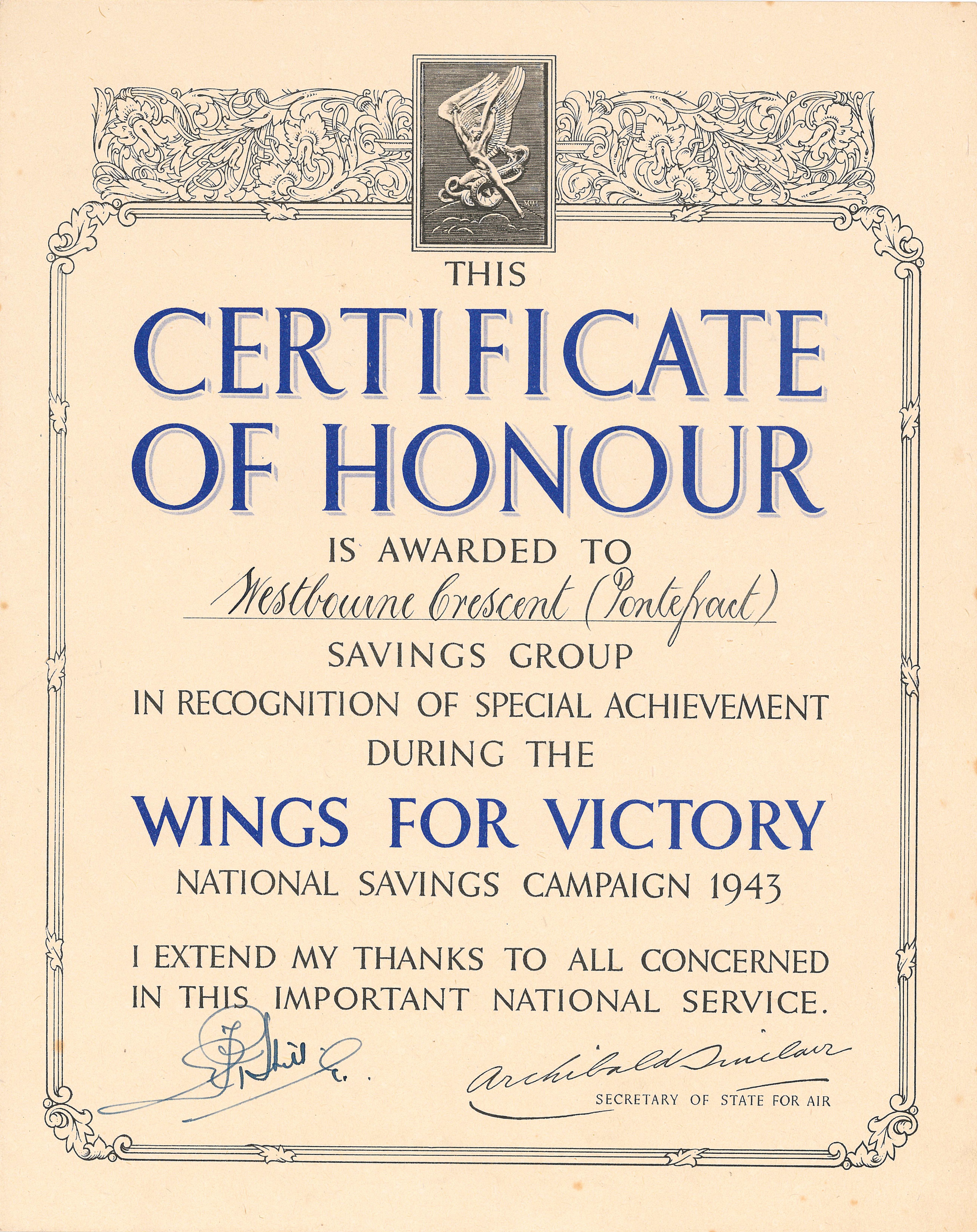
A certificate reading 'This certificate of honour is awarded to Westbourne Crescent (Pontefract) savings group in recognition of special achievement during the Wings for Victory National Savings Campaign 1943. I extend my thanks to all concerned in this important national service.' It is signed by Archibald Sinclair
A Certificate of Honour awarded to Westbourne Crescent in Pontefract, in recognition of their fundraising efforts. It is signed by Archibald Sinclair, Secretary of State for Air.

Fundraising each year focussed on a ‘War Week’. Towns concentrated their efforts on a national theme. These included ‘Wings for Victory’ or ‘Warship Week’. Targets were linked to specific aims. This made the saving more real and meant people felt more involved.

Places that met their targets were given commemorative plaques to celebrate their achievements. Smaller groups could also be recognised with certificates.

Pontefract's fundraising weeks

Pontefract’s 4 ‘special weeks’ raised over £1 million.

10-17 January 1941 – ‘War Weapons’

Target £300,000. 

Raised £409,338.

14-21 February 1942 – ‘Warship Week’

Target £200,000, to adopt HMS Unique (a submarine). 

Raised £217,976.

5-12 June 1943 – ‘Wings for Victory’

Target £160,000, for 8 Mosquito bombers. 

Raised £205,263, enough for 10 bombers.

8-15 July 1944 – ‘Salute the Soldier’

Target £167,373, to equip 1 infantry and 1 parachute battalion.

Raised £206,600.

A poster featuring a futurist-style illustration of a soldier, and the words 'Pontefract, July 8 - 15, 1944. Target: £167,373 (to make £1,000,000). Salute the soldier with a salvo of savings'
A poster for Pontefract's 'Salute the Soldier' civic fundraising week

Warship Week

Part of a programme with an illustration of a submarine and the words 'official programme, Pontefract's Warship Week, February 14 to 21, 1942'
Part of the official programme for Pontefract's Warship Week, 1942

The fundraising focus for 1942 was the Navy. Pontefract’s Warship Week was held 14 - 21 February. Pontefract’s target was £200,000. The total raised was £217,976.

Pontefract adopted HMS Unique, a serving submarine. Seven members of the crew came to visit. They went to the races, saw Pontefract Castle, had tea with the fundraising committee, and went to a civic reception with the mayor.

HMS Unique had been in service since September 1940. She spent most of her time patrolling in the Mediterranean, sinking Italian merchant ships.

On 7 October 1942 she left Holy Loch for her 22nd wartime patrol. She was to search the Bay of Biscay for German blockade-runners, in particular the minesweeper Belgrano. The patrol was due to end in Gibraltar on 23 October.

HMS Unique in harbour, image from the Submariners Association

By 24 October she was overdue and reported missing. At the time it was unclear what had happened. Recent research suggests that on 13 October she attacked a damaged German tanker, the Spichern, heading for the French port of St Nazaire. The tanker reported seeing torpedo tracks. Both the Spichern and another British submarine, HMS Ursula, reported hearing explosions.

It seems most likely that one of HMS Unique’s torpedoes was faulty and exploded too soon. This damaged the submarine so badly that it sank, killing all 34 crew.

Pontefract later adopted another submarine, HMS Upstart. This survived the war and was passed to the Greek navy in August 1945.

HMS Unique - names and ages of the crew killed 13 October 1945

Wings for Victory

Part of the official programme with a photo of a mosquito bomber, and the words 'Pontefract Wings for Victory Week, June 5 to 12 1943, target: £160,000 for 8 Mosquito Bombers'
Part of the official programme for Pontefract's 'Wings for Victory' civic fundraising week

The fundraising focus in 1943 was the Air Force. Pontefract held a Wings for Victory week 5-12 June. The target was £160,000, but the total raised was £205,263. 

The goal had been for people in Pontefract to save enough to pay for 8 Mosquito Bomber aeroplanes. They raised enough for 10.

Page from a log book which reads 'this log book which will record the operational activities of an Aircraft is a tribute to the success acheived by Pontefract Savings Committee in the Wings for Victory National Savings Campaign, 1943'. Then handwritten is 'target: £160,000, achievement: £205,263. Representing the cost of 10 Mosquito (two-engined bombers)'
Page from the Wings for Victory Savings Committee log book

The new Mosquitoes were sent to 139 (Jamaica) Squadron to equip them as Pathfinders. The squadron was named in recognition of the remarkably generous donations from Jamaica in 1940.

Pathfinders used radio beams to find targets. They could either drop bombs far more accurately than normal bombers, or coloured flares. These flares meant ordinary, less accurate bombers could find also targets, even at night.

A dozen Mosquito Bomber aeroplanes on the ground in a row, surrounded by RAF pilots getting kitted up
Mosquitos of 139 Squadron at an RAF base

New foyer display at Pontefract Museum

We're paying tribute to the incredible fundraising efforts of the people of Pontefract in a new foyer display at Pontefract Museum. It has been specially installed in time for VE Day 80. The display will be here until September 2025.

A display case containing fundraising posters, plaques and a certificate of honour from the Pontefract civic fundraising effort
The display case at Pontefract Museum

Pontefract Museum is open Monday to Friday, 10am to 4:30pm and Saturdays, 10:30am to 4:30pm. It is free entry.

Tuesday, May 6, 2025

MHG Volunteer Blog 18: Forget-me-not

It's time for the latest blog from our dedicated team of volunteer gardeners at Pontefract Castle.

Find out more about their blog series here.

After weeks of sunshine, May Bank Holiday rolls around and it’s back to thermals and fleeces! 

Carole spent the day sorting out the “nursery”. She pricked out seedlings and potted-on cuttings for sale. It was a welcome respite from weeding, which will start again next week.

Rows of various seedlings in small pots
Seedlings potted-on for sale at Pontefract Castle

She also spent quite a lot of time talking to the visitors who had braved the cold. Most of the conversations were about liquorice. She did enjoy talking to a couple from Swinton about plants in general. They also discussed the sinking of the RMS Titanic, about which the husband was very knowledgeable.

Plant of the Week - Forget-me-not (myosotis symphytifolia)

Myosotis is a genus of flowering plants in the borage family. The name comes from the Ancient Greek for "mouse's ear", which the foliage is thought to resemble. It has many common names such as wood forget-me-not, mouse ear, scorpion grass, bird’s eye, robin’s eye, and love-me.

The forget-me-not is a biennial plant from the Northern hemisphere. It grows to a height of 18 inches. It has alternate grey-green leaves and small bright blue five-lobed flowers with white or yellow centres.  

It will grow in practically any soil type, in any aspect, but prefers moist, but well-drained, soil in partial shade. 

It flowers in late Spring or early Summer. The flowers have a subtle floral smell which is usually only noticeable at night.

Clusters of bright blue forget-me-not flowers, with a cobweb spun between the stems of two of the plants
Forget-me-nots growing at Pontefract Castle

Culinary uses of Forget-me-nots

Forget-me-nots have a delicate, slightly sweet, and mild floral flavour.  They can be added to salads, or used in cakes and baked goods. They can also be incorporated into syrups or even made into tea.

Folklore and other facts about Forget-me-nots

There are many Christian and folklore explanations about how the plant got its name, and its association with remembrance.

There is a German legend where a knight was walking with his lady near the Danube River and decided to pick the blue flowers for her. While picking the flowers he fell in the river and as he was swept away, he tossed the flowers to his love crying out to her "Forget-me-not!".

It is used in Germany to commemorate the fallen soldiers of the World Wars. This is similar to remembrance poppies in the UK.

In some traditions, it is believed that carrying or wearing forget-me-not flowers can protect against evil spirits and curses. This belief led to the inclusion of forget-me-not flowers in charms, amulets, and talismans for protection, and good fortune.

In this country, many health institutions use the forget-me-not as a symbol. It is used on notes, lists and at the side of beds to highlight that someone has dementia. The forget-me-not is the symbol of the Alzheimer's Society in Britain, New Zealand and the Netherlands.

Forget-me-not is food for the larvae of some lepidoptera species, including the hover fly (sphaerophoria scripta). Its nectar and pollen is enjoyed by bumblebees and butterflies.

Medieval uses*

King Henry IV of England, who owned Pontefract Castle, used this flower symbol as his lucky charm during his exile, as Henry Bolingbroke, in 1398.

In traditional medicine, the whole forget-me-not plant was used.  It was used as a topical application for wounds and eye infections. It treated a variety of other ailments, such as lung problems and nosebleeds. 

*As always, this isn't to be considered medical advice today. Please don't use any plants mentioned in these blogs as medicine without advice from a doctor.

Tuesday, April 29, 2025

MHG Volunteer Blog 17: Sweet Cicely

It's time for the latest blog from our dedicated team of volunteer gardeners at Pontefract Castle.

Find out more about their blog series here.

Finally, the first major weeding of 2025 is over! All we have to do now is keep on top of it. Weeds are already starting to come through in places that we weeded 3 weeks ago. 

Now, we need rain. Some of the plants are flowering early, and some are not reaching their usual height before they flower.

From now on, working in the MHG should be more fun. There's new plants to order, cuttings to take and seedlings to pot on.

The crab apple tree is looking well in its first full year with us.

A small crab apple tree with very pale pink flowers
The crab apple tree in flower in the Medieval Herb Garden

Last year visitor Mark bought a “grow your own” liquorice kit from the gift shop. He visited us today to let us know how his plant was getting on. His plant is now two to three inches high (our mature plants are currently 4 to 6 inches high) and it is ready to be potted-on into a bigger pot. Well done, Mark!

Plant of the Week - Sweet Cicely (myrrhis odorata)

The name 'myrrhis' comes from the Greek 'myrrhis', an aromatic oil from Asia. 'Odorata' means scented. The name 'cicely' is derived from the Latin 'seselis', which means parsley.

Sweet cicely has many common names such as anise chervil, anise fern, British myrrh, cow chervil, garden myrrh, Roman plant, shepherd's needle and sweet bracken.

Sweet cicely is a hardy, perennial, herbaceous, plant of the carrot family. It is native to Europe and can reach a height of 6ft. It is similar looking to cow parsley, but softer to the touch. The leaves are fernlike and grow up to 20 inches long.

It flowers in late Spring / early Summer. Its individual white flowers have five petals. These form clusters which can reach a width of over an inch. 

It prefers to grow in the shade in moist but well-drained soil. In the MHG, the plant is growing in full sun, and dry soil, and rarely gets to be more than 2 feet high.

Clusters of sweet cicily plants with tiny white flowers and green fern-like leaves
Sweet cicely in flower in the Medieval Herb Garden

Culinary uses of Sweet Cicely

In cooking, sweet cicely is often used as a natural sweetener in desserts, syrups, and drinks. It can be used in place of sugar, honey, or other sweeteners. Its liquorice-like flavour complements a wide range of sweet and savoury dishes.

Historically, all parts of the plant were used. The roots were eaten raw in salads or boiled and eaten like parsnips. They also made a good wine. The leaves were cooked like spinach, added to soups and stews, omelettes and custards. The stalks were used as a substitute for celery after light cooking, or dried and stored for later use.

The flower buds are edible and were used as decoration. The seeds were chewed raw.

Folklore and other facts about Sweet Cicely

Sweet cicely was often included in traditional European spring tonics to cleanse the body after winter. It has been used in traditional Scandinavian liqueurs and spirits.

Medieval uses*

In medieval Europe, sweet cicely was believed to have protective properties against evil spirits. It was often used in love potions and charms.

Sweet cicely has a long history of medicinal use, dating back to ancient Greece and Rome. Its leaves and roots potentially treated a variety of issues, including indigestion and respiratory problems. Its smell was believed to have a calming effect on the mind and body.

The plant has expectorant properties, helping to relieve congestion. It can be useful for treating coughs and colds. It has been used as a mild diuretic to help with fluid retention.

John Gerard (1597) said that sweet cicely wasvery good for old people that are dull and without courage: it rejoiceth and comforteth the heart, and increases their lust and strength.”

*As always, this isn't to be considered medical advice today. Please don't use any plants mentioned in these blogs as medicine without advice from a doctor.

Tuesday, April 22, 2025

MHG Volunteer Blog 16: Greater Stitchwort

It's time for the latest blog from our dedicated team of volunteer gardeners at Pontefract Castle.

Find out more about their blog series here.

21 April 2025

Bank Holiday Monday, so of course, we have rain. But rain is what the garden needs, although, it will make the weeds grow!  The flower count this week shows that we have 36 species in bloom; this time last year we had only 25.

No gardening could be done today. So, I thought I might show you, following blog number 7: rhubarb, how well our rhubarb is doing:

A row of large green leaves from the rhubarb plants in the medieval herb garden at Pontefract Castle
Leaves of our thriving rhubarb in the Medieval Herb Garden

Plant of the Week - Greater Stitchwort (stellaria holostea - rabelera holostea since 2019)

The common name stitchwort is a reference to the old belief that the plant could be used to cure side stitch, which people get when they run. The name “holostea” comes from the Greek 'holosteon', meaning 'entire bone'. This is due to the brittleness of the plant’s stems.

It has many common names such as greater starwort, adder’s meat, cuckoo meat, snake flower, daddy's-shirt-buttons, poor-man's buttonhole, brassy buttons, wedding cakes and star-of-Bethlehem.

It was formerly placed in the genus Stellaria, as Stellaria holostea. However, new research moved it to the Rabelera genus in 2019.

Greater stitchwort is a clump-forming, semi-evergreen, herbaceous perennial. It is native to Europe. 

It grows to a height of 24 inches. It has brittle stems with simple, opposite, grey-green leaves which are grass-like, having rough edges. Each successive pair of leaves are borne at right angles to each other. 

The flowers are white with five deeply-notched petals. These appear in late Spring and early Summer. The plant prefers to grow in light shade, in any moist, but well-drained, acid to neutral soil.

Clusters of greater stitchwort plants, with flowers almost like the common daisy, but with wider, more rounded petals
Greater stitchwort in flower

Culinary uses of Greater Stitchwort

The green parts of the plant, including leaves and shoots, can be chopped and added to salads for a mild, lettuce-like flavour. It can be used in stuffings or mixed into soups and stews. A pleasant drink can also be made from the plant.

Folklore and other facts about Greater Stitchwort

The plant provides pollen and nectar for bees, butterflies, hoverflies and other insects. Several moths, including the marsh pug, plain clary, and yellow underwing, feed on greater stitchwort. This makes it an important part of their lifecycle. 

The roots of the plant can be used to create a yellow-green dye. 

In some pagan and neopagan traditions, the plant is associated with Spring and rebirth. It is a symbol used in rituals and celebrations. 

In some regions, like Cornwall, the plant was believed to belong to the pixies. It was thought that picking it would anger them. Similarly, in some areas, children believed that picking stitchwort would lead to being "pixy-led". They thought they would become hopelessly lost, even in familiar places. 

Various names for the plant, like "cuckoo's meat," suggested it bloomed around the same time the cuckoo could be heard. Other names, like "adder's meat" and "snake-flower," possibly related to the plant's flowering period coinciding with snakes emerging from hibernation.

Medieval uses*

The plant was used to sooth coughs, sore throats, arthritis and urinary tract infections.

The plant's leaves are believed to have anti-inflammatory properties. Ointments were traditionally made from them to treat eczema, insect bites and skin rashes.

*As always, this isn't to be considered medical advice today. Please don't use any plants mentioned in these blogs as medicine without advice from a doctor.
Tuesday, April 15, 2025

MHG Volunteer Blog 15: Alexanders

Can you believe we're actually asking for rain in Yorkshire?! Find out what our Medieval Herb Gardeners have been up to this week in their latest blog.

14 April 2025

Monday, still no rain, and the ground is like dusty concrete. The plants are beginning to show the effects of the lack of water. Some are not getting to their usual height before they start to flower.

Being the Easter holidays, we had plenty of families visiting. We were regularly replying to the usual youngsters’ query of “Whatcha doin’?” !

Dave finished off weeding in front of the lavender 'hedge', and did some spot weeding on the thistles. Helen used her artistic skills to make a start on the new plant boards for the MHG.

A hand-drawn illustrated chalkboard for woad, with 'ancient source of indigo dye' and 'believed to be a cure for St Anthony's Fire' written on it
Helen's stunning plant board for Woad in the Medieval Herb Garden

Carole continued weeding from where she, and occasional volunteer, Sharon, had left off on Thursday – yes, we don’t just garden on a Monday!

The weekly plant count found 30 species in flower. Carole then spent some time deciding which plants to include in the first MHG talk of the season. The talk is on Easter Saturday 19 April at 1pm. You can book a free ticket for the talk here.

Carole and Helen also enjoyed interesting conversations with two of our visitors today. One was from the Crown Prosecution Service of Winnipeg and Manitoba, Canada. The second was with a member of the marketing team for Warwick Castle. We really do get visitors from far and wide!

Plant of the Week - Alexanders (smyrnium olusatrum) 

The name smyrnium comes from the Greek word for 'myrrh', because of the smell of its flowers and seeds. It also contains 'olusatrum' meaning 'black herb', from the Latin, olus = herb, and ater = black. This is because of its jet-black seeds, which form in late summer.

The name, 'alexanders', is a corruption of the Latin (olus ater ⇒ alisander). It doesn’t have anything to do with Alexander the Great, although the plant originated in Macedonia and the Mediterranean.

It has many common names such as: black lovage, hellroot, skit, horse parsley, parsley of Alexandria, black pot-herb, stanmarch, megweed and Thanet celery.

A cluster of tall, thin green alexanders, with small white tightly packed flowers
Alexanders growing in the Medieval Herb Garden

Alexanders is a vigorous, deciduous, hairless, clump-forming biennial. It has a solid stem up to 22 mm in diameter, which becomes hollow and grooved with age. The leaves are bright green and have toothed edges. They are arranged in groups of three at the end of the leaf stalk. The plant can reach a height of 1.5m.

In late spring and early summer, it produces branched umbels of small, greenish-yellow flowers. These emit a strong, myrrh-like scent and produce large amounts of nectar.

The fruit is round and black when fully ripe, and exudes an oil which smells of capsicum or diesel.  

Alexanders will grow in any soil, but prefers full sun.

Culinary uses of Alexanders

All parts of the plant can be eaten. Its tender young shoots, which taste like a cross between celery and parsley, can be foraged as early as late January.  

The leaves and stalks were used for soups, broths, and stews. The fleshy stems were eaten like celery and the leaves like parsley.

The thickened tap-roots were roasted or added to casseroles and stews, like parsnips. The buds could be pickled or fried.

The flowers could be used as a decoration in salads. The black seeds and flowers could be used as a pepper-like spice.

Alexanders fell out of favour in the 1700s. This was when celery ('apium graveolens') started being mass produced to replace wild herbs and vegetables.

By the time Mrs Beeton had compiled her “Book of Household Management” in 1861 alexanders was “used in this country in the same way in which celery is”. However, it could only be found growing wild on the sea coast, as “its cultivation is now almost entirely abandoned”.

Folklore and other facts about Alexanders

Alexanders was well-recognised in the classical world. It was recorded by the Greek natural historian Theophrastus (371BC - 287BC). The Roman writer Pliny the Elder (c23AD- 79AD) wrote extensively about its properties. It was in common use at the time of the Roman colonisation of Britain. It was one of many culinary species the Roman armies brought with them following their invasion in 43AD.

In Britain, over 150 insect species have been recorded visiting the flowers. These include many flies and bees, several beetles, butterflies, moths, and other types of insects.

On the Isle of Man, it was known as lus-ny-ollee. It was used by vets to treat animals with sore mouths.

Medieval uses*

Although mainly used as a food crop, Ancient Greek and Roman literature described medicinal uses for all parts of the plant. It was a traditional plant for cleansing the blood. It was also a digestive herb for strengthening the stomach. 

Sailors used it to treat scurvy. Herbalists used it to relieve stomach and urinary problems. 

Alexanders was also a remedy for headaches, toothaches, swellings of the body, cuts and bruises, asthma, consumption, and tuberculosis.

*As always, this isn't to be considered medical advice today. Please don't use any plants mentioned in these blogs as medicine without advice from a doctor.

Browse the previous Medieval Herb Garden blogs here