Showing posts with label slazenger. Show all posts

Thursday, August 14, 2025

Chloe: what I did on my work placement with Wakefield Museums and Castles

Chloe recently did a work placement with us as part of her university course. She's kindly written this guest blog about her experience. 

Read on to discover some of the interesting objects she catalogued for us!

During my work placement I was based in the museum store. I catalogued a small collection of items from the Sykes / Slazenger factory. The Sykes / Slazenger factory is mainly known for manufacturing sports items and equipment.

When I first started my work placement I was given a tour of the museum store. I was shown some of the objects and items they have and told about their significance. I was then shown the objects I would cataloguing throughout the eight weeks of my placement. I was also shown the history file. This contains everything needed to be kept with the collection, like the forms to say what needs to be catalogued or just used for reference. It also says how they got the items as well as the ownership of the items.

A table featuring a pile of photographs, photo album, racket head press, tennis racket and rifle furniture
The objects I catalogued

The items I was to catalogue were:

  • a pile of black and white photographs

  • a photo album with more black and white photographs

  • a head press (this was used to help make sure the tennis racket kept its shape)

  • a tennis racket with a head press

  • some rifle furniture (the wooden parts of a rifle) produced in the Sykes / Slazenger factory during the Second World War

The photographs

After looking through the objects, I decided I would start by cataloguing the black and white photographs. I started by putting the photographs into groups. I wanted to keep and catalogue the ones that were similar together.

A lot of the photographs were quite similar in nature. Cataloguing them was difficult, as it was hard to tell the difference between them.

Some of the photographs were pictures of some of the different manufacturing processes. These included how a tennis racket or a golf club was made. Others were of people using the machine, or just of the machines themselves.

This was very similar when I had catalogued the photo album. Some of the photographs were similar or the same to the ones I had already catalogued.

A man in an overcoat closely studying a golf club in the Sykes factory
 This photograph shows a man looking over a finished golf club. He is making sure that everything has been done correctly. He is also putting on the final touches to the golf club.

Cataloguing the 3D objects

Cataloguing the rifle parts, tennis racket, head presses and the film reel was different. These objects have depth, whereas the photographs do not.

When measuring the length of the objects, I had to use a tape measure. They were quite long and it would have been difficult to do so without. I also had to look closely at the objects to make sure the condition they were in was fine. 

I was also looking to see if there was anything that was engraved or marked on to the objects.

A vintage wooden racket with a head press attached
The racket, still in its head press

The Sykes factory started to manufacture the wooden rifle parts during the Second World War. They would have slowed down the manufacturing of the sports items they produced, along with some of the machines in the photographs.

Various parts to construct a rifle made out of smooth polished wood
Pieces of wooden rifle furniture made by Sykes

There were some books amongst the items within the collection I was able to use for referencing. This was useful as I was able to match the photographs to the pictures of the machines within the books. 

There were some small pieces of paper that also had the name and description of what the machine was used for and how it worked. I was able to match the pieces of paper to the photographs as some of the machines had their names engraved on the front.

A book titled Sykes and the War and a printed thesis
'Sykes and the War' and a thesis I used to research the objects

I had lastly catalogued some letters within the collection. They were in correspondence with the Sykes / Slazenger factory (more importantly the people within the factory). The majority of them had the dates in which they were sent. This made it easier for me to catalogue them in time order.

A lot of the letters were in response to Briggs receiving the British Empire Medal that was awarded by the King. This was due to his hard work in the war effort. Briggs sent letters back saying that it was a joint effort with the people he was working with and only done with the support of others.

This small collection I have catalogued is a part of a bigger collection Wakefield Museums and Castles has. There is loads more to find out about other sports items and equipment that were made at the factory. There's also lots to learn about the history behind the factory and how they stepped in to help with the war effort.

Tuesday, September 26, 2023

Wakefield's Sporting Heritage

When it comes to sporting heritage, Wakefield District has lots to celebrate… even more than you might think!

We've dug out some sporty showpieces from our collection, many of which also feature in our 100 Years of Collecting Online Exhibition.

We are Rugby League

The Wakefield district is often defined by Rugby League. It both unites and divides our communities.

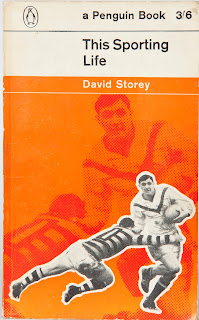
David Storey encapsulates this in his classic 1960 gritty northern novel, This Sporting Life:

Front cover of This Sporting Life, with a rugby player tackling an opponent
Our copy of This Sporting Life, on display at Wakefield Museum

The story follows a Wakefield Trinity player as he navigates his sporting career and his love life. In 1963 a film version starring Richard Harris was released to rave reviews. 

Belle Vue stadium features as a key location in the film and many residents remember being paid to attend as extras in the stands.

Most local people are close followers of one of the big three teams: Wakefield Trinity, Castleford Tigers and Featherstone Rovers. 

We have some fantastic objects telling the stories of the clubs, covering their historic victories and record-breaking achievements.

Iconic objects include this thick woollen jersey worn by Wakefield Trinity’s Harper Oliver Hamshaw way back in the 1880s: 

A thick woollen button-up jersey, navy blue with a red horizontal stripe across the chest and the arms.
Harper Oliver Hamshaw's rugby jersey

This was a time when Trinity shaped the creation of professional rugby league by paying their star player, three-quarter back, Edward ‘Teddy’ Bartram, a salary of £52. This made him the first professional rugby league player.

Professional sport would be nothing without the supporters! 

Telling local fans' stories is just as important as that of the players. This rosette was proudly worn by a Featherstone Rovers supporter when Fev reached the Rugby League Challenge Cup Final in 1974:

A blue and white rosette with 'Featherstone R', 'Wembley' and a picture of the trophy on it
A fan's Featherstone Rovers rosette from the 1974 Rugby League Challenge Cup Final


Local players didn't only capture hearts and minds - they smashed records. 

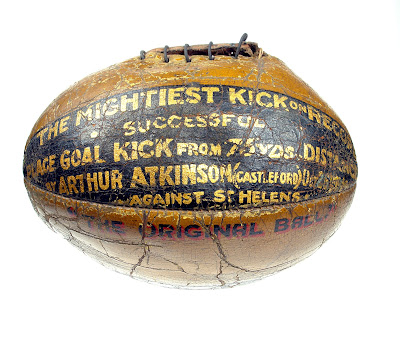
This rugby ball was used by Arthur ‘Brus’ Atkinson to make a record goal kick of 75 yards in Castleford's victory against St. Helens, on 26 October 1929. 

The record still stands 94 years later!

An old hand-stitched rugby ball with the details of Atkinson's achievement written on it
Arthur Atkinson's record-breaking rugby ball


But - it's not just rugby league Wakefield makes waves in!


Super Sharp Shooter: Stephanie Park

Stephanie Park nee Hopley (1940-2012) was a nurse and midwife in Wakefield. After losing a leg following an accident, she took up competitive shooting. Stephanie went on to become the World Disabled Champion in target shooting in 1987 and the winner of the Cardiff Open Shoot in 1989. This was the first sports event in which disabled and non-disabled competitors took part equally. 

She was also a world champion athlete in field sports and archery.

Stephanie in action, aiming her rifle while in her wheelchair. She has short, dark curly hair and is wearing a leather jacket and jeans.
Stephanie in action

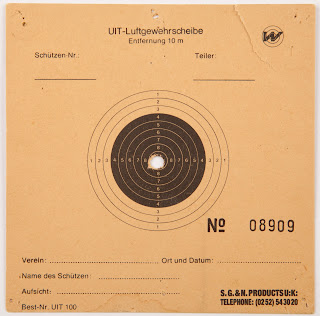
She hit all 10 shots through the central ring of this target shot at the 1989 National Small Bore Rifle Association Championship, and rightfully kept it as a souvenir! It features in our 100 Years of Collecting Online Exhibition:

A square cardboard target shot with all 10 shots through the central ring
Stephanie's keepsake target shot from the 1989 National Small Bore Rifle Association Championship 

Stephanie was also a disability rights campaigner and community leader. Her proud son Daniel kindly donated her archive to our collection in 2014.

Click here to read more about Stephanie's incredible life and career. 


Tour de Force: Barry Hoban

Barry Hoban is a former professional cyclist from Wakefield who rode during the late 1960s and early 1970s. 

He holds the record for the most Tour de Frances completed by a British rider – having finished 11 of the 12 he started between 1965 and 1978. 

He was also the first Briton to win two consecutive stages of the Tour, a feat not matched until 2008!


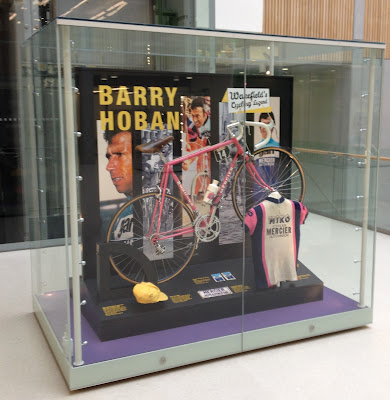
Square glass display case featuring photos and objects relating to Barry Hoban's career, including a pink road bike and pink, white and blue jersey
A display from 2014 showcasing Barry Hoban, featuring one of his bikes and jerseys

A Supporting Role: Sykes & Slazenger

As well as our sporting stars and top teams, Wakefield District has a very proud heritage of sports manufacturing.

In 1870 a saddler’s apprentice from Horbury founded William Sykes Ltd. Soon he was the chairman of a thriving international business. Sykes produced equipment for a huge variety of sports, from billiards to boxing, crown green bowling to croquet. 

Advertising poster for 'Choose a Sykes Model', with images of the EDB, the Blue Riband, the Ruby and the Alpha rackets, and the taglines 'Senior Service' and 'Simply Splendid - none better'
A vintage Sykes advert from the 1930s

Sykes eventually became part of the Dunlop Slazenger empire, pioneering ground breaking new products and technologies. For more than a century, Horbury was a centre of excellence and innovation in sports production, supplying top competitions like the FA Cup and Challenge Cup.

When Australian legend Don Bradman maintained a test cricket batting average of 99.9 over his career (1928 – 1948), he did so using cricket bats made in Horbury. The Don Bradman endorsed signature cricket bat became a very popular and long running brand of bat for Sykes, and continued after the company merged with Slazenger:

Old wooden cricket bat, engraved with 'Sykes, Don Bradman - Autograph' and Bradman's signature
A Don Bradman signature cricket bat


When England won the World Cup in 1966, they did so kicking a ball made here in Horbury. We've got one of the footballs made for the Final on display at Wakefield Museum:

Bright orange hand-stitched Slazenger Challenge 4-Star football
One of the Slazenger 4-Star Challenge footballs made for the 1966 World Cup

In 1988 German Tennis ace Steffi Graf became the first (and still only) player to win a Golden Grand Slam (she won each of the four Grand Slam tournaments and an Olympic Gold medal all in one year). 

She did so using a tennis racket designed and made in Horbury - The Dunlop 200G Max:

A purple tennis racket with green and brown details and the Dunlop logo
A Dunlop 200G Max racket, the type used by Steffi Graf to win her Golden Slam

So, yes - we're pretty proud of our sporting heritage!

Find out more:

 
Staff Pick - Wakefield Trinity and Me