Monday, August 19, 2013

Bug Hunt!

Bugs and other creepy crawlies are usually something to be avoided in museums - they can cause damage to collections - but last week, some intrepid adventurers explored the grounds and ruins of Sandal Castle to discover what creepy crawlie creatures are living there!

The explorers donned magnifying glasses and bug pots, before setting out to explore a variety of habitats.

Cadence looks very carefully, searching for tiny creatures!
We discovered a whole colony of crickets, some fantastic stripey caterpillars, lots of woodlice, slugs and snails, some beautiful butterflies - and even a fabulous frog!

The children were all fantastic at looking really closely for wildlife and being careful and kind with the creatures that they found, with many of them keen to explore the miniature habitats in their own gardens or parks. 


Creatures are examined before carefully returning them to the wild!

 
If you would like to explore the grounds of Sandal Castle yourself, admission is free and pedestrians can access the grounds all day. The car park is open 9.30am – 7.30pm in summer and till dusk in winter, and the Visitors' Centre is  open to the public Wednesday to Sunday 11am – 4:30pm. See here for more information.

Thursday, August 15, 2013

Calling all Wakefield Men... We need your hair!

We are at the cutting edge of working on the next exhibition for Wakefield Museum.  Opening on 26 October, Men in the Mirror will explore men’s hair in all its glory!

The exhibition will explore the roots of the barber’s profession; untangle the history of shaving equipment; look at the changing face of men’s hair fashion; and of course will feature some of the most resplendent moustaches you have ever seen.
A fine example of the chevron style moustache.
BUT….we need your help.  In the museum collections we have piles of splendid pictures of Victorian facial hair, we have heaps of images of dapper gentlemen from the 1920s and 1930s….but we are low on hair from the 1950s onwards.

So we are asking for the Men of Wakefield to dig out their old photos and send us images of magnificent hair-dos and facial hair from the 1950s to the present day.

Have you ever sported  a mullet, did you emulate a famous rock star’s style; did your hair make a stand against ‘the man’ with a Mohican; did you let it hang long and loose in the summer of love; have you tried to hide balding with a comb over; has your hair been pink, gelled, permed, spiked, dread-locked, crimped, feathered,  ; have you modelled an afro, bowl cut, bob, quiff, bouffant, crew cut, undercut, corn rows, mop-top, pompadour, or have you always stuck to a short back and sides.

Don’t forget the facial hair… lurking in your loft is there a long hidden photo of a goatee; a marvellous muttonchop;  a pencil, handlebar, toothbrush, horseshoe or fu-manchu moustache; or our favourite, the big, the bushy, the beautiful, full beard.

If you have a photo you’d like to share with Wakefield Museum and see featured this hairy exhibition please: 
  • post a copy to Wakefield Museum, Wakefield One, Burton Street, Wakefield, WF1 2EB (please note that the museum will be unable to return photos posted to us- so if you are particularly attached to it please make a copy!).
  • bring a copy to Wakefield Museum reception desk

Please let us know your name, when the photo was taken, and anything you’d like to say about the hair featured!


This splendid neck beard dates from 1865 – 1885, taken in a photography studio in Wakefield.


This gentleman does right to pose with his hat off, who’d want to hide those marvellous hair tufts, they balance the chin curtain perfectly.

These stunning mutton chops are taken from a photograph album dating to 1889. 


The jaunty angle of the hat shows off those gorgeous waves beautifully, on this World War 2 soldier. 

Wednesday, August 14, 2013

Castleford Forum Museum: Coal Mining Display

In the 1800s coal mining transformed Castleford into an industrial powerhouse.


A view of Fryston Colliery with allotments in front, taken by Jack Hulme
Castleford’s position on the South Yorkshire Coalfield with its excellent transport links made it ideal to supply mills and factories across Yorkshire. Coal powered Castleford glass works and potteries.

Castleford’s new museum, opening later this year will explore Castleford’s mining heritage. The mining display will follow mining from its early days, through to its boom.  Plus how Castleford has reinvented itself after the decline of the industry.

Mining case layout: A selection of objects that will feature in the mining display at Castleford Forum Museum

Wednesday, August 7, 2013

Castleford Forum Museum: Bad poetry, hedgehogs and giants

Castleford’s new museum, due to open in Autumn 2013 will tell many stories about the area and its people.

One of the stories told will be about a medieval manuscript, written in 1327 by Thomas of Castleford. The Book of Brute or as it is more commonly known, the Castleford Chronicle, is one of only 7 chronicles written in English before 1600.

The manuscript, now kept in a library in Germany, tells the story of Britain from its discovery by a boat full of ship wrecked sisters (the Legend of Albina) to the imprisonment of Edward II.  With tales of giants and haircuts, hedgehogs and King Lear, love and being hit over the head with axes in between.
Detail of a miniature of Albina from a French or Netherlandish manuscript in the British Library
The chronicle, told in verse, would be unreadable to most of us; with its northern dialect Middle English, and not many people would read its 39437 lines! Those that have read it have also noted that Thomas of Castleford was a terrible poet.

The author’s longwinded, badly rhyming history of Britain can give all aspiring artists the hope that talent is not necessarily a vital ingredient of enduring legacy.
 
The Castleford Chronicle - kept in Germany - has no illustrations, but plenty of bad rhymes! Image courtesy of Niedersächsische Staats- und Universitätsbibliothek Göttingen
 

Friday, August 2, 2013

Lots of fun in museums!

The summer holidays are upon us and at Wakefield Museum everyone has been getting creative! 

From flapper-inspired fascinators for all ages to fruit-based crafts for our younger visitors, there's been a lot to choose from!

We wanted to see how much juice an orange might hold . . . so we peeled and squeezed to find out!

Remember potato printing? We tried printing with apples, grapes, melon, lime...

“Brilliant again!  She loves coming to these sessions and can’t wait to come again.”
“This has been great for her, she wouldn’t normally even touch fruit!”
“Nice and friendly group with activity to keep everyone entertained”


The holidays have barely begun!  There's lots more to do!

Local Heroes
Some weird and wonderful people have come from Wakefield. At this workshop, you can find out all about some of these amazing and curious people – and you can also make some fabulous crafts to take home.
Ages 6-12 years old
11am-12.30 and 1.30-3pm
Wakefield Museum Learning Zone

Booking essential as places are limited on 01924 302700 or email.
Thursday 8 August


Why not drop into Pontefract Museum on Wednesday 21 August for Pontefract Of The Past?  No need to book!
 
Pontefract Of The Past
Pontefract is an amazing place with an amazing history – it even played a part in one of Henry VIII’s wives getting her head chopped off! You can learn about some surprising Pontefract stories at this drop-in workshop, as you make some brilliant crafts to take home.
Ages 3-12 years old
11am-2pm
Pontefract Museum
No need to book for this session!
Wednesday 21 August


Or if you have any budding thespians in the family, why not book onto Fantastical Theatricals?

Fantastical Theatricals
Almost a thousand years ago, Wakefield was really famous for its plays – and ever since then, there have always been plays and theatres in Wakefield. We will learn about some of those plays here – and you can make some dramatic props to take home!
Ages 6-12 years old
11am-12.30 and 1.30-3pm
Wakefield museum Learning Zone
Booking essential as places are limited on 01924 302700 or email.

Wednesday 28 August

 
Please email if you would like to be added to our mailing list.
 
For these, and lots of other great events over the summer, have a look at Experience Wakefield.
 

Wednesday, July 31, 2013

Castleford Museum sneak preview!

Castleford Museum is really taking shape.  Many of the museum structures have been made, delivered and installed.  The objects have been selected and case layouts considered.  The graphic panels are just about ready to be sent to print.
As a special sneak preview here are some images of how the museum will look with the structures, cases and panels in place…
This is what you will see as you first enter the museum space on the third floor of the Castleford Forum Library and Museum building
  
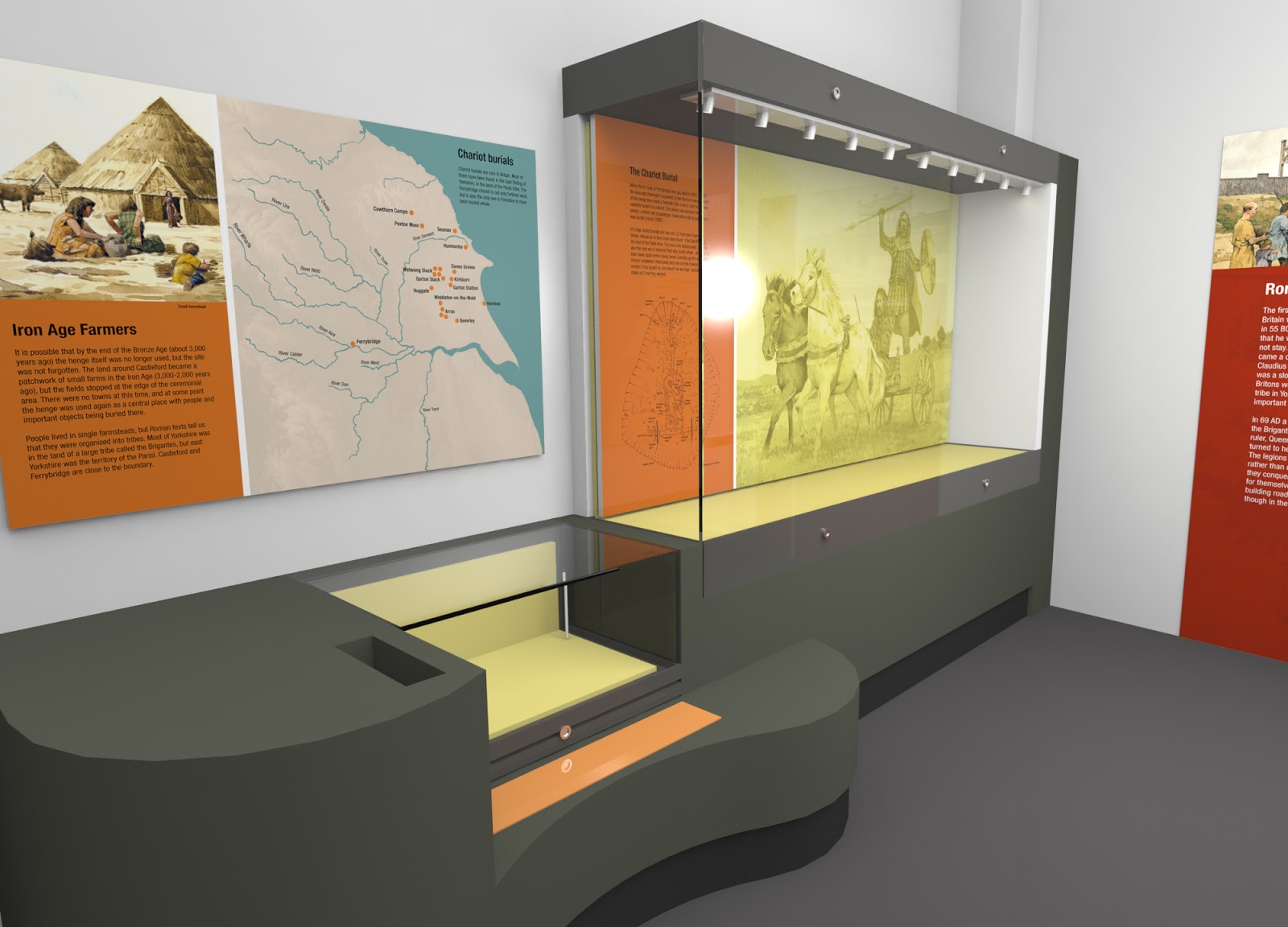
Here you can see an example of the panel designs and the specially commissioned images of Iron Age Castleford. The large case will house an amazing and unique chariot.

A huge empty case! This will be filled with pottery and glass including some spectacular glass walking sticks.

A glass walking stick that will form part of the glass and ceramics display.  These incredible glass sticks show the skill and craftsmanship of the glass workers.

Monday, July 29, 2013

Wakefield Art Walk

Our special 1920s event – All in a flap at Wakefield Museum – is nearly upon us.

The flapper dresses have been prepared, the accessories chosen (check out the incredible scarab beetle necklace with legs!!!), the bow ties are ready to be tied, the feathers are set to be added to fascinators and a selection of roaring ‘20s hits chosen. 


A necklace made from real Egyptian scarab beetles

The scarab beetles' legs are visible on the reverse!


Create Café have designed a 1920’s inspired menu for the occasion:

Wakefield Art Walk special 
Wednesday 31st August 4.30-7pm
2 Courses with a tea or coffee - £10


TO START

Soup of the day with fresh bread £4
Thai Coconut Broth £4
Greek Salad with Feta Cheese £5

1920’s Inspired special – BBQ Ribs
BBQ Ribs first became popular when Henry Ford, in collaboration with Thomas Edison and EB Kingsford, began commercial manufacturing by making them from sawdust and wood scraps from Ford's auto plants in Detroit. The Kingsford Company then built the town Kingsford, MI. The company was later sold, and today Kingsford converts more than one million tons of wood scrap into briquets a year. So Ford not only brought the world affordable cars, he created an industry that made backyard barbecue easy.

MAINS
Chargrilled Halloumi with Chargrilled Veg and Salsa £6
Grilled Salmon, Chargrilled Leeks & Fennel, Lemon Dressing £6
Chicken Noodle Salad with Thai Coconut Dressing £6

1920’s Inspired Special – Philly Cheese Steak Sandwich
Philadelphians Pat and Harry Olivieri are often credited with inventing the sandwich by serving chopped steak on hoagie rolls in the early 1930s. They began selling this variation of steak sandwiches at their hot dog stand near south Philadelphia's Italian Market. They became so popular that Pat opened up his own restaurant which still operates today as Pat's King of Steaks.

TO FOLLOW
Bakewell Tart with Pear and Almond Compote £3.50
Warm Triple Chocolate Brownie with Cream £3.50
Treacle tart with Orange Yoghurt £4
1920’s Inspired Special – New York Vanilla cheesecake, rhubarb syrup £3.50
In 1912, James Kraft developed a form of pasteurized cream cheese. Kraft acquired the Philadelphia trademark in 1928, and marketed pasteurized Philadelphia Cream Cheese which is now the most commonly used cheese for cheesecake.


DRINKS – All £2.50
For tonight only, we also have a selection of 1920’s inspired non-alcoholic drinks. We have put this list together by thinking of the traditional drinks that were consumed in this era and then adjusting them to be non-alcoholic versions. Not easy as most drinks in the era were Prohibition drinks meaning they were very short and very alcoholic…..!

Planters Punch – (Lemon Juice, Sugar, Orange, Pineapple, Grenadine)
During this era, "rum-running" became a "legitimate" trade in the United States. Smugglers used station wagons, trucks and boats to heist rum from Mexico, Cuba and Puerto Rico. The Bronx was a rum based cocktail very popular in the 1920’s.

Mojito - (Lime Juice, Fresh Mint, Sugar, Soda)
This Cuban drink became popular in the mid-19th century, but it really became famous in the mid 1920’s when the recipe was adjusted to include Bacardi, and it became the national drink of Cuba, and spread into America.

French 75 – (Lemon Juice, Sugar, Soda)
The drink was created in 1915 at the New York Bar in Paris—later Harry's New York Bar—by barman Harry MacElhone. The combination of gin and champagne was said to have such a kick that it felt like being shelled with the powerful French 75mm field gun, also called a "75 Cocktail", or "Soixante Quinze" in French. The French 75 was popularized in America at the Stork Club in New York.


We look forward to seeing you all there!


Free entry and activities
Wednesday 31 July 5pm – 7.30pm