Showing posts with label Arts Council England. Show all posts

Thursday, April 27, 2023

Knottingley: Fire & Water - Interview with David Appleyard

On 23 November 2022, we celebrated the industrial heritage of Knottingley through a commissioned artwork by David Appleyard. The project was funded by Arts Council England and was designed to celebrate the industrial heritage of Knottingley.

Knottingley: Fire & Water was an innovative artwork, with illuminations, projections, and local community responses. 
 It was an evening of wonder, celebration, and community spirit. Over seven months, David immersed himself in the community, working closely with local people to reflect on the Knottingley of the present, as well as the Knottingley of the past. More than 200 people took part. 

We've been reflecting on the legacy of the project, and went back to David to capture his thoughts and feelings about Knottingley: Fire & Water, ahead of more digital community resources being released later this year.

Read on to learn about his tips for community engagement and advice to aspiring artists!

David Appleyard in his studio, reviewing colourful alternative Knottingley town crests made by local school children under a large panel of glass. There are lots of various pieces of artmaking equipment behind him.
David Appleyard in his studio, reviewing alternative Knottingley town crests created by local schoolchildren. Photo by Nick Singleton.

Interview with artist David Appleyard


Q: How did you become aware of the Knottingley: Fire & Water project? What was the application process like, and do you have any advice on how to succeed at the application stage?

David: The application process followed an open call that was advertised on various national arts websites. As application processes go it was fairly straight-forward. I sent an initial expression of interest and made the shortlisting. I was then given time to develop my approach before being interviewed. The interview itself was friendly and informal and I was given plenty of opportunity to present ideas and working methods.

Advice on applications?

The application process is never as daunting as it might sound, it just takes time. You’ve got to be in it to win it - so just give it a go.


Q: The Knottingley: Fire & Water project was rooted in the local community – how did you get to know the community and build up trust with different individuals and groups?

David: I made a lot of visits to Knottingley and worked with specific groups to make sure that a broad range of people knew about the project.

I was visiting every two to three weeks so I got to know people quite well. The only way to build trust is to maintain communication with them, whether it be in person or online.


Q: What research did you carry out to understand the history and industrial heritage of the town?

David: Initially, I spent time researching Knottingley’s history using various web sources. However, this quickly progressed into the archives at Pontefract Museum where a fantastic collection of archive photographs are held. From the archives I moved out into the community to show people what I had found and to gain feedback.


Black and white photo of two workers at Bagley's Glassworks pouring molten glass from a gathering rod into a large mould
One of the archive photographs held by Wakefield Museums and Castles, showing two Bagley & Co workers pouring molten glass from a gathering rod into a mould.
Copyright Wakefield Museums and Castles.


Q: How did your artwork evolve throughout the process? How did your community engagement work shape the final piece?

David: The project developed quite a lot from my initial proposal and was entirely shaped by the stories that were shared, the comments that people added to response cards and the many conversations I had with people living locally.

The most important part of the project was to bring people together in the same way that the glass industry had done years before.


Q: What is the most important element to you: the process, the final outcome, the medium? Or something else?

David: Definitely the process, I never know what I’m going to get as a response and its exciting to work with unknowns. Most of the projects I’ve worked on in the last 15 years have been very different in terms of the outcome and medium. Everything has been driven by research and community involvement.


David Appleyard in a primary school classroom, showing an old photo of a barge on the canal to pupils watching on.
David at St Botolph's School in Knottingley, working with local schoolchildren to design their own Knottingley town crests.
Photo by Nick Singleton.


Q: Would you have done anything differently?

David: I’m happy with the way the project evolved. There were a couple of technical hitches on the night but other than that the research and engagement evolved neatly into the final work.


Q: What was the highlight of the project for you, as the artist?

David: There were a number of highlights to the project:

  • Witnessing the passion and belief that people can have towards the place where they live.
  • Seeing people come out on a cold November night to celebrate their local community.
  • The Silver Band performing Ultra Vox's Vienna!
  • Having the privilege of working with a really committed team!

Part of the Stoelzle Flaconnage glassworks lit up in blue, green and pink against the dark November night's sky. Steam is coming out of the large chimney.
Stoelzle Flaconnage glassworks in Knottingley on the night of the Knottingley: Fire & Water event

Part of the Allied Glass site lit up in red, orange and yellow against the dark November night's sky. Archive photos from Knottingley's heritage are projected onto one of the large square walls, this one is of a canal barge taking off.
An Allied Glass building in Knottingley on the night of the Knottingley: Fire & Water event.
Copyright Andrew Benge.


Tuesday, November 23, 2021

We’re recruiting! Could you be our new Digital Audience Development Officer?

Are you passionate about culture and heritage?
Can you develop and deliver engaging stories using museum objects?
Would you like to create memorable digital experiences for all ages?

 
If so, then this job may be for you.


We are looking for a dynamic individual to develop, embed and expand our newly developed digital strategy and action plan within the operations of Wakefield Museums and Castles. You will be working across teams within the service. The role will see you taking the lead on implementing the strategy and action plan across the team and integrating digital into the ethos of the service.
 

We would welcome applications from people with proven experience in managing, producing, organising, delivering and evaluating digital engagement content. The role will require you to research and create new and innovative ways of increasing access, and developing engagement opportunities that showcase our sites and collections.


This role is essential to our vision of providing a representative, accessible and community-driven museum service, which engages and connects people of all ages with the varied and fascinating heritage of the Wakefield district.


Please see Jobs at Wakefield Council for the full job profile and person specification. 


The closing date for applications is Friday 14th January 2022.

Interviews will be held in February 2022.

Should you wish to discuss this post, please contact Louise Bragan, Senior Officer: Programming and Learning 


Thursday, June 3, 2021

Bracing Air, Abundant Amusements: The Travel Posters of Charles Pears

Blog post from 2021. This exhibition has now closed, however there are lots of lovely photos and information about Charles Pears in this post!

We are very excited that Pontefract Museum has now reopened with a major new exhibition of artwork by Pontefract-born artist, Charles Pears (1873-1958). Bracing Air, Abundant Amusements: The Travel Posters of Charles Pears is the first retrospective of Pears’ work in his hometown. The exhibition focuses particularly on his prolific career as a commercial artist and will transport you back 100 years to the golden age of rail tourism, the British seaside holiday and poster design. 


National and leading art collections have kindly lent posters and original artworks to the show, including some that might even have been seen on platforms at Pontefract’s three rail stations in the 1930s. The exhibition also includes expert commentary from a leading authority on 20th century posters, as well as an exclusive new poster artwork for Pontefract. 


A marine master


The exhibition takes its title from the slogan of a poster promoting the 'Bracing Air' and 'Abundant Amusements' that holiday-makers and day-trippers could look forward to in Southend-on-Sea in 1927. Pears provided the artwork for the poster, showing yachts on the Essex waters. He was an enthusiastic sailor himself and had established a reputation as a leading marine artist, having served as an official Naval war artist during the First World War. 

Pears would go on to capture the Second World War on canvas too and later became the first president of the Royal Society of Marine Artists. He eventually retired to spend more time at sea and settled in Cornwall, where he painted his self-portrait, kindly lent to the exhibition from the Russell-Cotes Art Gallery and Museum, Bournemouth. It is the first time it has been exhibited in Pears' hometown, where he had first honed his artistic talent whilst growing up.

A self-portrait of Charles Pears out in a boat, wearing a captain's hat and smoking a pipe. He is an older, white gentleman.
Self portrait, 1944-46 by Charles Pears (1873-1958)
PHOTOGRAPH REPRODUCED WITH THE KIND PERMISSION OF THE RUSSELL-COTES ART GALLERY & MUSEUM, BOURNEMOUTH


Poster perfect


Pears went to school in East Hardwick and attended Pontefract College. As a young man, he moved to London and began his career as a cartoonist and illustrator, becoming a regular contributor to Punch and illustrating famous titles by authors like Lewis Carroll and Charles Dickens. 

A display case full of books illustrated by Charles Pears
Pears-illustrated books from the Wakefield Museums & Castles collection on display in the exhibition

An iconic illustration of the Mad Hatter's Tea Party from Alice and Wonderland drawn by Pears
Illustration in a 1907 edition of Alice in Wonderland, from the Wakefield Museums & Castles collection

In the 1920s and 1930s Pears perfected his trade as one of the travel industry’s go-to poster artists and enjoyed a successful commercial career. At this time, new public holidays and paid annual leave meant that people were enjoying more leisure time and heading off on holidays and day-trips. 

Most holiday-makers at the time travelled by train, taking advantage of summer timetables and special fares. In only the early days of radio and before television, the poster was the most effective means of mass communication and became the rail companies’ primary marketing tool. They turned to leading artists like Pears to produce the most appealing representations of resorts.

Bracing Air, Abundant Amusements includes many examples of Pears' most vibrant posters, alongside some of the original artworks. 

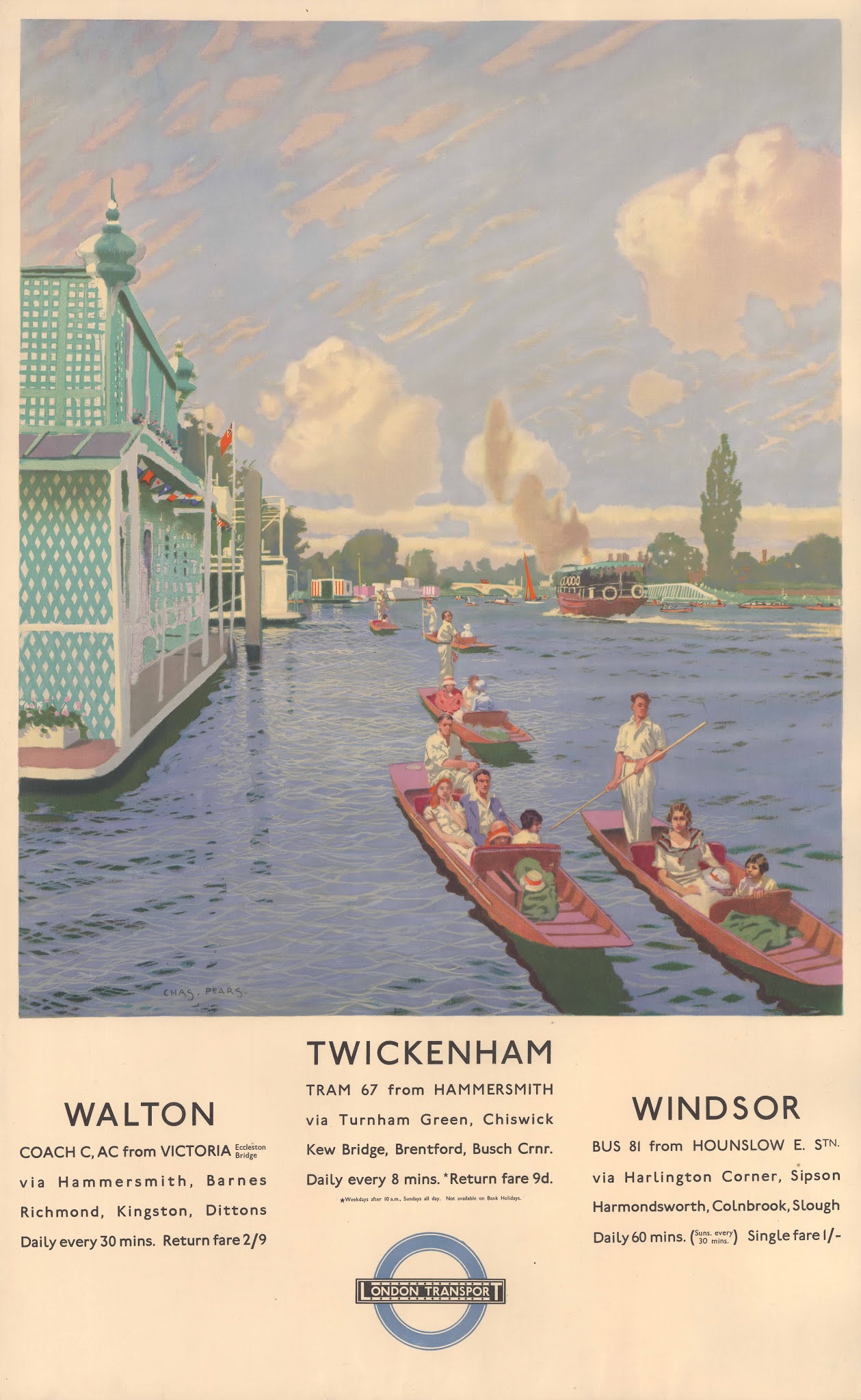
A poster for Twickenham, Walton and Windsor, showing people punting on the river

Twickenham, Walton and Windsor, Charles Pears, 1935

© TfL from the London Transport Museum collection

http://www.ltmuseum.co.uk/


The exhibition at Pontefract Museum
Spring on the River Thames, the original artwork for the poster, is on show in the exhibition.

Pick of the painters


It was Frank Pick, the Publicity Manager at London Underground, who initially recognised the potential of the travel poster. Pears was one of the first artists Pick worked with on an initiative to promote travel by public transport in leisure time as well as for commuting. As a marine specialist, Pears’ posters often promoted daytrips away from the hustle and bustle of the city along the picturesque banks of the River Thames. 

Between the wars, London Transport also ran special excursion services to Southend, the nearest beach resort to the capital. Pears produced no fewer than 14 different poster artworks for Southend, showing boats on the waves, water sports, local landmarks and all the attractions on offer. Visitors can see two examples in the exhibition, including the original oil painting for this sun-soaked scene.

Pears' illustrated poster for Southend on Sea, showing people playing in the sea in 1930s bathing costumes

Southend-on-Sea, Charles Pears, 1934

© TfL from the London Transport Museum collection

http://www.ltmuseum.co.uk/


Inspired by Frank Pick’s successful poster campaigns in London, railway companies also began to invest in the best artists for their adverts. After Britain’s many individual rail lines were grouped into the ‘Big Four’ in 1923, the newly formed regional companies each established advertising departments. They were competing with each other to attract tourists to the resorts on their lines, and only the most persuasive artworks would do. As an expert sailor and marine artist, Charles Pears was in high demand to provide seascapes that would tempt holiday-makers to the coast. 

This relaxing representation of Filey must have been an appealing image for passengers at Pontefract, which was served by LNER at the time. For the price of a rail ticket, they could escape the daily grind and get away from it at all on the East Coast. 

Pears' illustration of a young woman relaxing on the coast at Filey

Poster, LNER 'Filey for the Family' by Charles Pears, 1930

Science Museum Group

© The Board of Trustees of the Science Museum


A fun family day out


Certainly, at this time more people than ever before were flocking to the seaside with their buckets and spades. Families made sandcastles, wrote postcards and returned home with plenty of snapshots and souvenirs. As well as admiring Pears' posters, visitors to Pontefract Museum can also enjoy a trip down memory lane with retro holiday essentials and mid-century beach attire from the Wakefield Museums & Castles collection.

Retro bucket and spade, postcards and camera

Retro swim and beachwear

Elsewhere in the museum, you can admire even more of Charles Pears' skill and artistry. He enjoyed a prolific career and we weren't able to display all of his many designs in the exhibition but our slideshow includes posters for destinations all over the country and beyond. 

Inspired by Pears' example, graphic designer Georgina Westley has created a stunning new poster artwork for Pontefract. Adding a modern twist to Pears' style, she has produced a colourful celebration of his hometown today. Visit the exhibition to see the iconic view of the Buttercross and St Giles' Church in a new light!

There's also plenty for little ones to enjoy. Look out for the special family-friendly object labels and pick up your Take and Make activity bag, packed with seaside themed crafts inspired by the posters on display. 


Bracing Air, Abundant Amusements: The Travel Posters of Charles Pears is at Pontefract Museum, 24th May 2021 – 25th February 2022. 


The exhibition was made possible with a grant from the Weston Loan Programme with Art Fund.


To enjoy more of Charles Pears' work, check out our Curation on ArtUK for an overview of his celebrated career. 

Read more about Georgina Westley's poster in this special guest blog post

Monday, January 25, 2021

Digital Engagement Consultancy Opportunity

Wakefield Museums & Castles is looking to appoint a freelance digital consultant to develop a digital engagement strategy and action plan for the next three years. We want to review our current position, especially in light of the COVID-19 pandemic and its impact on the heritage sector, and develop an ambitious yet realistic strategy that will enable us to engage people with our collections in new and innovative ways.


In 2018, Wakefield Museums & Castles became a National Portfolio Organisation (NPO) funded by Arts Council England, to help them deliver their goal of ‘great art and culture for everyone’. Our current funding is in place until March 2023. One of the key aims of our NPO Business Plan is “to build a strong and diverse digital offer to raise our profile and improve the visitor’s experience and access to our collections and sites”. 

Over the past two years, we have made progress in achieving this aim; developing content for a new stand-alone website, developing the digital skills and expertise of our staff, and starting a programme of digitisation for our collections and historic documentation. However, it was the COVID-19 pandemic and subsequent closure of our museum sites that really pushed us forward in our use of digital. We quickly transitioned to a virtual offer, repurposing our Discover the Extraordinary blog to serve as a central hub for all our digital resources, and significantly increasing our social media output. We experimented with different types of content and platforms, always with the aim of maintaining access to and engagement with our collections and sites and keeping them at the heart of all of our content.

We would now like to undertake a review of our progress and use the valuable lessons and skills we have learned to develop an ambitious yet realistic digital strategy that will focus on digital audience development and engagement with our collections in new and innovative ways, over the next three years and beyond.


We want to:

  • Understand, increase and diversify our digital audience;
  • Increase engagement with, and accessibility of, our collections and sites through digital and be able to measure this;
  • Encourage creativity and community involvement with our digital activities;
  • Explore how we use digital interactions at our museum and castle sites;
  • Provide an online museum experience for those unable or unwilling to visit our sites in person;
  • Enhance the digital skills, expertise and confidence of our team, and effect a culture change in our organisation whereby digital becomes part of everyone’s role.

We are looking to appoint a consultant to help us devise a digital strategy and action plan, including:

  • Analysis of our current and target digital audiences (as distinct from our footfall audiences), and a methodology for measuring and evaluating digital impact, which might include benchmarking, analytics, KPIs etc.;
  • A strategy and streamlined process for developing and creating collections-based digital content, to reach new and more diverse audiences. This could include virtual tours, digital exhibitions and learning resources, videos, podcasts, games, mobile apps, live-streaming etc., featuring on our own website and/or third-party websites, including social media platforms;
  • An options analysis for future use and development of our Collections Online facility, including the introduction of open licensing;
  • The potential for user-generated digital content, including curated collections, exhibitions, tours, contributions of memories/information;
  • Digital interpretation techniques for use at our museum and castle sites, or at alternative sites in our communities, which could be anything from virtual reality experiences to touchscreen kiosks, and may involve third party developers;
  • The technology, hardware, software, tools and equipment needed to achieve our digital goals;
  • Staff training and skills development, ensuring everyone has the right level of digital capability and competency.


How to apply:

Please submit to lmellors@wakefield.gov.uk the following documentation:

  • A CV or resume of your previous experience, qualifications, skills, references etc.
  • An indicative project plan, showing how you would meet the objective and outputs of the project. This should be no more than 4 sides of A4.
  • A simple budget showing how you will be using the available budget and how you will fit the timescale for delivering the project.
  • You may also include photographs or testimonials from previous projects if you feel they will be relevant to your application.

If you are shortlisted, you will be asked to attend an interview, via Skype, where you can expand upon your proposal and give a presentation to the project board.

Closing Date: Monday 15 February 2021, 9am

Interviews will take place in the week commencing 22 February 2021.

Friday, October 18, 2019

Surrealism x visual impairment


Artist Cerys Dyson is currently exhibiting her photographic project ‘surrealism x visual impairment’ on ‘The Wall’- Wakefield Museums and Castles mini gallery- in Create Café at Wakefield One.


Photophobia, by Cerys Dyson


We asked Cerys about her work:


"My name is Cerys Dyson, I have studied a HND in photography at Wakefield College which is where the idea & project of ‘surrealism x visual impairment’ came from for my final major.

As well as just a project it has a deep sentimental value for me as I was born with nystagmus - living with it means I know what it’s like, but I wanted to push my boundaries further to investigate different conditions and raise awareness of how visually impaired people see!

Pictures within my project cover conditions such as photophobia, diabetic retinopathy, cataract, macular degeneration, tunnel vision and of course nystagmus! I also made a book which explains the conditions in detail to match the pictures.

Diabetic Retinopathy, By Cerys Dyson


Further progression for this project's audiences could ideally be in eye clinics, hospitals and other photographic galleries! "


Surrealism x visual impairment will be exhibited at Create Cafe until 11 November.
  
See more work from Cerys on Instagram: @cdysonphotography


Cerys Dyson


Thursday, March 28, 2019

Work experience with refugee communities

We are happy to welcome a guest-blog post from a Leeds University work experience student, Yanlinyi Xia.

I am an international student from China currently studying Art Gallery and Museum Studies at the University of Leeds. For my studies I am undertaking a placement with Wakefield Museums and Castles. The course I study covers different aspects of museum and gallery work including interpreting the past, engaging audiences and the history of museums. This provides me with a context and background in museum theory but my course also includes a work experience module, undertaking a placement with a museum to work on a project and get real world experience. 

My work experience project is with Wakefield Museums and Castles and I am supporting their work with Wakefield refugee communities. This project is a partnership between the museum service, World Jewish Relief for refugees (part of their Specialist Training and Employment Project (STEP) programme), and Horton Housing Association. I was so excited when I saw this, as an international student from China I am also new to the UK, and I think most of us have no idea about what happens to refugees in the process of resettling somewhere else. This experience has changed my thinking a lot. The STEP programme supports resettled Syrian refugees at the beginning of their journey into employment in the UK. This is a pilot project with the museum service and aims to provide a cultural and historic context, supporting the refugees to get to know the heritage of the local area where they are now settled. Tali Krikler, a freelance Learning and Participation consultant working for World Jewish Relief collaborated with the Museum Collections Officer to develop workshops in the museum exploring the local history and working heritage of the Wakefield District. Horton Housing, a not-for-profit organisation providing housing, training and support services to the most vulnerable people in society, supported the participants to attend the sessions and provided translation services.


In total five workshops were arranged over five weeks, meeting once a week on Wednesday afternoons. Each workshop covered a specific theme working with participants to investigate different industries and working life in Wakefield, historically and today. Tours were arranged around the museum for participants to see some of the displays and the workshops also featured hands-on sessions looking closely at different historic objects and discussing how they relate to work in Wakefield and their own working lives. I am still disappointed I could not attend on the “Food day” and taste the delicious cakes the participants brought in!


I have really enjoyed recording all the special moments in this project, talking with participants and photographing the sessions. The handling objects sparked curiosity, and everyone had an opportunity to handle the artefacts and learn more about the heritage of their new home town. People also liked to link unfamiliar objects to what they are familiar with from their lives in Syria. We look forward to finding more links between Wakefield and Syria to help spark discussion and raise the confidence of those who attend. The workshops also helped the participants to develop their English language and learn new words.  


Seeing participants learning and exploring by visiting the museum was the best thing for me!


There were lots of things to consider when planning the workshops; how do we decide the weekly theme? What methods do we use to encourage engagement? How do we measure what they have learned and how much they feel the sessions were useful? We are now planning a small display to highlight some of the key objects and themes that sparked interest. Please check back here and other social media for more details coming soon!


Monday, April 30, 2018

Pontefract Museum reopens on 14 May

Pontefract Museum is reopening on May 14 - with new displays and a new photographic exhibition featuring 100 years of shopping in the town.


The Museum has undergone a £65,000 refit funded by the Arts Council England, which is in addition to £120,000 that has been invested in gallery redevelopment and upgrades since 2015.


The work, made possible with grant funding from Arts Council England, has transformed Pontefract Museum. The new displays are exciting, accessible and tell wonderful stories of Pontefract’s rich and diverse past.


The new displays tell the story of Pontefract from the Georgian period up to the present day. The ballot box used in the first secret ballot to elect an MP in 1872 takes prominent position, with new comic book style interpretation. There are also new interactive and family friendly elements.


Also opening on 14 May is a new special exhibition, Sale of the Century - 100 years of Shopping in Pontefract.  This photography exhibition takes visitors on a shopping trip down memory lane exploring nostalgic images and contemporary views of the shops at the very heart of Pontefract.


Pete Massey, Director North, Arts Council England said


“We are delighted to welcome Wakefield Museums into our National Portfolio for 2018-22.The Museums service has planned even stronger community engagement and it is very exciting that Pontefract Museum is reopening after undergoing vital refurbishment work. I’m sure that the new displays will attract both local and visiting audiences to learn more about Pontefract’s history.”


To mark the reopening a celebration event, open to everyone, takes place on Saturday 19 May, 12.30 - 2.00pm.  For more information visit www.experiencewakefield.co.uk/pontefractmuseum


Arts Council England is the national development body for arts and culture across England, working to enrich people’s lives.  We support a range of activities across the arts, museums and libraries – from theatre to visual art, reading to dance, music to literature, and crafts to collections. Great art and culture inspires us, brings us together and teaches us about ourselves and the world around us. In short, it makes life better. Between 2018 and 2022, we will invest £1.45 billion of public money from government and an estimated £860 million from the National Lottery to help create these experiences for as many people as possible across the country www.artscouncil.org.uk

Wednesday, January 24, 2018

Walls, walls, walls!

Redevelopment work at Pontefract Museum is cracking on and it's all about the walls!


All of the old exhibition structures have been removed, as has the glass partition, leaving the space looking huge...


There were blinds at the windows these have been taken down.  The windows will be decorated with vinyl designs by artist Fabric Lenny, his work can be seen on other windows at the museum.


The old blinds
The glass partition is being replaced with a stud wall. 


The new wall will give us lots of extra display space in both the main gallery and the special exhibition gallery.


The existing gallery walls are being boarded over to provide a solid and plain backing for the new displays.


The museum exhibition team is also working on the interpretation, providing  graphic designers InchPunch with content for the exhibition panels and preparing the objects for display.


Work left to do includes painting the ceiling and new walls, building new display structures and installing new museum cases.


Pontefract Museum will reopen in the spring.  Follow @WFMuseums for updates.


Thursday, January 4, 2018

Pontefract Museum Gallery Redevelopment

Pontefract Museum is currently closed to enable us to carry out some exciting new gallery redevelopment work.


The museum closed on 23 December and after the staff had had a nice Christmas break work has now started in preparing the spaces for building work.


The first stage of the process is to wrap and protect all of the elements of the display that are remaining in the gallery (about two thirds of the gallery was redeveloped in 2016)


Elements of the display are covered for protection


Cases and parts of displays have been moved


A quick sweep up


Bit by bit objects are carefully removed and packed.  Some of the larger objects need specialist removers who will use lifting equipment.


Objects are packed on to crates for removal to the museum store


The next stage will be the removal of the green display structures you can see in some of the above photographs and the remaining elements of the old displays.  The ceiling will be painted white (it is currently black) and the gallery walls will be boarded out. 


As Pontefract Museum is  listed  we have been granted listed building consent to do this work.  All work has to be carried out so as not to damage any of the remaining original features of the beautiful art nouveau building.


Check back soon for more updates and follow @WFMuseums on Twitter.