Showing posts with label exhibition. Show all posts

Friday, July 11, 2025

Cynthia Kenny: A city framed - now open at Wakefield Museum

We've opened a new exhibition at Wakefield Museum celebrating the life and work of local artist, Cynthia Kenny (1929-2021)!

The exhibition, Cynthia Kenny: A city framed, is open until June 2026. It explores our changing city through the artist’s eyes.

Three adults sat on outdoors-inspired seating in the centre of the Cynthia Kenny gallery, with landscape and architectural buildings framed against deep blue walls
Photo credit: Nick Singleton

Cynthia Kenny was one of Wakefield’s most important artists. She painted places in Britain and beyond and exhibited around the world. But Wakefield always held a special place in her heart. From the 1960s to 2000s, Kenny documented Wakefield’s changing landscape.

The exhibition features cityscapes, rural scenes, and detailed studies of buildings. Visitors can admire iconic views and well-known landmarks and discover Wakefield’s hidden gems.

As well as producing her own intricate works, she was a founding member of Wakefield Art Club. Kenny was also a trustee for the Friends of Wakefield Art Gallery and Museum for many years.

The artworks are also brought to life by a new soundscape, created by artist Michelle Duxbury. Her recordings from the city to evoke a day in the life of Cynthia’s Wakefield. Duxbury has also recorded creative audio descriptions for several of the exhibition’s star works.

You can also find out more about Kenny’s influence and legacy. Enjoy an exclusive new film by Nick Singleton featuring interviews with Kenny’s friends, colleagues, and contemporaries.

The exhibition also reveals how Cynthia Kenny continues to inspire artists today, showcasing new photography by members of the Wakefield Museums and Castles Youth Forum.


There's more info, photos and videos from the exhibition on our Cynthia Kenny: a city framed page.

Wednesday, January 25, 2023

Moving Stories - Opening 6 February 2023


Decorative poster for Moving Stories at Wakefield Museum. Features motif of packing boxes with the Wakefield Museum logo on, surrounded by speech bubbles and movement, with stories waiting to break out of the boxes!

Moving Stories

Wakefield Museum

From 6 February 2023

Free Entry

Wakefield Museum is getting ready to move! 

We are developing an exciting new Library & Museum in the former British Home Stores (BHS) building in the heart of Wakefield city centre. As we prepare for the big move, we want to celebrate our story so far and we need your help to write the next chapter.

A postcard from the 1970s of Kirkgate, Wakefield, showing BHS (as British Home Stores) and Marks & Spencer shopfronts and people going about their daily business
A postcard of Kirkgate, Wakefield in the 1970s

Launching in the museum’s centenary year, Moving Stories is a vibrant, interactive exhibition. Join us for a look back at the stories we’ve told over the last 100 years. Discover the new stories that we’ve been hearing. And tell us your own story.

Take a peek behind the scenes and find out how we plan to turn an empty, old department store into awe-inspiring museum galleries. Let us know what you would like to see in the new venue. Be part of the story as we work together to create something special for the Wakefield district. 

A map of the Wakefield district with coloured sticky notes and flag pins full of people's answers to the question "What puts Wakefield on the map?" at an event in Featherstone last summer.
Responses to "What puts Wakefield on the map?" at an event in Featherstone last Summer

Moving Stories features exciting new illustrations by West Yorkshire artist, Tom Bailey.

Tom Bailey is an artist from Leeds who draws pictures to make things easier to understand. He often attends events, listens to people and draws what they say. Tom also illustrates books and makes murals. Have a look at more of Tom’s pictures on Instagram at @mrtombailey.

Click here for some photos from the exhibition and a selection of Tom's drawings going on display!

Click here for visitor and access information at Wakefield Museum


The new Library & Museum is funded by the government’s Levelling Up Fund and Wakefield Council. The project is part of the Wakefield City Masterplan, which aims to deliver improved facilities for residents.

Tuesday, November 8, 2022

Volunteer Opportunity: Exhibition Engagement & Evaluation Volunteer

From 14th November 2022, we will open an exciting new exhibition at Pontefract Museum – Women in Rugby League: Life with the Lionesses! This motivational touring exhibition showcases the women pioneers of international rugby league. For more information on the exhibition, click here.

We are looking for Exhibition Engagement & Evaluation Volunteers to support the project. 

You will welcome visitors to the exhibition space, provide information about the objects on display, help our Visitor Experience Assistants to monitor the security of the loaned objects, and gather visitor feedback about the exhibition. 

You will help us to ensure that every visitor to the exhibition feels welcome, learns something new, and has an enjoyable visit.

a volunteer engaging with a young visitor at Pontefract Museum

This opportunity is based at Pontefract Museum, 5 Salter Row, Pontefract, WF8 1BA.

What will I be doing?

Based in the exhibition gallery, you will:

-       Welcome visitors to the exhibition space.

-       Provide a brief introduction to the exhibition content and answer any questions visitors might have.

-       Encourage visitors to engage with the interpretation, including short films and dressing up/selfie opportunities.

-       Be present in the exhibition space to keep a close eye on the objects on display.

-       Observe how visitors interact with the exhibition and feedback to the Curatorial & Exhibitions team.

-       Invite visitors to answer a short evaluation survey.

What skills, experience and qualities do I need?

-       Interest in museums, collections, history or sport.

-       Good verbal communication skills.

-       A friendly, approachable manner and the confidence to speak to members of the public.

-       Ability to work independently.

How much time will I be expected to give?

-       At least one morning or afternoon per week – a regular slot would be preferable.
The museum’s opening hours are 10am - 4:30pm, Monday to Friday, and 10:30am – 4:30pm, Saturday. The museum is closed on a Sunday.

The exhibition runs from 14th November 2022 until 26 August 2023.  

What can I expect from Wakefield Museums & Castles?

-       A unique chance to work on an inspirational touring exhibition, the first major celebration of women’s international rugby league.

-       A welcoming and friendly team of staff and volunteers to work with.

-       Induction, full training, and ongoing support.

-       A named member of staff to provide support and answer questions.

-       Opportunity to develop skills, knowledge and confidence.

The induction programme for this role will include:

-       An overview of Wakefield Museums & Castles, our sites and collections- who we are and what we do.

-       Our volunteer policy and the volunteer agreement (signed by volunteers and their supervisor), including Assignment of Copyright and our Transparency Notice about how we process and protect your personal data.

-       Relevant policies and procedures, including Health and Safety.

-       Training and information on the exhibition content, the evaluation survey, and how to respond to queries from the public.


How do I apply?

Please email MusCasVolunteering@wakefield.gov.uk with any queries or to request an Expression of Interest form.

For a range of other exciting and varied volunteering opportunities with Wakefield Museums & Castles, click here

Monday, November 7, 2022

Women in Rugby League: Life with the Lionesses

Pontefract Museum
14 November 2022 – 30 September 2023


We're excited to be hosting Life with the Lionesses: The Exhibition. Partnership with Women in Rugby League

This motivational touring exhibition showcases the women pioneers of international Rugby League: the Lionesses. Hear from the women themselves and follow their ground-breaking journey on and off the field - from fundraising for their own tour, to playing on an equal stage with their male counterparts in the 2021 World Cup.

Visitors to the exhibition will discover a previously hidden history with a timeline spanning 100 years of women’s sporting achievements.

The exhibition opens at Pontefract Museum on 14th November, ahead of the World Cup final, which takes place in England on Saturday 19th November.  


Photo of the England women's rugby league team, the Lionesses, in action in 2002
The Lionesses in action in 2002

Many of the trail-blazing women featured in the exhibition come from or have played in the Wakefield district, including the inspirational coach, Jackie Sheldon. Her team tracksuit, jersey, and blazer will be on display in the exhibition alongside other previously unseen objects from the women’s rugby league archive, kindly lent by Heritage Quay, University of Huddersfield.


Photo of Jackie Shelton in front of exhibition information about her career and legacy
Jackie Shelton at the touring exhibition


Visit Pontefract Museum to discover this hidden history and celebrate how far the Lionesses have come.

For visitor and access information, click here

Opening times:

Monday
​10am – 4.30pm
Tuesday
​10am – 4:30pm
Wednesday
​10am – 4:30pm
Thursday
​10am – 4:30pm
Friday
​10am – 4:30pm
Saturday
​10:30am – 4:30pm
Sunday
​Closed

FREE entry


For more information about the exhibition, visit https://experiencewakefield.co.uk/event/women-in-rugby-league-life-with-the-lionesses-exhibition/

Find out more about the Women in Rugby League project at https://www.womeninrugbyleague.org.uk/

Interested in volunteering at this exhibition to help make it a success? Find out more here

Monday, October 3, 2022

#CleverClogs - New Display at Wakefield Museum

Sarah Verreault, a student at the University of Leicester’s School of Museum Studies, has completed an audit of the museum’s shoe collection over the past eight weeks. She has chosen the story of British clogs, locally worn and produced, to highlight in a new display at Wakefield Museum

Learn more about these #cleverclogs in her blog below!

Sarah Verreault with her Clogs display at Wakefield Museum


What are British clogs?


A British clog has a leather upper, a wood sole, and irons nailed into the heel and sole.

They first appear in written accounts in the 1600s in Lancashire, Cheshire and Cumbria, then spread to the rest of the north of England. They reached peak popularity in the second half of the 19th century. They declined in the first half of the 20th century as other types of shoes became more affordable and fashions changed. Clogs then became a symbol of poverty and charity. Some industries, such as heavy engineering and farming, continued to use clogs. Today, they remain popular for certain kinds of dances such as Morris dancing and clog dancing. Other styles of wooden soled shoes still come in and out of fashion.

Clog making is now on the Heritage Craft Association’s Red List of Endangered Crafts with only five registered full-time makers.

A child's pair of red-brown leather clogs with a nailed wooden sole. They have an ankle bar with a small brownb button, and a small decorative steel buckle. There is brass on the toe tip. They have horseshoe irons on the sole and heel.
A child's pair of leather clogs, with horseshoe irons on the sole and heel, dating between the 1920-1950s


How are clogs made?


The leather uppers were made in the same way and styles as other types of shoes. New and old shoes could be clogged to make them more hard-wearing. A pair of uppers could be re-ironed and reclogged many times, so the leather was well cared for.

The clog-block maker would harvest the wood, preferably alder, and cut it into blocks to sell to the clogger. The clogger carved the blocks into a sole. Like other shoes, until the middle of the 19th century, they were made on straight lasts, meaning that the left and right were the same shape. If the clogger was skilled enough, the sole could be fit to the foot of the customer.

Earlier clogs were bound around the edges with hoop-iron. The familiar grooved horseshoe irons became more common in the early 19th century. The local blacksmith or the clogger would fit the irons. Extra protection like iron plates and leather pads could also be added.

A pair of child's clogs made from black-brown leather, with a square wooden toe
A pair of child's clogs, with leather upper and a square upturned toe, dating likely from 1850-1900

Where were they worn?

Clogs were particularly present in the north of England and the south of Scotland but do also feature elsewhere. They are well suited to the landscape and weather in this region. Clogs require a special rocking or rolling movement to walk because they are much heavier and stiffer than shoes.

They were worn by women and men, adults and children, in the country and cities. They were worn at work and in everyday life including to church. Crimp clogs, called ‘dandy’, ‘Sunday’ or ‘neat’ clogs, would have elaborate designs cut into the upper. Children used to play at making sparks fly by hitting their irons on stone. The wood sole wore through stockings quickly so many people wore clogs bare foot. With or without stockings, they were often lined with straw, hay or bracken.

They were worn in mines, quarries, pits and kilns, in building trades, docks and wharfs, agriculture, transport, brewing, mills and factories. Different styles of uppers were associated with different occupations such as the miner’s blutcher clog whose upper only has two pieces or brewer’s clogs with watertight tongues and very square toes. How long a pair would last depend on who wore them and where. Pit clogs would last a little over a year, but in a mill, they could last 20 years with care.


Local Connections: Wm. Lamb Clog Manufacturer

Based in Bottomboat, Stanley, West Yorkshire, the company began in 1887 when William Lamb began producing clogs for miners. It then expanded to supplying shoes for women working in cotton mills. They became one of the biggest British clog manufacturers.
Seven male workers stood outside the Wm Lamb Clog Manufactuers Shop. There is a horse and cart with an array of clogs on display, and one of the men is stood on the cart holding a pair for sale. The other workers hold an array of tools and clogs, and one has his hand petting a dog.
Workers stood outside Wm. Lamb Clog Manufacturers' shop, c.1900-1920

In the 1920s, the company started making work boots, and army boots during the First and Second World Wars. Later in the century, they manufactured football boots and trainers. Today, they have stopped manufacturing and are focused on importing footwear.

Black and white photo of the outside of Wm. Lamb Clog Manfuacturer, a rectangular brick building, two floors high, with large windows. There is a clogger stood at the first floor opening, a mustachioed man in a car loaded presumably with clogs, and three other workers in flat caps stood outside posing for the camera
Wm. Lamb Clog Manufacturer in Bottomboat, c.1910-1925


The Clogs - Dress to Impress exhibition is now on display at Wakefield Museum in the main gallery. For opening times and access information, click here

Looking for a soundtrack for your clog-tastic reading? We've put together a Spotify playlist inspired by Sarah's shoe audit here!

To learn about another important industries in the Wakefield area, Ossett's shoddy and mungo trade, click here.

Friday, March 11, 2022

Wakefield Museums & Castles shortlisted for 'museums Oscar!'

We are thrilled and proud to have been shortlisted for the Museums + Heritage Sustainable Project of the Year Award 2022, for our project, A World of Good.


Known as the ‘Oscars of the museums world’, the Museums + Heritage Awards celebrate the very best in the world of museums, galleries, cultural and heritage visitor attractions. Hundreds of entrants from around the world will battle it out to win one of seventeen prestigious awards. The Sustainable Project of the Year award is sponsored by the National Lottery Heritage Fund, and celebrates outstanding environmentally sustainable projects or exhibitions, which can demonstrate best practice in approaches to managing environmental impacts.


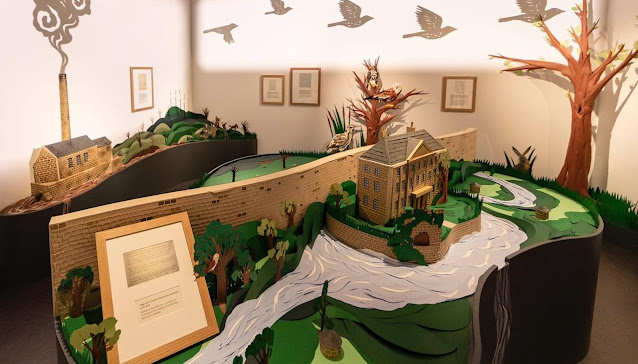
Wakefield Museums & Castles have been shortlisted for A World of Good, a project designed to inspire positive action on the climate crisis. At the centre of the project is the immersive, multi-sensory A World of Good exhibition at Wakefield Museum, which uses sculpture, animation and sound to bring the work of 19th-century environmentalist Charles Waterton to life. It asks visitors to sign up to an environmental manifesto and make a pledge to take real and meaningful action on the climate crisis.


Our Do A World of Good pledges are simple and practical ways you can make a difference.


Alongside the exhibition, we have produced educational resources for schools and communities, a social media campaign, and events and workshops designed to inspire and motivate you to make a change. Our team have also written an action plan to reduce the carbon footprint of our museums and castles.

“It is great to see the Museums & Castles team being acknowledged for this project, which addresses one of the most urgent contemporary issues we face. Museums play a vital role in engaging and educating people about the world around us and A World of Good is a perfect example of that.”

Councillor Michael Graham, Cabinet Member for Culture, Leisure & Sport for Wakefield Council


The winner of the Museums + Heritage Awards will be announced at the Museums + Heritage Show on 11 May 2022.


You can visit the A World of Good exhibition at Wakefield Museum until July 2022, or find out more about the project on our A World of Good pages on this blog.

Follow @WFMuseums #AWorldOfGood and #DoAWorldOfGood on Twitter for more content and join in the conversation on the hashtags - we'd love to hear how you are Doing A World of Good in your home, garden, work or lifestyle. 

Find out more about the awards and all the amazing shortlisted projects on the Museums + Heritage Awards website.


Friday, October 8, 2021

Our Museums Change Lives!

Wakefield Museums & Castles have been shortlisted for the Museums Association's Museums Change Lives Best Project Award 2021, for our project A World of Good.

The Museums Change Lives awards are awarded by the Museums Association, the sector body for museums in the UK, to recognise and celebrate outstanding practice by UK museums delivering social impact. They promote the best examples of work by museums and individuals that support communities and engage with contemporary issues. Previous winners of the award include National Museums Northern Ireland and the Jewish Museum London.

We have been shortlisted for the Best Project award for A World of Good, a project designed to inspire positive action on the climate crisis. At the centre of the project is the A World of Good exhibition at Wakefield Museum, which uses sculpture, animation and sound to bring the work of 19th-century environmentalist Charles Waterton to life. It asks visitors to sign up to an environmental manifesto and make a pledge to take real and meaningful action on the climate crisis.

Gallery view of A World of Good exhibition at Wakefield Museum

Alongside the exhibition, we have produced educational resources for schools and communities, a social media campaign, and events and workshops designed to inspire and motivate you to make a change. We have also written our own action plan to reduce the carbon footprint of our museums and castles.

Councillor Michael Graham, Cabinet Member for Culture, Leisure & Sport for Wakefield Council, said “It is great to see the Museums & Castles team being acknowledged for this project, which addresses one of the most urgent contemporary issues we face. Museums play a vital role in engaging and educating people about the world around us and A World of Good is a perfect example of that.”

The winner of the Museums Change Lives award will be announced at the Museums Association annual conference on 8 November 2021 and we'll share the news on our Twitter account.

You can visit the A World of Good exhibition at Wakefield Museum until July 2022, or find out more about the project here

Thursday, June 3, 2021

Bracing Air, Abundant Amusements: The Travel Posters of Charles Pears

Blog post from 2021. This exhibition has now closed, however there are lots of lovely photos and information about Charles Pears in this post!

We are very excited that Pontefract Museum has now reopened with a major new exhibition of artwork by Pontefract-born artist, Charles Pears (1873-1958). Bracing Air, Abundant Amusements: The Travel Posters of Charles Pears is the first retrospective of Pears’ work in his hometown. The exhibition focuses particularly on his prolific career as a commercial artist and will transport you back 100 years to the golden age of rail tourism, the British seaside holiday and poster design. 


National and leading art collections have kindly lent posters and original artworks to the show, including some that might even have been seen on platforms at Pontefract’s three rail stations in the 1930s. The exhibition also includes expert commentary from a leading authority on 20th century posters, as well as an exclusive new poster artwork for Pontefract. 


A marine master


The exhibition takes its title from the slogan of a poster promoting the 'Bracing Air' and 'Abundant Amusements' that holiday-makers and day-trippers could look forward to in Southend-on-Sea in 1927. Pears provided the artwork for the poster, showing yachts on the Essex waters. He was an enthusiastic sailor himself and had established a reputation as a leading marine artist, having served as an official Naval war artist during the First World War. 

Pears would go on to capture the Second World War on canvas too and later became the first president of the Royal Society of Marine Artists. He eventually retired to spend more time at sea and settled in Cornwall, where he painted his self-portrait, kindly lent to the exhibition from the Russell-Cotes Art Gallery and Museum, Bournemouth. It is the first time it has been exhibited in Pears' hometown, where he had first honed his artistic talent whilst growing up.

A self-portrait of Charles Pears out in a boat, wearing a captain's hat and smoking a pipe. He is an older, white gentleman.
Self portrait, 1944-46 by Charles Pears (1873-1958)
PHOTOGRAPH REPRODUCED WITH THE KIND PERMISSION OF THE RUSSELL-COTES ART GALLERY & MUSEUM, BOURNEMOUTH


Poster perfect


Pears went to school in East Hardwick and attended Pontefract College. As a young man, he moved to London and began his career as a cartoonist and illustrator, becoming a regular contributor to Punch and illustrating famous titles by authors like Lewis Carroll and Charles Dickens. 

A display case full of books illustrated by Charles Pears
Pears-illustrated books from the Wakefield Museums & Castles collection on display in the exhibition

An iconic illustration of the Mad Hatter's Tea Party from Alice and Wonderland drawn by Pears
Illustration in a 1907 edition of Alice in Wonderland, from the Wakefield Museums & Castles collection

In the 1920s and 1930s Pears perfected his trade as one of the travel industry’s go-to poster artists and enjoyed a successful commercial career. At this time, new public holidays and paid annual leave meant that people were enjoying more leisure time and heading off on holidays and day-trips. 

Most holiday-makers at the time travelled by train, taking advantage of summer timetables and special fares. In only the early days of radio and before television, the poster was the most effective means of mass communication and became the rail companies’ primary marketing tool. They turned to leading artists like Pears to produce the most appealing representations of resorts.

Bracing Air, Abundant Amusements includes many examples of Pears' most vibrant posters, alongside some of the original artworks. 

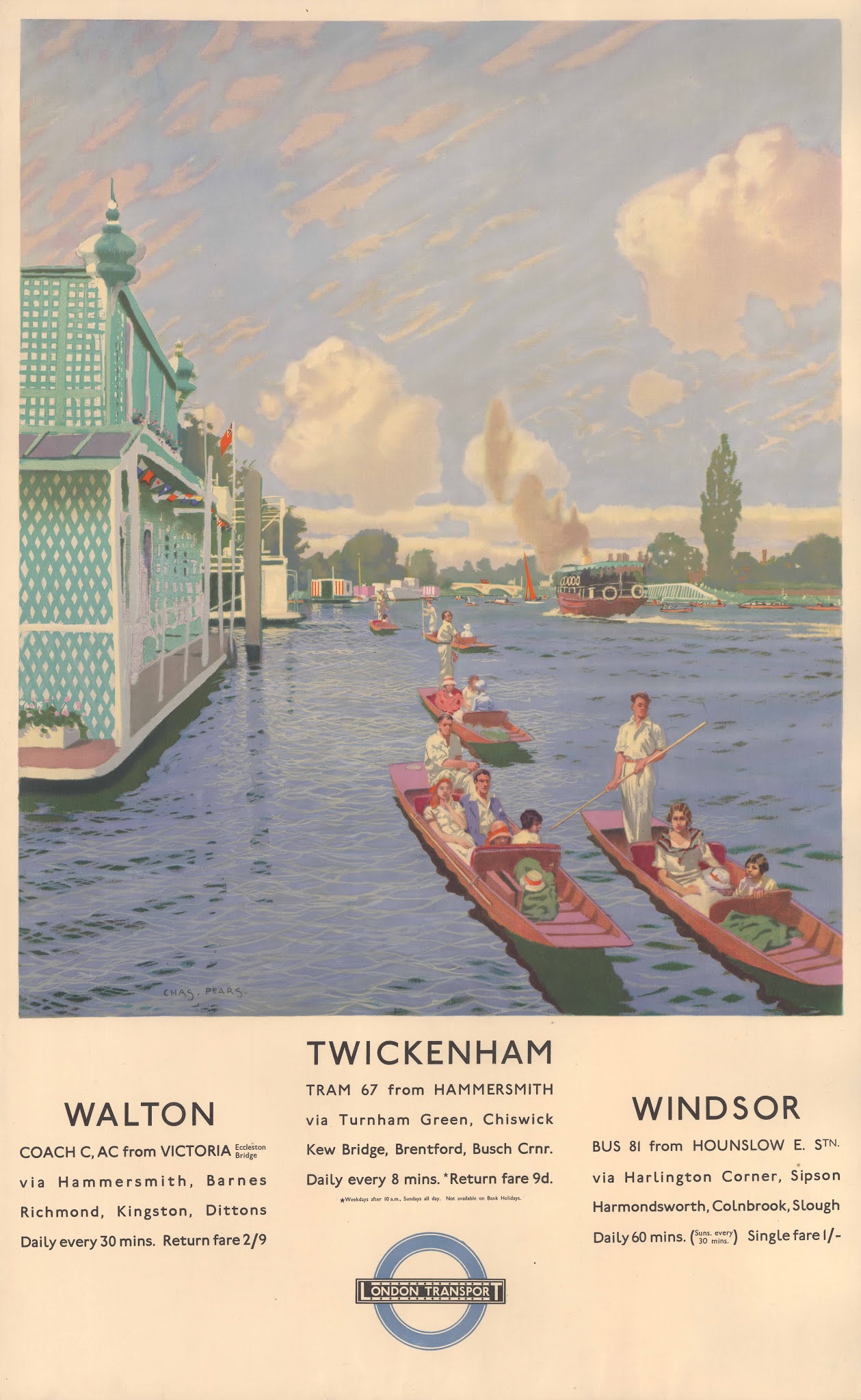
A poster for Twickenham, Walton and Windsor, showing people punting on the river

Twickenham, Walton and Windsor, Charles Pears, 1935

© TfL from the London Transport Museum collection

http://www.ltmuseum.co.uk/


The exhibition at Pontefract Museum
Spring on the River Thames, the original artwork for the poster, is on show in the exhibition.

Pick of the painters


It was Frank Pick, the Publicity Manager at London Underground, who initially recognised the potential of the travel poster. Pears was one of the first artists Pick worked with on an initiative to promote travel by public transport in leisure time as well as for commuting. As a marine specialist, Pears’ posters often promoted daytrips away from the hustle and bustle of the city along the picturesque banks of the River Thames. 

Between the wars, London Transport also ran special excursion services to Southend, the nearest beach resort to the capital. Pears produced no fewer than 14 different poster artworks for Southend, showing boats on the waves, water sports, local landmarks and all the attractions on offer. Visitors can see two examples in the exhibition, including the original oil painting for this sun-soaked scene.

Pears' illustrated poster for Southend on Sea, showing people playing in the sea in 1930s bathing costumes

Southend-on-Sea, Charles Pears, 1934

© TfL from the London Transport Museum collection

http://www.ltmuseum.co.uk/


Inspired by Frank Pick’s successful poster campaigns in London, railway companies also began to invest in the best artists for their adverts. After Britain’s many individual rail lines were grouped into the ‘Big Four’ in 1923, the newly formed regional companies each established advertising departments. They were competing with each other to attract tourists to the resorts on their lines, and only the most persuasive artworks would do. As an expert sailor and marine artist, Charles Pears was in high demand to provide seascapes that would tempt holiday-makers to the coast. 

This relaxing representation of Filey must have been an appealing image for passengers at Pontefract, which was served by LNER at the time. For the price of a rail ticket, they could escape the daily grind and get away from it at all on the East Coast. 

Pears' illustration of a young woman relaxing on the coast at Filey

Poster, LNER 'Filey for the Family' by Charles Pears, 1930

Science Museum Group

© The Board of Trustees of the Science Museum


A fun family day out


Certainly, at this time more people than ever before were flocking to the seaside with their buckets and spades. Families made sandcastles, wrote postcards and returned home with plenty of snapshots and souvenirs. As well as admiring Pears' posters, visitors to Pontefract Museum can also enjoy a trip down memory lane with retro holiday essentials and mid-century beach attire from the Wakefield Museums & Castles collection.

Retro bucket and spade, postcards and camera

Retro swim and beachwear

Elsewhere in the museum, you can admire even more of Charles Pears' skill and artistry. He enjoyed a prolific career and we weren't able to display all of his many designs in the exhibition but our slideshow includes posters for destinations all over the country and beyond. 

Inspired by Pears' example, graphic designer Georgina Westley has created a stunning new poster artwork for Pontefract. Adding a modern twist to Pears' style, she has produced a colourful celebration of his hometown today. Visit the exhibition to see the iconic view of the Buttercross and St Giles' Church in a new light!

There's also plenty for little ones to enjoy. Look out for the special family-friendly object labels and pick up your Take and Make activity bag, packed with seaside themed crafts inspired by the posters on display. 


Bracing Air, Abundant Amusements: The Travel Posters of Charles Pears is at Pontefract Museum, 24th May 2021 – 25th February 2022. 


The exhibition was made possible with a grant from the Weston Loan Programme with Art Fund.


To enjoy more of Charles Pears' work, check out our Curation on ArtUK for an overview of his celebrated career. 

Read more about Georgina Westley's poster in this special guest blog post

Monday, January 25, 2021

Rachel List: We're All In This Together

At the end of 2020, we were privileged to install a new exhibition at Pontefract Museum, the first ever solo show by local lockdown artist, Rachel List. Sadly, Covid-19 restrictions meant we weren't able to welcome visitors to the exhibition in person at the time so we brought Rachel’s colourful and poignant work to you online instead.

Now two years on from the first lockdown you are at last be able to enjoy Rachel's exhibition in person at the museum. Newly updated, it features some of her most-loved mural designs and a newly commissioned work. As well as admiring her paintings, you can also watch Rachel star in two short films, one on her work during Covid and another on what lockdowns have meant for her. See the show at Pontefract Museum until 29th October 2022.


Rachel List in her paint-covered clothes sat below her mural 'We're all in this together' with her arms outstretched. The mural is of two hands holding a paper-chain of people painted in rainbow colours.

When lockdown began, like many of us, Pontefract artist, Rachel could no longer go out to work. She normally spends her days painting murals in people’s homes, which was not allowed under the restrictions. But even though she was unable to do her day job, Rachel still had an urge to make art.

‘For me work is not just work, I’ve got that drive to create.' 

Rachel List

So she took her brushes with her on her daily exercise and started painting her murals outside instead, livening up walls around Pontefract while most of us were still sleeping. Her bright, colourful works brilliantly capture the spirit of that first lockdown when we clapped for the NHS.

‘A lot of us had been furloughed and were sitting at home feeling pretty useless … and it just seemed important to show support.’

Rachel's paint-covered clothes and paint pallets on paper plates on display at Pontefract Museum

Rachel painting the 'we're all in this together' mural

As a museum service we also want to collect objects that capture and tell the stories of Covid and lockdown in our communities. But of course we can't collect a huge mural on a pub wall. So we are immensely grateful to Rachel for recreating some of her work in a more manageable format for the exhibition. These paintings will also become a permanent part of the museum collection, preserved to tell the story of Pontefract’s lockdown for future generations.


A mural of an NHS nurse, wearing a face mask and boxing gloves, and crying rainbow tears

A mural of an NHS doctor or nurse in full PPE with rainbow wings

A wooden pallete painted with a hand painting a rainbow and the words 'we're all in this together'

A mural of an eye crying rainbow tears with the words "we turned our tears into a rainbow!

A nurse dressed in 1950s-style uniform, carrying a bucket of paint and a paintbrush, with the NHS logo freshly painted on the wall beside her

A mural of Captain Tom during his iconic walk, with rainbow balloons attached to his walker, and the painter nurse from the mural above beside him

‘It’s all about how something good can come out of a bad thing. There will be a rainbow after the storm.’
Rachel List


Films produced by Voices and Video - www.voicesandvideo.co.uk

To see Rachel's murals in their original locations and enjoy more of her work, why not explore our StoryMap:


Do you have a favourite Rachel List mural? Join in the conversation on social media using the hashtag #RachelList:

Twitter @WFMuseums, @Rachellist9
Facebook @PontefractMuseum 
Instagram @wakefieldmuseums, @rachthepachel