Friday, October 25, 2013

Fabulous Forties Vintage - Hat 3

Vote on your favourite 1940s hat by clicking on any of the cool / interesting / funny buttons below!

Hat option 3

1940s sweeping style!

Thursday, October 24, 2013

New approaches to working with schools

We have had a busy start to the school year.  From delivering workshops in role as Tudors and Victorians to finding out about Toys from the Past, our collections have been brought to life to children throughout the district.

We've also been trying some new things!

National Wool Week earlier this month saw pupils investigating the textile trade in Victorian Ossett.  Ossett was one of the main producers in the area for Mungo and Shoddy – Victorians were recycling even back then!  Looking at maps of the town, trade directories and census records pupils begin to piece together the lives of some of the inhabitants of Ossett over 130 years ago.  Working closely with the West Yorkshire Archive Service, pupils were introduced to Healey Mills in the late Victorian era, to learn new skills and about thier local area.
 
"Thanks for the workshop on thurs, was great and the kids loved it! We’ve loads to investigate now... Mini bus booked for Ossett!”

“The workshop was very meaniful to the children so they really enjoyed”

"Well organised and informative. Well worth the money. Thank you"


We've also been introducing digital technology to Primary School pupils - right through from Year 1 to Year 6!

New digital sessions using i-Pads have allowed pupils to look at the museums collections and create their own pieces of storytelling.  Younger pupils have been storytelling using digital puppet applications, whereas the Year 3s and over created short pieces of animation to explore Charles Waterton and the cayman on display in Wakefield Museum.


“The ipads really inspired the children to draw and join in, especially the less artistic.”
“Very enjoyable, the children loved the whole morning"

To find out about the sessions available to schools, please see the listing here, and/or email for further details.

Tuesday, October 22, 2013

Unique collections in demand

Some important Roman Castleford objects from the museum collections were loaned to Malton Museum for a dayschool on 17th October. The loans are parts of clay moulds and glass waste. At first glance, not the most exciting of finds.  
Part of a clay mould 
These strange lumps of clay were once moulds used to make highly-decorated bronze vessels with bands of colourful enamel on the outside. 
The type of beautiful enameled bronze flask that was made from Castleford moulds
None of the actual bronze vessels have been found (so far!), and so the evidence for them comes from the clay moulds which were broken open to retrieve the vessels after they had been cast.  The coloured glass was used to create the enamel coloured patterns. 

So far Castleford is the only place in Roman Britain where this specialist manufacture has been found.  

As they are manufacturing waste, they are not impressive to look at, and in the past archaeologists may have overlooked this type of evidence. The workshop was aimed at archaeologists, finds specialists and museum curators so in the future they are more likely to recognise this kind of material when it turns up in excavations.

Professional training workshop at Malton Museum last week
A sample of these very special clay moulds will be on display in the new Castleford Forum Museum.

Thursday, October 17, 2013

New museum display goes to Airedale Library!

Over the last 3 years, the 'You Are What You Ate' project has used evidence of medieval eating habits to examine how people eat today.  The project has included 3 exhibitions:

Sugar and Spice And All Things Nice at Wakefield Museum in 2011 (featuring some amazing 'bling' objects for medieval fine-dining)

The Dark Side of Eating at Pontefract Museum in 2012 (featuring the grim and grizzly effects of bad diet on the skeleton)

Food For All Seasons at Wakefield Museum in 2013 (featuring a stunning illuminated Book of Hours)

But we couldn't leave it there!

All 3 exhibitions have been distilled down into one display, which is now set to tour around the districts' libraries. 
The 'pod' will be in Airedale Library and Learning Centre until 12 January

The interactive 'pod' went into Airedale Library and Learning Centre this week - along with its bones, beer goggles, medieval cooking pot, recipe cards - and more!  A lot has been squeezed into this small display. Talks, school sessions and family activities are all being programmed in the libraries.

The pod is in Airedale until Sunday 12th January, and then moves onto its next venue.  Watch this space!


Plenty to see and do - including recipe cards to take away!


Wednesday, October 16, 2013

We're on TV this Thursday!

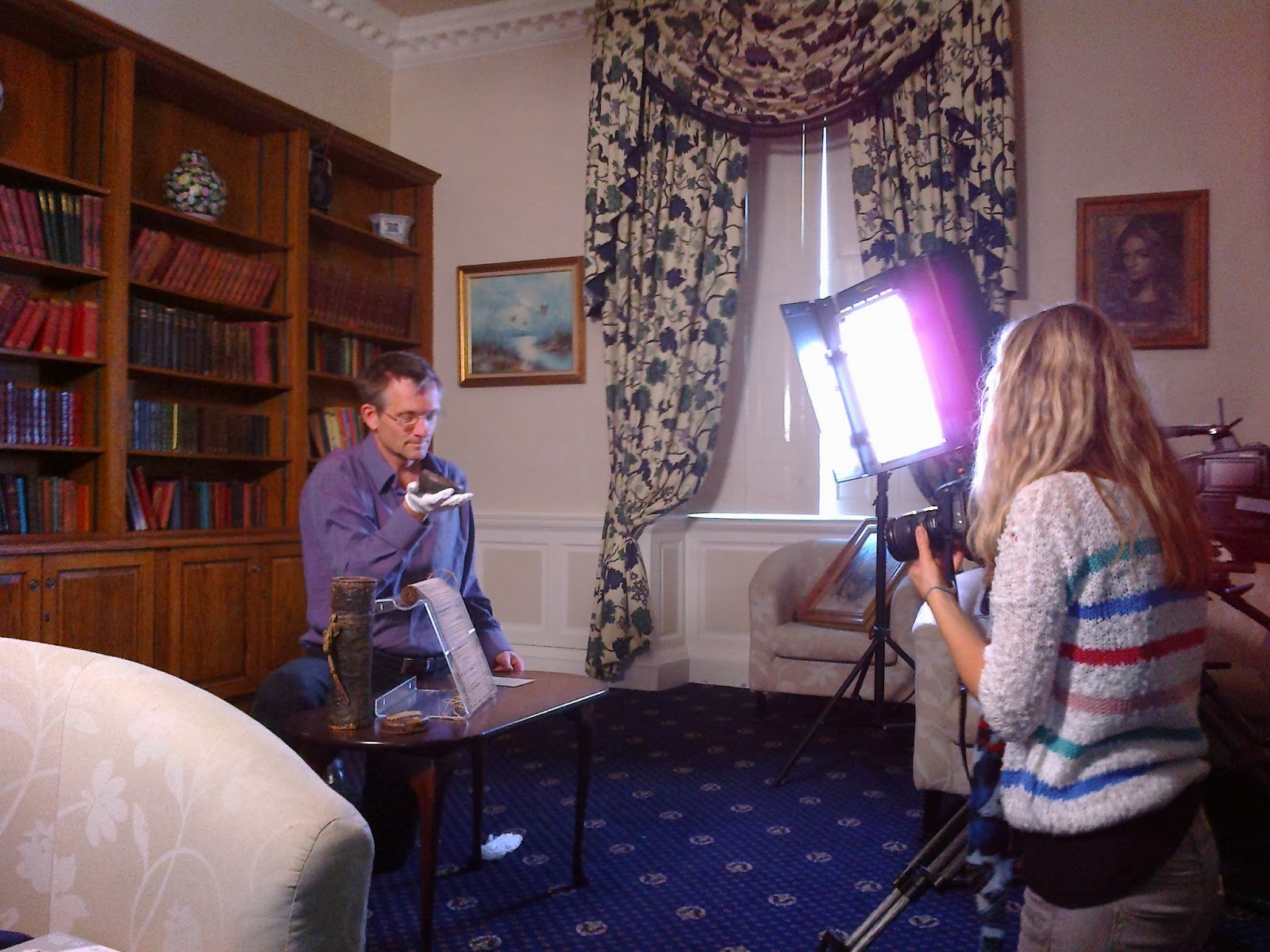
This Thursday at 9pm, Wakefield Museum’s collections will feature on Pain, Pus and Poison: The Search for Modern Medicines a new series on BBC4 hosted by Dr Michael Mosley. The series explores some of the unlikely and surprising sources of many modern drugs. 

This week's episode looks at how some poisons have become cures  for illness and features the work of Wakefield’s pioneering Victorian eco-warrior Charles Waterton. During travels in Guyana in South America in 1812 Waterton learned how the Amerindian tribes made curare, a poison with which they tipped blow pipe darts. He brought back powerful samples and applied them to a donkey, which he then kept alive by using a pair of bellows to keep it breathing. The donkey survived and lived for decades, and Waterton had led new research into modern anaesthetics.


Dr Michael Mosley wearing gloves and holding an object in front of an impressive bookcase at Walton Hall
Filming at Walton Hall

Dr Michael Mosley looking at objects on a table in front of a book case at Walton Hall
Don't get too close to those darts Dr Mosley!

Tuesday, October 15, 2013

Moustache Musings

Guest Blogger - Mr Percy Tew's Moustache

Greetings and salutations to all moustache enthusiasts. I have the splendid honour of being asked by Wakefield Museum to do a ‘guest blog’. 
Allow me to introduce myself, I am the fur, the mane, the whiskers, the strands, the lip thatch the marvellous and resplendent moustache of Mr Percy Tew.

Percy Tew and I in1889

The face upon which I reside belongs to that of Percy Tew, the eminent and important Wakefield Banker.  You may find us in the hallowed chambers of the West Riding Bank on Wood Street Wakefield.

I have been asked by the pogonophiles (those who love or study beards) at Wakefield Museum to discuss my life as a distinguished moustache and tell you about the forthcoming exhibition at this fine venue.
The life of an illustrious moustache such as myself, comes with grave and significant responsibilities. As a banker’s moustache I must represent stability, responsibility, trust and morality.  Mr Tew and I are to be trusted, admired and revered.  I must be constantly in perfect order, this is no mean feat. For example Mrs Tew likes to ensure that her beloved husband is well provided with tea, but a hot cup of steaming tea can play havoc with one’s moustache styling – a drooping moustache is not an attractive or desirable look.  Luckily there is a fine invention to combat this terrible peril – the moustache cup.  A small crescent shaped lip is applied to the cup allowing the moustache to gently rest whilst supping, keeping the strands safe from wilting.

I like to think that I have assisted with some of Mr Tew’s most inspired ideas, as when he is deep in thought he often twiddles some of my longer strands.  I am well rewarded of course,  Mr Tew keeps impeccably groomed, visiting his trusted barber frequently.  He also uses the best brand of moustache wax and has several effective and beautiful moustache brushes.
I note with considerable interest the varying styles of men’s hair featuring in this new exhibition.  I am astonished and alarmed to see some of the slapdash and, frankly shocking, ‘modern’ styles some men find acceptable.  It even transpires that men now shave at home – themselves – how preposterous.  

I would encourage all forms of facial hair to visit this most informative and entertaining display.
Now I ‘moustache’ I have a very important banking problem to solve with Mr Tew…

Men in the Mirror: opens Saturday 26 October at Wakefield Museum. Free admission.

Thursday, October 10, 2013

Drambuie bottles, hobnail boots and crisp packets

Artefacts or objects – Why do we collect and display what we do

After a Twitter post about objects going on display at the new Castleford Forum Museum (opening soon by the way!) we had a comment in response questioning the use of the word ‘objects’:

Hope you mean artefacts I see objects in the street & don't want see them in a Museum?”

This got us thinking….

When we think of the ‘great’ museum artefacts we are lucky enough to be able to see in our country’s museums we may think of The Rosetta Stone, The Piltdown man, The Sutton Hoo burial and The Crown Jewels.  These fabulous, unique, inspiring and priceless items are crucial in telling the story of Britain, and exploring its place in the world.  So how do you feel about museums collecting and displaying a Drambuie bottle or a hobnail boot?

As a museum service we have a collecting policy which informs what is added to, and kept in, our collections.  Here is an extract from our policy:

‘Wakefield Council’s Museums collect, safeguards and make accessible approximately 118,000 objects that document and record the human, social and cultural history of Wakefield and district from the distant past to the present day. We want to enable both citizens and visitors to the district to explore these collections for inspiration, learning and enjoyment.’

It goes on to say:

‘Wakefield Museums collects social history material that enhances an extensive collection showing the changing lives of people in the Wakefield district since 1650. Formal collecting first began in the early 1920s. Together, this material is evidence of the way of life and achievements of people who lived or live in the Wakefield district.’

Our collection includes some amazing objects.  The collections that will be going on display at Castleford Forum Museum are varied and fascinating, unraveling the story of Castleford and the people who have lived there:

Bronze Age settlers who left bone tools and daggers


An Iron Age warrior buried in a chariot


A Roman soldier who lost a hobnail boot!


Coalminers fighting for their livelihoods


Castleford glass workers creating the everyday and demonstrating their extreme skill and craftsmanship


Whatever we collect and however we want to refer to them, as artefacts or objects, as unique or every day, as conventional or controversial, we try to ensure that our collections reflect real lives, and allow us to tell the stories that our ancestors, or we, create every day.  
We therefore believe that every object in our collection, no matter how spectacular or every day helps tell the stories of our lives and our history.
As for those objects that you see in the street….
Here is a crisp packet commemorating the royal wedding in1982 - should this be in a museum?
 
We'd love to know what you think about what we collect and display….