Friday, July 7, 2023

Pontefract Castle Interactive Painting: New Resource

Explore the history of Pontefract Castle through this interactive version of Alexander Keirincx's painting

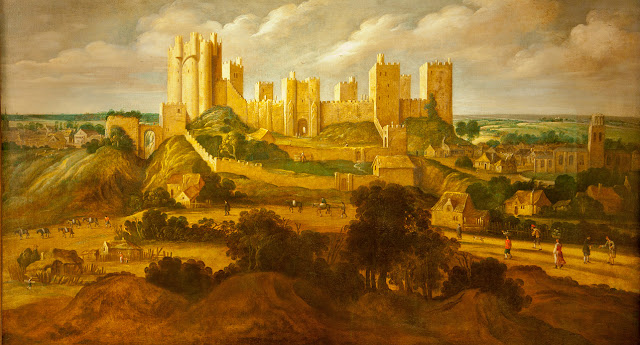
Commissioned by Charles I and painted by Keirincx in 1640, it shows the Castle in its heyday.

A large oil painting of Pontefract Castle as it was in about 1640, painted by Alexander Keirincx. It shows what a grand site it was, and much larger than the standing remains today might suggest. There are 10 towers and 3 lines of defensive walls extending down to the Knottingley Road.

We're developing new digital content all the time. We would love to have your feedback on the Interactive Painting, or anything else you would like to see - post it in the comments below!


Want to see the Castle for real? Pontefract Castle is free entry and open daily. Click here for visitor and access information for Pontefract Castle.

We also hold Dungeon Tours and Castle Explorer Tours every weekend! Click here to book.

The original painting is on display in Pontefract Museum.

The painting is on loan to Wakefield Museums and Castles from The Hepworth Wakefield.

Thursday, June 22, 2023

Artist Commission - Healthy Hedgerows: Sandal Castle Environmental Project

We've got an exciting new opportunity for artists who love nature and community engagement! 

The Healthy Hedgerows Project is a project delivered by Wakefield Museums & Castles, in collaboration with The Woodland Trust and local primary schools. The project aims to rebuild and strengthen the biodiversity of Sandal Castle through the planned management and replanting of the hedgerows around the site.

The ruins of Sandal Castle on a sunny day


As part of the project, we're commissioning an artist to work with local primary schools, museum staff and the Woodland Trust to create an artwork that responds to the environment, particularly the flora and fauna of the Sandal Castle site, and to the hedgerow replanting carried out by our Hedgerow Heroes.

Apply by: 21 July 2023
Fee: £7000


Click here for full brief and how to apply

Thursday, June 8, 2023

Albert Wainwright: Pride Month 2023

This Pride Month, we are proud to share a fantastic new addition to our collection!

We have recently acquired a small number of sketchbook pages by Albert Wainwright (1898-1943), an influential artist from Castleford.

A friend and contemporary of Henry Moore, Wainwright produced a large and varied body of work. This included ceramics, theatrical design and book illustrations, as well as watercolours and drawings. 

Although he didn’t reach Moore’s commercial success or recognition during his sadly short lifetime, Wainwright’s reputation has deservedly increased in recent years. 

His work is also significant in its depiction of gay love at a time when homosexuality was still illegal in Britain.

A sketch depicting two seated schoolboys by the riverbank, with further studies of male figures reclining on one another. The seated schoolboys are in colour, wearing navy blue blazers and shorts, and pale green caps and socks.
Sketch by Albert Wainwright, recently acquired by Wakefield Museums & Castles. Features drawings of schoolboys, including a pair where one is tenderly reclining on the other.

Wainwright was born and brought up in Castleford. He attended Castleford Grammar School and was taught by the inspirational artist Alice Gostick

Gostick encouraged Wainwright’s artistic potential and her support helped him to secure a place at the Leeds School of Art in 1914. 

Gostick’s influence on Wainwright’s art continued. He became a regular at her renowned pottery painting classes, hand-painting ceramics in a traditional style known as Castleford ‘Peasant Pottery’. 

In 1927, Wainwright returned to Castleford Grammar School as an art teacher, temporarily taking Gostick’s place after she became ill. 
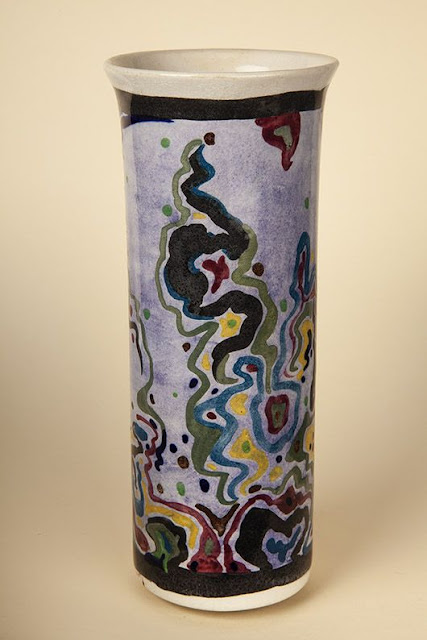
A tall, thin cylindrical vase, made and hand-painted by Albert Wainwright. The painting style is abstract, with purples, reds, yellows, greens and black swirls painted onto the white base.
Hand-painted vase by Wainwright in the style of Alice Gostick

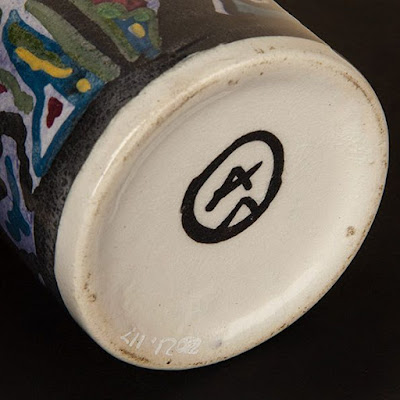
Base of the same vase, with Wainwright's monogram, a capital A in a circle
Base of the same vase above, marked with Wainwright's monogram.

Gostick also encouraged her pupils to design costume, stage sets and programmes for school productions. 

The experience was invaluable for Wainwright, who went on to work as a theatrical designer. He received over a hundred costume and scenery commissions. 

His intricate watercolour designs spanned a wide range of productions.

Portrait poster for exhibition of Wainwright's work. Reads 'Albert Wainwright, 1898 - 1943. Artist, illustrator, theatre and costume designer of Castleford.' Includes a large illustration by Wainwright of a costume design for  an Ancient Greek female character in art-deco style
Poster for an exhibition of Wainwright's work at Wakefield Art Gallery in the 1980s. It features an example of his costume design.

As well as his commercial work, Wainwright was a prolific draughtsman. 

He filled many sketchbooks with illustrations and watercolours of local landmarks and characters, capturing a snapshot of industrial Castleford in the 1920s and 1930s. 
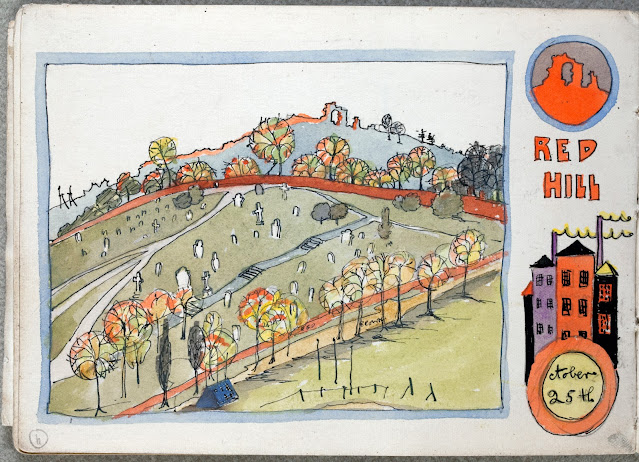
Sketch by Wainwright of the cemetery at Red Hill. To the right of the main sketch are the words 'Red Hill', 4 tall narrow buildings with billowing chimneys, and 'October 25th' in a stylised circle
Page from the 'Castleford Notebook', 1928 by Albert Wainwright. Sketch of the cemetery on Red Hill.
With thanks to The Hepworth Wakefield.

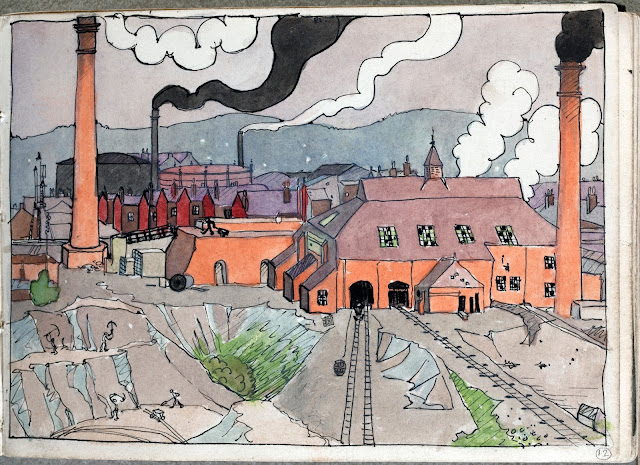
Sketch by Wainwright of large, busy factories and mining activity at Castleford. The chimneys are billowing black and white fumes. The miners in the foreground are small, almost stick figures
Page from the 'Castleford Notebook', 1928 by Albert Wainwright. Sketch of factories and mines in Castleford.
With thanks to The Hepworth Wakefield.

His personal sketchbooks also include many studies of people, including androgynous figures, young men and depictions of male intimacy. 

Wainwright was gay but homosexuality remained illegal in Britain during his lifetime. It was not decriminalised until 1967, 24 years after his premature death. 

Although Wainwright’s sketchbooks were not originally intended for public view, they are a rare record of gay love in the early 20th century.

We are very pleased to have acquired some examples of these sketchbook pages at auction earlier this year. They are a valuable addition to our collection. In addition to examples of Wainwright’s ceramics, theatre work and industrial sketches already in our collection, these sketches of male intimacy will help us to tell a fuller story of his life and career. 

They reveal a sometimes hidden LGTBQ+ history. 

Sketch of two schoolboys, one reclining on the other, and a third schoolboy looking at his reflection in the water.
Sketch by Albert Wainwright, recently acquired by Wakefield Museums & Castles. Features drawings of schoolboys, including a pair where one is reclining on the other.

Albert Wainwright sadly died from meningitis aged just 45 in 1943. 

He was living in and teaching in Bridlington at the time and had achieved a name for himself within his native Yorkshire. 

Today, his artistic achievement is increasingly recognised and we are proud to celebrate his work in our displays at Castleford Library & Museum.

Click here for more LGBTQ+ stories in our collections

Click here to read more about Alice Gostick

Click here for visitor information at Castleford Museum (opens in new page)

Tuesday, May 16, 2023

Roman Castleford and RomanFest 2023

By Jove! Castleford Roman Festival is back for 2023.

On Saturday 10 June all roads lead to Castleford for a Roman-themed family fun day.

We've got a whole host of Roman blog articles, activities and videos to explore ahead of the Festival on our Roman Castleford landing page!

A young visitor in replica Roman armour at Castleford Museum - they look pretty fierce!

March over to the Roman Castleford page to:

Saturday, May 6, 2023

Coronation Medals and Memorabilia

To mark the Coronation of King Charles III, we've been looking through our collection for coins, medals and memorabilia from coronations past.

Coins and medals in particular have been an important part of establishing a new leader's rule and presence throughout the world, since ancient times. 

All of the following items are from our collection - maybe you have some too?


William IV (Reigned 1830 to 1837)

Coronation coin for William IV, stylised as 'William IIII' and Queen Adelaide. Their rather crude portraits are on the 'heads' side, and 'Crowned at Westminster Sept 8 1831' on the reverse, with an image of the Crown Jewels


A medal issued to mark the coronation of King William IV and Queen Adelaide at Westminster, on September 8 1831. 


Wednesday, May 3, 2023

Interactive exhibit design opportunity at Pontefract Castle

We are looking to appoint a contractor to design, build and fit interactive elements at the Pontefract Castle Visitor Centre that will engage, educate and enhance the visitor experience.

A young visitor and their grownup outside the Visitor Centre at Pontefract Castle


Pontefract Castle

From its construction in 1070 to its demise following the Civil Wars, the once-fearsome fortress of Pontefract Castle dominated Yorkshire and beyond, bearing witness to some of England’s most momentous historical events, earning itself the name of the Key to the North!

Today, the castle is a place of adventure, with wide open spaces to explore and play, and fascinating ruins to investigate. Family-friendly interpretation boards around the grounds reveal the castle’s eventful history. 

A very young visitor running ahead of their grownups, beaming, in the grounds at Pontefract Castle

Two young visitors inspecting an information panel at Pontefract Castle. They are dressed up in medieval-style fancy dress.

From the top of the keep, visitors can admire the surrounding Yorkshire countryside. The children’s playground is the perfect place for young visitors to burn off some energy and create their own castle adventures.

The Visitor Centre includes an Activity Space, Gift Shop, Café, and museum display area. The displays are located in a glazed link area between the Gift Shop and Cafe.

Display cases in the current layout of the Visitor Centre at Pontefract Castle
The museum display space in Pontefract Castle Visitor Centre


Commission brief

We are now inviting proposals to design, build and fit interactive elements that will expand our visitor offer. This should include: 

  • Hands-on interactive element/s inspired by the collections on display 
  • A dressing up area for all ages inspired by the displays and site history 
  • Design and print of complementary graphic panel/s, incorporating existing content to be supplied by the client 
  • Fit out /installation of above elements 

Factors for consideration:

  • The exhibit will not be directly overseen by a member staff so will need to be robust and self-explanatory. 
  • Environmentally-friendly, sustainable materials should be used wherever possible but must also be long-lasting and fit for purpose.
  • This area gets direct sunlight from the adjacent window and can reach high temperatures in the summer. 
  • Structures should be of a durable finish and easily cleaned. 
  • The exhibit must be inclusive and meet all physical, sensory and intellectual accessibility requirements.
  • Copyright for all text, graphics and images supplied by the client is to be retained by the client. 
The successful contractor will work closely with Wakefield Museums & Castles staff, particularly the Curatorial & Exhibitions team, who will retain overall editorial and curatorial control of the display content. 

The successful contractor will be appointed in June 2023. 
The exhibit should be installed by end August 2023.

Deadline for proposals is 9am, 30 May 2023. 

For a copy of the full brief, details of how to apply, or for more information, please contact Steph Webb, Senior Officer: Curatorial & Exhibitions on swebb@wakefield.gov.uk

Thursday, April 27, 2023

Knottingley: Fire & Water - Interview with David Appleyard

On 23 November 2022, we celebrated the industrial heritage of Knottingley through a commissioned artwork by David Appleyard. The project was funded by Arts Council England and was designed to celebrate the industrial heritage of Knottingley.

Knottingley: Fire & Water was an innovative artwork, with illuminations, projections, and local community responses. 
 It was an evening of wonder, celebration, and community spirit. Over seven months, David immersed himself in the community, working closely with local people to reflect on the Knottingley of the present, as well as the Knottingley of the past. More than 200 people took part. 

We've been reflecting on the legacy of the project, and went back to David to capture his thoughts and feelings about Knottingley: Fire & Water, ahead of more digital community resources being released later this year.

Read on to learn about his tips for community engagement and advice to aspiring artists!

David Appleyard in his studio, reviewing colourful alternative Knottingley town crests made by local school children under a large panel of glass. There are lots of various pieces of artmaking equipment behind him.
David Appleyard in his studio, reviewing alternative Knottingley town crests created by local schoolchildren. Photo by Nick Singleton.

Interview with artist David Appleyard


Q: How did you become aware of the Knottingley: Fire & Water project? What was the application process like, and do you have any advice on how to succeed at the application stage?

David: The application process followed an open call that was advertised on various national arts websites. As application processes go it was fairly straight-forward. I sent an initial expression of interest and made the shortlisting. I was then given time to develop my approach before being interviewed. The interview itself was friendly and informal and I was given plenty of opportunity to present ideas and working methods.

Advice on applications?

The application process is never as daunting as it might sound, it just takes time. You’ve got to be in it to win it - so just give it a go.


Q: The Knottingley: Fire & Water project was rooted in the local community – how did you get to know the community and build up trust with different individuals and groups?

David: I made a lot of visits to Knottingley and worked with specific groups to make sure that a broad range of people knew about the project.

I was visiting every two to three weeks so I got to know people quite well. The only way to build trust is to maintain communication with them, whether it be in person or online.


Q: What research did you carry out to understand the history and industrial heritage of the town?

David: Initially, I spent time researching Knottingley’s history using various web sources. However, this quickly progressed into the archives at Pontefract Museum where a fantastic collection of archive photographs are held. From the archives I moved out into the community to show people what I had found and to gain feedback.


Black and white photo of two workers at Bagley's Glassworks pouring molten glass from a gathering rod into a large mould
One of the archive photographs held by Wakefield Museums and Castles, showing two Bagley & Co workers pouring molten glass from a gathering rod into a mould.
Copyright Wakefield Museums and Castles.


Q: How did your artwork evolve throughout the process? How did your community engagement work shape the final piece?

David: The project developed quite a lot from my initial proposal and was entirely shaped by the stories that were shared, the comments that people added to response cards and the many conversations I had with people living locally.

The most important part of the project was to bring people together in the same way that the glass industry had done years before.


Q: What is the most important element to you: the process, the final outcome, the medium? Or something else?

David: Definitely the process, I never know what I’m going to get as a response and its exciting to work with unknowns. Most of the projects I’ve worked on in the last 15 years have been very different in terms of the outcome and medium. Everything has been driven by research and community involvement.


David Appleyard in a primary school classroom, showing an old photo of a barge on the canal to pupils watching on.
David at St Botolph's School in Knottingley, working with local schoolchildren to design their own Knottingley town crests.
Photo by Nick Singleton.


Q: Would you have done anything differently?

David: I’m happy with the way the project evolved. There were a couple of technical hitches on the night but other than that the research and engagement evolved neatly into the final work.


Q: What was the highlight of the project for you, as the artist?

David: There were a number of highlights to the project:

  • Witnessing the passion and belief that people can have towards the place where they live.
  • Seeing people come out on a cold November night to celebrate their local community.
  • The Silver Band performing Ultra Vox's Vienna!
  • Having the privilege of working with a really committed team!

Part of the Stoelzle Flaconnage glassworks lit up in blue, green and pink against the dark November night's sky. Steam is coming out of the large chimney.
Stoelzle Flaconnage glassworks in Knottingley on the night of the Knottingley: Fire & Water event

Part of the Allied Glass site lit up in red, orange and yellow against the dark November night's sky. Archive photos from Knottingley's heritage are projected onto one of the large square walls, this one is of a canal barge taking off.
An Allied Glass building in Knottingley on the night of the Knottingley: Fire & Water event.
Copyright Andrew Benge.