Showing posts with label First World War. Show all posts

Wednesday, May 29, 2024

D-Day 80 Display

Malcom Patterson, Chairman of the Horbury, Sitlington and Ossett branch of the Royal British Legion, contacted us to ask if we could help with a special display to commemorate the 80th anniversary of D-Day. 

The display, featuring objects loaned by Gavin Cave, will be in the shop window of Grooms Rooms Menswear in Horbury from 1 to 17 June 2024.

A soldier's uniform and a dispatch rider's uniform from the D-Day landings on display on mannequins, with a wreath of poppies and a note commemorating the names of those who died in the Second World War by the Horbury Sitlington and Ossett Royal British Legion
The D-Day display in Grooms Rooms Menswear

D-Day display

D-Day was on June 6, 1944. It involved the simultaneous landing of tens of thousands of troops on five separate beaches in Normandy. 

It was the largest military naval, air and land operation ever attempted. It marked the start of the campaign to liberate Nazi-occupied north-west Europe.

Local collector, Gavin Cave, has worked with the Wakefield Museums and Castles team to create a display of some of his collection. 

This includes the uniform of a ‘typical’ British soldier and sailor landing on the Normandy beaches on D-Day, and the uniform of a dispatch rider. Dispatch riders were one of the many specialist troops involved in supporting the landings.

Gavin has said that he’s really enjoyed the opportunity to display some of his collection, though some of it has been a bit of a project to get it ready for display!

The D-Day uniforms 

The uniforms are all original, possibly unissued items.

The 'typical’ uniform includes a MkII steel helmet, which has a net attached to afford camouflage and concealment. The steel dispatch rider helmet is designed to also give protection whilst riding a motorcycle.

Gavin holding up a helmet in each hand. He is looking towards the dispatch rider helmet, which is a dome-shaped khaki helmet with leather straps hanging down over the ears. The 'typical' helmet on the right is a similar shape but a darker khaki, with a net attached.
Gavin holding the two helmets - the dispatch rider helmet is on the left, and the 'typical' one on the right.

The clothing is different too. 

The ‘typical’ soldier and sailor wears a woollen battledress jacket (late 1940 austerity pattern) and battledress trousers (1939 pattern). The trousers are much higher waisted than modern trousers, in keeping with the fashion of the day. They also had the added advantage of keeping the lower back warm! 

He also wears 1937 pattern webbing. This has two ammo pouches at the front, large enough to take the magazines for a Bren gun.

The brown woollen shirt and battledress trousers worn by a 'typical' soldier on D-Day, with multiple pockets, and accompanying boots
The 'typical' soldier / sailor uniform, ready for display

He carries a water bottle, entrenching tool and his small pack. This would contain his 24-hour rations. He also had a waterproof cape, jumper, mug, mess tins and spare socks. On his feet he wears regulation ammunition boots.

The dispatch rider wears a rubberised coat over his battledress jacket. The coat straps over the legs of his jodhpur-like trousers, allowing for easy riding.


A long brown rubberised overcoat, partially opened to show the brown jodphur-like trousers designed to provide comfort when riding a motorbike
The dispatch rider's uniform, with coat opened to show the jodphur-like trousers

A pair of dispatch rider boots (bought and worn by Gavin's wife in the ‘90s!) were in particularly poor condition. They have been painstakingly restored to prevent further deterioration of the leather. Many layers of polish had to be removed, so that the leather could be conditioned and consolidated.


Leather boots that reach up to the mid calf, with buckles and laces up to the top.
The dispatch rider boots, now restored

June 6, 1944 – A Big Day (for other reasons!)

Irene Winifred Cheshire was born in Horbury in 1924. During the Second World War, she was a ‘Private’ (cook) in the Auxiliary Territorial Service (A.T.S.), stationed at Pontefract barracks.

Here she met Harry Patterson. Harry was born in Co. Durham in 1914. He had joined The Green Howards before switching to become a ‘Private’ (cook) in the Army Catering Corps (A.C.C.) on its formation. He was then sent to Pontefract.

Harry and Irene were granted Special Leave to get married on June 6, 1944. The wedding took place at St. Peter & St. Leonards church in Horbury.

Harry, in uniform, and Irene, in a white wedding dress with veil, with their family on their wedding day


Operation Neptune (the D-Day landings) was top secret. The couple will have been unaware that their wedding was to be on the same day as the largest military naval, air and land operation ever attempted!

Horbury’s role in WW2

Many British manufacturers switched to producing equipment to help the war effort. This included Sykes of Horbury, the famous local sports manufacturers. 

By the Second World War, Sykes employed a thousand local people. As they had in the First World War, the Sykes workers produced an array of equipment for the Second World War. 

A group of Sykes workers, all women, making wooden rifle furniture. One is holding her piece up and looking down it to check its quality.
Workers making rifle furniture at Sykes' Albion Mill in the Second World War

These ranged from bayonets and ammunition boxes to sand goggles and snow shoes - made using the same techniques as their tennis rackets!

A wooden oval-shaped snow shoe, with rope attached to a piece of fabric where the foot would be, and straps across the top.
A Sykes' Second World War snow shoe, made using their steam bending tennis racket technique.


Other local people were also involved in the war effort leading up to the D-Day landings. 

With thanks to the Royal British Legion for their support with this display.

Royal British Legion logo

Friday, November 11, 2022

Remembrance Day: George Kellett and Arthur Cox

 On November 11, 1918, Wakefield-born soldier George Kellett wrote in his diary:

"We heard that an Armistice had been signed but we keep hearing explosions and cannot tell whether it is gunfire or not"

George’s diary is a valuable insight into an ordinary soldier’s experience of the First World War. 

We’ve put together an interactive learning resource based on his diary entries.

Sepia photograph of George Kellett in his army uniform. He is a young white man in his early 20s. He has short hair, is clean-shaven, and smiling at the camera.
George Kellett in uniform during the First World War.
He would have been in his early 20s during the War.

George survived the war and was demobilised (taken out of active service) on January 21st 1919.

He went home to marry his childhood sweetheart Emma.

Handwritten note from George to Emma, which reads: 21st January 1919 - Demobilised today. Don't write until you hear from me. Best love, George xxx
A postcard from George to Emma, which reads: 21st January 1919 - Demobilised today. Don't write until you hear from me. Best love, George xxx

Unfortunately, many soldiers were not as lucky as George.

We’re also remembering Sergeant Arthur Cox, from Thornes Lane, Wakefield.

A Sergeant with the Royal Field Artillery, Arthur earned the Military Medal for bravery in the field.

A hand-tinted photograph of Sergeant Arthur Cox during the First World War. He is seated, holding a cane, with his hat on a table beside him. There is a handwritten sign to the left of the photo that says ‘Somewhere in France’
A hand-tinted photograph of Sergeant Arthur Cox

Unlike George, Arthur was an experienced soldier, having previously risen to the rank of Corporal with a volunteer regiment, the Queen’s Own Yorkshire Dragoons. 

He had fought in South Africa during the Second Boer War and been honoured with the Freedom of Wakefield.

Arthur sadly died just a few weeks after the government announced his Military Medal award in the London Gazette. 

Arthur Cox's 7 service medals and memorial plaque
Arthur Cox's medals, with the Military Medal (top left), other service medals, and his memorial plaque in the centre.

Arthur was killed in action on 29th July 1917 ahead of the 3rd Battle of Ypres, better known as Passchendaele. 
He is buried at the Godeswaersvelde British War Cemetery in France, near the Belgian border. 

After the Armistice, Arthur’s widow received a photograph of his grave, his posthumous service medals, and a memorial plaque. Sometimes called the ‘Widow’s Penny, these plaques were sent to the next of kin of all fallen soldiers. Arthur’s family proudly displayed the plaque surrounded by his medals from both wars. 

A photograph of Sergeant Cox’s grave sent to his widow after the Armistice. It is a simple wooden cross planted into the field where he was buried
The photograph of Arthur's grave at Goedeswaersvelde British War Cemetary, sent to his widow after the Armistice

Sargeant Arthur Cox's headstone, with a poppy growing beside it.
Sargeant Cox's grave in more recent years, now with a headstone.
Photo shared with thanks to Clare Ledger-Potter, Cox's great-granddaughter.

Today, we are remembering Arthur, George, and all of those who have served in the armed forces.

Click here to read George's 1918 diary entries and find out more about his experiences.

Friday, November 4, 2022

New Interactive World War 1 Resource: George Kellett's Diary

What lessons can we learn from World War 1? 

How do you teach World War 1 to a child?

How do you teach about Remembrance Day?

We’ve put together an interactive resource based on the diary of Wakefield-born soldier, George Kellett, ready-made for use in lessons or for homework.

For KS2 upwards and packed full of photos, videos, objects and an interactive map, view it here!

Sepia photograph of George Kellett in his army uniform. He is a young white man in his early 20s. He has short hair, is clean-shaven, and smiling at the camera.
A photo of George Kellett in his soldier's uniform


Monday, May 10, 2021

New to our collection: First World War bandolier

We are always looking for objects with a strong local story to add to our collection. Although our museums have been sadly closed for most of the last year, behind the scenes we have still been busy acquiring exciting items. One recent addition is this top notch example of Horbury leatherwork from the First World War (1914 – 1918). It shows another way that the town contributed to the war effort.


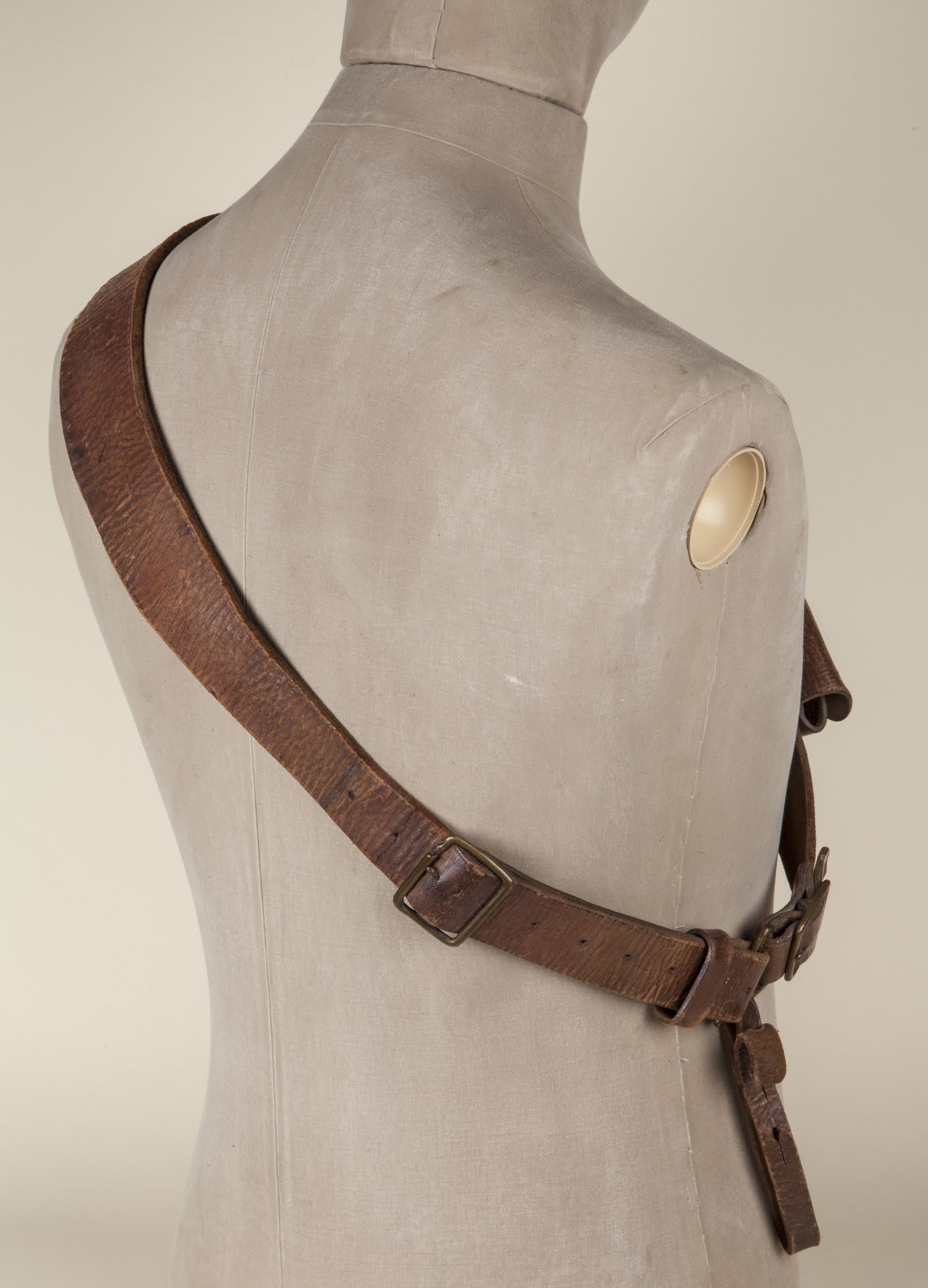
A leather bandolier on a mannequin. It is worn over one shoulder around the body.

Bandolier, 1916, made by William Sykes Ltd. in Horbury


A bandolier is an ammunition belt, worn by soldiers over the shoulder and across the chest to carry extra bullets. This example is composed of a leather strap with a buckle and has five rifle bullet pouches sewn into it. 

Back of the bandolier, demonstrating how the object is secured around the body like a belt
Side of the leather bandolier


It is a 1903 pattern used by British soldiers during the First World War.

3 soldiers wearing bandoliers. Two are seated, and one is stood. They are in full uniform.
Soldiers wearing bandoliers in the Queen's Own Yorkshire Dragoons. They are P.H. Charlesworth, A. Beilby and Mr Cooper, 1914 - 1918

A black and white photo of a soldier in the Royal Artillery wearing a bandolier and carrying a cane
Soldier in the Royal Artillery with a bandolier, 1914 - 1918

The bandolier is stamped with the name Sykes and the year 1916. Sykes refers to the local company, William Sykes Ltd. At the time, the company was on its way to becoming one of the largest sports manufacturers in the world. Skilled leather and wood workers made all manner of bats, balls, rackets, pads and gloves for every kind of player, amateur and professional, all from Sykes’ Yorkshire Athletic Manufactory in Horbury.

They also adapted their skills to make equipment for the military. As early as the Boer War (1899 – 1902), Sykes fulfilled orders for the War Office. As well as sports equipment for basic training, they made kit such as this bandolier and other leather strapping worn by soldiers.

By the Second World War (1939 - 1945), the Sykes workforce of a thousand local people produced an array of equipment, from bayonets and ammunition boxes to sand goggles and skis. The factory made over a million sets of wooden rifle furniture at a peak rate of 11,000 sets a week.

A sepia photograph of a dozen workers, male and female, making rifle furniture
A sepia photograph of several women seated making rifle furniture
Workers making rifle furniture at Sykes' Albion Mill in the Second World War

The bandolier is the first example of William Sykes Ltd's First World War work that we’ve ever seen and acquired. It will become part of our Playmakers collection, which represents and celebrates the incredible contribution to international sport made by skilled workers in Horbury from the late 1800s to late 1900s.  


The Playmakers logo


Sykes produced a vast range of goods for a huge variety of different sports. When the company later became part of the Dunlop Slazenger group, Horbury remained the centre of production and innovation. Thousands of people enjoyed playing sports using Horbury-made goods. Equipment developed locally starred on the world stage at major sporting events. Many elite sports people chose pioneering Horbury products to help propel them to the top of their game.


For more of our collections highlights, click here.


Friday, November 9, 2018

Armistice100 at Wakefield Museum

11th November 2018 marks a hundred years since the end of the First World War. A century ago in northern France, Private George Kellett wrote in his 1918 diary,

We heard that an Armistice had been signed but we keep hearing explosions and cannot tell     whether it is gunfire or not.

 
Lett’s No 26 diary 2018 belonging to Private George Kellett

George was a joiner from Agbrigg Road, Sandal serving with the Duke of Cornwall regiment. He had received the diary as a Christmas present along with a Christmas cake, parkin and apples. His matter of fact account of such a historic occasion is typical of his stoic, often mundane diary entries that document a year at war. George began 1918 recovering from injury before rejoining his regiment. He writes of daily activities such as inspections and parades, writing letters and receiving news from home. When he’s not busy with tasks such as digging communication trenches and laying cabling, he enjoys games of cards, draughts and billiards, and training with a tug of war team.
 
In and amongst the daily routine though, there are reminders of the reality of war.

4 September 1918: Went out burying the dead today. 

11 September 1918: Packed our kits and went up the line at 9am, two guides of the Stafford and Bucks met us and took us into the front line. G.West and three more fellows in our platoon got killed and four or five wounded going up. We went over the top at 6:30pm [?] Burton, Bill Revitt and three or four more were wounded and three more killed. We reached a trench just over the canal and had to stand to all night.

George’s diary is a fascinating insight into an ordinary soldier’s experience of the First World War. We were honoured when his family donated it to our collections and were very proud to put it on display at Wakefield Museum as part of our Armistice 100 commemorations. 

 
George scribbled this note to his future wife, Emma, upon his demobilization.
 

Hand-tinted photograph of Sergeant Arthur Cox during the First World War
 
George survived the war and was demobilised in 1919. He came home to marry his sweetheart. Tragically, Arthur Cox of Thornes Lane didn’t return to his family in Wakefield. A Sergeant with the Royal Field Artillery, Arthur earned the Military Medal for bravery in the field but sadly died just a few weeks after the government announced his award in the London Gazette. Unlike George, Arthur was an experienced soldier, having previously risen to the rank of Corporal with a volunteer regiment, the Queen’s Own Yorkshire Dragoons. He had fought in South Africa during the Second Boer War and been honoured with the Freedom of Wakefield.

 
A photograph of Sergeant Cox’s grave sent to his widow

Sargeant Arthur Cox's headstone, with a poppy resting against it
Sargeant Cox's grave in more recent years, now with a headstone.
Photo shared with thanks to Clare Ledger-Potter, Cox's great-granddaughter.

Arthur was killed in action on 29th July 1917 ahead of the 3rd Battle of Ypres, better known as Passchendaele. He is buried at the Godeswaersvelde British War Cemetery in France, near the Belgian border. After the Armistice, Arthur’s widow received a photograph of his grave, his posthumous service medals, and a memorial plaque. Sometimes called the ‘Widow’s Penny, these plaques were sent to the next of kin of all fallen soldiers. Arthur’s family proudly displayed the plaque surrounded by his medals from both wars. In 2018 we had their collection on display in our Wakefield Museum Welcome Space to commemorate the service given by him and so many other local men. Alongside the objects are several hand-made poppies. These were contributed by our Young Curators (aged 8-13), who have been learning about Arthur and George and wanted to help honour them.

Arthur’s Military Medal (top left), service medals and memorial plaque

The commemorations continued in Create café, where we were also remembering Nurse Marion Walker and her colleagues and patients at the White Rose Auxiliary Hospital, Heath Hall. Many soldiers spent time there recovering from their injuries and illness before returning to the front lines. Volunteers like Marion helped to care for them during their convalescence.

 
Staff and patients at the White Rose Hospital
 
As the Armistice was signed in France, Marion was collecting signatures of her own from the soldiers in her care. Carrying an autograph book was common practice for auxiliary nurses. Patients passed away their time and showed appreciation for the nurses by leaving their names, mottos and messages, and often doodles and cartoons on the pages.

 
Leatherette autograph book belonging to Nurse Marion Walker
 
Marion’s book, compiled between 1917 and 1919, gives a moving glimpse into wartime resilience. Despite the hardships the men had endured, their entries are full of friendship and love, humour and hope.
 
We reproduced a selection of our favourite pages to display in Create. 


‘If writing in albums remembrance ensures/ With the greatest of pleasure, I’ll scribble in yours./ Some write for pleasure. Some write for fame./ But I simply write to sign my name.’


Thursday, November 10, 2016

Commemorating World War 1

It is coming up 98 years since the armistice of World War One.

Here at Wakefield Museum we have a variety of objects on display that tell the various stories about people, places and events surrounding World War One.  There is now also a new downloadable teachers' pack to support schools by providing information about some of the objects in the collections. The pack can be found here.

There were many families affected by World War One, not just those who lost loved ones but also the people who survived and returned.  One gentleman who returned home to Wakefield was George Kellett. Relatives of George donated his diary, written in 1918, whilst a soldier in France and Belgium. With agreement from the family the museum have used social media to share the George's thoughts. To see what life was like for one Wakefield man see @WW1_Diary on Twitter.
 
George Kellett's 1918 diary is now in the museum collection
Sadly there were many who did not return home. Students from Kettlethorpe High School earlier this year researched and developed work on two such men. Their work is on display at the museum and further information can be seen in the previous blog post found here.

Students from Kettlethorpe High School in Wakefield Museum with their thought-provoking display
 

Friday, July 1, 2016

Commemoration of Local Soldiers and the Battle of the Somme

On Monday the 20 June, Wakefield Museum was pleased to host a visit by four pupils, Emily-Jo, Rachel, Holly and Nell, and their history teacher, Miss Quartermain, from Kettlethorpe High School. The purpose of the visit was very special – to install a display created by the pupils to commemorate the First World War.

Kettlethorpe pupils and teacher responsible for making and installing this moving display - Holly, Nell, Ms Quartermaine, Rachel and Emily-Jo
 
The pupils had conducted research to find out about two First World War soldiers – Pte Frank Hollings and Sgt Nelson Summers – both of whom had connections with the Wakefield area.

Pte Hollings was born and raised in Sandal and was associated with the Harriers at Thornes Park. He died on 20 December, 1915 in a gas attack in Ypres. He was 20 years old.


Sgt Summers was in the King’s Own Yorkshire Light Infantry. Though born in Staffordshire, in his adulthood he lived in Horbury and worked at Charles Roberts & Co. railway works. Sgt Summers was married and had three children. He died at the Battle of the Somme on 1 July, 1916 at the age of 30.

The pupils were able to make contact with some of Sgt Summers’ descendants. His granddaughter was able to tell them that, prior to the outbreak of WWI, Nelson Summers was a member of the Territorials in Wakefield.

Kettlethorpe pupil, Rachel, working with curator, John Whitaker, to install the WWI display in the museum entrance

In addition to conducting their local research, Emily-Jo, Rachel and Miss Quartermain had the opportunity through a government funded programme to journey to France and Belgium to see the WWI battlefields for themselves. One of the objectives set for the pupils by this programme was to share what they saw, learned and experienced with at least 110 other people. The pupils chose written words and art as the mediums through which to share this information.

With this in mind, the school asked if the pupils could display their finished work at Wakefield Museum - and we were very happy to say ‘yes’. The result is a very moving display with, at its centre, a beautifully crafted patch-work textile that illustrates different aspects of what soldiers like Pte Hollings and Sgt Summers experienced during the war and the ways in which we remember WWI soldiers today. This is accompanied in the display by an original drawing dedicated to the memory of Pte Hollings and Sgt Summers created by Lucy, a pupil who was not able to attend for the installation, as well as text cards that reveal what the pupils learned about the lives of the two local soldiers and the impact this project has had on the pupils themselves. The display reached the target of attracting 110 viewers within two days.

 
Beautifully made patchwork textile commemorating Pte Hollings and Sgt Summers

The installation of the Kettlethorpe pupils’ display in Wakefield Museum is very timely as 1 July, 2016 marks 100 years since the Battle of the Somme.
It is joined by a second commemorative display installed by our curatorial and design team in the atrium on the Upper Ground Floor of Wakefield One which features a wrist watch that was worn by Captain R. England, also of the King’s Own Yorkshire Light Infantry, during the war. On a paper tag attached to the watch Captain England typed, ‘D [Company] was timed to “go over the top” at 7.48 a.m. on the 1 July and this is the watch which timed that event in the battle’.  Captain England survived the Battle of the Somme and donated the watch to Wakefield Museum in 1974. On a paper tag attached to the watch when it was donated are typed the following words: 'D [Company] was timed to "go over the top" at 7.48 a.m. on the 1st July and this is the watch which times that event in the battle".


A wrist watch belonging to Captain R. England and worn at the Battle of the Somme. This watch is now at the centre of a commemorative display at Wakefield One.


New display to commemorate the Battle of the Somme
 
Both displays can be viewed at Wakefield One throughout the summer


We have also launched a new Downloadable Resource Pack for Schools. 
Click on the image below to download.


https://drive.google.com/file/d/0B0mdv9Gr3eTkQjZNSXJTZ21kbEk/view?usp=sharing
Downloadable Teachers' Pack


Thursday, July 23, 2015

Oh! What a Lovely War!


Join us for an evening of persuasion and propaganda!

Oh, Oh, Oh What a Lovely War!

We have now changed our A Call To Arms exhibition to show a whole new selection of WW1 recruitment posters from our collection.


To celebrate this chance to see a whole new set of diverse and powerful posters, we are holding an evening of First World War music and song and patriotic crafts.  Try to resist the persuasive powers of our own Recruiting Sergeant. 

Drop in between 5pm and 7.30pm on Wednesday 29th July


This event is part of the Artwalk Wakefield


Wednesday, March 11, 2015

The persuasive power of 'Mother'

As the shops are full of Mother's Day marketing, we look back to 1915 and see that the persuasive powers of 'mother' were used to get men to sign up to the army.

‘Go! It’s your duty lad. Join to-day’

This poster features in Wakefield Museums new exhibition 'A call to arms: the art of persuasion - recruitment posters of World War One.'

Lithograph, June 1915.  Printed by David Allen & sons Ltd, Harrow.  Published by the Parliamentary Recruiting Committee, no 109.

By June 1915 recruits for the army had fallen and enthusiasm for the war effort was waning.
Posters like this one tried to appeal to mothers to put aside selfish reasons and send in their boys. It received criticism for appearing too much like any other advertising campaign and humorous copies depicted the mother selling different products.

See this poster and others at Wakefield Museum, Wakefield One, Burton Street, Wakefield, WF1 2DD.  Free entry.  The exhibition runs until 26 September.  

Wednesday, December 31, 2014

George Kellett's World War One Diary: December 1918

Throughout 2014 have been tweeting entries from a World War 1 soldier’s 1918 diary. You can follow George Kellett’s diary entries on Twitter @WW1_Diary.

This is the last month's diary entries.

For George Kellett's November diary entries please see our previous blog: November 1918 


Sunday 1 December 1918
ED again today

Wednesday 4 December 1918
Left Malonne for Sclayn

Thursday 5 December 1918
Left Sclayn for Huy

Friday 6 December 1918
Left Huy for Ouffet  about 22 kilos

Saturday 7 December 1918
Left Ouffet for Soumagne about 23 kilos

Sunday 8 December 1918
Left  Soumagne at 9am for Becco about 8 or 9 kilos

Monday 9 December 1918
Left Becco for Longfaye a march of 23 miles

Tuesday 10 December 1918
No march today a day of resting

Wednesday 11 December 1918
Left Longfaye at 8am Elsenborn

Friday 13 December 1918
Left Kesternich for ?

Saturday 14 December 1918
Arrived at Duren

Tuesday 15 December 1918
Making bread sticks for the company.  Went down town after went in a cafĂ© for a supper where they had a violin and piano.  Had a good time.

Thursday 17 December 1918
Out for a short march from 10am to noon

Wednesday 25 December 1918
Had dinner in the gym a jolly good food.

Saturday 28 December 1918
No parade standing by to make Rifle Racks for the barracks

Sunday 29 December 1918
No parade again today but have not started work yet.  Went to church service in the town tonight with Cpt Palmer.