Showing posts with label Collection Highlights. Show all posts

Thursday, May 29, 2025

Wayne: My Work Placement with Wakefield Museums and Castles

This blog has been written by Wayne who has been volunteering with us at the museum store since 2021. He has also been doing a university course on preventative conservation. Wayne has been looking at how museum objects can be stored, displayed, and generally looked after in ways that protect them from damage.

As part of Wayne’s course, he had to do a student placement where he would put some of what he has learned into practice. He chose to do his student placement with us! Read on to find out what he's been up to.

Wayne concentrating on dusting the rim of a blue felt uniform cap with a paintbrush and small Museum vacuum
Wayne lightly dusting a uniform cap with a paintbrush and the Museum Vac at the Museum Store

My Work Placement with Wakefield Museums and Castles

I'm Wayne. I have just completed my university student placement module with Wakefield Museums and Castles at the museum store. I have also been a volunteer here for a long time now and so it was nice to take on a different role.

During my placement I worked closely with various members of the Museums and Castles Team on different projects. The guidance and generosity of the staff played a crucial role in my development. They helped me expand my knowledge further by putting into practice what I have been learning.

My first project was to look at light levels. I was checking if the light in the museum and the museum cases was too bright for the objects on display. Different types of objects have different reactions to brightness levels. Some of these reactions can cause permanent damage or colour fading to the object. Light levels are checked with a light meter. This measures the brightness of light in lux, or by the amount of light that falls on a surface, which is measured in lumens per square metre.  

Ceiling-height shelves stretching into the distance filled with shallow carboard boxes
Rows of boxes of carefully stored objects in the Museum Store

I started the project by locating light-sensitive objects (objects most likely to fade or become damaged) that are on display in the museums, using the collections database. I then checked how long they had been on display for. Damage caused by light can also be affected by how long an object has been exposed to light.

To prevent light damage from happening, it is important to regularly test, monitor, and set light brightness. We also calculate how long the object can be displayed for before it becomes at risk of light damage. When an object reaches its display time limit, it should be moved to dark storage where it can “get some rest”. 

The next stage of my work was to identify which of the museum objects on display have reached their display limit so that they can be swapped and moved to dark storage.

Food collections

Now this may sound strange to many people that already know food and museum collections don’t go together normally! Food can rot or attract pests like mice and insects. These may then damage other objects as well.

However, there are some food objects in the museum collection. They can tell us a great deal about the past. One such object is a hot cross bun from the Crimean War. This bun is nearly 200 years old. It is said to have survived inside a pocket of a soldier because he forgot it was there “like you do”.

A very old, crusty, shrunken and hard hot cross bun
The hot cross bun that survived the Crimean War!

This brings me to my next project, which I also decided to base the written part of my student placement on. Before I could start the project, I had to locate all the food objects in the museum collection. This was not easy! A lot of the object records on the collections database describe the wrapping, or box, but not always whether the food itself was still in the packaging.

Once I identified the food, I looked at its condition and whether it was in sealed packaging and whether it had dried out or started to rot or fall apart. I then looked at how these food-based objects could be stored and displayed in a way that would prevent or stop any deterioration.

After I started to research this, I soon realised that there was a gap in information in this area. The information I did find included protecting the food from the threat of pests by keeping them in sealed containers. These will keep out even the smallest insect.


A large plastic tub with individually packaged food items including an old carton of tea, with humidity indicator and silica gel packets
A freshly repacked box with food collection objects - not to be mistaken for your lunch...

The food was also placed inside separate plastic bags. This meant that more than one object can be packed in a box, but each object is still sealed and separate. I also placed a humidity strip and silica gel into the boxes. The humidity strip monitors how much moisture is in the box and the silica gel absorbs it.

Once everything was repacked into plastic boxes, I put all of the food objects into the same storage area. This will make it easier to check them, as this will need to done regularly.   

Working with the museum team, we did make the decision to remove some of the food from its packaging and dispose of it. Some of these objects included food that were in open packets, like some crisps from 1981 that really did smell bad!

A brown crisp packet with 'Royal Wedding 1981 - Smiths Crisps - Bovril Flavour' printed on it
Out-of-date commemorative Bovril Flavour crisps, anyone?

There were also some bonbons that had turned brown in colour. We did keep the packaging for the museum collection, however.

A jar containing a dark brown substance with a label that reads 'plums bottled on the first day of the Great War, 1914 - 1918'
A jar of plums 'bottled on the first day of the Great War, 1914-18'

I would like to thank all the staff at the museum store and many others that made my work placement an enjoyable experience.

Friday, July 7, 2023

100 Years and Counting!

Decorative asset and logo for W M and C 100 - 100 Years of Collecting

2023 marks the centenary of the Wakefield Museums & Castles collection. We have been collecting objects and telling stories for 100 years!

We are celebrating our centenary throughout 2023 and into 2024 with new displays, digital content and events. 

We're launching the celebrations with a new Online Exhibition showcasing 100 objects that represent our 100 years of collecting. Click here to explore! 

But first, let's go back to the the very beginning...

10 July 1923 - Our first official objects 

The first ever entry in our accession books (the early handwritten records of all objects entering the collection) was on 10 July 1923. It was for 'One Mahogany Cabinet' containing 'Mosses' and 'Lichens', as well as 'Three Madonna Pictures from Board' 'and 14 cases of Birds'. 

An eclectic selection that paved the way for the 100 years of wonderful and weird objects to come!

Handwritten accession book entry for July 1923. In addition to the objects on July 10, a large oil painting of 'The Village Christening' was accessioned on July 12 and 'four etchings and two watercolours' on July 27.
The first ever entry in our accession books on 10 July 1923

A large, tall mahogany cabinet, with double doors and three large drawers below these
The mahogany cabinet in question, our first ever officially accessioned object

Wakefield's first civic museum and art gallery

The doors of Wakefield’s first civic museum and art gallery opened at Holmfield House in Thornes Park in 1923. 

The first curator, Harold Parkin, had gathered a small but impressive collection for display. It included bullets and cannon balls found at Sandal Castle, Ancient Roman coins, and a night watchman’s Waits badge. There were also donations and loans of furniture, paintings and armour.

More on the first Wakefield Museum

Holmfield House situated in Thornes Park, a pretty but relatively small building surrounded by plants and shrubs
Holmfield House, circa 1940s.

Two women and two young boys, all very smartly dressed, viewing a photography exhibition. Lots of framed photographs are hung together very closely, completely covering the walls. We do things a bit differently today!
Visitors to a photography exhibition at Holmfield House in the 1930s - we do things a bit differently today!

From then - to now

Since then, our collection has grown and grown! We’ve opened new museums and moved between different sites. 

In 1934, Wakefield Corporation opened a dedicated art gallery on Wentworth Terrace. It was open until 2009. Today, the fine art collection is managed and cared for by The Hepworth Wakefield. 

In 1956 Wakefield Museum left Holmfield House for the former Mechanics Institute on Wood Street, where the displays included popular recreated room scenes from history. 

In 2012, we moved to the city’s newest civic building, Wakefield One, where you can find us today!

The exterior of Pontefract Museum, an art nouveau building that used to be a library, built in 1904
The beautiful art nouveau building housing Pontefract Museum

Pontefract and Castleford

In 1974 Wakefield Council began caring for and developing the collections from Pontefract Museum and Castleford Library. 

Pontefract Museum moved to our current home in the former Carnegie Library in 1978. We’re very proud to continue to care for the beautiful art nouveau building. 

In 2013, we opened Castleford Forum Library & Museum, sharing the history of the town’s origins as Roman Lagentium, its proud industrial past and present, as well as changing displays produced with our local communities.


From 1 to over 100,000 objects

We now look after over 112,000 objects that tell the story of our district from the distant past to the present day. We programme exhibitions and displays at Castleford, Pontefract and Wakefield Museums, Pontefract Castle Visitor Centre and our Museum Hubs across the district. 

Any objects that are not currently on display are cared for at our Museum Store, ready for future exhibitions and research. 


Online Exhibition - 100 Years of Collecting


Front page of our 100 Years of Collecting Online Exhibition. Click the image to go to the exhibition page.

Check back on our blog over the coming weeks and months for more about our centenary, and object highlights compiled by our team and volunteers! 

You can also follow the project on social media with the hashtag #WMC100.

Wednesday, April 13, 2022

Finding Alice Gostick

In this special post, our brilliant Research Volunteer, Katie, tells us about her experience tracing the life of Alice Gostick, an influential local art teacher, who worked at Castleford School from 1911 - 1930.


Finding Alice's past


Born in Newcastle-Under-Lyme, Staffordshire in 1875, Miss Alice Gostick was later to move to Castleford and become the art teacher for Henry Moore, one of the most influential sculptors of his time. But what about Alice herself? My task as a Research Volunteer was to investigate Alice and find out more about her life aside from teaching Moore. However, finding information on Miss Gostick was no easy feat.

Initially, I was advised to start my research by browsing the family history website, Find My Past. This website is a phenomenal resource, which includes copies from censuses, birth, marriage and death records, the 1939 Register and more. As I had not used this site before, I needed some time to become familiar with how to navigate the records. However, this did not take long as the site is certainly user-friendly.

From here, I was able to gain an understanding of Alice’s early life. Her parents were Clair (b.1845) and Arthur Gostick (b.1844). She had one older sister named Constance (b.1874) and one younger brother named Frank (b.1878). Before Alice moved to Castleford and began teaching at Castleford School, she worked as an Art Mistress in Staffordshire and lived with her sister.

There were some difficulties with using Find My Past. As the site has all public records, there were some occasions where my search would return multiple people called Alice Gostick, which required some figuring out to ensure I was using the correct record. For example, there were several Alice Gosticks, who may have died at around the same time. Additionally, the site does not have any qualitative data, so I could not find much information about Alice as a person.

As there was not any marriage record for Alice, that led me to believe that she remained unmarried. This idea was furthered when I began to read biographies on Henry Moore that had some information on Alice. In Roger Berthoud’s The Life of Henry Moore (1987), Alice was noted to have lived with a ‘companion’ rather than spouse until her death. Alice is referred to on numerous occasions in this study. Interestingly, she was noted by Berthoud to be,

‘a pleasant looking woman with brown hair, full of enthusiasm yet gentle and generous.’

I was surprised to learn that Alice invited her students to her home and remained friends with Henry Moore until her death, decades after she had taught him at school.
 
Alice Gostick seated and painting a piece of pottery, with 11 of her students (male and female). Henry Moore is one of the students, seated on the floor on the far left.
Alice Gostick's pottery class, December 1919.
Alice seated far left. Henry Moore sitting on floor, far left.
© The Henry Moore Foundation.


Making the news


Whilst in Castleford, Alice taught school pupils and students at evening classes how to decorate pottery by hand in a style known as Peasant Pottery. Alice became synonymous with her pottery painting classes. I was pleasantly surprised to find them mentioned in local newspapers. These newspaper articles also offered some information on what Alice was doing where and when. Before she moved to Castleford, she was also part of evening art classes run by the art school she worked at in Staffordshire. The Staffordshire Sentinel (7th September 1908) published an article naming her as one of the art teachers assisting with the classes, which were a roaring success. 

I also found out that by 1921, at age 46, Alice was living with her mother, Clair, in Glasshoughton, near Castleford. Then there was a small but fantastic article from the Yorkshire Post and Leeds Intelligencer in 1930, marking Gostick’s retirement from teaching after she had worked for Castleford School for 19 years. Alice’s work was celebrated in this local newspaper, which revealed that 170 art centres across the country had taken on the idea of individually decorating pottery by hand, which she is said to have ‘initiated.’

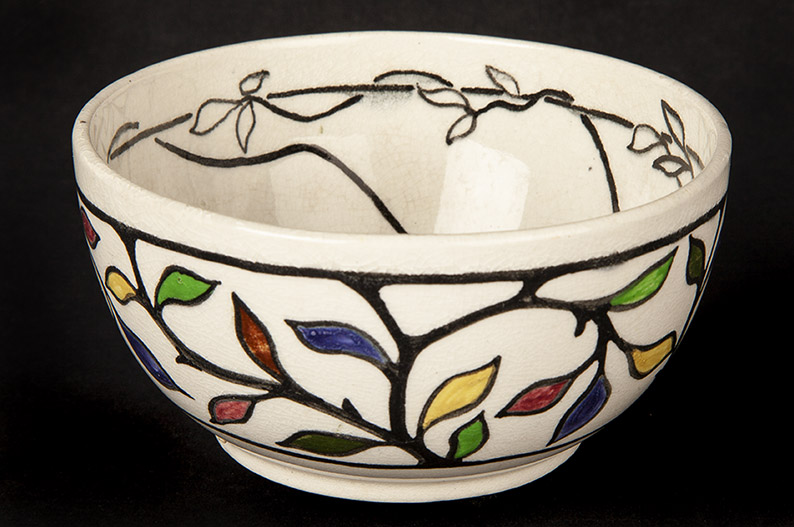
Hand-painted dish, Clokie & Co Ltd, Castleford. Believed to have been decorated by Alice's student, Henry Moore.


Overall, it has been an exciting opportunity to research Alice, who was relatively unknown apart from her teaching of Henry Moore. Although the research generated some challenges, including the limited qualitative documentation on her life, with most information being in relation to Moore, it is thrilling when you do come across something interesting or surprising about her. She led an interesting life, fulfilling her passion for art and pottery in Castleford, where she was a favourite of many of her students.

By Katie Simpson


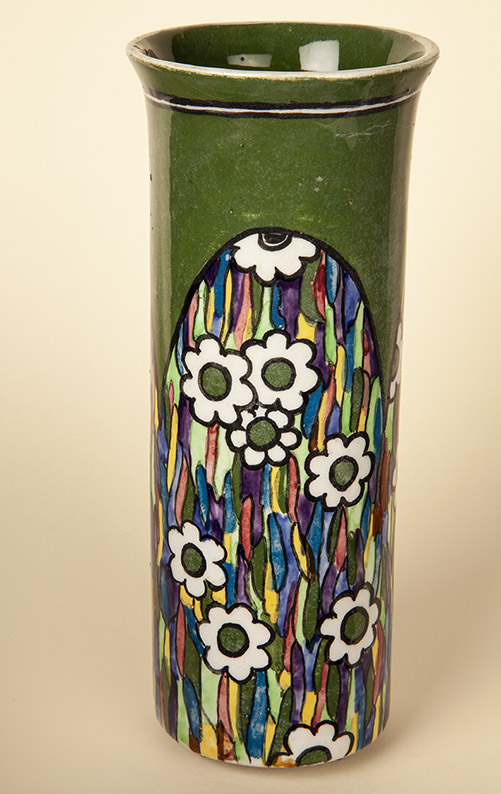
Thanks to generous donations from our amazing supporters and visitors, Wakefield Museums & Castles have been able to purchase examples of Castleford Peasant Pottery, hand decorated by Alice Gostick and her students. 


Sugar bowl and side plate, hand-painted by Alice Gostick, c. 1919

Tea set, hand-painted by Alice Gostick, c. 1918

Vase, hand-painted by Gostick's student, Albert Wainwright


Donations help us develop and care for our collections, including purchasing objects that tell the inspirational, unique stories of  the Wakefield district. Donate here to support our work. 

Want to read more from our fantastic Research Volunteers? Hannah explores the life and legacy of Charlie Williams for Black History Month here!

Monday, September 27, 2021

Cleaning up history

We're very lucky to have lots of brilliant volunteers help us with our projects. In this special post, Kylie tells us about her recent experience as a conservation volunteer and explores one object she found especially interesting during her time with us.


This summer preparations began for the Wakefield Museums & Castles partial store move, which meant dusting and packing objects that are not currently on display at any of the museum locations. Together as volunteers, under supervision, we were able to help review shelves of objects so that their documentation would be up to date and their condition for moving would be improved.

Objects kept at the store will typically have significance to Wakefield and the surrounding area. There were many interesting objects for us to clean. For example, typewriters could have dust settle under the keys whilst on open shelves. Using brushes, microfibre cloths, smoke sponges, or museum vacuums, they were returned to a clean state. These dry-cleaning methods will not always cause drastic changes in appearance, but it is still satisfying to know objects are cleaner and protected from damage by dust.

Old typewriters on the shelves in the Museum Store
Some of the typewriters before we dry cleaned and repacked them.

An object of particular interest was a black case of entomology equipment, used to study insects. The donor information named Walter Fletcher as the former owner, which is corroborated by the ‘WF’ scratched into a magnifying lens in the kit. Unfortunately, not much else is recorded about him, but it is clear he had a passion for entomology and took time to curate the required supplies over a long period of time. 

Walter Fletcher's entomology kit, a black wooden case, around the size of a laptop
Walter Fletcher's entomology kit

Inside there were 44 small empty boxes, some made of metal but most were paper. The majority also had labels for tablets from chemists. The size of these must have been perfect for storing insects. Discerning the exact date of the supplies and owner is difficult, but the labels of the various pill boxes  inside the case suggest it is from 1935-1968 due to the company name, Timothy Whites & Taylors. There are no objects made of plastic in the box, which may suggest earlier than the 1960s.  

The repurposed pill boxes are small circular boxes, made out of cardboard. They are originally from Timothy Whites & Taylors Dispensing Chemists, from 66 Kirkgate, Wakefield.
Pill boxes from local chemists seem to have been repurposed to store insect specimens.

There were also wooden blocks with string wound around them that would have been used to hold insects in place while drying them. There were metal tools, scalpel blades and packages of pins to assist in this process. A large net that could be dissembled was also able to fit in one compartment of the case. Everything needed for this hobby or passion to be fulfilled.

There was care to detail in so much of what Fletcher kept. He had nine glass slides with different insects, each carefully labelled.


Some of Fletcher's insect specimens in handmade specimen cards. These are all small types of fly.

In conserving this case, all objects were removed and the interior cleaned by brushes and a museum vacuum. Some objects required wrapping in acid free tissue, which will help stop any reactions between materials. This included the metal boxes because they react to relative humidity more than other organic materials like paper. Objects that were loose, like two large feathers, were also wrapped in tissue. Other objects were put into zip sealed plastic bags. This included loose pins and other sharp hazards. The goal is that all the different parts of the kit would stay together if the case was moved and it would be unlikely for damage to occur.

There are many more interesting objects to be found in the store. Dry cleaning and improving packaging for storage is helpful so that the objects will remain conserved for study or display in the future.


Special thanks to Kylie and all our conservation volunteers for their help preparing objects for the move. To keep up to date with this project and see what other treasures we discover, follow us on social media. Look out for updates on the hashtag #WFWhatsInStore.


Wednesday, July 21, 2021

“History opening up”: Transcribing the Sykes Visitor Book

In 2019, Wakefield Museums & Castles acquired a very special object: a Visitor Book from William Sykes Ltd in Horbury, Wakefield.

The woven front cover of the Sykes' visitor book. It has clearly been well used

William Sykes Ltd was a sporting goods manufacturer based in Horbury, Wakefield. In 1870, William Sykes used all his life savings to buy his own saddlery. After 10 years in business, he turned his leather working skills to making footballs and soon expanded into making goods for a wide range of different sports. William Sykes Ltd went from strength to strength and was soon selling equipment all over the world and supplying major tournaments like the FA Cup. William Sykes Ltd eventually merged with rival firms, Slazenger and Dunlop, but Horbury remained the centre of production until the factory’s closure in 1986. Find out more about William Sykes Ltd.

In 2021, Anne Dawson, one of our wonderful volunteers, took on the challenge of transcribing the Visitor Book and researching the names within it. After 6 weeks, and 12 pages, Anne shares what she has found so far…

Have you ever been asked to sign a Visitor Book?  Maybe you have been to another office for a meeting.  Perhaps it was that lovely little B&B where you flicked back a few pages to see what everyone else had written before adding your "great breakfast" to the comments section.

You probably didn't think that a hundred years later, someone would be trying to decipher your name and working out where you were from.

The Sykes Factory was a major manufacturer of leather footballs, expanding to golf and cricket and other sports - at one point making 21 models of tennis racket. During World War II, it switched production to the war effort. It merged with Slazenger it 1942 and in 1959 was bought by Dunlop. 

A winter sports advert for Sykes for the 1939-40 season, depicting some of the many pieces of sporting equipment made at the factory

When I started to look at the Visitor Book, which started in 1930, I expected to see a list of (indecipherable) names, their hometown and the odd comment.

What I found was a truly fascinating historical document.  The first thing that struck me was that people had come from all over the world - South Africa, Australia, Canada. There were place names which we don't use now, like Bombay and Malaya... And the people......

The names on the page became real living people again.  The first page dated 1931 has a visit from H.R.H. George, Duke of Kent.  But you sort of expect royalty to visit factories - there are often plaques to visits from Dukes and Princesses, so that wasn't unusual.

One page of the Sykes' visitor book full of people's names and signatures

Then names that I recognised started to appear. Len Hutton, who is described as one of the greatest cricketers of all time, and Dan Maskell, who I knew as a commentator, but he also played and coached tennis. Whole teams came to visit, including the Australian Rugby League Touring Club, Bristol City Football Club and the New Zealand Cricket team. Sometimes the visitors seem to have no connection to sports, such as a group from Castrop Rauxell, a mining town in Germany that was twinned with Wakefield in 1949.   

As well as signing their names, some visitors also made annotations in the book. Bob Andrews put an arrow up to the visitor above him with the words "what a great act to follow" – that previous visitor was Don Bradman, one of the most famous cricket batsman of his time. Sykes had a partnership with Bradman, who visited the factory in November 1934 and again in June 1948. They produced a ‘Don Bradman’ series of cricket bats and Bradman used a Sykes cricket bat to hit every one of his record achievements – something Sykes were keen to promote!

A double-page advert for Sykes' cricket equipment, featuring Don Bradman

I think what really made me feel I was looking at history though was the comment made on 10 August 1945, when Japan offered to surrender to the Allies during World War II. The comment reads: "10th August 1945!  What a day!... we are going to start business again. I was lucky enough to be here that day and I'll never forget it..."  Unfortunately in his excitement, his name is illegible.

Comments and notes left in the Sykes' visitor book in the 1930s and 40s

So next time you are asked to sign a Visitor Book, think of the person in the future trying to decipher your name and write legibly!

With thanks to Anne for all her hard work in transcribing the Visitor Book. If you're interested in volunteering with our collections, please get in touch with Leah Mellors, Collections & Exhibitions Manager, on lmellors@wakefield.gov.uk.

For more information on William Sykes Ltd, click here.

Monday, May 10, 2021

New to our collection: First World War bandolier

We are always looking for objects with a strong local story to add to our collection. Although our museums have been sadly closed for most of the last year, behind the scenes we have still been busy acquiring exciting items. One recent addition is this top notch example of Horbury leatherwork from the First World War (1914 – 1918). It shows another way that the town contributed to the war effort.


A leather bandolier on a mannequin. It is worn over one shoulder around the body.

Bandolier, 1916, made by William Sykes Ltd. in Horbury


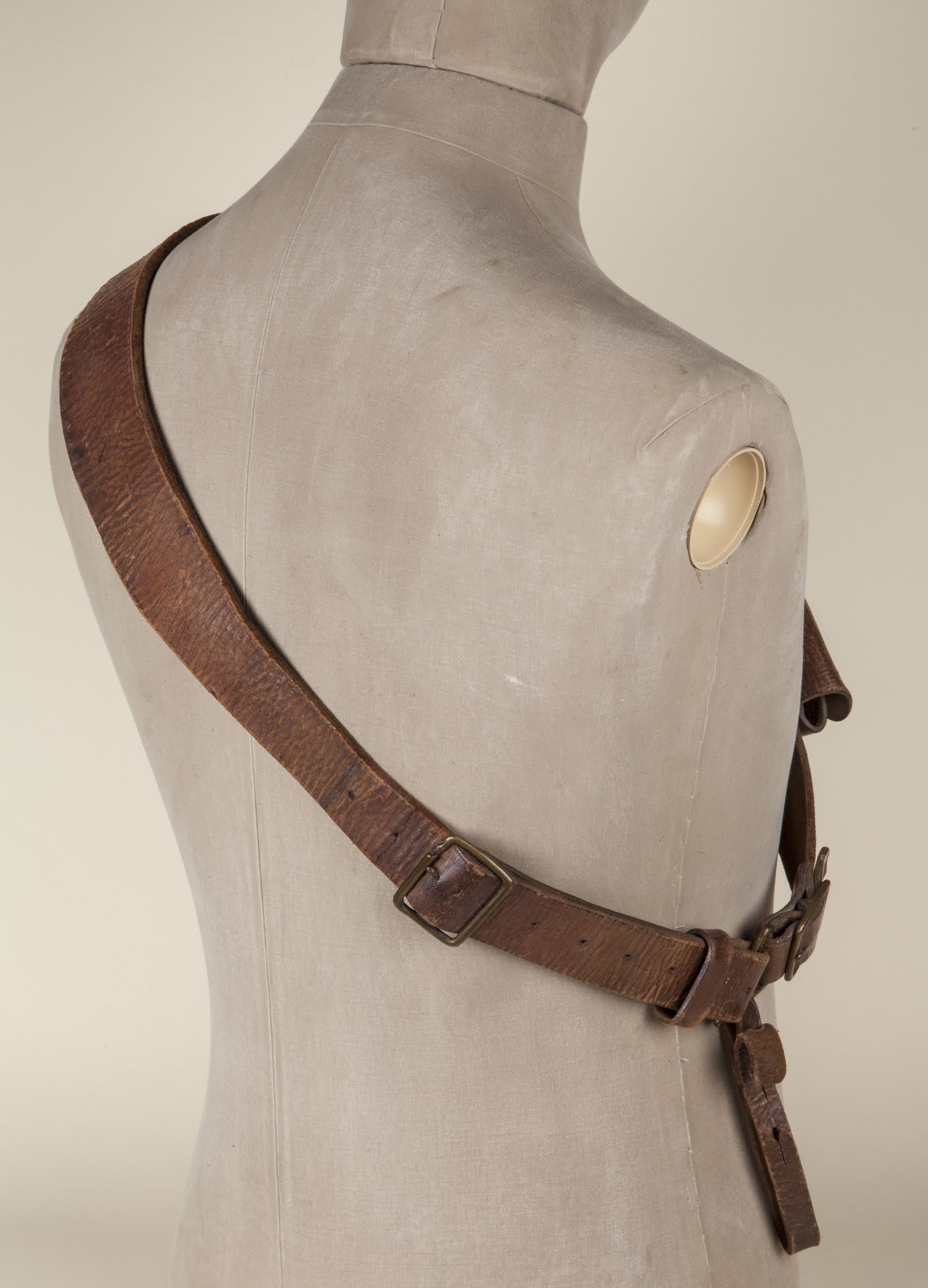
A bandolier is an ammunition belt, worn by soldiers over the shoulder and across the chest to carry extra bullets. This example is composed of a leather strap with a buckle and has five rifle bullet pouches sewn into it. 

Back of the bandolier, demonstrating how the object is secured around the body like a belt
Side of the leather bandolier


It is a 1903 pattern used by British soldiers during the First World War.

3 soldiers wearing bandoliers. Two are seated, and one is stood. They are in full uniform.
Soldiers wearing bandoliers in the Queen's Own Yorkshire Dragoons. They are P.H. Charlesworth, A. Beilby and Mr Cooper, 1914 - 1918

A black and white photo of a soldier in the Royal Artillery wearing a bandolier and carrying a cane
Soldier in the Royal Artillery with a bandolier, 1914 - 1918

The bandolier is stamped with the name Sykes and the year 1916. Sykes refers to the local company, William Sykes Ltd. At the time, the company was on its way to becoming one of the largest sports manufacturers in the world. Skilled leather and wood workers made all manner of bats, balls, rackets, pads and gloves for every kind of player, amateur and professional, all from Sykes’ Yorkshire Athletic Manufactory in Horbury.

They also adapted their skills to make equipment for the military. As early as the Boer War (1899 – 1902), Sykes fulfilled orders for the War Office. As well as sports equipment for basic training, they made kit such as this bandolier and other leather strapping worn by soldiers.

By the Second World War (1939 - 1945), the Sykes workforce of a thousand local people produced an array of equipment, from bayonets and ammunition boxes to sand goggles and skis. The factory made over a million sets of wooden rifle furniture at a peak rate of 11,000 sets a week.

A sepia photograph of a dozen workers, male and female, making rifle furniture
A sepia photograph of several women seated making rifle furniture
Workers making rifle furniture at Sykes' Albion Mill in the Second World War

The bandolier is the first example of William Sykes Ltd's First World War work that we’ve ever seen and acquired. It will become part of our Playmakers collection, which represents and celebrates the incredible contribution to international sport made by skilled workers in Horbury from the late 1800s to late 1900s.  


The Playmakers logo


Sykes produced a vast range of goods for a huge variety of different sports. When the company later became part of the Dunlop Slazenger group, Horbury remained the centre of production and innovation. Thousands of people enjoyed playing sports using Horbury-made goods. Equipment developed locally starred on the world stage at major sporting events. Many elite sports people chose pioneering Horbury products to help propel them to the top of their game.


For more of our collections highlights, click here.


Sunday, December 27, 2020

Play your cards right

The 'Twixmas' period is the perfect time for having fun with family, when many of us dig out the packs of cards and challenge each other to a game. So we thought we'd have a root in our Toys and Games collection for some ideas to pass the winter evenings. From traditional trick-taking and trumps, to more obscure offerings, we found some real aces.


We are all familiar with the humble playing card thanks to a long tradition dating back to the 14th century when playing cards first arrived in Europe. They most probably came to the West via India and Egypt from China, where they were likely invented along with the pioneering of paper and printing. Originally lavishly hand illustrated, playing cards were the preserve of the rich until advances in printing technology made them cheaper and more readily available to the masses. The backs of cards were left blank until the 19th century. They were first decorated to avoid cheating by marking cards but manufacturers soon saw the advertising potential. Playing cards are often now produced as promotion items like this pack advertising Wakefield based brewery, Beverleys.


Vintage playing cards with adverts for Beverley's Beers on the back
Playing cards advertising Beverleys Beers, John Waddington Ltd, c. 1950s - 1970s


The four suits we are so familiar with in Britain today originate from France. The global popularity of whist and bridge meant the Anglo-French suitmarks became the international standard, although national variations remain.

A small metal trump indicator. By pressing the top of it, it would change the display to one of 4 card suits.
Trump indicator used in whist. Whoever played the highest scoring clubs card would have won the trick in this round. 

A wooden whist marker inlaid with precious stones in the shape of insects
The tabs on this whist marker lift up to indicate the score. The large tabs are for points scored in the round and the smaller tabs for number of rounds won. This is an exquisite example of a Shibayama marker exported from Japan- it is lacquered and inlaid with precious stones like mother of pearl.

A bakerlite bridge game card holder
Playing cards and bridge scoring sheets
Bridge set in Bakelite case, Seaforth, 1930s - 1950s

There are countless games to be played with a standard 52 card deck, whether single player or for teams or large groups. But we have also found a variety of other card decks in the collection, some educational and some a little more frivolous.

Counties of England card game in a small decorated box
Counties of England, Jacques & Sons 

Counties of England is a geographical variation on Happy Families. Players compete to complete a county by collecting all the appropriate town cards. The winner collected the most counties. Of course, the real victor is whoever collects Yorkshire!


Colourful 'beat your neighbours' card game with food and drink illustrations

Beat Your Neighbour is a catch and collect game- the aim is to claim all your opponents’ cards. Without looking at their hand, each player turns over a card in turn. If someone plays a Put card, the next player has to surrender that number of cards. If they do not turn over a Put card themselves, the previous player claims the pile. There are many varieties of Beat Your Neighbours card, each with different themed illustrations.


Snip snap card game
Snip Snap, Stanfield Holdings, 1970s

Snip-Snap is a matching game with a difference. It was designed to help the British adapt to the new decimal currency system introduced in 1971. Players won cards by being the first to spot pairs. They would shout ‘Snip’ for a matching pair of decimal coins or ‘Snap’ for two identical old currency cards. When a pre-decimal card is matched with its new currency equivalent, players must declare, ‘Snip-Snap!’ whilst being careful not to call an incorrect pair and be forced to forfeit a card to each of their opponents.

Vintage pit card game
Pit, John Waddington Ltd

Pit is a trading game mimicking a corn exchange. The cards represent different crops (9 cards for each of the 7 grains) and players vie to be the first to complete a full set. Players trade cards with each other, declaring the number of cards they wish to swap but not revealing the commodity. The traders all shout out their offers at once resulting in a high energy, high volume competition. Each complete set has a different points value and the victorious trader is the first to reach 500 points.

Vintage muggins game
Muggins, R&S, early 20th century
There are no winners as such in this game - rather the objective is not to be the Muggins, the last player left holding any cards. There are four packs of cards numbered 1-25 that are shuffled and shared out by the dealer. The aim is to reunite the cards into their four groups. Each player takes it in turns to discard as many cards as they can but cards must be played in numerical order, either ascending from 1 or descending from 25. If you don't have the next number in the sequence, you must instead accept a card into your hand from each of your opponents.

Muggins promises 'roars of laughter'. As a nation, we have been enjoying card games for centuries. Which is your favourite?  Let us know what you've been playing these holidays in the comments and over on social media.

If you'd like more inspiration for games to enjoy this Christmas, check out Old Fashioned Fun and don't forget you can browse our Toys and Games collection online

Monday, October 26, 2020

Black History Month: Sugar nippers not shackles

For Black History Month 2020, Wakefield Museums & Castles are exploring four stories related to British slave ownership in the early 1800s. This week, we are focusing on our collections and how we can reveal hidden stories from objects that at first glance seem to be unrelated.


The story of the British slave trade and slave ownership is part of every town and city in Britain. Local history museums can tell the story too. Although most local museums do not have the shackles or whips used to subjugate those who were enslaved, we can show how the products and profits of enslavement reached every home in Britain, including Wakefield. 

It can be surprising how many different and diverse stories museum objects can tell.

The Triangle of Trade

An old printed and handwritten banknote from 1800
Banknote of the Wakefield Bank, Ingram, Kennett and Ingram, 1800

Captain Francis Ingram of Wakefield used the profits from trading in enslaved people to start Wakefield’s first bank. In the 1770s and 1780s he was a major figure in the slave trade, involved in 105 voyages, which took away close to 34,000 slaves from Africa. It is estimated that these ships delivered just over 29,000 people to the Americas, meaning that around 5,000 died making the journey across the Atlantic Ocean.

Ingram’s business was part of the so called Triangle of Trade. British merchants like Ingram sailed from ports such as Liverpool and traded goods for enslaved Black people from African merchants in ports along the West African coast. 

The enslaved people were tightly packed into ships, which then travelled across the Atlantic to the British colonies in North and South America and the Caribbean. Many enslaved men, women and children died in the crossing. The ships were unsanitary and overcrowded.

The industrial revolution in Britain in the 1700s and 1800s relied on the exploitation of enslaved people in the British colonies. The merchants traded the enslaved to plantation owners in return for the goods they would be put to work to grow and harvest. The key products were cotton, coffee, rum, sugar, and tobacco. These goods were then shipped back to Europe and made their way to wardrobes, kitchens, dining tables and pockets in Britain. Some would then complete the cycle and be shipped to Africa to be traded for more enslaved workers.


The products of slavery


The use of slave labour enabled mass production, meaning that expensive commodities became more affordable to less wealthy families and began to appear in homes across the country. The household objects associated with these luxury goods eventually arrived in our museum collections.

An ornate coffee pot, which looks like a tall thin teapot

Coffee pot, Newhall, 1820s


'Sugar nippers', a metal tool that looks like a pair of pliers or scissors with rounded edges

Sugar nippers, early 1800s

Sugar arrived at a household in a cone or ‘loaf’. It was broken up with a sugar axe or hammer and then nippers like these were used to cut off smaller chunks.


A ceramic ornate sugar bowl
Sugar bowl, D. Dunderdale and Co., Castleford, 1790 – 1821


A glass bottle labelled 'Jamaica rum'
Bottle labelled ‘Jamaica rum’ from a travel chest ‘cellarette’, late 1700s


An ornate metal tobacco box

Tobacco box, late 1700s


Shamefully, the lives of most enslaved people from the early 1800s are absent from history. But their stories and suffering are often hidden in plain sight in our collections and displays, and the social and industrial history of the nation. 


This is the third article in our Black History Month series looking at Wakefield’s links to slavery. The final post next week will consider how the Waterton family were entangled with the practice of slavery in the late 1700s and early 1800s and what Wakefield Museum is doing to address it.


Previous posts