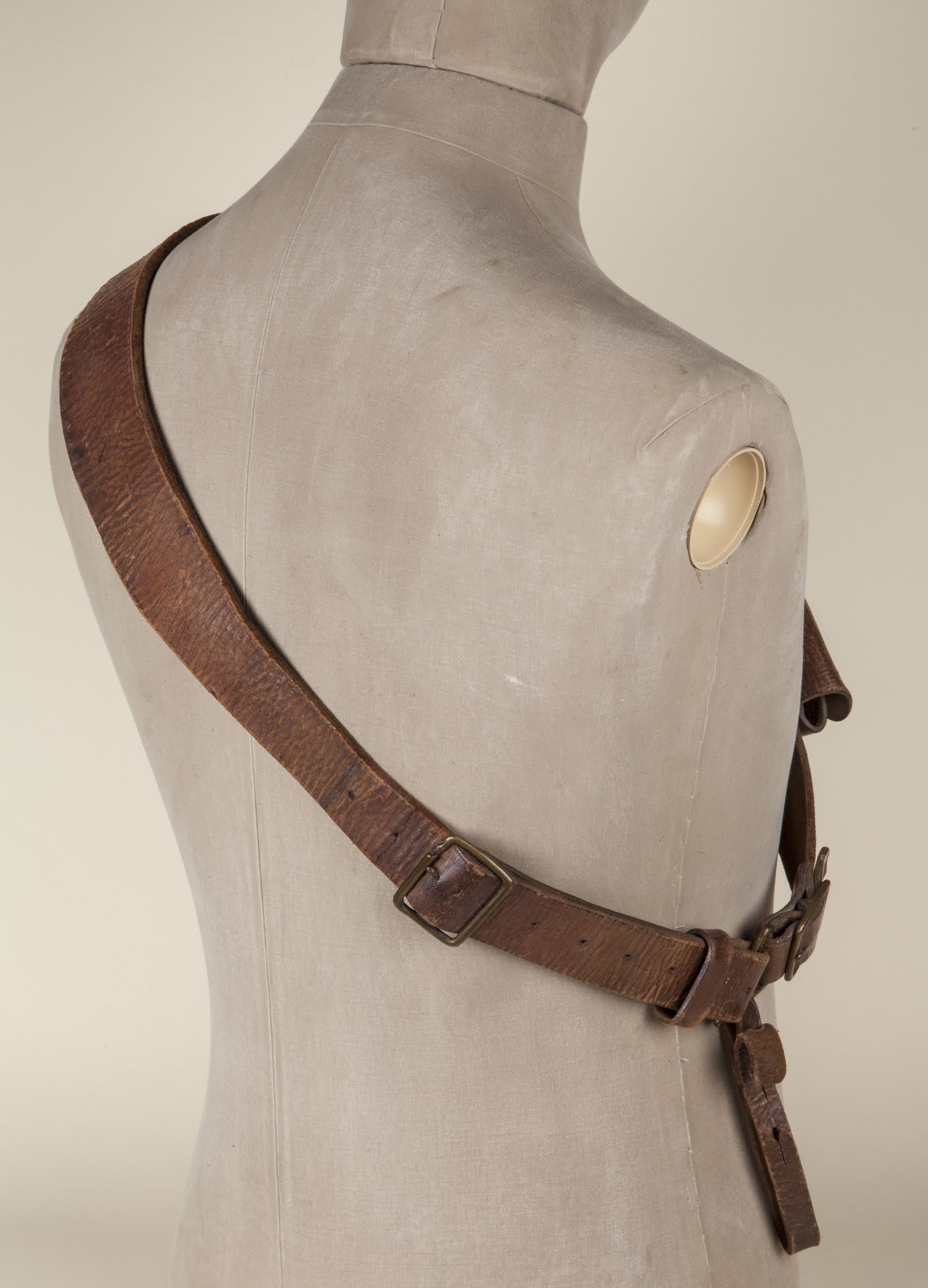
The display, featuring objects loaned by Gavin Cave, will be in the shop window of Grooms Rooms Menswear in Horbury from 1 to 17 June 2024.
 |
| The D-Day display in Grooms Rooms Menswear |
D-Day display
D-Day was on June 6, 1944. It involved the simultaneous landing of tens of thousands of troops on five separate beaches in Normandy.
It was the largest military naval, air and land operation ever attempted. It marked the start of the campaign to liberate Nazi-occupied north-west Europe.
Local collector, Gavin Cave, has worked with the Wakefield Museums and Castles team to create a display of some of his collection.
Local collector, Gavin Cave, has worked with the Wakefield Museums and Castles team to create a display of some of his collection.
This includes the uniform of a ‘typical’ British soldier and sailor landing on the Normandy beaches on D-Day, and the uniform of a dispatch rider. Dispatch riders were one of the many specialist troops involved in supporting the landings.
Gavin has said that he’s really enjoyed the opportunity to display some of his collection, though some of it has been a bit of a project to get it ready for display!
Gavin has said that he’s really enjoyed the opportunity to display some of his collection, though some of it has been a bit of a project to get it ready for display!
The D-Day uniforms
The uniforms are all original, possibly unissued items.The 'typical’ uniform includes a MkII steel helmet, which has a net attached to afford camouflage and concealment. The steel dispatch rider helmet is designed to also give protection whilst riding a motorcycle.
 |
| Gavin holding the two helmets - the dispatch rider helmet is on the left, and the 'typical' one on the right. |
The clothing is different too.
The ‘typical’ soldier and sailor wears a woollen battledress jacket (late 1940 austerity pattern) and battledress trousers (1939 pattern). The trousers are much higher waisted than modern trousers, in keeping with the fashion of the day. They also had the added advantage of keeping the lower back warm!
He also wears 1937 pattern webbing. This has two ammo pouches at the front, large enough to take the magazines for a Bren gun.
 |
| The 'typical' soldier / sailor uniform, ready for display |
He carries a water bottle, entrenching tool and his small pack. This would contain his 24-hour rations. He also had a waterproof cape, jumper, mug, mess tins and spare socks. On his feet he wears regulation ammunition boots.
The dispatch rider wears a rubberised coat over his battledress jacket. The coat straps over the legs of his jodhpur-like trousers, allowing for easy riding.
 |
| The dispatch rider's uniform, with coat opened to show the jodphur-like trousers |
A pair of dispatch rider boots (bought and worn by Gavin's wife in the ‘90s!) were in particularly poor condition. They have been painstakingly restored to prevent further deterioration of the leather. Many layers of polish had to be removed, so that the leather could be conditioned and consolidated.
 |
| The dispatch rider boots, now restored |
June 6, 1944 – A Big Day (for other reasons!)
Irene Winifred Cheshire was born in Horbury in 1924. During the Second World War, she was a ‘Private’ (cook) in the Auxiliary Territorial Service (A.T.S.), stationed at Pontefract barracks.
Here she met Harry Patterson. Harry was born in Co. Durham in 1914. He had joined The Green Howards before switching to become a ‘Private’ (cook) in the Army Catering Corps (A.C.C.) on its formation. He was then sent to Pontefract.
Harry and Irene were granted Special Leave to get married on June 6, 1944. The wedding took place at St. Peter & St. Leonards church in Horbury.

Operation Neptune (the D-Day landings) was top secret. The couple will have been unaware that their wedding was to be on the same day as the largest military naval, air and land operation ever attempted!
Here she met Harry Patterson. Harry was born in Co. Durham in 1914. He had joined The Green Howards before switching to become a ‘Private’ (cook) in the Army Catering Corps (A.C.C.) on its formation. He was then sent to Pontefract.
Harry and Irene were granted Special Leave to get married on June 6, 1944. The wedding took place at St. Peter & St. Leonards church in Horbury.

Operation Neptune (the D-Day landings) was top secret. The couple will have been unaware that their wedding was to be on the same day as the largest military naval, air and land operation ever attempted!
Horbury’s role in WW2
Many British manufacturers switched to producing equipment to help the war effort. This included Sykes of Horbury, the famous local sports manufacturers.By the Second World War, Sykes employed a thousand local people. As they had in the First World War, the Sykes workers produced an array of equipment for the Second World War.
 |
| Workers making rifle furniture at Sykes' Albion Mill in the Second World War |
These ranged from bayonets and ammunition boxes to sand goggles and snow shoes - made using the same techniques as their tennis rackets!
 |
| A Sykes' Second World War snow shoe, made using their steam bending tennis racket technique. |
Other local people were also involved in the war effort leading up to the D-Day landings.
With thanks to the Royal British Legion for their support with this display.