Showing posts with label horbury. Show all posts

Thursday, August 14, 2025

Chloe: what I did on my work placement with Wakefield Museums and Castles

Chloe recently did a work placement with us as part of her university course. She's kindly written this guest blog about her experience. 

Read on to discover some of the interesting objects she catalogued for us!

During my work placement I was based in the museum store. I catalogued a small collection of items from the Sykes / Slazenger factory. The Sykes / Slazenger factory is mainly known for manufacturing sports items and equipment.

When I first started my work placement I was given a tour of the museum store. I was shown some of the objects and items they have and told about their significance. I was then shown the objects I would cataloguing throughout the eight weeks of my placement. I was also shown the history file. This contains everything needed to be kept with the collection, like the forms to say what needs to be catalogued or just used for reference. It also says how they got the items as well as the ownership of the items.

A table featuring a pile of photographs, photo album, racket head press, tennis racket and rifle furniture
The objects I catalogued

The items I was to catalogue were:

  • a pile of black and white photographs

  • a photo album with more black and white photographs

  • a head press (this was used to help make sure the tennis racket kept its shape)

  • a tennis racket with a head press

  • some rifle furniture (the wooden parts of a rifle) produced in the Sykes / Slazenger factory during the Second World War

The photographs

After looking through the objects, I decided I would start by cataloguing the black and white photographs. I started by putting the photographs into groups. I wanted to keep and catalogue the ones that were similar together.

A lot of the photographs were quite similar in nature. Cataloguing them was difficult, as it was hard to tell the difference between them.

Some of the photographs were pictures of some of the different manufacturing processes. These included how a tennis racket or a golf club was made. Others were of people using the machine, or just of the machines themselves.

This was very similar when I had catalogued the photo album. Some of the photographs were similar or the same to the ones I had already catalogued.

A man in an overcoat closely studying a golf club in the Sykes factory
 This photograph shows a man looking over a finished golf club. He is making sure that everything has been done correctly. He is also putting on the final touches to the golf club.

Cataloguing the 3D objects

Cataloguing the rifle parts, tennis racket, head presses and the film reel was different. These objects have depth, whereas the photographs do not.

When measuring the length of the objects, I had to use a tape measure. They were quite long and it would have been difficult to do so without. I also had to look closely at the objects to make sure the condition they were in was fine. 

I was also looking to see if there was anything that was engraved or marked on to the objects.

A vintage wooden racket with a head press attached
The racket, still in its head press

The Sykes factory started to manufacture the wooden rifle parts during the Second World War. They would have slowed down the manufacturing of the sports items they produced, along with some of the machines in the photographs.

Various parts to construct a rifle made out of smooth polished wood
Pieces of wooden rifle furniture made by Sykes

There were some books amongst the items within the collection I was able to use for referencing. This was useful as I was able to match the photographs to the pictures of the machines within the books. 

There were some small pieces of paper that also had the name and description of what the machine was used for and how it worked. I was able to match the pieces of paper to the photographs as some of the machines had their names engraved on the front.

A book titled Sykes and the War and a printed thesis
'Sykes and the War' and a thesis I used to research the objects

I had lastly catalogued some letters within the collection. They were in correspondence with the Sykes / Slazenger factory (more importantly the people within the factory). The majority of them had the dates in which they were sent. This made it easier for me to catalogue them in time order.

A lot of the letters were in response to Briggs receiving the British Empire Medal that was awarded by the King. This was due to his hard work in the war effort. Briggs sent letters back saying that it was a joint effort with the people he was working with and only done with the support of others.

This small collection I have catalogued is a part of a bigger collection Wakefield Museums and Castles has. There is loads more to find out about other sports items and equipment that were made at the factory. There's also lots to learn about the history behind the factory and how they stepped in to help with the war effort.

Wednesday, May 29, 2024

D-Day 80 Display

Malcom Patterson, Chairman of the Horbury, Sitlington and Ossett branch of the Royal British Legion, contacted us to ask if we could help with a special display to commemorate the 80th anniversary of D-Day. 

The display, featuring objects loaned by Gavin Cave, will be in the shop window of Grooms Rooms Menswear in Horbury from 1 to 17 June 2024.

A soldier's uniform and a dispatch rider's uniform from the D-Day landings on display on mannequins, with a wreath of poppies and a note commemorating the names of those who died in the Second World War by the Horbury Sitlington and Ossett Royal British Legion
The D-Day display in Grooms Rooms Menswear

D-Day display

D-Day was on June 6, 1944. It involved the simultaneous landing of tens of thousands of troops on five separate beaches in Normandy. 

It was the largest military naval, air and land operation ever attempted. It marked the start of the campaign to liberate Nazi-occupied north-west Europe.

Local collector, Gavin Cave, has worked with the Wakefield Museums and Castles team to create a display of some of his collection. 

This includes the uniform of a ‘typical’ British soldier and sailor landing on the Normandy beaches on D-Day, and the uniform of a dispatch rider. Dispatch riders were one of the many specialist troops involved in supporting the landings.

Gavin has said that he’s really enjoyed the opportunity to display some of his collection, though some of it has been a bit of a project to get it ready for display!

The D-Day uniforms 

The uniforms are all original, possibly unissued items.

The 'typical’ uniform includes a MkII steel helmet, which has a net attached to afford camouflage and concealment. The steel dispatch rider helmet is designed to also give protection whilst riding a motorcycle.

Gavin holding up a helmet in each hand. He is looking towards the dispatch rider helmet, which is a dome-shaped khaki helmet with leather straps hanging down over the ears. The 'typical' helmet on the right is a similar shape but a darker khaki, with a net attached.
Gavin holding the two helmets - the dispatch rider helmet is on the left, and the 'typical' one on the right.

The clothing is different too. 

The ‘typical’ soldier and sailor wears a woollen battledress jacket (late 1940 austerity pattern) and battledress trousers (1939 pattern). The trousers are much higher waisted than modern trousers, in keeping with the fashion of the day. They also had the added advantage of keeping the lower back warm! 

He also wears 1937 pattern webbing. This has two ammo pouches at the front, large enough to take the magazines for a Bren gun.

The brown woollen shirt and battledress trousers worn by a 'typical' soldier on D-Day, with multiple pockets, and accompanying boots
The 'typical' soldier / sailor uniform, ready for display

He carries a water bottle, entrenching tool and his small pack. This would contain his 24-hour rations. He also had a waterproof cape, jumper, mug, mess tins and spare socks. On his feet he wears regulation ammunition boots.

The dispatch rider wears a rubberised coat over his battledress jacket. The coat straps over the legs of his jodhpur-like trousers, allowing for easy riding.


A long brown rubberised overcoat, partially opened to show the brown jodphur-like trousers designed to provide comfort when riding a motorbike
The dispatch rider's uniform, with coat opened to show the jodphur-like trousers

A pair of dispatch rider boots (bought and worn by Gavin's wife in the ‘90s!) were in particularly poor condition. They have been painstakingly restored to prevent further deterioration of the leather. Many layers of polish had to be removed, so that the leather could be conditioned and consolidated.


Leather boots that reach up to the mid calf, with buckles and laces up to the top.
The dispatch rider boots, now restored

June 6, 1944 – A Big Day (for other reasons!)

Irene Winifred Cheshire was born in Horbury in 1924. During the Second World War, she was a ‘Private’ (cook) in the Auxiliary Territorial Service (A.T.S.), stationed at Pontefract barracks.

Here she met Harry Patterson. Harry was born in Co. Durham in 1914. He had joined The Green Howards before switching to become a ‘Private’ (cook) in the Army Catering Corps (A.C.C.) on its formation. He was then sent to Pontefract.

Harry and Irene were granted Special Leave to get married on June 6, 1944. The wedding took place at St. Peter & St. Leonards church in Horbury.

Harry, in uniform, and Irene, in a white wedding dress with veil, with their family on their wedding day


Operation Neptune (the D-Day landings) was top secret. The couple will have been unaware that their wedding was to be on the same day as the largest military naval, air and land operation ever attempted!

Horbury’s role in WW2

Many British manufacturers switched to producing equipment to help the war effort. This included Sykes of Horbury, the famous local sports manufacturers. 

By the Second World War, Sykes employed a thousand local people. As they had in the First World War, the Sykes workers produced an array of equipment for the Second World War. 

A group of Sykes workers, all women, making wooden rifle furniture. One is holding her piece up and looking down it to check its quality.
Workers making rifle furniture at Sykes' Albion Mill in the Second World War

These ranged from bayonets and ammunition boxes to sand goggles and snow shoes - made using the same techniques as their tennis rackets!

A wooden oval-shaped snow shoe, with rope attached to a piece of fabric where the foot would be, and straps across the top.
A Sykes' Second World War snow shoe, made using their steam bending tennis racket technique.


Other local people were also involved in the war effort leading up to the D-Day landings. 

With thanks to the Royal British Legion for their support with this display.

Royal British Legion logo

Monday, May 10, 2021

New to our collection: First World War bandolier

We are always looking for objects with a strong local story to add to our collection. Although our museums have been sadly closed for most of the last year, behind the scenes we have still been busy acquiring exciting items. One recent addition is this top notch example of Horbury leatherwork from the First World War (1914 – 1918). It shows another way that the town contributed to the war effort.


A leather bandolier on a mannequin. It is worn over one shoulder around the body.

Bandolier, 1916, made by William Sykes Ltd. in Horbury


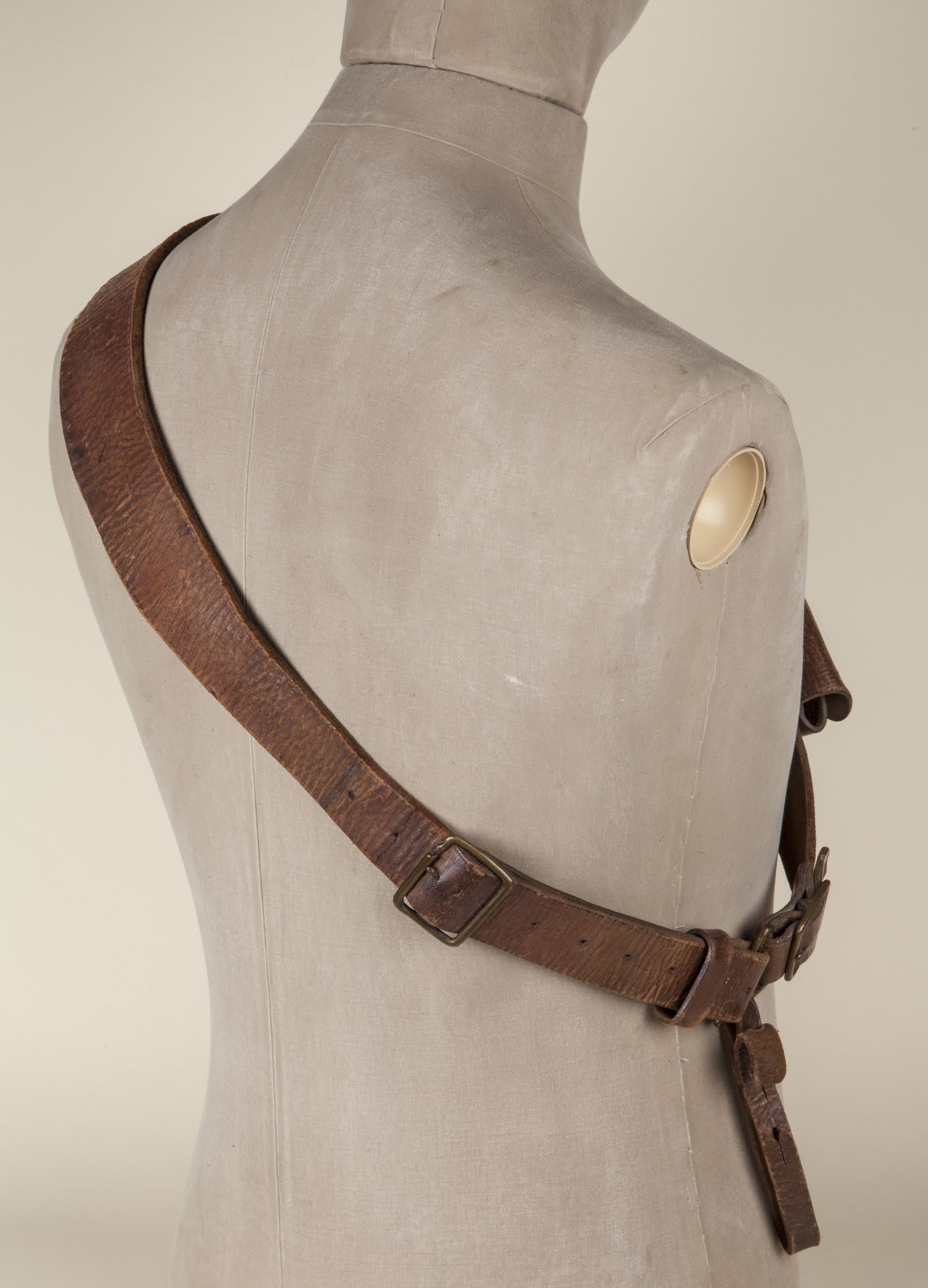
A bandolier is an ammunition belt, worn by soldiers over the shoulder and across the chest to carry extra bullets. This example is composed of a leather strap with a buckle and has five rifle bullet pouches sewn into it. 

Back of the bandolier, demonstrating how the object is secured around the body like a belt
Side of the leather bandolier


It is a 1903 pattern used by British soldiers during the First World War.

3 soldiers wearing bandoliers. Two are seated, and one is stood. They are in full uniform.
Soldiers wearing bandoliers in the Queen's Own Yorkshire Dragoons. They are P.H. Charlesworth, A. Beilby and Mr Cooper, 1914 - 1918

A black and white photo of a soldier in the Royal Artillery wearing a bandolier and carrying a cane
Soldier in the Royal Artillery with a bandolier, 1914 - 1918

The bandolier is stamped with the name Sykes and the year 1916. Sykes refers to the local company, William Sykes Ltd. At the time, the company was on its way to becoming one of the largest sports manufacturers in the world. Skilled leather and wood workers made all manner of bats, balls, rackets, pads and gloves for every kind of player, amateur and professional, all from Sykes’ Yorkshire Athletic Manufactory in Horbury.

They also adapted their skills to make equipment for the military. As early as the Boer War (1899 – 1902), Sykes fulfilled orders for the War Office. As well as sports equipment for basic training, they made kit such as this bandolier and other leather strapping worn by soldiers.

By the Second World War (1939 - 1945), the Sykes workforce of a thousand local people produced an array of equipment, from bayonets and ammunition boxes to sand goggles and skis. The factory made over a million sets of wooden rifle furniture at a peak rate of 11,000 sets a week.

A sepia photograph of a dozen workers, male and female, making rifle furniture
A sepia photograph of several women seated making rifle furniture
Workers making rifle furniture at Sykes' Albion Mill in the Second World War

The bandolier is the first example of William Sykes Ltd's First World War work that we’ve ever seen and acquired. It will become part of our Playmakers collection, which represents and celebrates the incredible contribution to international sport made by skilled workers in Horbury from the late 1800s to late 1900s.  


The Playmakers logo


Sykes produced a vast range of goods for a huge variety of different sports. When the company later became part of the Dunlop Slazenger group, Horbury remained the centre of production and innovation. Thousands of people enjoyed playing sports using Horbury-made goods. Equipment developed locally starred on the world stage at major sporting events. Many elite sports people chose pioneering Horbury products to help propel them to the top of their game.


For more of our collections highlights, click here.