Showing posts with label museum store. Show all posts

Thursday, August 14, 2025

Chloe: what I did on my work placement with Wakefield Museums and Castles

Chloe recently did a work placement with us as part of her university course. She's kindly written this guest blog about her experience. 

Read on to discover some of the interesting objects she catalogued for us!

During my work placement I was based in the museum store. I catalogued a small collection of items from the Sykes / Slazenger factory. The Sykes / Slazenger factory is mainly known for manufacturing sports items and equipment.

When I first started my work placement I was given a tour of the museum store. I was shown some of the objects and items they have and told about their significance. I was then shown the objects I would cataloguing throughout the eight weeks of my placement. I was also shown the history file. This contains everything needed to be kept with the collection, like the forms to say what needs to be catalogued or just used for reference. It also says how they got the items as well as the ownership of the items.

A table featuring a pile of photographs, photo album, racket head press, tennis racket and rifle furniture
The objects I catalogued

The items I was to catalogue were:

  • a pile of black and white photographs

  • a photo album with more black and white photographs

  • a head press (this was used to help make sure the tennis racket kept its shape)

  • a tennis racket with a head press

  • some rifle furniture (the wooden parts of a rifle) produced in the Sykes / Slazenger factory during the Second World War

The photographs

After looking through the objects, I decided I would start by cataloguing the black and white photographs. I started by putting the photographs into groups. I wanted to keep and catalogue the ones that were similar together.

A lot of the photographs were quite similar in nature. Cataloguing them was difficult, as it was hard to tell the difference between them.

Some of the photographs were pictures of some of the different manufacturing processes. These included how a tennis racket or a golf club was made. Others were of people using the machine, or just of the machines themselves.

This was very similar when I had catalogued the photo album. Some of the photographs were similar or the same to the ones I had already catalogued.

A man in an overcoat closely studying a golf club in the Sykes factory
 This photograph shows a man looking over a finished golf club. He is making sure that everything has been done correctly. He is also putting on the final touches to the golf club.

Cataloguing the 3D objects

Cataloguing the rifle parts, tennis racket, head presses and the film reel was different. These objects have depth, whereas the photographs do not.

When measuring the length of the objects, I had to use a tape measure. They were quite long and it would have been difficult to do so without. I also had to look closely at the objects to make sure the condition they were in was fine. 

I was also looking to see if there was anything that was engraved or marked on to the objects.

A vintage wooden racket with a head press attached
The racket, still in its head press

The Sykes factory started to manufacture the wooden rifle parts during the Second World War. They would have slowed down the manufacturing of the sports items they produced, along with some of the machines in the photographs.

Various parts to construct a rifle made out of smooth polished wood
Pieces of wooden rifle furniture made by Sykes

There were some books amongst the items within the collection I was able to use for referencing. This was useful as I was able to match the photographs to the pictures of the machines within the books. 

There were some small pieces of paper that also had the name and description of what the machine was used for and how it worked. I was able to match the pieces of paper to the photographs as some of the machines had their names engraved on the front.

A book titled Sykes and the War and a printed thesis
'Sykes and the War' and a thesis I used to research the objects

I had lastly catalogued some letters within the collection. They were in correspondence with the Sykes / Slazenger factory (more importantly the people within the factory). The majority of them had the dates in which they were sent. This made it easier for me to catalogue them in time order.

A lot of the letters were in response to Briggs receiving the British Empire Medal that was awarded by the King. This was due to his hard work in the war effort. Briggs sent letters back saying that it was a joint effort with the people he was working with and only done with the support of others.

This small collection I have catalogued is a part of a bigger collection Wakefield Museums and Castles has. There is loads more to find out about other sports items and equipment that were made at the factory. There's also lots to learn about the history behind the factory and how they stepped in to help with the war effort.

Thursday, May 29, 2025

Wayne: My Work Placement with Wakefield Museums and Castles

This blog has been written by Wayne who has been volunteering with us at the museum store since 2021. He has also been doing a university course on preventative conservation. Wayne has been looking at how museum objects can be stored, displayed, and generally looked after in ways that protect them from damage.

As part of Wayne’s course, he had to do a student placement where he would put some of what he has learned into practice. He chose to do his student placement with us! Read on to find out what he's been up to.

Wayne concentrating on dusting the rim of a blue felt uniform cap with a paintbrush and small Museum vacuum
Wayne lightly dusting a uniform cap with a paintbrush and the Museum Vac at the Museum Store

My Work Placement with Wakefield Museums and Castles

I'm Wayne. I have just completed my university student placement module with Wakefield Museums and Castles at the museum store. I have also been a volunteer here for a long time now and so it was nice to take on a different role.

During my placement I worked closely with various members of the Museums and Castles Team on different projects. The guidance and generosity of the staff played a crucial role in my development. They helped me expand my knowledge further by putting into practice what I have been learning.

My first project was to look at light levels. I was checking if the light in the museum and the museum cases was too bright for the objects on display. Different types of objects have different reactions to brightness levels. Some of these reactions can cause permanent damage or colour fading to the object. Light levels are checked with a light meter. This measures the brightness of light in lux, or by the amount of light that falls on a surface, which is measured in lumens per square metre.  

Ceiling-height shelves stretching into the distance filled with shallow carboard boxes
Rows of boxes of carefully stored objects in the Museum Store

I started the project by locating light-sensitive objects (objects most likely to fade or become damaged) that are on display in the museums, using the collections database. I then checked how long they had been on display for. Damage caused by light can also be affected by how long an object has been exposed to light.

To prevent light damage from happening, it is important to regularly test, monitor, and set light brightness. We also calculate how long the object can be displayed for before it becomes at risk of light damage. When an object reaches its display time limit, it should be moved to dark storage where it can “get some rest”. 

The next stage of my work was to identify which of the museum objects on display have reached their display limit so that they can be swapped and moved to dark storage.

Food collections

Now this may sound strange to many people that already know food and museum collections don’t go together normally! Food can rot or attract pests like mice and insects. These may then damage other objects as well.

However, there are some food objects in the museum collection. They can tell us a great deal about the past. One such object is a hot cross bun from the Crimean War. This bun is nearly 200 years old. It is said to have survived inside a pocket of a soldier because he forgot it was there “like you do”.

A very old, crusty, shrunken and hard hot cross bun
The hot cross bun that survived the Crimean War!

This brings me to my next project, which I also decided to base the written part of my student placement on. Before I could start the project, I had to locate all the food objects in the museum collection. This was not easy! A lot of the object records on the collections database describe the wrapping, or box, but not always whether the food itself was still in the packaging.

Once I identified the food, I looked at its condition and whether it was in sealed packaging and whether it had dried out or started to rot or fall apart. I then looked at how these food-based objects could be stored and displayed in a way that would prevent or stop any deterioration.

After I started to research this, I soon realised that there was a gap in information in this area. The information I did find included protecting the food from the threat of pests by keeping them in sealed containers. These will keep out even the smallest insect.


A large plastic tub with individually packaged food items including an old carton of tea, with humidity indicator and silica gel packets
A freshly repacked box with food collection objects - not to be mistaken for your lunch...

The food was also placed inside separate plastic bags. This meant that more than one object can be packed in a box, but each object is still sealed and separate. I also placed a humidity strip and silica gel into the boxes. The humidity strip monitors how much moisture is in the box and the silica gel absorbs it.

Once everything was repacked into plastic boxes, I put all of the food objects into the same storage area. This will make it easier to check them, as this will need to done regularly.   

Working with the museum team, we did make the decision to remove some of the food from its packaging and dispose of it. Some of these objects included food that were in open packets, like some crisps from 1981 that really did smell bad!

A brown crisp packet with 'Royal Wedding 1981 - Smiths Crisps - Bovril Flavour' printed on it
Out-of-date commemorative Bovril Flavour crisps, anyone?

There were also some bonbons that had turned brown in colour. We did keep the packaging for the museum collection, however.

A jar containing a dark brown substance with a label that reads 'plums bottled on the first day of the Great War, 1914 - 1918'
A jar of plums 'bottled on the first day of the Great War, 1914-18'

I would like to thank all the staff at the museum store and many others that made my work placement an enjoyable experience.

Friday, July 7, 2023

100 Years and Counting!

Decorative asset and logo for W M and C 100 - 100 Years of Collecting

2023 marks the centenary of the Wakefield Museums & Castles collection. We have been collecting objects and telling stories for 100 years!

We are celebrating our centenary throughout 2023 and into 2024 with new displays, digital content and events. 

We're launching the celebrations with a new Online Exhibition showcasing 100 objects that represent our 100 years of collecting. Click here to explore! 

But first, let's go back to the the very beginning...

10 July 1923 - Our first official objects 

The first ever entry in our accession books (the early handwritten records of all objects entering the collection) was on 10 July 1923. It was for 'One Mahogany Cabinet' containing 'Mosses' and 'Lichens', as well as 'Three Madonna Pictures from Board' 'and 14 cases of Birds'. 

An eclectic selection that paved the way for the 100 years of wonderful and weird objects to come!

Handwritten accession book entry for July 1923. In addition to the objects on July 10, a large oil painting of 'The Village Christening' was accessioned on July 12 and 'four etchings and two watercolours' on July 27.
The first ever entry in our accession books on 10 July 1923

A large, tall mahogany cabinet, with double doors and three large drawers below these
The mahogany cabinet in question, our first ever officially accessioned object

Wakefield's first civic museum and art gallery

The doors of Wakefield’s first civic museum and art gallery opened at Holmfield House in Thornes Park in 1923. 

The first curator, Harold Parkin, had gathered a small but impressive collection for display. It included bullets and cannon balls found at Sandal Castle, Ancient Roman coins, and a night watchman’s Waits badge. There were also donations and loans of furniture, paintings and armour.

More on the first Wakefield Museum

Holmfield House situated in Thornes Park, a pretty but relatively small building surrounded by plants and shrubs
Holmfield House, circa 1940s.

Two women and two young boys, all very smartly dressed, viewing a photography exhibition. Lots of framed photographs are hung together very closely, completely covering the walls. We do things a bit differently today!
Visitors to a photography exhibition at Holmfield House in the 1930s - we do things a bit differently today!

From then - to now

Since then, our collection has grown and grown! We’ve opened new museums and moved between different sites. 

In 1934, Wakefield Corporation opened a dedicated art gallery on Wentworth Terrace. It was open until 2009. Today, the fine art collection is managed and cared for by The Hepworth Wakefield. 

In 1956 Wakefield Museum left Holmfield House for the former Mechanics Institute on Wood Street, where the displays included popular recreated room scenes from history. 

In 2012, we moved to the city’s newest civic building, Wakefield One, where you can find us today!

The exterior of Pontefract Museum, an art nouveau building that used to be a library, built in 1904
The beautiful art nouveau building housing Pontefract Museum

Pontefract and Castleford

In 1974 Wakefield Council began caring for and developing the collections from Pontefract Museum and Castleford Library. 

Pontefract Museum moved to our current home in the former Carnegie Library in 1978. We’re very proud to continue to care for the beautiful art nouveau building. 

In 2013, we opened Castleford Forum Library & Museum, sharing the history of the town’s origins as Roman Lagentium, its proud industrial past and present, as well as changing displays produced with our local communities.


From 1 to over 100,000 objects

We now look after over 112,000 objects that tell the story of our district from the distant past to the present day. We programme exhibitions and displays at Castleford, Pontefract and Wakefield Museums, Pontefract Castle Visitor Centre and our Museum Hubs across the district. 

Any objects that are not currently on display are cared for at our Museum Store, ready for future exhibitions and research. 


Online Exhibition - 100 Years of Collecting


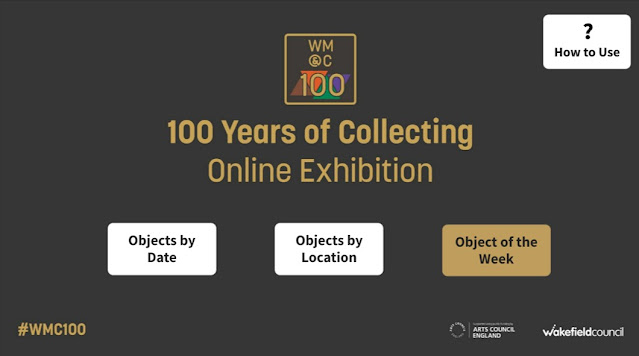
Front page of our 100 Years of Collecting Online Exhibition. Click the image to go to the exhibition page.

Check back on our blog over the coming weeks and months for more about our centenary, and object highlights compiled by our team and volunteers! 

You can also follow the project on social media with the hashtag #WMC100.