Wednesday, August 24, 2022

Ossett's Shoddy and Mungo Trade

 
In this special post, our Research Volunteer, Sarah Hulme tells us about her experience looking into the mungo and shoddy industry in Ossett. Ossett was once home to over forty mills and its production of mungo and shoddy shaped the town as we know it today.

A black and white photograph of two men sat on a delivery truck, which has 'Edward Clay & Sons, Mungo Manufacturers, Ossett' written on it. Behind the truck is a low brick wall with iron railings and trees behind.
Photograph of Edward Clay, from Edward Clay & Sons, Ossett
                                        with his delivery van (image courtesy of John  Clay)

Where does the word shoddy come from?

Today the word ‘shoddy’ refers to a job poorly done or something of poor quality. Did you know that the origins of this word actually come from the textile industry in the Heavy Woollen District (Batley, Dewsbury, Morley and Ossett and some surrounding towns in the mid-19th century)?
 
An image of a piece of brown-coloured rough looking cloth, with a light blue background
A piece of undyed shoddy
(image courtesy of
Kirklees Museums and Galleries)

In the 1990s, travelling by train from Leeds to Huddersfield every day for work, I would see a beautiful, Victorian mill building from Dewsbury Station. Painted on to the front of this in white antique lettering were the words ‘Established. 1856, Machell Brothers Limited, Shoddy and Mungo Manufacturers’. I always wondered what this meant but, rushing to work, I never took the time to look it up.

Looking into Wakefield District’s textile heritage, I’ve had the pleasure of meeting experts in Ossett’s textile heritage.  From our conversations I discovered more about what these textiles are and why their production in Ossett from the mid-19th century was so hugely important to Ossett’s history, architecture, economy and people.


What are Mungo and Shoddy?  

What is Shoddy?

Shoddy is the production of a recovered or recycled inferior quality yarn or fabric. It is made using the shredded fibres of woollen knitted cloth (cardigans, sweaters) rags or tailors’ clippings that gave a length of threaded material to be mixed with new wool and formed into reclaimed cloth. The negative association to the word ‘shoddy’ has arisen because shoddy was a low status fibre that poor people wore and was made into overcoats, military uniforms, blankets, and horse rugs.  Rags that weren’t mixed with new wool became flock and ended up being used for upholstery or to stuff mattresses or saddles. Shoddy production created a wide range of associated trades from rag and bone men, to rag merchants, rag sorters and packers, dyers, rag traders and mill owners.

What is Mungo?

Mungo was a different material from shoddy because it was made up of shorter and very fine fibres.  It was made by shredding felted or woven items like hats, worsted suits and woollen material. 


Mungo and Shoddy in Ossett

The Latin phrase 'Inutile Utile Ex Arte', on the unofficial coat of arms of Ossett means 'Useful things made useful by skills. This is said to refer to the mungo and shoddy heritage of the town. 
The unofficial coat of arms of Ossett 
(image courtesy of www.ossett.net)
 
In the early 19th century, the Napoleonic Wars led to a shortage of wool imports and woollen products. Clever business owners repurposed wool out of waste wool. Shoddy was first made in Batley by Benjamin Law in 1813.  Between 1800 and 1850 the mungo and shoddy trade led to a tripling of the populations of the towns of Batley and Dewsbury.  This expansion led mungo and shoddy producers to look to neighbouring towns for new mill sites.


Why Ossett?

Ossett’s location on the river Calder and its new railway station led to it becoming home to over forty mills, numerous dye sheds and rag warehouses in the 1850s.

The Calder and Hebble Navigation was finished in 1770 providing waterways to transport mungo and shoddy.  The river Calder was also used by Ossett’s mills in the recovered wool production process.

In 1848, railway stations opened across Batley, Dewsbury, Morley and Ossett.  Huge bales of rags could be brought in from all over the UK and Europe. Finished mungo and shoddy was easily exported by rail from these towns. 

Rag merchants at the time organised huge rag auctions at train station forecourts that were incredibly popular.

A journalist described dealers overcome by “visions of filthy rags being transmitted into shining gold” at the train depots of Batley and Dewsbury, as the thousands of bales arrived at the station from abroad. (From Devil’s Dust To The Renaissance of Rags, Shoddy, by Hanna Rose Shell.)

A black and white photograph showing several groups of women walking between mill buildings
Victoria Mill, 1950s, female staff leaving for home after work.
(Image courtesy of Neville Ashby, www.ossett.net)

From Rags to Riches

The mungo and shoddy industry brought huge wealth to the mill owners in Ossett. These industrialists were able to buy land and build detached Victorian villas in Ossett with their newfound wealth.

John Clay spoke of the number of these families that bought second homes in Runswick Bay on the North Yorkshire Coast and how it became referred to as ‘Ossett by the Sea’. 

The descendants of several mungo and shoddy mill owning families in Ossett remain in the town today.  

Image of a poster with text reading 'Ossett Street Side, Near Dewsbury, Valuable Freehold Mill, Dwelling Houses & Land, To Be Sold by Auction, by Messrs Cullingworth & Son'
Poster for the sale of Flushdyke Mill, Ossett 
(image courtesy of Kirklees Museums & Galleries)


19th Century Recycling to 20th Century Industrial Decline

How did this great idea to recycle wool from leftover rags not become a green recycling industry today?

Repurposing wool was a great example of recycling. Leftovers of textile waste and dust from the mungo and shoddy process were even spread over soil in the nearby rhubarb growing fields as fertiliser!  Whilst the idea of recycling woollen rags and reusing them was a great idea, the working conditions in the 1800s in the mills and rag warehouses were poor.   

Breathing in textile dust all day caused ‘shoddy fever’. Women often worked as rag sorters and children fixing broken looms.  There were several deaths due to accidents with poorly maintained machinery.

After the Second World War the mungo and shoddy industry fell into decline.  With the arrival of synthetic fibres and ‘off the peg’ suits, wool was less in demand. Surviving mills have diversified into producing other felt products using mungo and shoddy rather than products for the garment industry.  Products for mattress fillings, hanging basket liners and insulation are still produced using a similar process.  Today with the climate crisis, businesses are looking again at the processes of mungo and shoddy to see how they can be transformed into a safe modern business that is great for the environment.


Share Your Stories

People in Ossett are rightly very proud of their mungo and shoddy producing heritage. We're creating an exciting new Wakefield Library & Museum in the heart of Wakefield City Centre, and we need your stories.  

We would love for the people of Ossett and the surrounding area to add their memories, stories, photographs and objects from the mungo and shoddy industry as part of the new museum.  If you are interested in taking part, please email museums@wakefield.gov.uk


For more information about another important industry in the Wakefield district, clog manufacturing, click here


Wednesday, August 17, 2022

What puts Wakefield on the map?

We've been going around the District as part of the A Grand Day Out summer festivals, asking about the places, memories, stories and people that make Wakefield special to you. 


Below is an interactive image with some of your contributions so far - move your mouse over the flags for more information! 

Green flags are places and attractions, yellow flags are memories, pink flags are for people and community groups, and blue flags are about where people live.


What places, memories or people would you put on the map?
Comment below or get in touch at museums@wakefield.gov.uk to tell us your stories!

To find out more about the New Library and Museum for Wakefield, click here

Wednesday, August 3, 2022

Awesome August 2022

The school holidays can seem like a long time to keep the kids occupied, so we’ve put together an easy planner with ideas at each of our sites - all activities are free!


(Each image has alt text)

Step Into History at Pontefract Castle: Join us for a new theme each week! All activities free. 1st - 6th Aug: Victorian Historians; 8th - 13th Aug: Medieval Melee; 15th - 20th Aug: Tomfoolery; 22nd - 27th Aug: Civil Wars. Photo of two young visitors in medieval dress-up at the Castle grinning at each other.
Sensory Summer at Wakefield Museum - use a different sense to explore our collections each week! 4th Aug Touch (drop-in 10am - 3pm); 11th Aug Smell (bookable); 18th Aug Sound (drop-in 10am - 3pm); 25th Aug Taste (bookable). For the 11th and 25th sessions Book online at bit.ly/WMandCTickets. Photo of a young visitor touching a piece of Stone Age flint in Wakefield Museum, the sign says 'please touch'. All activities free.

Made in Pontefract at Pontefract Museum. Try a new activity every Wednesday! All activities free. 3rd Aug: Glass and Colour; 10th Aug: Clockwork; 17th Aug: Exploring with IT; 24th Aug: Liquorice; 31st Aug: Sounds of Ponte's Past. Photo of a young visitor enjoying crafts at Pontefract Museum.

Creative Castleford at Castleford Museum. Try a new set of activities each week! All activities free. 1st - 6th Aug: industry; 8th - 13th Aug: Fantastic Fashions; 15th - 20th Aug: Seaside; 22nd - 27th Aug: Tools and Tech. Photo of two young visitors and accompanying adult enjoying hands-on activities at Castleford Museum.


SEND Family Activities at Castleford Museum - Fridays in August 10am - 3pm. All activities free. Free activities designed for SEND families. Changes to the sensory experience in the galleries for a more relaxed experience.

For the full planner in downloadable PDF format, click here.

For bookable sessions, click here to book.

Saturday, July 16, 2022

Ferry Fryston Chariot Burial #FestivalofArchaeology

 Today marks the start of the Council for British Archaeology's #FestivalofArchaeology!

This year's theme is journeys, so we're digging deeper (get it...?) into our fantastic Ferry Fryston Iron Age chariot burial, on display at Castleford Museum.


The chariot was found when the A1 road at #Ferrybridge was being upgraded in 2003-2006.

It had been used for a burial, and a man's body had been carefully buried inside the chariot.

Radiocarbon dating suggests he was buried around 200 BC.

Iron Age chariot burials are rare, and only 21 have been found in Britain so far. This makes our Ferry Fryston one very special!

Even though the wood had almost completely rotted away and only corroded pieces of metal remain, it has taught us a lot about how Iron Age chariots were made and how they worked.


So, who was the man buried in the Ferry Fryston chariot?


Image shows part of the Ferry Fryston chariot display at Castleford Museum, with the skull of the man buried on the left, the brooch from his cloak second from left, and nave hoops from the chariot wheels


Archaeologists studied his skeleton and were able to find out the following things:

🧍 The man was aged 30-40, and had been buried lying on his back with his legs folded under him

🦷 Chemical analysis of his teeth suggests he was not local, but from East Yorkshire or even Scotland

💍 He was wearing a cloak pinned at the left shoulder by a brooch, with a round glass head that was originally red [this is the object second from the left]

🛡 Pieces of corroded metal suggest he may also have had a shield

What journeys do you think he would have taken to get here? What journeys was he being prepared for in both life and death?

The Chariot

Burials of Iron Age chariots like this are very rare, so ours is really important!

The chariot would have been mainly made out of wood, and even though this had almost completely rotted away and only corroded pieces of metal remain, it has taught us a lot about how Iron Age chariots were made and how they worked.


1) The large iron tyres would have given the wooden wheels strength to drive over rough ground. Chariots like these certainly weren't driving over planned tarmac roads like the A1 in Ferrybridge today where it was found!


2) These four strong iron bands are called nave hoops, and they would have held together the wheel hubs


3) These are linch pins, which stopped the wheels from falling off.


4) These wooden chariots were pulled by horses, which were controlled by a 'bit' in their mouths. This would have been attached to reins which ran through these terret rings to stop the reins from getting tangled.


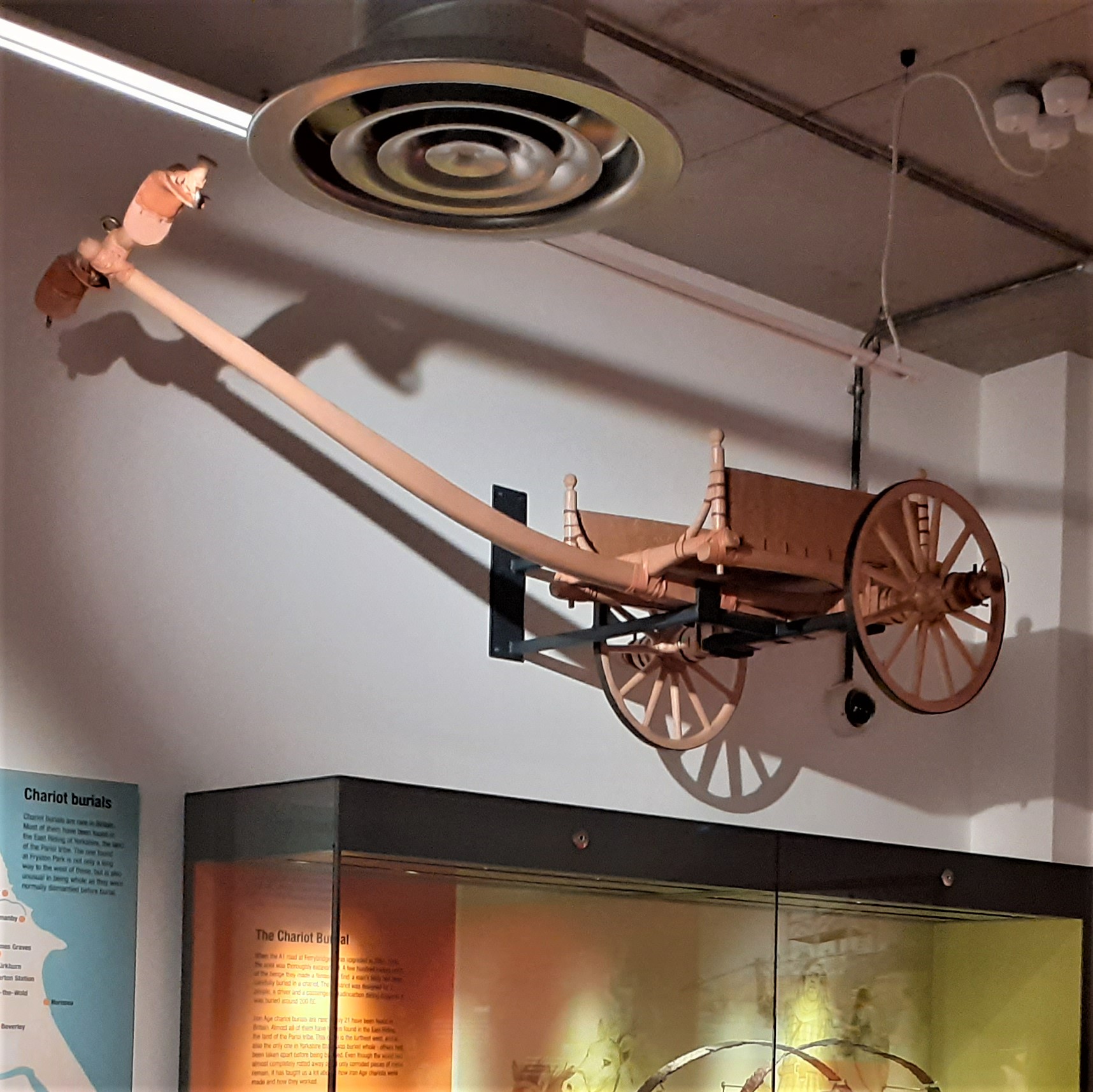
What might the full chariot have looked like?


Well our experts think it would have looked like this...


What did you think? Were you close?

It would have been mostly made out of wood, likely with a square seat attached to the two large wheels where the rider would have sat.

This then had a long wooden beam stretching up to where two horses would have been attached to pull the chariot along.


The Burial


This picture shows a drawing of the Excavation Plan of the chariot, which is carefully drawn showing what was found and exactly where it was found. 


This is important, as it helps archaeologists to fill in the gaps of what hasn't survived in the ground (particularly the wood of the chariot) to build the bigger picture!

Down the middle of the diagram you can see the remains of and the indentation made by the original chariot. This is what was used by our experts to design what the full chariot might have looked like.

At the bottom, in the middle, you can see how the man's skeleton was found, with his legs bent behind him.

It also shows you where our items in the display case were found: wheel rings (1), the nave hoops (2-3 and 9-10), the linch pins (6), the terret rings (13 - 17), the horse bit (20) and the brooch would have been on/within the skeleton.

Can you imagine what it must have felt like to find this? Have you made any of your own archaeological discoveries?

Come and see the chariot in all its glory for yourself at Castleford Museum!

Opening hours (FREE ENTRY)

Monday
​9:30am - 5pm
Tuesday
​9:30am - 5pm
Wednesday
​Closed
Thursday
​9:30am - 5pm
Friday
​9:30am - 5pm
Saturday
​9:30am - 4pm
Sunday
​Closed

For lots more information about Roman Castleford. click here

Tuesday, July 12, 2022

Pledge to #DoAWorldOfGood

Issues like the climate crisis and sustainability can seem huge and out of our control. 

However, there are changes we can all make to how we live our lives - both big and small - that can help. 

Click the interactive image below to find out different things you can do in your Home, Garden, Work and Lifestyle.

Once you've found some changes you can make, click on the 'PLEDGE' button on the image or scroll down and Pledge to #DoAWorldOfGood on the Google Form 👇

Post your experiences, changes and choices on Facebook, Twitter and Instagram with #DoAWorldOfGood and we'll share our favourites!


Wednesday, April 13, 2022

Finding Alice Gostick

In this special post, our brilliant Research Volunteer, Katie, tells us about her experience tracing the life of Alice Gostick, an influential local art teacher, who worked at Castleford School from 1911 - 1930.


Finding Alice's past


Born in Newcastle-Under-Lyme, Staffordshire in 1875, Miss Alice Gostick was later to move to Castleford and become the art teacher for Henry Moore, one of the most influential sculptors of his time. But what about Alice herself? My task as a Research Volunteer was to investigate Alice and find out more about her life aside from teaching Moore. However, finding information on Miss Gostick was no easy feat.

Initially, I was advised to start my research by browsing the family history website, Find My Past. This website is a phenomenal resource, which includes copies from censuses, birth, marriage and death records, the 1939 Register and more. As I had not used this site before, I needed some time to become familiar with how to navigate the records. However, this did not take long as the site is certainly user-friendly.

From here, I was able to gain an understanding of Alice’s early life. Her parents were Clair (b.1845) and Arthur Gostick (b.1844). She had one older sister named Constance (b.1874) and one younger brother named Frank (b.1878). Before Alice moved to Castleford and began teaching at Castleford School, she worked as an Art Mistress in Staffordshire and lived with her sister.

There were some difficulties with using Find My Past. As the site has all public records, there were some occasions where my search would return multiple people called Alice Gostick, which required some figuring out to ensure I was using the correct record. For example, there were several Alice Gosticks, who may have died at around the same time. Additionally, the site does not have any qualitative data, so I could not find much information about Alice as a person.

As there was not any marriage record for Alice, that led me to believe that she remained unmarried. This idea was furthered when I began to read biographies on Henry Moore that had some information on Alice. In Roger Berthoud’s The Life of Henry Moore (1987), Alice was noted to have lived with a ‘companion’ rather than spouse until her death. Alice is referred to on numerous occasions in this study. Interestingly, she was noted by Berthoud to be,

‘a pleasant looking woman with brown hair, full of enthusiasm yet gentle and generous.’

I was surprised to learn that Alice invited her students to her home and remained friends with Henry Moore until her death, decades after she had taught him at school.
 
Alice Gostick seated and painting a piece of pottery, with 11 of her students (male and female). Henry Moore is one of the students, seated on the floor on the far left.
Alice Gostick's pottery class, December 1919.
Alice seated far left. Henry Moore sitting on floor, far left.
© The Henry Moore Foundation.


Making the news


Whilst in Castleford, Alice taught school pupils and students at evening classes how to decorate pottery by hand in a style known as Peasant Pottery. Alice became synonymous with her pottery painting classes. I was pleasantly surprised to find them mentioned in local newspapers. These newspaper articles also offered some information on what Alice was doing where and when. Before she moved to Castleford, she was also part of evening art classes run by the art school she worked at in Staffordshire. The Staffordshire Sentinel (7th September 1908) published an article naming her as one of the art teachers assisting with the classes, which were a roaring success. 

I also found out that by 1921, at age 46, Alice was living with her mother, Clair, in Glasshoughton, near Castleford. Then there was a small but fantastic article from the Yorkshire Post and Leeds Intelligencer in 1930, marking Gostick’s retirement from teaching after she had worked for Castleford School for 19 years. Alice’s work was celebrated in this local newspaper, which revealed that 170 art centres across the country had taken on the idea of individually decorating pottery by hand, which she is said to have ‘initiated.’

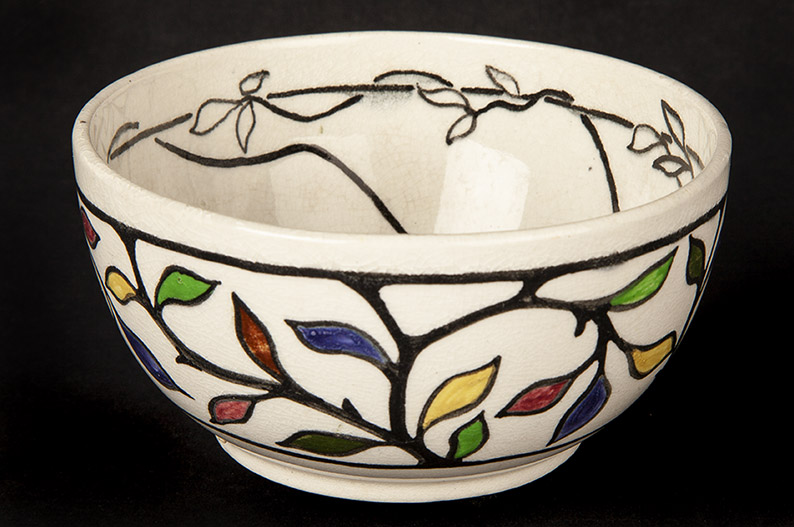
Hand-painted dish, Clokie & Co Ltd, Castleford. Believed to have been decorated by Alice's student, Henry Moore.


Overall, it has been an exciting opportunity to research Alice, who was relatively unknown apart from her teaching of Henry Moore. Although the research generated some challenges, including the limited qualitative documentation on her life, with most information being in relation to Moore, it is thrilling when you do come across something interesting or surprising about her. She led an interesting life, fulfilling her passion for art and pottery in Castleford, where she was a favourite of many of her students.

By Katie Simpson


Thanks to generous donations from our amazing supporters and visitors, Wakefield Museums & Castles have been able to purchase examples of Castleford Peasant Pottery, hand decorated by Alice Gostick and her students. 


Sugar bowl and side plate, hand-painted by Alice Gostick, c. 1919

Tea set, hand-painted by Alice Gostick, c. 1918

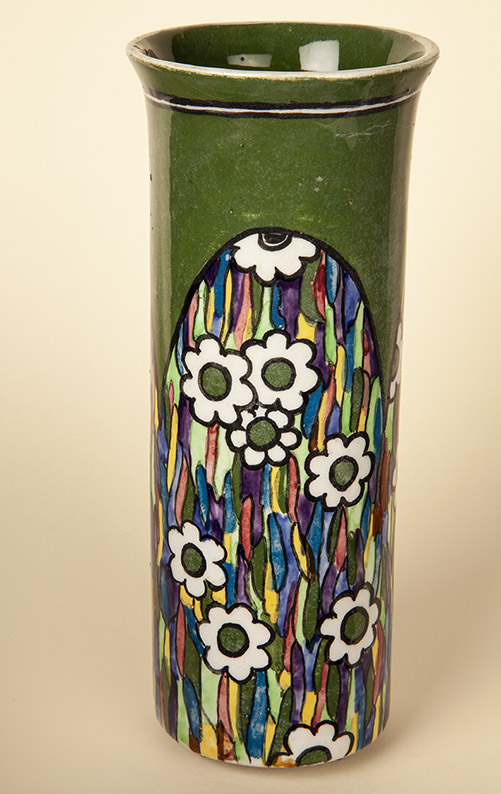
Vase, hand-painted by Gostick's student, Albert Wainwright


Donations help us develop and care for our collections, including purchasing objects that tell the inspirational, unique stories of  the Wakefield district. Donate here to support our work. 

Want to read more from our fantastic Research Volunteers? Hannah explores the life and legacy of Charlie Williams for Black History Month here!

Friday, April 8, 2022

Knottingley: Fire & Water - David Appleyard selected as artist

We're excited to announce that we have appointed Yorkshire-based contemporary artist David Appleyard to create a public artwork for the town of Knottingley.

David Appleyard with an artwork from one of his previous projects

After a competitive process, David was chosen to create an artwork for the Knottingley: Fire & Water project. The project is funded by Arts Council England and is designed to celebrate the industrial heritage of Knottingley.

David will work closely with local residents in Knottingley to create an artwork that explores, shares and celebrates the glassmaking and shipbuilding industries in the town. The artwork will be developed over the next seven months and installed in November 2022, during Wakefield Council’s Light Up festival.

David will use the museum's collections, along with the stories and memories of local people, as the inspiration for his artwork. The final pieces will explore the theme of 'vessels', bringing together the glassmaking and shipbuilding industries. 

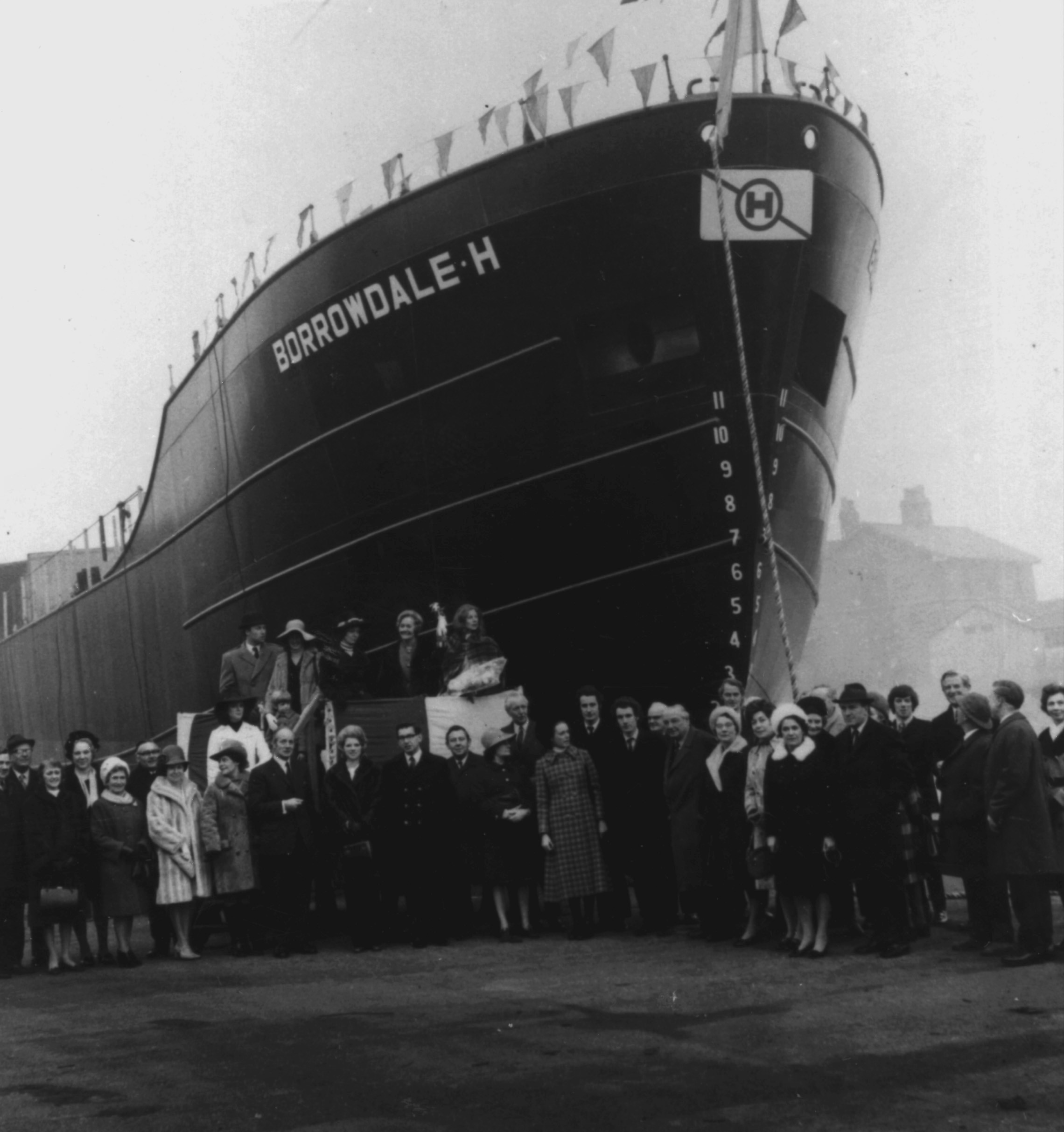
The launch of the "Borrowdale H" ship from Harker's shipyard in Knottingley

David Appleyard is an artist based in Sheffield, who works collaboratively with communities and local people to create artworks inspired by history and heritage. Storytelling using objects and installations is key to David’s work and he uses a variety of materials to create his artworks, which include sculpture, light and sound. 

Mark Lynam, Corporate Director Regeneration and Economic Growth for Wakefield Council, said “We are delighted to have appointed David to deliver this exciting new artwork for Knottingley. We chose David because of his track record of working closely with communities to create inspiring artworks, and we’re excited to work with David and Knottingley residents to celebrate the history and heritage of the town”.

David Appleyard said "I'm delighted to have been given such an exciting opportunity to develop creative work with people in Knottingley. The town has a fascinating heritage as a manufacturer of vessels of all shapes and sizes, from ships to glassware. I hope to use this commission as an opportunity to continue this tradition while making connections with local communities".

Final details of the artwork, including its location, are yet to be decided. To find out how to get involved in the project and help to shape the final artwork, contact Leah Mellors, Collections & Exhibitions Manager, on lmellors@wakefield.gov.uk.