Tuesday, April 18, 2023

Richmal Mangnall: Q&A

In this guest blog, artist Guy Schofield talks about Richmal Mangnall: Q&A, a new display exploring Richmal Mangnall's life through digital art and AI. The display was co-created with a group of young people over a series of digital arts workshops. 

Read on to go behind the scenes - and see what ChatGPT has to say about the future of education!

Part of the display Richmal Mangnall: Q&A at Wakefield One. This part focusses on the painting of Mangnall and some of the young participants' work


This exhibition is about the life and work of Richmal Mangnall, a schoolteacher and writer who became headmistress of Crofton Hall School in 1808.

Richmal Mangnall (1769-1820) was originally a pupil at Crofton Hall school and became a teacher there in the 1790s. As well as teaching hundreds of young people, she also wrote the textbook Historical and Miscellaneous Questions for the Use of Young People. At first, the book was just intended for use at the school in Crofton. However, it went on to become an influential textbook used at schools across the country. By 1857, it had reached 84 editions. ‘Mangnall’s Questions’ was referenced by many influential writers and social commentators, including Charles Dickens, Elizabeth Gaskell, and James Joyce. 

The book was made up of a series of questions and answers in which Mangnall covered geography, science, literature and religion. This might seem strange to us now but in the late 18th century, learning by rote (memorising facts and figures) was a common way of educating young people.

In this project, a group of young people from Wakefield and surrounding areas worked with artist Guy Schofield to think, talk and make art about Mangnall’s life and ideas. We thought about how the concept of asking and answering precise questions and answers connects with the modern world, especially in fields such as education, coding, and AI. We also discussed how women’s roles have changed in teaching and learning since Mangnall’s time. Over several sessions we made digital artworks using a range of different techniques.


Guy Schofield helping a young participant at one of the digital arts workshops. There are printouts of information next to them, including an image of Richmal Mangnall
Guy Schofield working with the young participants at one of the Digital Arts Workshops

Session 1: Saturday 7 January 2023

We started the project by talking about Richmal Mangnall’s life and work. Mangnall became a teacher at a time when women were expected to take care of children and the home. Very few women were able to work in professional jobs and teaching was one of the few careers available to them.

We also talked about Mangnall’s Questions and how learning by rote compares to the young people’s experience of school. We thought about fields where precise questions and answers are still very important, such as coding.

After discussing the idea of learning by instruction, we wrote programs to instruct a computer to draw digital self portraits. Each of the lines and shapes in these images is defined by a line of code. Some of the images relate to ideas about education and Mangnall’s life. Others represent objects we felt were significant to us. For example, Evie chose to experiment with abstract shapes, while Owen made an image of his PlayStation 1.  


A series of pink, green and blue abstract shapes on a dark red background
Evie's digital artwork experimenting with abstract shapes.

A series of shapes used to create the image of a PlayStation 1, grey on black background
Owen's digital artwork of his PlayStation 1.

Session 2: Saturday 21 January 2023

Following the work in the previous session, we thought about how questions and answers are important in different types of programming. We rewrote a slitscan program in the programming language Processing, to store images of different sizes. Slitscans are long-exposure images in which a moving line of pixels is recorded over time. The young people captured slitscans of objects from Wakefield Museum including several relating to Richmal Mangnall’s life.


A slitscan image of the Cameron motorcycle, with parts of the bike repeated out of sequence
A slitscan image of the Cameron motorcycle built by Amy Gill's father, on display at Wakefield Museum

We also talked about art in Mangnall’s time and how important people were celebrated through statues and paintings. We used the photogrammetry app Polycam on a mobile phone to make ‘virtual statues’ representing ideas from the workshops. Photogrammetry involves using a computer to make 3D models of objects from hundreds of photographs. Archaeologists and engineers use photogrammetry to make accurate digital measurements of landscapes and objects. We put the statues into a virtual art gallery using 3D software Blender.


A virtual statue of one of the young participants, sat reading a book, on display in a virtual art gallery
A virtual statute of one of the young participants created in Polycam, on display on a virtual art gallery

Session 3: Saturday 28 January 2023

We started the session talking about how Artificial Intelligences such as DALL-E and ChatGPT are in the news at the moment. Artificial Intelligence (AI) is being used more and more in a range of technologies, from social media to medicine. We experimented with two different AIs to make artworks.

We asked OpenAI.com’s DALL-E2 to make images relating to Richmal Mangnall and the themes of the exhibition. The images produced by AIs are based on a limited understanding of the world and often include nightmarish misunderstandings of the shapes of objects. We asked DALL-E2 to make images from the following prompts:


A digitally created image of a dark yellow book with a title 'Whis Ho Monas The Wastass???', with an illustration of a young person looking somewhat confused
DALLE-2's image from the prompt 'The cover of the book 'Historical and Miscellaneous Questions for the Use of Young People''

A digitally-created 'watercolour' with a series of children seated in rows in an historical classroom
DALLE-2's image from the prompt 'Crofton Hall Schoolroom from the 18th century in watercolour with students including one wearing a dunces cap, with no teacher'


We also tried to make DALL-E2 create an image of Richmal Mangnall by describing her in prompts. We found that the AI assumed that Mangnall was male, which showed how AIs can reproduce the biases and prejudices in the information they work with.

A digitally-created 'oil painting' of a white male figure, in a suit, with a moustache trying to escape his face
A DALLE-2 image responding to the prompt 'Richmal Mangnall', and assuming she was male

A digitally-created 'oil painting' created by prompts trying to recreate the oil painting of Mangnall. It shows a female figure in a similar white dress and cap to Mangnall, with orange necklace, reading a book
A DALLE-2 image responding to prompts trying to recreate the oil painting of Richmal Mangnall - this one is much closer!

Working with ChatGPT

ChatGPT is a chatbot: an Artificial Intelligence designed to have conversations with human beings. Taking the idea of simple questions and answers, we asked ChatGPT what it knew about Richmal Mangnall and about education in the past and future. We found that ChatGPT could produce quite convincing statements about education…

“It is difficult to predict exactly how education will change in the next 250 years, as it will likely be influenced by a variety of factors such as technological advancements, societal changes, and shifts in global priorities.”

….but that it struggled with basic information about human beings. When we asked about Richmal Mangnall, it confused her with the author Richmal Crompton and said that she wrote several books after her own death!

The last part of the workshop was spent planning the exhibition. The young people thought about how to use sustainable materials wherever possible and made mock-ups of the display case, using prints of the artwork they had made. 


Highlights

The thing I enjoyed most about the project was how enthusiastic the young people were. They were really courageous in tackling big ideas around education, diversity and AI. 

The young people took a really active part in the design of the exhibition and had some great ideas about how to display the work they had made in a three dimensional space. 


You can watch the unveiling of 'Richmal Mangnall: Q&A' by some of the young participants, with an introduction from Curator John Whitaker, below:


Richmal Mangnall: Q&A is now on display in the Wakefield One atrium until late September 2023. 

The atrium case is just outside of Wakefield Museum, up the stairs in the wider Wakefield One building. Click here for access and visitor information at Wakefield Museum.

Want to learn more? Join us on Thursday 27 April for our Online Talk - Richmal Mangnall: Q&A with Guy Schofield and John Whitaker!

Saturday, April 8, 2023

"Her own Empire" - the story of Cliffe's Drapers, Featherstone

Laura, a Public History MA student on placement with us from the University of York, has been exploring the treasures of the ‘Cliffe costume collection’. Read on to discover what they found, and ‘visit’ Miss Cliffe’s Featherstone shop for yourself!


Annie Cliffe, as a young, stern-looking woman outside her Drapers Shop. The two large display windows either side of the door are filled with stock for sale. The handpainted sign above the door reads 'General - A. Cliffe - Drapers'
Miss Annie Cliffe outside her shop, from the early 20th century.
Photo copyright of Wakefield Libraries.


On Station Lane, where Cohen’s Chemist now is, Featherstone has its very own hidden history. 

In the early twentieth century Station Lane was a bustling hub of local business and shops. Alongside a newsagents, a greengrocers, and a bookmakers, was a drapers shop, owned by Miss Annie Cliffe. Described as “friendly, kind and considerate”, Miss Cliffe was a pioneering local businesswoman. 

In this blog, we’ll explore Miss Cliffe’s story and how the Cliffe Costume Collection now owned by Wakefield Museums & Castles is a treasure chest of practically untouched working-class clothing and accessories.


A black and white photo showing Station Lane extending into the distance. There are various shops along the street and people going about their daily business. There is also a steamroller working on improving the road surface.
A photo of Station Lane, Featherstone, from the early 20th century.
Photo copyright of Wakefield Libraries.


“It was the only place [dad] could get [caps] from”


Originally acquired by Wakefield Museum in the late 1970s, the Cliffe Costume Collection is made up of over 600 items of clothing and accessories. The items are mainly designed for women (blouses, stockings, jerseys, undergarments) but there are also children’s clothes and accessories designed for men, such as flat caps and ties.

A purple smoke shaped high-neck blouse. There is white lace on the collar and the neck. Around the neck and front of the blouse there are basting stitches to keep pleats in place.
A purple blouse, Edwardian-style. Around the neck and front of the blouse there are basting stitches to keep the pleats in place when on display. These stitches would have been easy to remove once the shirt had been purchased. Part of the unsold stock from Cliffe's Drapers now in our collection.

Miss Cliffe’s shop is remembered as being “old-fashioned” and “like Aladdin’s cave” in a series of oral histories recorded in the 1990s. 

The counter on the right was for the many blouses and other items of clothing. The counter facing the door mainly displayed knitting needles, sewing tools and materials for hand-making and mending clothes. 

Although money may have been tight for working-class people, shops like Miss Cliffe’s widened accessibility to the latest fashions. The collection the shop left behind helps show how fashion in Featherstone developed over the decades. 


A green-blue Tam O'Shanter hat that was for sale at Cliffe's Drapers. 
Tam O'Shanters were especially popular during the 1920s and were often worn by young girls and women. They were easy to sew or knit, and relatively cheap to buy. As a result, many young women would make or buy multiple Tam O'Shanters to match with different outfits.


“Her own Empire”


Establishing the origins of Cliffe’s Drapers has been quite difficult as the relevant documents have been lost. Until now, it wasn’t clear whether Miss Cliffe owned her shop or if she managed it for her parents. However, we can now confidently say that Cliffe’s Drapers was owned and ran by Miss Cliffe.

Annie Cliffe was born in Huddersfield on the 29th of March 1880. By the 1911 census she and her family were living at 21 Kimberley Street, Featherstone.

In the 1921 census, she is recorded to still be living with her father (Alfred) and sister (Gertrude), who was working as a teacher. Miss Cliffe is recorded as a “Draper shop keeper” and her employer being “her own account” which implies that this was her own business. The 1921 census is also the earliest account so far that we have found that records the shop. The 1927 and 1932 censuses also record Miss Cliffe along with her shop ownership.

As an unmarried woman from not a particularly affluent family, the fact that she owned and ran her own shop is pioneering. This would have been very rare in the early twentieth century. Women could own businesses and shops at this time, and around 30% of businesses between 1851 and 1911 record female owners. However, the social norms and inequalities of the time would have made it extremely difficult for a single woman to have her own business. Understandably, Miss Cliffe was very proud of her shop, which an oral history interviewee in the 1990s remembers as “her own Empire”.


A pin striped child’s sailor suit jacket with a Peter Pan collar, belt and white buttons.
An unsold garment from Cliffe's Drapers, dating to the early 20th century.

If clothes could talk…


As Miss Cliffe was often reluctant to mark down her stock, she accumulated a large amount in her stockroom when unsold items went out of fashion. Miss Cliffe continued to proudly run her shop until she died, aged in her nineties. Before the shop closed in the late 1960s it was practically a time capsule of working-class clothing! 

Generally, clothes worn by working class people do not survive as they are worn, passed down and repaired until they were irreparable. This makes the collection particularly special, as shines a spotlight on the sort of clothes the ‘ordinary people’ of Featherstone and Yorkshire were wearing in the early twentieth century.

An exhibition will be installed later in 2023 at Featherstone Library, bringing some of Miss Cliffe’s shop stock back to the local high street.


Do you have memories of Miss Cliffe and her drapers shop? Comment below!

Monday, March 20, 2023

Eggcellent Easter 2023

Looking for things to do this Easter Holidays in Wakefield? 

Here's what's on at Wakefield Museums and Castles for Saturday 1 to Monday 10 April!


Eggcellent Easter 2023 poster, includes photo of yellow tulips, little eggs and felt bunnies

Dragon Egg Week at Pontefract Castle. Includes photo of Ilbert the Dragon and a young visitor dressed as a knight

Dragon Egg Week at Pontefract Castle

The Easter Dragon Egg Hunt at Pontefract Castle is back, and better than ever. Help Ilbert the Dragon find all of his eggs on a new trail available from Saturday 1 April to Monday 10 April.

Join in with different dragon activities throughout the week, including storytelling, eco-friendly crafts and the first ever Dragon Parade!

Almost all of our eggcellent Dragon Egg Week activities, including the trail, are free. 

Trail available 10am – 4pm daily from the Visitor Centre.

Click here for full information about all Dragon Egg Week activities

Castleford Changes at Castleford Museum. Includes photo of two young visitors enjoying crafts

Castleford Changes at Castleford Museum

Monday 3, Tuesday 4 and Thursday 6* April
10am to 3pm
Free and drop-in

Have you noticed something different around town? We’re exploring how Castleford has changed over the last 100 years with a spotlight on the images from Albert Wainwright’s Castleford Sketchbook. 

Practice your sketching skills, make your mark on a community artwork, and look forward to what the next 100 years will bring! 

*Thurs 6: SEND families are welcome at all of our sessions but we are running this SEND session for those families who require a more relaxed atmosphere.

Let's Investigate Eggs! at Wakefield Museum. Includes photo of an egg painted with a farm scene

Let's Investigate Eggs! at Wakefield Museum

Thursday 6 April
10am and 1.30pm

As Easter approaches, it’s an eggciting time to investigate eggs! Join us to explore egg related objects in the museum’s collection. 
Decorate your own excellent egg cup and take historical recipes home to make together. 

£2.50 per child. Accompanying adults free


The Wild Escape logo, including Art Fund and Arts Council England logos

The Wild Escape

Go on an animal adventure around our museums and make some eco-friendly crafts with The Wild Escape! 

All activities are free and drop-in.

Castleford Museum - Tues 11, Thurs 13 & Fri 14 April* (relaxed SEND day) - 10am to 3pm each day.

Pontefract Museum - Weds 12 April - 10.30am to 12.30pm and 1pm to 3pm

Wakefield Museum - Fri 14 April - 10.30am to 12.30pm and 1pm to 3.30pm

The Wild Escape is a major new project led by Art Fund uniting hundreds of museums with schools and families in a celebration of UK wildlife and creativity.

Fred the Frog finds his way home at Wakefield Museum

Fred the Frog Finds His Way Home at Wakefield Museum

Thursday 13 April
10.30am and 1.30pm
Free - booking required

Help Fred the Frog find his way home in this interactive storytelling, singalong and play session for 2-to-5-year-olds and their adults!

You can also make your own funny froggy friend to take home.


Let's Sow Some Seeds at Pontefract Castle. Includes photo of two young visitors exploring the herb garden at the Castle.

Let's Sow Some Seeds! at Pontefract Castle

Thursday 13 April
10am and 1.30pm

Join us for this fun multi-sensory session where we will see, smell and sample some of the tasty herbs grown at the Castle! 

You will also get to create together, decorating your own plant pots and sowing herb seeds to grow at home. 

£2.50 per child, accompanying adults free


Click here for visitor and access information for all our sites

Click here for a printable PDF Easter Planner with all of our activities and workshops on

Tuesday, March 14, 2023

How To Do Oral History - A Guide

After our previous blog post on ‘What is Oral History?’, you might be wondering where to start collecting your own stories! Here's How to Do Oral History - A Guide.


In her final blog, Lydia challenges you to bring out your inner historian and collect your own oral histories. They could even feature in the Moving Stories exhibition


As part of the New Library and Museum project, Wakefield Museums and Castles are reviewing their current oral history archives and looking to interview more members of the public. Moving Stories, the new exhibition at Wakefield Museum, has created a perfect opportunity to share some of these oral histories with local people.


Cartoon drawing of the following story: My dad used to run the Albion Cinema in Castleford. He looked like Cliff Richard! Herbie came to visit.
One of Tom Bailey's drawings on display in the Moving Stories exhibition


Have you ever wanted to ask a relative what it was like to grow up in Wakefield or what it was like to immigrate to the area from another country? You may have a neighbour who was part of the mining industry or worked in one of the liquorice factories. You may know someone who has been involved with Wakefield Pride or the Rhubarb Festival.


In our previous blog posts, we’ve explored Sue Riley’s memories of creating drag outfits. We also explained just what an oral history is. Now, we are giving you the tools to record your own oral histories


Want to get started? Here’s our top tips for collecting oral histories!


3 men sat on a step outdoors having a chat with one stood up behind. 1 of them is smoking
Some gents having a chat in Fryston, taken by Jack Hulme between 1935 and 1955


Top Tips for doing Oral Histories


Choose a comfortable and safe space when conducting the interview – often, it is best to use the interviewee’s home or an area that is familiar to them.


It is also useful to choose somewhere with little to no background noise (if possible). Remember to mute your phone!


Think about how you communicate with the other person – a little bit of encouragement goes a long way for their confidence. Think about your eye contact, body language and other visual cues. There are lots of ways to show that you’re interested without interrupting or breaking the flow of their story.


Using a mix of specific and more open questions allows for insightful discoveries. It is always a great idea to prepare some questions while allowing room for the conversation to develop naturally.


A response may spark a new question in your head, but it is important not to interrupt. Listen closely and take notes of any points you would like to circle back to and expand on.


Remember to focus on their personal experience! It is easy for us to discuss an experience or how it affected other people rather than reflect on our feelings. Try and bring the interviewee back to their own position in these circumstances.


In the video above, Jo talks about her experience of doing 'Selfie Pantomimes' during the COVID-19 Lockdowns. This story would be hard to demonstrate with an object, but comes to life in Jo's Oral History recording! 

What are the benefits of Oral Histories?


Oral histories bring history and museum collections to life.


Providing a human angle to a time in history can make it easier for people to relate, connect, or empathise with the stories. Hearing a person’s story in their own words and dialect can be really moving and revealing, and you get a sense of their personality and character.


Steph Webb, Senior Officer for Curatorial and Exhibitions with Wakefield Museums and Castles, particularly loves hearing people’s accents and dialects in oral history. She says it helps establish a sense of place and gives a powerful feeling of authenticity. It’s also what is so fantastic about the current Moving Stories exhibition.


Oral histories can help address the problems with museum collections and tell stories that aren’t represented or have previously been hidden. Sometimes, physical objects on specific topics are hard to find. An oral history can allow you to still capture and share the story even where you don’t have the objects.


What are the challenges of Oral History?


While it is always interesting to hear how someone remembers an event or story, we have to remember that memory is subjective, so it may not always be 100% accurate.


An important aspect to remember is that not everyone realises their story is important or worth sharing. They believe they have nothing interesting to say and are reluctant to share their experience, even when it is exactly what we are looking for!


Similarly, some people can be hesitant to share their stories, and this could be for many reasons. Maybe this will be the first time sharing it, they may not be sure about how you will tell their story afterwards. Perhaps they just aren’t confident speaking to others.


Building trust and rapport with the interviewee is essential to get the best out of your oral history recording.


A visitor placing a postcard in the slot in the Moving Stories exhibition
A visitor writing their story onto a postcard and submitting it at the Moving Stories exhibition at Wakefield Museum

Get in touch

Have you got a story you’d like to share? Drop us an email at museums@wakefield.gov.uk. We’d love to hear from you!

Why not visit the Moving Stories exhibition at Wakefield Museum for some inspiration?


Tuesday, March 7, 2023

What is Oral History? A Guide

Lydia, a Modern History MA student on placement with us from the University of York, has been exploring our oral history collections. She has put together this handy guide on all things oral histories.

Have you ever heard of the term ‘oral history’? Not many people have! 

As they are a big part of the Moving Stories exhibition at Wakefield Museum, I felt it was important to explain what an oral history is and why they are important.

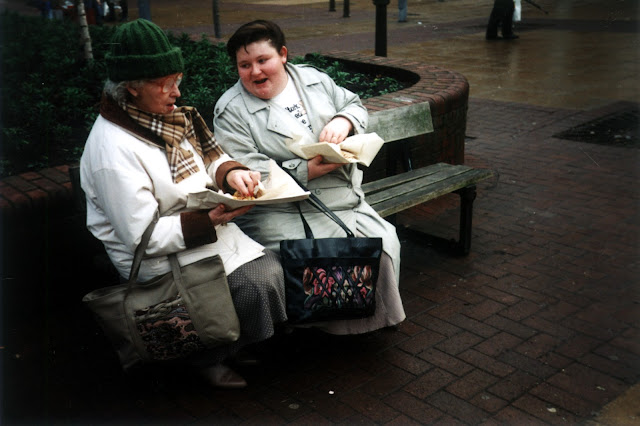
Two women sat chatting on a bench with their fish and chips. The older lady is wrapped up in a coat, scarf and woolly hat, and the younger lady is wearing her coat open
Two women chatting over their fish and chips at the Bull Ring in Wakefield, 1993

What is Oral History?

‘Oral history’ can sound like a scary clinical term and is often thought of as a serious interview; in reality, it is a conversation. It is the sharing of experiences verbally and the conversation can be guided by questions set in advance, or in response to what is being discussed. The types of oral histories vary depending on what setting it is taking place in.

What are some good Oral History questions? How do you do an Oral History interview?

Collecting an oral history can be a formal process. This prompts some people to compare it to a serious interview. The idea is to record a person’s personal experiences and discover more about them and what they have lived through by asking questions and listening to their responses. 

This is best done through open-ended questions, allowing the other person to tell their story naturally without being stuck with closed ‘yes/no’ questions. An open-ended question could be “What was Wakefield like when you were growing up?”, whereas a closed question is more like “Did you like Wakefield when you were growing up?”. Here, the interviewee could simply answer “yes” or “no” and it shuts the conversation down completely!

How are Oral Histories used?

For historians and curators, oral histories are used as a research source to better understand a place, period, or significant event. The team at Wakefield Museums and Castles are currently exploring their oral history collection to better understand the stories of Wakefield and to understand ”What puts Wakefield on the map?”


We asked the question "What Puts Wakefield on the Map?" at the A Grand Day Out summer festivals in 2022. 
This digital map contains some of the responses. Tap the flags for more information. 
Green flags are places and attractions, yellow flags are memories, pink flags are for people and community groups, and blue flags are about where people live.

In the past, oral history has been passed down through folklore and myths. It is believed to be the first form of history. It is very important for people from many different cultures around the world. Nowadays, oral history can be engaged with in less creative manners and is at risk of becoming forgotten.
It is likely that most people have engaged with oral history in some way and may not have even realised it. Have you ever listened to a story about your family’s history or asked your relatives about their past? Have you ever told others about your own experiences in the past? These are just a few examples of how people engage with oral history daily.

The difference between ‘formal’ and ‘informal’ oral histories is that they serve unique purposes. With more formal oral histories, we record and collect them so they can be referred to over the years and used for research purposes. Informal oral histories are told for personal reasons, to connect with family history, to keep ancestors’ memories alive, and to make sure your story is heard. But there is no guarantee that these stories will be recorded forever in this setting.


In this video, Herbert tells us about cycling home from dances during the Blackout! 
Drawn by Tom Bailey.
See and hear more stories from local people in Moving Stories, now open at Wakefield Museum

Why is Oral History important?

The benefit of oral histories is that we can collect massive amounts of information from this technique, helping us round out the history and objects we already possess. They help to keep voices from the past alive for generations to come.

For example, we can learn lots from government documents, records and maps of mining facilities; we can study the health and safety information at the time, the layout of the mines, the number of workers and any labour disputes. But what we lack is the perspective of the people involved. Through oral history, we can add a human element to the information available by asking what it was like to work there, their experience during strikes, whether they witnessed any accidents on or off the records, and most importantly, what this all meant to them. When using this method, we gain a first-hand perspective and authentic narrative.

Finally, a key concept of oral history is the act of preservation. Not only does it mean that it will be forever preserved and available for use, but the entire recording of the conversations is preserved, so there is no risk of only having the interviewer’s interpretation. We know that in history, there has been a tendency to maintain one perspective, but if we preserve oral history correctly, we can prevent that.

This is another reason oral history is so important, as it can help us combat disparities in history. We are all aware that history has tended to erase certain voices, preventing groups of people from having their stories told. History is all too often a story of the ‘victors’, or just wealthy, straight white men. But we can change that, and Wakefield Museums and Castles want to be a part of that change. We want to collect your story no matter your background or what you have to say. We can’t wait to hear your story!


Who knows, it might just feature in our New Library and Museum

To see examples of our oral history collections, check out our current Moving Stories exhibition, where some of our oral histories have been brought to life in drawings by Tom Bailey 

There's also Lydia’s LGBT+ History Month blog post on Sue Riley and Madam Connie.


Tuesday, February 21, 2023

LGBT+ History Month 2023: Behind the Lens

Lydia, a Modern History MA student on placement with us from the University of York, has been exploring the treasure trove of our oral histories collection to support the ongoing evolution of our new Moving Stories exhibition.

Here’s what she’s uncovered in our Rainbow Trails oral history archive, a compilation of Wakefield’s LGBT+ stories!

The ‘Wakefield Storytellers’ section of the Moving Stories exhibition is dedicated to showcasing stories from local people. Some of these were already in our oral history collections, and others are new ones we are collecting all the time.

Given this year’s LGBT+ History Month focus on ‘Behind the Lens’, I have been exploring stories from Wakefield’s local LGBT+ stars and allies, both on and off the stage.

Let me introduce local legends Sue Riley and Madam Connie!

Sue grew up making her own clothes. She recalls that most people did when she was younger, and she always helped others with their clothes when asked. After moving to Wakefield in the 1990s, Sue met local drag queen Madame Connie at the Fernandes Brewery pub. Soon after learning about Sue’s talents, Madame Connie gave Sue her first ever drag outfit commission. This was a partnership to continue for many years, as Sue explains in the clip below:

Sue made an array of dresses from all sorts of unsuspecting materials and took to the challenges given to her by Wakefield’s drag performers. One of her favourite dresses that she made for Madame Connie was this black velvet dress with hologram sequins and golden wings.

Madam Connie showing off her black velvet and golden hologrammed sequin dress, holding up the golden cape. She is wearing a black bobbed wig and has gold eyeshadow, and looks fabulous!
Madam Connie slaying the house boots down in her Norma Desmond outfit!
Photo copyright of Sue Riley, early 2000s

In the audio clip below, Sue describes stepping up to the challenge of creating this iconic dress!

Another challenge was presented to Sue when she was asked to fashion a dress out of white and brown cow print material. She designed a rock and roll dress with lots of frilly petticoats at the request of the drag queen. When she realised she had leftover fabric, Sue designed something extra for the performer... Listen to the clip below to find out what this was:

Clearly, this line of work was destined for Sue as her flourish for creativity matched the vibrant looks the drag queens wanted to create.

Sue’s work was incredibly important to Wakefield and the local LGBT+ community. Performing on stage allows people to create other personas and step out of their comfort zone; the creation of these dresses helped solidify these characters on stage and gave the performers the confidence they needed.

Drag came to the stage many years ago in theatre performances and has continued to develop in recent years and is now even present on television shows. Drag was never about impersonating a woman or a man; it was about an exaggerated performance to create a new identity. While drag was less accepted in the past, some still broke through the barrier and began to make changes. One of these iconic performers was Sue Riley’s favourite drag queen, whom she had seen perform live, Danny La Rue.

Drag impacts our lives more than you can imagine; even some of today’s slang comes from the drag industry. 

But instead of continuing, here's a bonus clip from Steven spilling the 'T' on what Madam Connie means to him:

We are proud to tell Sue Riley's story and spread the word about her work #BehindTheLens.

Please look out for our future engagement with Wakefield’s LGBT+ stories, and if you have any memories to share or pictures of Sue Riley’s dresses, or Madam Connie's performances, please tweet us or email us at museums@wakefield.gov.uk.

We also have one of Madam Connie's wigs on display in the new Moving Stories exhibition at Wakefield Museum!

A bright red bobbed wig with darker red undertones, on a bejewelled and glittery mannequin head on display at Wakefield Museum
One of Madam Connie's wigs, worn at performances in the early 2000s.
Photo credit Nick Singleton

We can’t wait to hear more of Wakefield’s LGBT+ stories!

Friday, February 3, 2023

Rhubarb, Rhubarb, Rhubarb!

Wakefield's annual Rhubarb Festival returns 16 to 18 February 2024!

But just why is Wakefield rooting for rhubarb? Allow us to explain...

A series of log chalet stands serving a wide range of rhubarb-based treats and goodies, with Wakefield Cathedral in the background

Where does rhubarb come from?

Rhubarb root comes from Ancient China. It was originally powdered and used as a medicine. The type of rhubarb we eat and bake with today was introduced into England in the 1800s.

What was rhubarb used for?

As well as baking and eating, rhubarb was used in medicine for thousands of years. On display at Wakefield Museum we have this handwritten Cure for Cholera from the 1890s. It recommends a mixture of powdered rhubarb, laudanum, Cayenne pepper and peppermint to help relieve the symptoms of cholera. 

A handwritten cure for cholera indicating measures and ingredients, which includes powdered rhubar
Cure for Cholera from the 1890s - you can see this at Wakefield Museum

Rhubarb was also made into botanically brewed drinks, carbonated water and homemade wines. 

A small glass bottle, discoloured by the previous rhubarb contents. It is pointed at the base and has a cork stopper.wine con
A bottle of rhubarb wine from 1886 - an extreme vintage!
This is also on display at Wakefield Museum

Where is the Rhubarb Triangle? Why is it called the Rhubarb Triangle?

The Rhubarb Triangle is the land between Wakefield, Leeds and Morley, famous for growing Yorkshire Forced Rhubarb. It is called the 'Rhubarb Triangle' as these three places form the three points of a triangle, within which the forced rhubarb is grown.

Why is Wakefield famous for rhubarb?

Thanks to good soil mixed with lots of ashes, horse manure and textile waste, and just the right amount of rain, Wakefield specialises in "forced rhubarb". 

The forced rhubarb industry boomed from the 1880s. Low roofed forcing sheds built across the Rhubarb Triangle supplied the markets in London, and on to Europe. Special trains packed with rhubarb ran overnight between January and March.

A wooden toy 'Rhubarb Train' set up, on top of artwork designed by Liz Kay about the Rhubarb Train
Your little ones (and big kids too!) can help the Rhubarb Train make its deliveries on time at Wakefield Museum! Featuring artwork by local artist Liz Kay.

What is Forced Rhubarb?

Forced rhubarb is a technique used to grow rhubarb out of season. The rhubarb roots are taken into warm, dark sheds lit with candles. These conditions encourage the rhubarb stalks to grow very quickly.

In 2010, Yorkshire Forced Rhubarb gained European protection. This gives it the same status and recognition as products like Parma Ham! 

A dark shed with low roof full of forced rhubarb stalks, lit by candles
View inside a forced rhubarb shed

What does Forced Rhubarb sound like?

Forced rhubarb growing sounds like this. It's a lot noisier than you'd think!

What is the Rhubarb Festival?

The Rhubarb Festival is Wakefield's celebration of the city's most famous vegetable. It is one of the first food and drink festivals in the national calendar. There will be over 60 chalets selling local and regional rhubarb-based delights, a range of comedy and music events, and a series of workshops. 

A young rhubarb festival-goer with butterfly facepaint, smiling as they hold a bunch of fresh forced rhubarb


Where does the phrase "rhubarb, rhubarb, rhubarb" come from?

When extras and background characters on film and stage sets needed to create the impression of conversation, they would repeatedly say "rhubarb, rhubarb, rhubarb" out of time with one another. This created background noise that couldn't be understood over the main dialogue, and looks like natural conversation!


Where can I find out more about rhubarb?

We celebrate rhubarb all year round with a dedicated display at Wakefield Museum. See objects from the city's rhubarb-growing past, listen to the sound of forced rhubarb and make the Rhubarb Train get to its deliveries on time!

Rhubarb exhibit at Wakefield Museum, with information, objects, rhubarb toy train and a button to listen to the sound of forced rhubarb growing
The Rhubarb exhibit at Wakefield Museum

Wakefield Museum is free entry, and is open:

Monday
​9am - 5pm
Tuesday
​9am - 5pm
Wednesday
​9am - 7pm
Thursday
​9am - 7pm
Friday
​9am - 5pm
Saturday
9am - 4pm
Sunday
​Closed