Showing posts with label Moving Stories. Show all posts

Tuesday, March 14, 2023

How To Do Oral History - A Guide

After our previous blog post on ‘What is Oral History?’, you might be wondering where to start collecting your own stories! Here's How to Do Oral History - A Guide.


In her final blog, Lydia challenges you to bring out your inner historian and collect your own oral histories. They could even feature in the Moving Stories exhibition


As part of the New Library and Museum project, Wakefield Museums and Castles are reviewing their current oral history archives and looking to interview more members of the public. Moving Stories, the new exhibition at Wakefield Museum, has created a perfect opportunity to share some of these oral histories with local people.


Cartoon drawing of the following story: My dad used to run the Albion Cinema in Castleford. He looked like Cliff Richard! Herbie came to visit.
One of Tom Bailey's drawings on display in the Moving Stories exhibition


Have you ever wanted to ask a relative what it was like to grow up in Wakefield or what it was like to immigrate to the area from another country? You may have a neighbour who was part of the mining industry or worked in one of the liquorice factories. You may know someone who has been involved with Wakefield Pride or the Rhubarb Festival.


In our previous blog posts, we’ve explored Sue Riley’s memories of creating drag outfits. We also explained just what an oral history is. Now, we are giving you the tools to record your own oral histories


Want to get started? Here’s our top tips for collecting oral histories!


3 men sat on a step outdoors having a chat with one stood up behind. 1 of them is smoking
Some gents having a chat in Fryston, taken by Jack Hulme between 1935 and 1955


Top Tips for doing Oral Histories


Choose a comfortable and safe space when conducting the interview – often, it is best to use the interviewee’s home or an area that is familiar to them.


It is also useful to choose somewhere with little to no background noise (if possible). Remember to mute your phone!


Think about how you communicate with the other person – a little bit of encouragement goes a long way for their confidence. Think about your eye contact, body language and other visual cues. There are lots of ways to show that you’re interested without interrupting or breaking the flow of their story.


Using a mix of specific and more open questions allows for insightful discoveries. It is always a great idea to prepare some questions while allowing room for the conversation to develop naturally.


A response may spark a new question in your head, but it is important not to interrupt. Listen closely and take notes of any points you would like to circle back to and expand on.


Remember to focus on their personal experience! It is easy for us to discuss an experience or how it affected other people rather than reflect on our feelings. Try and bring the interviewee back to their own position in these circumstances.


In the video above, Jo talks about her experience of doing 'Selfie Pantomimes' during the COVID-19 Lockdowns. This story would be hard to demonstrate with an object, but comes to life in Jo's Oral History recording! 

What are the benefits of Oral Histories?


Oral histories bring history and museum collections to life.


Providing a human angle to a time in history can make it easier for people to relate, connect, or empathise with the stories. Hearing a person’s story in their own words and dialect can be really moving and revealing, and you get a sense of their personality and character.


Steph Webb, Senior Officer for Curatorial and Exhibitions with Wakefield Museums and Castles, particularly loves hearing people’s accents and dialects in oral history. She says it helps establish a sense of place and gives a powerful feeling of authenticity. It’s also what is so fantastic about the current Moving Stories exhibition.


Oral histories can help address the problems with museum collections and tell stories that aren’t represented or have previously been hidden. Sometimes, physical objects on specific topics are hard to find. An oral history can allow you to still capture and share the story even where you don’t have the objects.


What are the challenges of Oral History?


While it is always interesting to hear how someone remembers an event or story, we have to remember that memory is subjective, so it may not always be 100% accurate.


An important aspect to remember is that not everyone realises their story is important or worth sharing. They believe they have nothing interesting to say and are reluctant to share their experience, even when it is exactly what we are looking for!


Similarly, some people can be hesitant to share their stories, and this could be for many reasons. Maybe this will be the first time sharing it, they may not be sure about how you will tell their story afterwards. Perhaps they just aren’t confident speaking to others.


Building trust and rapport with the interviewee is essential to get the best out of your oral history recording.


A visitor placing a postcard in the slot in the Moving Stories exhibition
A visitor writing their story onto a postcard and submitting it at the Moving Stories exhibition at Wakefield Museum

Get in touch

Have you got a story you’d like to share? Drop us an email at museums@wakefield.gov.uk. We’d love to hear from you!

Why not visit the Moving Stories exhibition at Wakefield Museum for some inspiration?


Tuesday, March 7, 2023

What is Oral History? A Guide

Lydia, a Modern History MA student on placement with us from the University of York, has been exploring our oral history collections. She has put together this handy guide on all things oral histories.

Have you ever heard of the term ‘oral history’? Not many people have! 

As they are a big part of the Moving Stories exhibition at Wakefield Museum, I felt it was important to explain what an oral history is and why they are important.

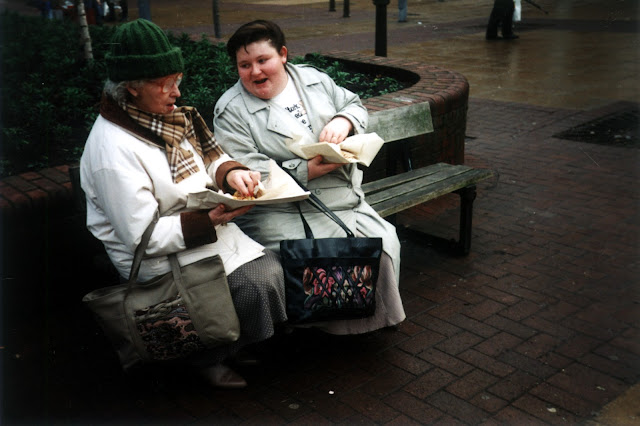
Two women sat chatting on a bench with their fish and chips. The older lady is wrapped up in a coat, scarf and woolly hat, and the younger lady is wearing her coat open
Two women chatting over their fish and chips at the Bull Ring in Wakefield, 1993

What is Oral History?

‘Oral history’ can sound like a scary clinical term and is often thought of as a serious interview; in reality, it is a conversation. It is the sharing of experiences verbally and the conversation can be guided by questions set in advance, or in response to what is being discussed. The types of oral histories vary depending on what setting it is taking place in.

What are some good Oral History questions? How do you do an Oral History interview?

Collecting an oral history can be a formal process. This prompts some people to compare it to a serious interview. The idea is to record a person’s personal experiences and discover more about them and what they have lived through by asking questions and listening to their responses. 

This is best done through open-ended questions, allowing the other person to tell their story naturally without being stuck with closed ‘yes/no’ questions. An open-ended question could be “What was Wakefield like when you were growing up?”, whereas a closed question is more like “Did you like Wakefield when you were growing up?”. Here, the interviewee could simply answer “yes” or “no” and it shuts the conversation down completely!

How are Oral Histories used?

For historians and curators, oral histories are used as a research source to better understand a place, period, or significant event. The team at Wakefield Museums and Castles are currently exploring their oral history collection to better understand the stories of Wakefield and to understand ”What puts Wakefield on the map?”


We asked the question "What Puts Wakefield on the Map?" at the A Grand Day Out summer festivals in 2022. 
This digital map contains some of the responses. Tap the flags for more information. 
Green flags are places and attractions, yellow flags are memories, pink flags are for people and community groups, and blue flags are about where people live.

In the past, oral history has been passed down through folklore and myths. It is believed to be the first form of history. It is very important for people from many different cultures around the world. Nowadays, oral history can be engaged with in less creative manners and is at risk of becoming forgotten.
It is likely that most people have engaged with oral history in some way and may not have even realised it. Have you ever listened to a story about your family’s history or asked your relatives about their past? Have you ever told others about your own experiences in the past? These are just a few examples of how people engage with oral history daily.

The difference between ‘formal’ and ‘informal’ oral histories is that they serve unique purposes. With more formal oral histories, we record and collect them so they can be referred to over the years and used for research purposes. Informal oral histories are told for personal reasons, to connect with family history, to keep ancestors’ memories alive, and to make sure your story is heard. But there is no guarantee that these stories will be recorded forever in this setting.


In this video, Herbert tells us about cycling home from dances during the Blackout! 
Drawn by Tom Bailey.
See and hear more stories from local people in Moving Stories, now open at Wakefield Museum

Why is Oral History important?

The benefit of oral histories is that we can collect massive amounts of information from this technique, helping us round out the history and objects we already possess. They help to keep voices from the past alive for generations to come.

For example, we can learn lots from government documents, records and maps of mining facilities; we can study the health and safety information at the time, the layout of the mines, the number of workers and any labour disputes. But what we lack is the perspective of the people involved. Through oral history, we can add a human element to the information available by asking what it was like to work there, their experience during strikes, whether they witnessed any accidents on or off the records, and most importantly, what this all meant to them. When using this method, we gain a first-hand perspective and authentic narrative.

Finally, a key concept of oral history is the act of preservation. Not only does it mean that it will be forever preserved and available for use, but the entire recording of the conversations is preserved, so there is no risk of only having the interviewer’s interpretation. We know that in history, there has been a tendency to maintain one perspective, but if we preserve oral history correctly, we can prevent that.

This is another reason oral history is so important, as it can help us combat disparities in history. We are all aware that history has tended to erase certain voices, preventing groups of people from having their stories told. History is all too often a story of the ‘victors’, or just wealthy, straight white men. But we can change that, and Wakefield Museums and Castles want to be a part of that change. We want to collect your story no matter your background or what you have to say. We can’t wait to hear your story!


Who knows, it might just feature in our New Library and Museum

To see examples of our oral history collections, check out our current Moving Stories exhibition, where some of our oral histories have been brought to life in drawings by Tom Bailey 

There's also Lydia’s LGBT+ History Month blog post on Sue Riley and Madam Connie.


Tuesday, February 21, 2023

LGBT+ History Month 2023: Behind the Lens

Lydia, a Modern History MA student on placement with us from the University of York, has been exploring the treasure trove of our oral histories collection to support the ongoing evolution of our new Moving Stories exhibition.

Here’s what she’s uncovered in our Rainbow Trails oral history archive, a compilation of Wakefield’s LGBT+ stories!

The ‘Wakefield Storytellers’ section of the Moving Stories exhibition is dedicated to showcasing stories from local people. Some of these were already in our oral history collections, and others are new ones we are collecting all the time.

Given this year’s LGBT+ History Month focus on ‘Behind the Lens’, I have been exploring stories from Wakefield’s local LGBT+ stars and allies, both on and off the stage.

Let me introduce local legends Sue Riley and Madam Connie!

Sue grew up making her own clothes. She recalls that most people did when she was younger, and she always helped others with their clothes when asked. After moving to Wakefield in the 1990s, Sue met local drag queen Madame Connie at the Fernandes Brewery pub. Soon after learning about Sue’s talents, Madame Connie gave Sue her first ever drag outfit commission. This was a partnership to continue for many years, as Sue explains in the clip below:

Sue made an array of dresses from all sorts of unsuspecting materials and took to the challenges given to her by Wakefield’s drag performers. One of her favourite dresses that she made for Madame Connie was this black velvet dress with hologram sequins and golden wings.

Madam Connie showing off her black velvet and golden hologrammed sequin dress, holding up the golden cape. She is wearing a black bobbed wig and has gold eyeshadow, and looks fabulous!
Madam Connie slaying the house boots down in her Norma Desmond outfit!
Photo copyright of Sue Riley, early 2000s

In the audio clip below, Sue describes stepping up to the challenge of creating this iconic dress!

Another challenge was presented to Sue when she was asked to fashion a dress out of white and brown cow print material. She designed a rock and roll dress with lots of frilly petticoats at the request of the drag queen. When she realised she had leftover fabric, Sue designed something extra for the performer... Listen to the clip below to find out what this was:

Clearly, this line of work was destined for Sue as her flourish for creativity matched the vibrant looks the drag queens wanted to create.

Sue’s work was incredibly important to Wakefield and the local LGBT+ community. Performing on stage allows people to create other personas and step out of their comfort zone; the creation of these dresses helped solidify these characters on stage and gave the performers the confidence they needed.

Drag came to the stage many years ago in theatre performances and has continued to develop in recent years and is now even present on television shows. Drag was never about impersonating a woman or a man; it was about an exaggerated performance to create a new identity. While drag was less accepted in the past, some still broke through the barrier and began to make changes. One of these iconic performers was Sue Riley’s favourite drag queen, whom she had seen perform live, Danny La Rue.

Drag impacts our lives more than you can imagine; even some of today’s slang comes from the drag industry. 

But instead of continuing, here's a bonus clip from Steven spilling the 'T' on what Madam Connie means to him:

We are proud to tell Sue Riley's story and spread the word about her work #BehindTheLens.

Please look out for our future engagement with Wakefield’s LGBT+ stories, and if you have any memories to share or pictures of Sue Riley’s dresses, or Madam Connie's performances, please tweet us or email us at museums@wakefield.gov.uk.

We also have one of Madam Connie's wigs on display in the new Moving Stories exhibition at Wakefield Museum!

A bright red bobbed wig with darker red undertones, on a bejewelled and glittery mannequin head on display at Wakefield Museum
One of Madam Connie's wigs, worn at performances in the early 2000s.
Photo credit Nick Singleton

We can’t wait to hear more of Wakefield’s LGBT+ stories!

Wednesday, January 25, 2023

Moving Stories - Opening 6 February 2023


Decorative poster for Moving Stories at Wakefield Museum. Features motif of packing boxes with the Wakefield Museum logo on, surrounded by speech bubbles and movement, with stories waiting to break out of the boxes!

Moving Stories

Wakefield Museum

From 6 February 2023

Free Entry

Wakefield Museum is getting ready to move! 

We are developing an exciting new Library & Museum in the former British Home Stores (BHS) building in the heart of Wakefield city centre. As we prepare for the big move, we want to celebrate our story so far and we need your help to write the next chapter.

A postcard from the 1970s of Kirkgate, Wakefield, showing BHS (as British Home Stores) and Marks & Spencer shopfronts and people going about their daily business
A postcard of Kirkgate, Wakefield in the 1970s

Launching in the museum’s centenary year, Moving Stories is a vibrant, interactive exhibition. Join us for a look back at the stories we’ve told over the last 100 years. Discover the new stories that we’ve been hearing. And tell us your own story.

Take a peek behind the scenes and find out how we plan to turn an empty, old department store into awe-inspiring museum galleries. Let us know what you would like to see in the new venue. Be part of the story as we work together to create something special for the Wakefield district. 

A map of the Wakefield district with coloured sticky notes and flag pins full of people's answers to the question "What puts Wakefield on the map?" at an event in Featherstone last summer.
Responses to "What puts Wakefield on the map?" at an event in Featherstone last Summer

Moving Stories features exciting new illustrations by West Yorkshire artist, Tom Bailey.

Tom Bailey is an artist from Leeds who draws pictures to make things easier to understand. He often attends events, listens to people and draws what they say. Tom also illustrates books and makes murals. Have a look at more of Tom’s pictures on Instagram at @mrtombailey.

Click here for some photos from the exhibition and a selection of Tom's drawings going on display!

Click here for visitor and access information at Wakefield Museum


The new Library & Museum is funded by the government’s Levelling Up Fund and Wakefield Council. The project is part of the Wakefield City Masterplan, which aims to deliver improved facilities for residents.