Showing posts with label adults. Show all posts

Thursday, June 3, 2021

Bracing Air, Abundant Amusements: The Travel Posters of Charles Pears

Blog post from 2021. This exhibition has now closed, however there are lots of lovely photos and information about Charles Pears in this post!

We are very excited that Pontefract Museum has now reopened with a major new exhibition of artwork by Pontefract-born artist, Charles Pears (1873-1958). Bracing Air, Abundant Amusements: The Travel Posters of Charles Pears is the first retrospective of Pears’ work in his hometown. The exhibition focuses particularly on his prolific career as a commercial artist and will transport you back 100 years to the golden age of rail tourism, the British seaside holiday and poster design. 


National and leading art collections have kindly lent posters and original artworks to the show, including some that might even have been seen on platforms at Pontefract’s three rail stations in the 1930s. The exhibition also includes expert commentary from a leading authority on 20th century posters, as well as an exclusive new poster artwork for Pontefract. 


A marine master


The exhibition takes its title from the slogan of a poster promoting the 'Bracing Air' and 'Abundant Amusements' that holiday-makers and day-trippers could look forward to in Southend-on-Sea in 1927. Pears provided the artwork for the poster, showing yachts on the Essex waters. He was an enthusiastic sailor himself and had established a reputation as a leading marine artist, having served as an official Naval war artist during the First World War. 

Pears would go on to capture the Second World War on canvas too and later became the first president of the Royal Society of Marine Artists. He eventually retired to spend more time at sea and settled in Cornwall, where he painted his self-portrait, kindly lent to the exhibition from the Russell-Cotes Art Gallery and Museum, Bournemouth. It is the first time it has been exhibited in Pears' hometown, where he had first honed his artistic talent whilst growing up.

A self-portrait of Charles Pears out in a boat, wearing a captain's hat and smoking a pipe. He is an older, white gentleman.
Self portrait, 1944-46 by Charles Pears (1873-1958)
PHOTOGRAPH REPRODUCED WITH THE KIND PERMISSION OF THE RUSSELL-COTES ART GALLERY & MUSEUM, BOURNEMOUTH


Poster perfect


Pears went to school in East Hardwick and attended Pontefract College. As a young man, he moved to London and began his career as a cartoonist and illustrator, becoming a regular contributor to Punch and illustrating famous titles by authors like Lewis Carroll and Charles Dickens. 

A display case full of books illustrated by Charles Pears
Pears-illustrated books from the Wakefield Museums & Castles collection on display in the exhibition

An iconic illustration of the Mad Hatter's Tea Party from Alice and Wonderland drawn by Pears
Illustration in a 1907 edition of Alice in Wonderland, from the Wakefield Museums & Castles collection

In the 1920s and 1930s Pears perfected his trade as one of the travel industry’s go-to poster artists and enjoyed a successful commercial career. At this time, new public holidays and paid annual leave meant that people were enjoying more leisure time and heading off on holidays and day-trips. 

Most holiday-makers at the time travelled by train, taking advantage of summer timetables and special fares. In only the early days of radio and before television, the poster was the most effective means of mass communication and became the rail companies’ primary marketing tool. They turned to leading artists like Pears to produce the most appealing representations of resorts.

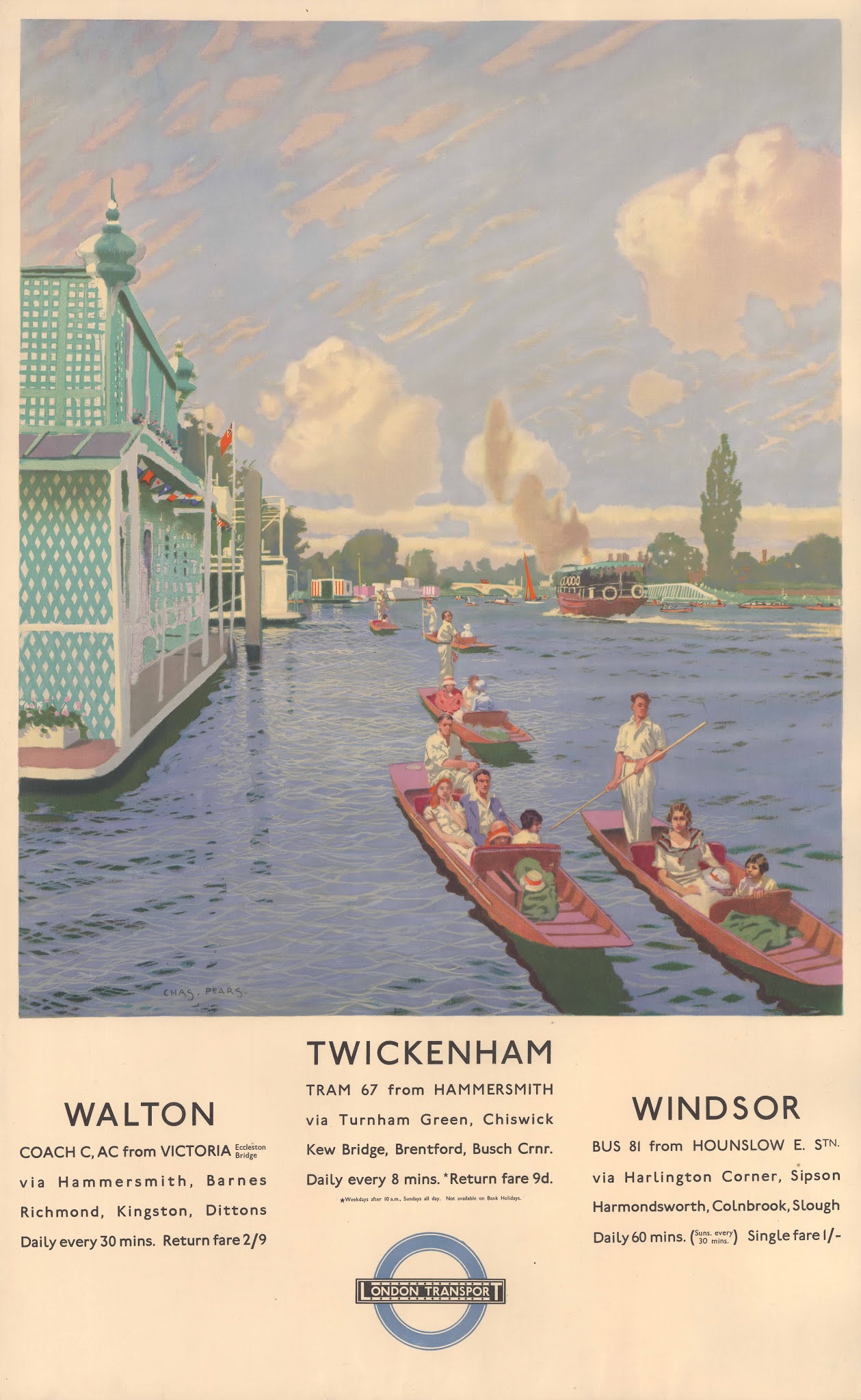
Bracing Air, Abundant Amusements includes many examples of Pears' most vibrant posters, alongside some of the original artworks. 

A poster for Twickenham, Walton and Windsor, showing people punting on the river

Twickenham, Walton and Windsor, Charles Pears, 1935

© TfL from the London Transport Museum collection

http://www.ltmuseum.co.uk/


The exhibition at Pontefract Museum
Spring on the River Thames, the original artwork for the poster, is on show in the exhibition.

Pick of the painters


It was Frank Pick, the Publicity Manager at London Underground, who initially recognised the potential of the travel poster. Pears was one of the first artists Pick worked with on an initiative to promote travel by public transport in leisure time as well as for commuting. As a marine specialist, Pears’ posters often promoted daytrips away from the hustle and bustle of the city along the picturesque banks of the River Thames. 

Between the wars, London Transport also ran special excursion services to Southend, the nearest beach resort to the capital. Pears produced no fewer than 14 different poster artworks for Southend, showing boats on the waves, water sports, local landmarks and all the attractions on offer. Visitors can see two examples in the exhibition, including the original oil painting for this sun-soaked scene.

Pears' illustrated poster for Southend on Sea, showing people playing in the sea in 1930s bathing costumes

Southend-on-Sea, Charles Pears, 1934

© TfL from the London Transport Museum collection

http://www.ltmuseum.co.uk/


Inspired by Frank Pick’s successful poster campaigns in London, railway companies also began to invest in the best artists for their adverts. After Britain’s many individual rail lines were grouped into the ‘Big Four’ in 1923, the newly formed regional companies each established advertising departments. They were competing with each other to attract tourists to the resorts on their lines, and only the most persuasive artworks would do. As an expert sailor and marine artist, Charles Pears was in high demand to provide seascapes that would tempt holiday-makers to the coast. 

This relaxing representation of Filey must have been an appealing image for passengers at Pontefract, which was served by LNER at the time. For the price of a rail ticket, they could escape the daily grind and get away from it at all on the East Coast. 

Pears' illustration of a young woman relaxing on the coast at Filey

Poster, LNER 'Filey for the Family' by Charles Pears, 1930

Science Museum Group

© The Board of Trustees of the Science Museum


A fun family day out


Certainly, at this time more people than ever before were flocking to the seaside with their buckets and spades. Families made sandcastles, wrote postcards and returned home with plenty of snapshots and souvenirs. As well as admiring Pears' posters, visitors to Pontefract Museum can also enjoy a trip down memory lane with retro holiday essentials and mid-century beach attire from the Wakefield Museums & Castles collection.

Retro bucket and spade, postcards and camera

Retro swim and beachwear

Elsewhere in the museum, you can admire even more of Charles Pears' skill and artistry. He enjoyed a prolific career and we weren't able to display all of his many designs in the exhibition but our slideshow includes posters for destinations all over the country and beyond. 

Inspired by Pears' example, graphic designer Georgina Westley has created a stunning new poster artwork for Pontefract. Adding a modern twist to Pears' style, she has produced a colourful celebration of his hometown today. Visit the exhibition to see the iconic view of the Buttercross and St Giles' Church in a new light!

There's also plenty for little ones to enjoy. Look out for the special family-friendly object labels and pick up your Take and Make activity bag, packed with seaside themed crafts inspired by the posters on display. 


Bracing Air, Abundant Amusements: The Travel Posters of Charles Pears is at Pontefract Museum, 24th May 2021 – 25th February 2022. 


The exhibition was made possible with a grant from the Weston Loan Programme with Art Fund.


To enjoy more of Charles Pears' work, check out our Curation on ArtUK for an overview of his celebrated career. 

Read more about Georgina Westley's poster in this special guest blog post

Monday, January 25, 2021

Rachel List: We're All In This Together

At the end of 2020, we were privileged to install a new exhibition at Pontefract Museum, the first ever solo show by local lockdown artist, Rachel List. Sadly, Covid-19 restrictions meant we weren't able to welcome visitors to the exhibition in person at the time so we brought Rachel’s colourful and poignant work to you online instead.

Now two years on from the first lockdown you are at last be able to enjoy Rachel's exhibition in person at the museum. Newly updated, it features some of her most-loved mural designs and a newly commissioned work. As well as admiring her paintings, you can also watch Rachel star in two short films, one on her work during Covid and another on what lockdowns have meant for her. See the show at Pontefract Museum until 29th October 2022.


Rachel List in her paint-covered clothes sat below her mural 'We're all in this together' with her arms outstretched. The mural is of two hands holding a paper-chain of people painted in rainbow colours.

When lockdown began, like many of us, Pontefract artist, Rachel could no longer go out to work. She normally spends her days painting murals in people’s homes, which was not allowed under the restrictions. But even though she was unable to do her day job, Rachel still had an urge to make art.

‘For me work is not just work, I’ve got that drive to create.' 

Rachel List

So she took her brushes with her on her daily exercise and started painting her murals outside instead, livening up walls around Pontefract while most of us were still sleeping. Her bright, colourful works brilliantly capture the spirit of that first lockdown when we clapped for the NHS.

‘A lot of us had been furloughed and were sitting at home feeling pretty useless … and it just seemed important to show support.’

Rachel's paint-covered clothes and paint pallets on paper plates on display at Pontefract Museum

Rachel painting the 'we're all in this together' mural

As a museum service we also want to collect objects that capture and tell the stories of Covid and lockdown in our communities. But of course we can't collect a huge mural on a pub wall. So we are immensely grateful to Rachel for recreating some of her work in a more manageable format for the exhibition. These paintings will also become a permanent part of the museum collection, preserved to tell the story of Pontefract’s lockdown for future generations.


A mural of an NHS nurse, wearing a face mask and boxing gloves, and crying rainbow tears

A mural of an NHS doctor or nurse in full PPE with rainbow wings

A wooden pallete painted with a hand painting a rainbow and the words 'we're all in this together'

A mural of an eye crying rainbow tears with the words "we turned our tears into a rainbow!

A nurse dressed in 1950s-style uniform, carrying a bucket of paint and a paintbrush, with the NHS logo freshly painted on the wall beside her

A mural of Captain Tom during his iconic walk, with rainbow balloons attached to his walker, and the painter nurse from the mural above beside him

‘It’s all about how something good can come out of a bad thing. There will be a rainbow after the storm.’
Rachel List


Films produced by Voices and Video - www.voicesandvideo.co.uk

To see Rachel's murals in their original locations and enjoy more of her work, why not explore our StoryMap:


Do you have a favourite Rachel List mural? Join in the conversation on social media using the hashtag #RachelList:

Twitter @WFMuseums, @Rachellist9
Facebook @PontefractMuseum 
Instagram @wakefieldmuseums, @rachthepachel

Tuesday, November 3, 2020

Black History Month: Charles Waterton and slavery

Charles Waterton, the pioneering naturalist, explorer and conservationist of Walton Hall near Wakefield, also spent seven years as a manager of sugar plantations and enslaved people in Guiana in South America.

In 2019 Wakefield Museums & Castles began a research project to learn more about Waterton’s involvement with the practice of slavery. This final post in our 2020 Black History Month series outlines what we know so far and our plans for further research and changes to our galleries.


Content warning: this article discusses the Transatlantic Slave Trade. It contains some outdated terms and attitudes when quoting from historical sources.

Updated on 13 October 2023

Portrait of Charles Waterton, a middle-aged white man with short hair, in smart clothes. He is seated at a desk, with a taxidermy red bird perched on his finger, some books on the desk and a taxidermied cat's head on top of the books.
Charles Waterton by Charles Willson Peale in 1824. By this time Waterton had stopped working on plantations and returned to Europe, never to return to South America.


In the 1790s, Britain took over the control of Guiana from the Dutch. The land in the new colony was perfect for growing sugar and so had the potential to make lots of money for British investors. The Waterton family were among the many British people who rushed to buy land there, from wealthy merchants to poorer families. These sugar plantations exploited enslaved people to maximise profits.

The Waterton family and slavery

Waterton’s father and uncle each owned a plantation in Guiana:

              La Jalousie & Fellowship bought by Charles’ uncle, Christopher in 1797. In 1835 it had 292 enslaved persons.

              Walton Hall plantation bought by Charles’ father in 1805. It was sold in 1817 with 287 enslaved persons.

In his book, Essays on Natural History, Charles Waterton writes about how his family became involved in sugar and slavery:

"Our family found its way to the New World in the following manner: - My father's sister [Anne] was remarkably handsome. As she was one day walking in the streets of Wakefield, a gentleman, by name [Michael] Daly, from Demerara, met her accidentally, and fell desperately in love with her: they were married in due course of time, although the family was very much averse to the match. Soon after this, my father's younger brother [Christopher], who had no hopes at home on account of the penal laws, followed his sister to Demerara, and settled there."

Source: Waterton, Charles; Natural History Essays

The penal laws restricted Catholic involvement in government and business. Waterton and his family were Catholics. Despite his aristocratic home and heritage, Waterton was unable to use his title as a Lord. He also couldn’t work as a judge, officer in the army, or become an MP.

Charles Waterton’s involvement with slavery

Aged 22, Waterton was sent to administer the plantations and the enslaved workforce on behalf of his family. He did this job for seven years (1805 – 1812). He probably received a salary for this work. It is likely he was sent out in order to avoid paying someone outside of the family.

Charles’ father died in 1805, shortly after his arrival in Guiana. The will of Thomas Waterton, Charles’ father, now is in the John Goodchild collection with West Yorkshire Archive Services, reveals that Charles inherited the family home in Walton but did not inherit the family estates and the ‘slaves thereon’ in Guiana. Waterton managed the plantations on behalf of younger family members until they came of age to manage them themselves.

An illustration of the grand Walton Hall in its grounds
Walton Hall near Wakefield in 1830. Waterton’s father remodelled the house in the 1760s, long before he invested in slavery and sugar.

In 1833 Waterton was challenged over his family’s involvement with slavery. He wrote: 

"I never possessed a slave in my life, or any part of a plantation. From 1807 to 1812, at intervals, I administered the estate of an uncle, and others; during the period, the yellow fever and tertian ague kept giving me frequent hints that there was not much pleasure to be expected from being ‘surrounded by slaves and attendants’"

Waterton, Charles; Mag of Nat Hist.  July 7 1833. P.394

 Waterton finished working as a planation manager in 1812 and began his first ‘wandering’ in South America:

"In the month of April, 1812, my father (Thomas) and uncle (Christopher) being dead, I delivered over the estates to those concerned in them, and never more put foot upon them. In my subsequent visits to Guiana, having no other object in view than that of natural history, I merely stayed a day or two in the town of Stabroek (now called George Town), to procure what necessaries I wanted; and then I hastened up into the forest of the interior, as the Wanderings will show."


A painting of Waterton riding a caiman, surrounded by exotic animals, with Daddy Quashi and members of an Amerinidian tribe pulling on the baited rope
Waterton riding a caiman out of the Essequibo River in Demerara by Captain Edwin Jones, 1820s. Daddy Quashi, a formerly enslaved man, can be seen pulling on the baited rope with members of an Amerindian tribe.

Waterton on slavery

Waterton never campaigned to end slavery but he did speak out against it. In his book, Wanderings in South America, he writes against the practice but defends the treatment of enslaved people by plantation managers:

"slavery can never be defended; he whose heart is not of iron can never wish to be able to defend it: while he heaves a sigh for the poor negro in captivity, he wishes from his soul that the traffic had been stifled in its birth; but unfortunately, the governments of Europe nourished it, and now that they are exerting themselves to do away with the evil, and ensure liberty to the sons of Africa, the situation of the plantation slaves is depicted as truly deplorable, and their condition wretched. It is not so. A Briton’s heart, proverbially kind and generous, is not changed by climate, or its streams of compassion dried up by the scorching heat of a Demerara sun; he cheers his Negroes in labour, comforts them in sickness. Is kind to them in old age, never forgets that they are fellow creatures."

Source: Waterton, Charles; Wanderings in South America

In 1807 the transportation of enslaved people from Africa was abolished in the British Empire after a nationwide campaign. However, it did not end the practice of slavery in the colonies and the anti-slavery campaign focused on the treatment of slaves within the plantations. Waterton did not like this argument and wrote of kind treatment towards enslaved people. However, we do not know what conditions were actually like on the plantations he managed.

We do know that he taught taxidermy to John Edmonstone, who was enslaved to Charles Edmonstone, Waterton’s friend and future father in law, and that some formerly enslaved people accompanied Waterton on his famous expeditions in the rainforest.

When Britain finally abolished slavery in 1833, those that owned enslaved people received compensation from the government. The loan needed to pay the compensation was so big it was only paid off in 2015. As Waterton himself had not owned a plantation or any shares in enslaved people, he did not receive compensation, but some family members on his uncle’s side did.

Slavery and Wakefield Museum

Since 2020, Wakefield Museums & Castles have completed research into the Waterton family’s involvement in slavery. We have updated this article to reflect this and new interpretation has been installed at Wakefield Museum telling this important part of the Waterton story. This can also be accessed on our Charles Waterton and Slavery page. We are grateful to Wakefield Council’s Global Majority Race Equality Network (formerly the BAME Staff Forum) and the Black Family Forum for their contribution to the information.

We continue to explore the Wakefield district’s links to slavery and are committed to telling this story in our sites and programmes, including as we work towards a new Wakefield Library & Museum.

Related posts

John Edmonstone

Eliza, Anne and Helen Edmonstone

Sugar nippers not shackles: slavery in local history collections


Monday, October 26, 2020

Black History Month: Sugar nippers not shackles

For Black History Month 2020, Wakefield Museums & Castles are exploring four stories related to British slave ownership in the early 1800s. This week, we are focusing on our collections and how we can reveal hidden stories from objects that at first glance seem to be unrelated.


The story of the British slave trade and slave ownership is part of every town and city in Britain. Local history museums can tell the story too. Although most local museums do not have the shackles or whips used to subjugate those who were enslaved, we can show how the products and profits of enslavement reached every home in Britain, including Wakefield. 

It can be surprising how many different and diverse stories museum objects can tell.

The Triangle of Trade

An old printed and handwritten banknote from 1800
Banknote of the Wakefield Bank, Ingram, Kennett and Ingram, 1800

Captain Francis Ingram of Wakefield used the profits from trading in enslaved people to start Wakefield’s first bank. In the 1770s and 1780s he was a major figure in the slave trade, involved in 105 voyages, which took away close to 34,000 slaves from Africa. It is estimated that these ships delivered just over 29,000 people to the Americas, meaning that around 5,000 died making the journey across the Atlantic Ocean.

Ingram’s business was part of the so called Triangle of Trade. British merchants like Ingram sailed from ports such as Liverpool and traded goods for enslaved Black people from African merchants in ports along the West African coast. 

The enslaved people were tightly packed into ships, which then travelled across the Atlantic to the British colonies in North and South America and the Caribbean. Many enslaved men, women and children died in the crossing. The ships were unsanitary and overcrowded.

The industrial revolution in Britain in the 1700s and 1800s relied on the exploitation of enslaved people in the British colonies. The merchants traded the enslaved to plantation owners in return for the goods they would be put to work to grow and harvest. The key products were cotton, coffee, rum, sugar, and tobacco. These goods were then shipped back to Europe and made their way to wardrobes, kitchens, dining tables and pockets in Britain. Some would then complete the cycle and be shipped to Africa to be traded for more enslaved workers.


The products of slavery


The use of slave labour enabled mass production, meaning that expensive commodities became more affordable to less wealthy families and began to appear in homes across the country. The household objects associated with these luxury goods eventually arrived in our museum collections.

An ornate coffee pot, which looks like a tall thin teapot

Coffee pot, Newhall, 1820s


'Sugar nippers', a metal tool that looks like a pair of pliers or scissors with rounded edges

Sugar nippers, early 1800s

Sugar arrived at a household in a cone or ‘loaf’. It was broken up with a sugar axe or hammer and then nippers like these were used to cut off smaller chunks.


A ceramic ornate sugar bowl
Sugar bowl, D. Dunderdale and Co., Castleford, 1790 – 1821


A glass bottle labelled 'Jamaica rum'
Bottle labelled ‘Jamaica rum’ from a travel chest ‘cellarette’, late 1700s


An ornate metal tobacco box

Tobacco box, late 1700s


Shamefully, the lives of most enslaved people from the early 1800s are absent from history. But their stories and suffering are often hidden in plain sight in our collections and displays, and the social and industrial history of the nation. 


This is the third article in our Black History Month series looking at Wakefield’s links to slavery. The final post next week will consider how the Waterton family were entangled with the practice of slavery in the late 1700s and early 1800s and what Wakefield Museum is doing to address it.


Previous posts


Monday, October 19, 2020

Black History Month: Eliza, Anne and Helen Edmonstone

For Black History Month 2020, Wakefield Museums & Castles are exploring four stories related to British slave ownership in the early 1800s. In the second post of the series, we are looking at the extraordinary lives of three mixed race sisters.


Eliza, Anne and Helen Edmonstone were born (1807, 1812 and 1813) into the messy mix of colonialism, violence and indigenous tribes of British Guiana, and later married into the family of an eccentric Wakefield naturalist. Their story begins in the world of slavery and ends in environmental activism and the creation of the world’s first nature reserve.

The Edmonstone sisters must have made quite an impression when they came to Wakefield in the late 1820s. They were described as tall, dark and beautiful maidens but the darkness of their skin also marked them as outsiders. On a visit in 1845, the famous naturalist Charles Darwin described them as ‘Mulatresses’, his only comment on them (an abhorrent racial slur today) forged purely by their skin colour and their mixed race heritage.


Early life in colonial South America


Eliza, Anne and Helen were born in hot, humid and remote British Guiana in South America, three of four sisters and two brothers. Their Scottish father was a wood merchant named Charles Edmonstone and their mother was descended from Amazonian royalty, ‘Princess’ Minda, the daughter of an Arawak chief from a powerful indigenous tribe.

Their home, Warrow’s Point on the Mibiri Creek, was an 11 day trek up the Demerara River from the coast line plantations, the ports and markets, and the decadence of the capital Georgetown. The Edmonstones’ domestic life was a curious set up. Two families of freed slaves lived in the garden (one of whom was John Edmonstone) and they were taught how to read and write by a Scotsman called Old Glen, a former sailor, soldier, plantation owner and preacher who lived in a hut at the end of the garden. The family regularly entertained military generals, politicians, tribal leaders and even enslaved people. It was here that their father became close friends with Anne’s future husband, Charles Waterton of Walton Hall. 

An illustration of Edmonstone's "wood cutting establishment"

Mr Edmonstone’s Wood Cutting Establishment

Mibiri Creek, Demerara River

Thomas Staunton St Clair, sketched around 1808

A Residence in the West Indies and America (London 1834, Vol 2)

Copyright unknown


This multi-cultural home put the family at the centre of many tensions within colonial life. Charles Edmonstone’s family connections to the indigenous tribes put him in a unique position. He was employed by the British Government to track down enslaved people, who often made camps within the rainforest. This role brought violence and former slaves were sometimes killed by the hunters. The idea of hunting down those that had escaped their bondage is repugnant but was very common throughout the British colonies.

Despite his role as hunter, Edmonstone also insisted that all recaptured enslaved people be pardoned and never returned to their ‘owners’. Instead they were exiled to neighbouring islands. Edmonstone had the title of Burgher – captain and Protector of the Indians during his time in Guiana and was vocal in his belief that the indigenous people should have better treatment and protection.


A Scottish proposal


In 1817 the family left the colour, chaos and colonialism of Guiana for cold and grey Scotland. They were now wealthy and, having bought back the ancestral home, Cardross Park near Glasgow, attempting to insert themselves into Scottish high society. It must have been a huge culture shock for the children and their mother.

Ten years later, Charles Waterton, who had now completed four adventures in the Americas and been busily creating a museum in his house and the world’s first nature park in his grounds, came to Cardross Park to visit his old friend with a proposal to marry Anne. He had written the previous month stating that he had not ‘the courage enough to look for a wife’.

He would have found the Edmonstones in a poor state. The whole family struggled with the British climate - the sisters suffered from back aches, leg aches and headaches; their father’s health was deteriorating; and their mother was painfully thin and reliant on laudanum. Waterton’s proposal may have come as a relief to the mounting debts and uncertainty, for within two years the sisters were orphans.


To Bruges


Waterton’s family were strict Catholics so Eliza and Anne were sent to the English Convent in Bruges to be converted to Catholicism. They regularly wrote to their younger sister, Helen, in Scotland during their two year regimented stay in Bruges. Wakefield Museums and Castles holds several of their letters. They write with affection for their new surroundings:

‘It is just, my dearest Helen, that I should now answer the many letters you have written to me and endeavour at the same time to give you an account of the Many happy days I have spent in this Dear Convent .’ 

Anne Edmonstone to Helen, October 1827

As the wedding day grew closer, Anne expressed her nervousness and fear for marrying. Although she states she is ‘confident of his love’, in the month before her wedding she writes:

‘The time of my marriage approaches very quickly. I tremble when I think of it. One happiness is that it will be very private’

Anne Edmonstone to Eliza, 20 April 1829

A letter from Anne Edmonstone to Eliza
Wakefield Museums & Castles collection


The couple married at 5:30am on 18th May 1829 at the convent. She was only 17 and Waterton was 47. There is a plaque commemorating the marriage at the convent today.


A tragic loss

Whilst the newlyweds departed for a honeymoon across Belgium, France and Italy, Eliza travelled to Walton Hall to meet Charles Waterton’s sister, Helen Carr.

‘I found Walton Lake beyond description and Mr and Mrs Carr a charming couple (to use our dear Father’s expression) lay aside your fears Annie Dear. I am certain you will like her at first sight. She spoke in the kindest manner and she longed very much for you arrival in England.

Eliza Edmonstone to Anne Waterton, nee Edmonstone, 23 June 1829

Eliza  and Helen soon settled into the surroundings of Walton Hall.

An illustration of Walton Hall and its impressive grounds

Walton Hall as it looked when Eliza and Helen arrived in 1831. Drawn by Waterton’s friend Captain Jones.

By the autumn of 1829 Helen was at the English Convent, Eliza had returned to Scotland, and Anne had settled into life at Walton Hall and entered a pregnancy that would end in tragedy. She gave birth to a boy, Edmund, on 19 April 1830. Anne died on 27 April. She was 18, a wife for less than a year, a mother for eight days.

‘Her Dear baby, “Edmund Waterton” is alive and well –she requested that you might be informed that she died – ‘most happy’ She had a deep seated conviction that she should die and this did not at all dis-compose her.’

J.G.Morris to Sister Marian Nyren at the English Convent, Bruges, 27th April, 1830


Family life at Walton Hall and beyond

Waterton requested to be made responsible for Eliza and Helen and within a few months had formed a new family unit of two sisters, a brother and a son, which would endure for the next 35 years.

I feel a great comfort in thinking that you are with him, that you will soothe his grief by your Sisterly and affectionate conduct.

Marian Nyren to Eliza Edmonstone, June 25th Bruges, 1830

 They were extremely close and rarely separated:

My sisters and I keep Spanish hours. We breakfast at eight, dine at one, and take tea and coffee at six….we are so close we are like three branches on a single stem’

Charles Waterton to Norman Moore, 1864


A modern-day drawing of Eliza and Helen with baby Edmund

Eliza and Helen with baby Edmund

Extract from The Extraordinary Life of Charles Waterton, A comicbook adventure, Part Three, The Defence of Nature, 2015

Drawn by Richard Bell

Being the older sister, Eliza was in a position of responsibility - she managed the house and supervised Edmund’s education until he went away for school. She wrote the letters to Charles when he was away, with a note added by Helen. When Charles took a local polluting soap making business to court for pollution, it was a property owned by Eliza that settled the argument.

Both sisters suffered from ill health, possibly from the climate. Eliza had bad knees and lungs, Helen had kidney problems, and both suffered debilitating headaches. Waterton took them on European tours in search of cures, to various French and German spa towns and warmer climates. As with most journeys with Waterton, they had to endure mishaps like getting shipwrecked off the coast of Italy.


Lost to history


In his later years, Waterton obviously trusted his sisters with his legacy much more than he did his own son. Edmund was resentful, particularly of Eliza’s position in the family. Waterton changed his will late in his life to give Walton Hall and its contents to Eliza and Helen. When Waterton died in 1865, Edmund took the sisters to court. They avoided a confrontation by agreeing to leave Walton Hall for a house in Scarborough but they never settled in one place. Eliza died in Ostend in 1870 aged 63 and Helen died in 1879 in Bruges aged 66. Neither sister married.

As Charles Darwin’s comments show, the colour of Eliza and Helen’s skin marked them out at the time as exotic outsiders. Another visitor to Walton Hall compared the sisters to the Native Americans he had seen in Canada. An unspecified incident occurred with Eliza in 1854, which nearly led to the two sisters leaving Walton Hall for good. Could the distress caused have been related to her mixed race heritage?

These few descriptions of the sisters is all that we have. They did have their portraits painted but they are lost, as are the meticulous diaries they kept. We are forced instead to rely on their relationship with Waterton for an understanding of their lives.


Over the next fortnight, we will be sharing two further articles focusing on the connections between Charles Waterton of Walton Hall and the practice of slavery in the early 1800s.

Previous post

Friday, October 9, 2020

Black History Month: John Edmonstone

For Black History Month 2020, Wakefield Museums & Castles are exploring four stories related to British slave ownership in the early 1800s. This week, we are focusing on the life of John Edmonstone (179? - 1833?): Taxidermist, teacher, slave.


The lives of individual enslaved people are difficult to learn about - their stories are underrepresented in schools and in society as a whole. Documented stories of individuals are also few and far between. They were treated as property, used for the service and profit of others. John Edmonstone, named by the man who enslaved him, is a rare story. His life began in enslavement in South America and ended as a respected teacher and skilled taxidermist in Edinburgh.

The first known reference to John is in ‘Wanderings in South America,’ a famous book written in 1825 by Charles Waterton of Walton Hall near Wakefield. During a third expedition to Demerara in British Guiana in 1820, he returned to Mibiri Creek, ‘the former habitation of my worthy friend Mr Edmonstone’. His ‘worthy friend’ was Charles Edmonstone, a close friend and future father in law. Charles Edmonstone owned a wood cutting business that used an enslaved workforce, including John Edmonstone.

An illustration of "Mr Edmonstone's Wood Cutting Establishment"

Mr Edmonstone’s Wood Cutting Establishment

Mibiri Creek, Demerara River

Thomas Staunton St Clair, sketched around 1808

A Residence in the West Indies and America (London 1834, Vol 2)

Copyright unknown


Waterton was highly skilled at preserving birds for display in his museum in Wakefield. The skins he acquired had to be preserved very quickly in the heat of South America and he needed help to do it. He writes:

"It was upon this hill in former days that I first tried to teach John, the black slave of my friend Mr. Edmonstone, the proper way to do birds. But John had poor abilities, and it required much time and patience to drive anything into him. Some years after this his master took him to Scotland, where, becoming free, John left him, and got employed in the Glasgow, and then the Edinburgh Museum.”

Waterton, Charles, Wanderings in South America, the north-west of the United States, and the Antilles in the years 1812, 1816, 1820 and 1824, London, 1825, pp 153 - 154

Waterton was a difficult man, known to have a quick temper, was very argumentative and rarely praised people  - John was no exception. Although Waterton described him as having ‘poor abilities,’ it’s very likely that John accompanied him on numerous expeditions into the rainforests of Guiana and learned valuable taxidermy skills.

Waterton stated that, once freed, John began an independent life in Scotland. The Edinburgh Post Office Directory for 1824 – 1825 lists John Edmonston (missing an ‘e’) as a bird-stuffer, living at 37, Lothian Street. This address is close to Edinburgh University and he had found employment teaching students how to preserve birds. One of his students would become one of the world’s greatest naturalists – Charles Darwin.

Darwin and his brother lodged a few doors away. In his autobiography he confirms Edmonstone’s connections with Waterton:

'a negro lived in Edinburgh, who had travelled with Waterton, and gained his livelihood by stuffing birds, which he did excellently: he gave me lessons for payment, and I used often to sit with him, for he was a very pleasant and intelligent man.’

Darwin, Francis, Editor, The life and letters of Charles Darwin, including an autobiographical chapter, 3 vols. London, 1887, Vol 1, p.40.

Edmonstone’s lessons cost Darwin ‘one guinea, for an hour every day for two months’. For that bargain price he learned skills that would last him a lifetime. It’s possible those 40 or so sessions inspired the impressionable young student to quit medicine and become a naturalist. Five years later, in 1831, Darwin undertook his historic voyage on board the HMS Beagle, on which he first began to form his theory on natural selection. The Galápagos finches, used to support his theory on the transmutation of species, were preserved using the techniques that Edmonstone had taught him.

Drawing of John Edmonstone teaching a teenage Charles Darwin

Artist impression of John Edmonston teaching a teenage Charles Darwin in Edinburgh, 1825

Copyright unknown

Edmonstone was a celebrated taxidermist in his day; along with teaching, some his work was bought by Edinburgh’s zoolological museum. The museum register shows the acquisition of a 15ft skin of a boa constrictor in 1822 – 23, presented by a Mr Edmonston. In October 1823 the weekly report books state that two swallows, one water ouzel and one chaffinch were bought from John Edmonston, and fishes in 1825.

A large taxidermied boa constrictor

Waterton’s boa constrictor on display at Wakefield Museum

Was the boa preserved by John Edmonstone similar?

Very little more is known about him. The Edinburgh Post Office Directory lists him living in 1832-33 at 6, South St David’s Street, Edinburgh. It is shameful that most stories of enslaved people are only known through the writing of those in a position of white privilege. We do not have John’s point of view of his enslavement or even whether he had any choice in joining Waterton on his expeditions. All we know is that after he gained his freedom, he became a highly respected teacher and craftsman in the art of taxidermy (soon to become a Victorian obsession) and a mentor to one of the most important thinkers of the 1800s.

Today he is regarded as one of the '100 Great Black Britons'.

Throughout October we will be sharing three further articles focusing on the connections between Charles Waterton of Walton Hall and the practice of slavery in the early 1800s. 

Find out more:

https://play.acast.com/s/notwhatyouthought/johnedmonstonetheformerslavewhotaughtdarwin

https://www.jstor.org/stable/531678?seq=1#metadata_info_tab_contents

https://www.nhm.ac.uk/our-science/collections/zoology-collections/bird-skin-collections/bird-skin-collection-hms-beagle.html

https://100greatblackbritons.com/

https://www.blackhistorymonth.org.uk/

Thursday, September 10, 2020

Heritage Open Days: St Thomas of Pontefract

Did you know? Pontefract was the site of reputed miracles in the 14th century.


This is just one of the fascinating stories featured in a talk from the Wakefield Museums & Castles programme about the folklore surrounding Pontefract Castle.  For Heritage Open Days, we're sharing a taster of the talk, which aims to establish which castle myths are fact and which are fiction, with this tale of Thomas of Lancaster.


A painting of Thomas of Lancaster with St George, both in armour
Thomas of Lancaster with St George
Unknown author / Public domain
https://upload.wikimedia.org/wikipedia/commons/8/8d/BodleianDouce231Fol1rEdCrouchbackAndStGeorge.jpg


Thomas inherited the Earldom of Lancaster in 1296, when he was just 18.  He had married Alice de Lacy two years earlier and, by agreement of the marriage contract, he went on to inherit her father's titles and lands at Lincoln and Pontefract, which he retained even after he and Alice divorced in 1318.


Family feud

Lancaster was involved in a long running feud with his cousin, King Edward II.  It centred around Lancaster and a number of other barons’ intense dislike of two royal favourites: Piers Gaveston and Hugh le Despenser.  His dislike for the two was rooted in his jealousy at how closely they seemed to control Edward, and in the closeness of their relationship, which was seen to be unnatural.

Lancaster acted as “judge” in the trial and subsequent execution of Gaveston in 1312.  He went on to lead a rebellion against Despenser in 1321.  This time, however, he was defeated at the Battle of Boroughbridge, where he was captured, taken to Pontefract Castle and tried.  Incidentally, he was tried in the Royal Apartments at the castle, having been held in “Thomas’s Tower” (now known as the Constable Tower), which ironically had supposedly been constructed for the sole purpose of holding Despenser!  The King, who by this point had developed an intense dislike for Lancaster, sat on the tribunal himself alongside two members of the Despenser family. 

The remains of the royal apartments at Pontefract Castle

Foreground: The Royal Apartments, scene of Thomas’s Trial

Back right: The Constable Tower, site of the Thomas’s Tower.

Lancaster was not able to give evidence in his defence, and was sentenced to be hung, drawn and beheaded. This was later commuted to a simple beheading owing to his royal blood.  The act was to be carried out on a hill behind the castle on 22nd March 1322.


Miracle man


Lancaster's rebellion against an unpopular king won him popularity with the people.  His objection to the King's controversial close relationship with a single advisor saw him gain support from his men and other barons.

Thus, when miracles were reported at the site of his execution - including that of a cleric curing his blindness by rubbing sand from the spot into his eyes - people were quick to call for Thomas' canonisation. One of his knights even financed a chapel on what is now known as St Thomas' Hill. He was venerated locally until the Reformation in the 16th century.

Part of an 1888 map of Pontefract
1888 map of Pontefract, showing St Thomas’s Hill, St Thomas’s Mill, and the site of St Thomas’s Chapel


Long forgotten

Despite a petition from the Commons to Edward III calling for his canonisation, Thomas was never granted official sainthood. Today, Pontefract’s 'saint', who was celebrated for acts that would now be considered hate crimes or treason, is largely forgotten. There are now houses on the site of the former chapel and even the tower that Thomas built was later remodelled and renamed.  But if ever you are looking for an unusual fact about Pontefract, you can say it was the site of supposed miracles in the 14th century and claimed its own saint.


Visit our Heritage Open Days: Hidden Histories of Wakefield Museums & Castles page for more from our weird and wonderful collections and sites.

Heritage Open Days: Behind the scenes at the museum store

The Wakefield Museums & Castles collection contains more than 111,000 objects that tell the story of our district from the distant past to the present day. Today, we can only display a small proportion of the collection at any one time. But even if they're not on show, all the objects are kept safe for future use. To celebrate Heritage Open Days 2020, we thought we'd give you a sneak peek behind the scenes at the museum store, sharing some highlights of the collection and how we care for them.


A century of collecting


Our collection has been in development for over a century and continues to grow today. The first museum in Pontefract was established by volunteers at Pontefract Castle in the 19th century. In Wakefield, Holmfield House in Clarence Park opened its doors as the city's first museum and art gallery in 1923. And by the 1930s, objects were also being collected in Castleford, originally by the local library. 

An advertisement for Pontefract's first museum in 1892
Pontefract's first museum opened at the castle on 29th April 1892 with 256 objects.

Younger and older visitors exploring a jam-packed exhibition of paintings and framed illustrations on the walls
Visitors enjoying an exhibition at Holmfield House, 1930s


In 2020, our social history and archaeology collections are a treasure trove of fascinating stories that form the basis of our main museum galleries, our special exhibitions, and many displays in our communities across the district. We regularly update our displays to showcase as many different objects as possible. Those that are not currently on display are looked after at the museum store.

From the very small...

A small wooden pig-shaped Stanhope viewer
This tiny pig shaped Stanhope viewer contains six early 20th century images of Castleford and measures just 16 x 21 x 10mm!

Demonstration of viewing the images in the pig Stanhope viewer


... to the very large! 

A bright red old fire engine inside the Museum Store
Dennis Big Four fire engine

The Dennis Fire Engine being used by the City of Wakefield fire brigade. The firefighters are in full protective equipment of the time, including gas masks.
The engine was used by the City of Wakefield fire bridge, 1935-1954, before being acquired by the museum in 1968.

And the very old...

An Ancient Egyptian clay mould in the shape of an eye
Ancient Egyptian clay mould for jewellery manufacture, c. 1200-1400 BC


... to the very new.
Child's bowl and cup set decorated with cartoon of Peppa Pig
Child's Peppa Pig bowl and cup set, 2018


All shapes and sizes


In the collections store, we organise objects according to a variety of criteria, including size, shape, material or theme. This makes the best use of our space, allows us to meet the varied conservation needs of different kinds of objects, and helps us to find things more easily. Our objects are packed using inert materials that won't cause their condition to deteriorate and will help protect them from dust and dirt, changes to the environment, or damage by movement and vibration.

Here's a whistle stop tour!

Rows and rows of boxed objects on shelves at the store
These archive boxes contain our photographic and ephemera (paper based) collections, organised by theme.

An open ephemera box showing old theatre programmes
Ephemera is kept flat in conservation grade polyester sleeves and supported by acid free cardboard.

Several old typewriters on shelves at the store
A selection of typewriters in one of our small social history aisles

Larger boxed objects on shelves at the store
Most small social history objects are wrapped in acid free tissue and boxed.

Plastic draws full of various objects in the plastics collection
These drawers contain some of our large plastics collection. Plastic requires specialised care and, unlike other objects, these need air circulation and so are not stored in sealed boxes. We store plastics according to their type (e.g. PVC) and they are supported on inert Plastazote. 


A series of old tennis rackets mounted on wire mesh
Storing suitable objects on wall mounted wire mesh allows us to save shelf space for bulkier items.

A series of walking sticks and canes mounted on wire mesh
More than you can shake a walking stick at


A series of large old tools mounted on wire mesh
The right tool for the job

Shelves full of items from our furniture collection at the store
Our large social history racking includes our furniture collection.

Shelves full of boxes at the store

Shelves full of archaeology collection boxes
Our archaeology aisles contain many thousands of finds from local excavations.

Shelves full of large archaeology and stonework pieces
Larger archaeology such as stonework is kept on wooden pallets on stronger shelving, which can support heavy objects. 

A case full of various-sized cannon balls
Like these cannon balls!


Hive of activity


As well as our weird and wonderful objects, there's often a few members of the collections team to be found at the store - our natural habitat! This is where we add new objects to the collection and prepare for exhibitions, amongst many other tasks.

Every object is given a unique identification number on our collections database. After a new acquisition has been accepted into the collection, we create a record that tells us what it is and what it looks like, how and when we acquired it, and what's special or interesting about it. During the object's lifetime in the collection, its record is updated to document when it is exhibited or used, any change in its condition or any conservation work, or if we find out any new information about it. 

Once we have catalogued the object, it will be marked with its unique number. We use materials that won't damage the object and write the label somewhere where we can find it but that won't be visible on display. All labelling is semi-permanent - we don't want the number to come off so that we can't match it to its record but we also don't want to permanently change the object's appearance.

Cataloguing kit, including the SHIC guide (social history & industrial classification), purple latex free gloves, a zip lock bag, pencil, and computer
Cataloguing kit


After labelling, the object goes for photography. Good images help us to identify objects in future and keep a track of their condition. It also means that we can share our collections online - whether in our searchable databases, on our social media, or here on this blog!

An object set up ready to be photographed
A new acquisition ready for its close up!


Finally, the object is carefully packed and put away, making sure to record the location on its catalogue record so that we can find it in future, for example if we want to include it in an exhibition.

When we're choosing objects for exhibitions, we need to check their condition to make sure that it won't cause them any damage. Sometimes, we need to send items for conservation before we can display them. 

We often use the space at store to practise our exhibition layouts and test what will fit in our cases and which arrangements look best. 

An array of Sykes and Slazenger objects

An array of diaries and handwritten notes


We hope you've enjoyed this special Heritage Open Days glimpse into our store. For more behind the scenes content and collections stories, stay tuned to the blog and our social media. 

And if this has whet your appetite, you'll find some of our collections available to browse online.


Visit our Heritage Open Days: Hidden Histories of Wakefield Museums & Castles page for more from our weird and wonderful collections and sites.