Tuesday, February 3, 2015

Many Happy Returns!

Many Happy Returns of this day to Mr Richard Lowndes Salmon!

This lovely cup in our collection was given to a Mr Richard Lowndes Salmon - (presumably for his birthday) 240 years ago today!


Rev Richard Lowndes Salmon was vicar of Sandbach in Cheshire.

This sort of named cup is not uncommon - see this blog post from March 2012 to see other (more local ones) from our collection. 

Friday, January 30, 2015

A Day In the Life

Welcome to our next 'Day in the Life' blog.  A lot goes into making our museums wonderful places to visits and caring for our collections.  This series of blogs invites staff at Wakefield Museums to tell you about their day:


Louise Bragan
Learning Officer


Rather than focus on one day in my working life I would rather give an overview of what museums learning can provide to the wider Museums Team here at Wakefield. Having said that, today will see me write this blog post, plan and prepare for a 2-5s session for tomorrow, begin to research and write a new session on Charles Waterton for KS1 pupils, and go to buy ingredients for sessions on Wednesday.        

Egyptian shabti
          
Within Wakefield Museums Service I provide, with my colleague, schools workshops for pupils aged 4-16 years. Sessions include handling various objects from the collections to support traditional in school learning and help bring the past to life. From Egyptian artefacts to the remains of an Iron Age chariot, to the toys and games of the 1980s, we deliver sessions that allow pupils to come into direct contact with artefacts made by, used by and owned by real people in the past. 


We offer a core programme of sessions to schools, but we can also develop bespoke sessions upon request (providing we have the collections to support the theme!). This week will see the pilot of a Victorian Food session. 

Pupils will meet a resident of Wakefield's Victorian past - Ann Dixon, mother of 10 living in one of the worst areas of the town. By comparing and contrasting their own diet to that of Ann’s children, pupils will be able to develop empathy with people of the past. 


Along with the schools sessions we also deliver a programme of workshops to families during the holidays, inspired by the museum displays and collection. Currently I am doing my final planning for the February half term, including a boat themed workshop using the Viking era Log boat on display in Wakefield Library and a workshop using the collections to create a short animated story using iPads.


Each month I also run a session for 2-5year olds called Crafty Crocs at Wakefield Museum. This session allows the children and their grown ups to be creative - again taking inspiration from the museum collections and the wider world around us. For the session in February we are using the new 1950s display in Wakefield Museum as our stimulus for craft activities.


My role can be varied and allows me to come into contact with many of the museum's younger audience. I hope that we can inspire some of the youngsters we meet, help bring the textbooks and power points from school to life and help make the connections to the past become real. Through the hands on enquiry we provide, people have the opportunity to experience for themselves the achievements of past craftsmen and women, the daily jobs that people undertook and a chance to touch the past.

To see what Wakefield Museums have to offer for yourself, take a look at our sister blog – 
Wakefield Museums Learning

Thursday, January 22, 2015

Wakefield Museum Young Curators Club - in their own words

On Saturday 17 th January Wakefield Museums Young Curators Club met for their first session of 2015.

The group were asked to create a blog post on what they do at the club and why other children their age should visit the museum. Here is what they said:

Hello we are Oliver and Jack and we belong to the young curators based in Wakefield. We attend every third Saturday of each month.

We attend because it gives us something to do and a reason to get out of the house. At the young curators we do activities such as handling ancient objects and creating our own versions, as well as a lot more things that you could find out if you attend.


Above is an image in which we were looking around into the museum for ideas for this blog. We enjoyed dressing up and drawing the objects being displayed
Sessions are on the third Saturday of each month from 10:00 to 11:30 at Wakefield museum

SO GET OUT OF THE HOUSE AND DO SOMETHING CURATIVE  !!!!!
If you are from 8-13 then you are free to join our club!
We are all creative in some way and we like arts and crafts.
It’ s about history and art
So get out of the house and get creative


Where do I start?
We come to Wakefield Museum every third Saturday. We look at old objects and make things about them. In the museum I like the wireless and the polecat.


At Young Curators Club we help children age 8-13 understand our history. I love this club because you have lots of fun and have even got to make food!
We make things and paint things, hold real artefacts and have fun!


Friday, January 16, 2015

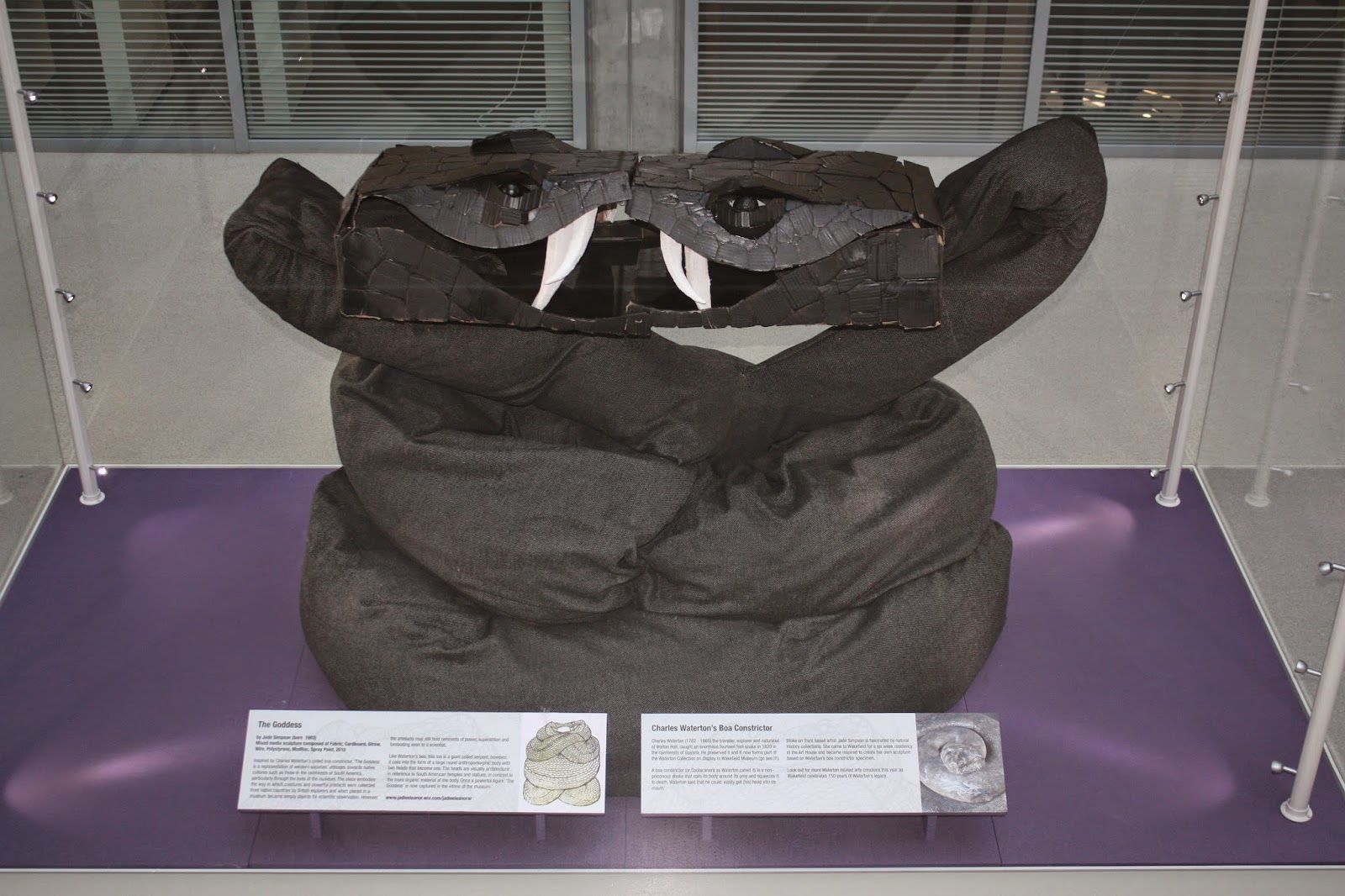
The Goddess - New installation at Wakefield Museum

The Goddess

A new atrium case display at Wakefield One

by Jade Simpson (born  1993)
Mixed media sculpture composed of Fabric, Cardboard, Straw, Wire, Polystyrene, ModRoc, Spray Paint, 2015

Inspired by Charles Waterton’s coiled boa constrictor, ‘The Goddess’ is a representation of western societies’ attitudes towards native cultures such as those in the rainforests of South America, particularly through the eyes of the museum. The piece embodies the way in which creatures and powerful artefacts were collected from native countries by British explorers and when placed in a museum became simply objects for scientific observation. However, the artefacts may still hold remnants of power, superstition and foreboding even to a scientist. 

Like Waterton’s boa, this too is a giant coiled serpent, however, it coils into the form of a large round anthropomorphic body with two heads that become one. The heads are visually architectural in reference to South American temples and statues, in contrast to the more organic material of the body. Once a powerful figure, ‘The Goddess’ is now captured in the vitrine of the museum.’

For more information about Jade and her work visit: jadieeleanor


 Charles Waterton’s Boa Constrictor


Charles Waterton (1782 - 1865) the traveller, explorer and naturalist of Walton Hall, caught an enormous fourteen foot snake in 1820 in the rainforests of Guyana. He preserved it and it now forms part of the Waterton Collection on display in Wakefield Museum (go see it!).

A boa constrictor (or Coulacanara as Waterton called it) is a non-poisonous snake that coils its body around its prey and squeezes it to death. Waterton said that he could ‘easily get (his) head into its mouth’.

Stoke on Trent based artist Jade Simpson is fascinated by natural History collections. She came to Wakefield for a six week residency at the Art House and became inspired to create her own sculpture based on Waterton’s boa constrictor specimen.

Look out for more Waterton related arty creations this year as Wakefield celebrates 150 years of Waterton’s legacy. 

Monday, January 5, 2015

Style Picks - last chance to see

Our stylish fashion exhibition closes at the end of January, so there is still time to catch it!


A magnificent celebration of our beautiful costume collections.

Four guest curators have raided Wakefield Museums’ wardrobe to create a rainbow of women’s wear trends, from 1730 to today.

In this colourful exhibition step into the pages of a glossy fashion magazine and enjoy stunning hats, shoes, dresses, accessories and corsets!

" Wow,  I love the Georgian shoes,  and the 20s dress, and the corset, and, and...!"

Plus:
Fabulous Fifties - a presentation from the amazing History Wardrobe.
28th January 6pm  - 7.30pm
Wakefield Museum (Learning Zone)
Free, but booking is essential as places are limited - call 01924 302700 or  email 

Detail from a 50s dress on display in Style Picks - on display until  31st January


Do you remember the Liberty bodice...? The reality of life for housewives in the 50s could be far from glamorous, but in this lively presentation we transform a domestic drudge into a domestic goddess.

This Cinderella transformation - inspired by Dior's New Look - is achieved with the help of bullet bras, sugared petticoats and sterling advice from the Experts... all set in the decade that reinvented dazzle.

Fabulous Fifties boasts a super array of original garments and accessories including French knickers, gym knickers (what colour were yours?) girdles, hats, bags, shoes, coats, cardigans and ridiculously pretty frocks.

Wednesday, December 31, 2014

George Kellett's World War One Diary: December 1918

Throughout 2014 have been tweeting entries from a World War 1 soldier’s 1918 diary. You can follow George Kellett’s diary entries on Twitter @WW1_Diary.

This is the last month's diary entries.

For George Kellett's November diary entries please see our previous blog: November 1918 


Sunday 1 December 1918
ED again today

Wednesday 4 December 1918
Left Malonne for Sclayn

Thursday 5 December 1918
Left Sclayn for Huy

Friday 6 December 1918
Left Huy for Ouffet  about 22 kilos

Saturday 7 December 1918
Left Ouffet for Soumagne about 23 kilos

Sunday 8 December 1918
Left  Soumagne at 9am for Becco about 8 or 9 kilos

Monday 9 December 1918
Left Becco for Longfaye a march of 23 miles

Tuesday 10 December 1918
No march today a day of resting

Wednesday 11 December 1918
Left Longfaye at 8am Elsenborn

Friday 13 December 1918
Left Kesternich for ?

Saturday 14 December 1918
Arrived at Duren

Tuesday 15 December 1918
Making bread sticks for the company.  Went down town after went in a cafĂ© for a supper where they had a violin and piano.  Had a good time.

Thursday 17 December 1918
Out for a short march from 10am to noon

Wednesday 25 December 1918
Had dinner in the gym a jolly good food.

Saturday 28 December 1918
No parade standing by to make Rifle Racks for the barracks

Sunday 29 December 1918
No parade again today but have not started work yet.  Went to church service in the town tonight with Cpt Palmer.

Thursday, December 25, 2014

The Twelve Days of Christmas

Merry Christmas!

Our Christmases, hectic though they may be, are actually a doddle compared to the traditions of old. Medieval people celebrated all 12 days of Christmas, from December 25 through to Epiphany – the day the three kings turned up with gifts for the newborn Jesus – although they did not usually feast every day. Some households had their big feast on Christmas Day. For others it was the first of January or the 6th, depending on local custom.

"The Twelve days of Christmas" song was first published in 1780,  without music.  The tune we all know coming much  later in 1909.

We have introduced 12 objects from our collections into Wakefield Museum's displays (please note, the museum is now closed until 9am on 5th January).


'A partridge in a pear tree'  - Partridge from natural history collection


"Two Turtle Doves" - Unmarked, Dunderdale stoneware teapot


"Three French hens" - Christmas card decorated with image of hen and roses.
"Four Collie Birds" - Blackbird from the Waterton Collection - the word 'collie' coming from collier, meaning black


"Five gold rings"- 500 year old ring with wording 'I'm all yours' in medieval French from Sandal Castle

"Six geese a-laying" - Painted wooden fan made with goose feathers

"Seven swans a-swimming" - Valentine card given to Frances Eliza Waddington c. 1880


"Eight maids a-milking" - Milk can produced 1910-15 with  J.C.B. trade mark

"Nine ladies dancing"  - Victorian lady's dance card and pencil made by Faber -  dated 24th February 1876

"Ten lords a-leaping" -   A ceramic bust of Lord Derby


"Eleven pipers piping"  - Wooden pipe with metal ring top and bottom


"Twelve Drummers Drumming" - Tin drum used by  Professor Stafford who taught Punch and Judy in the 1950s