Our July-September What's On guide is ready to download
Lots of activities, events and exhibitions for families and adults.
Click on the image below, or pop into one of our museums to pick up a copy!
Monday, June 13, 2016
Wednesday, May 18, 2016
Stories of Our Past
As part of Mental Health Awareness Week, we are very proud to be hosting an event run by the Mental Health Museum this Friday. We have asked Cara Sutherland, the curator of the MHM what the event is going to be all about...
Our collection is underpinned by peoples' stories and
although our objects can't actually talk, as in a Disney film (much to my
sadness), they do speak to us. They tell us of the places and times they were
part of, and just as much about the missing stories and hidden histories as
they do about the ones we know.
A perfect example of this is Mary Frances Heaton's
samplers. A fascinating jigsaw of symbols, stitched letters and fragments of a
broken heart. Her story is there, in the midst of our objects and the archives
from her time in the Asylum, but this jigsaw still needs to be pieced
together.
Local author David Scrimgeour has been piecing together and
meticulously transcribing the stories of patients like Mary over the last few
years. His book Proper People has recently been published and is a
fascinating insight into the people who are at the heart of the history of
mental health care. David's research has unearthed some of the Asylum's hidden
histories and has solved some of the MHM's mysteries. David has been part of
our wider responsibility to really look at our past to better understand our
future.
The
Stories of Our Past talk this Friday at 5pm is one not to be missed -
why? Because it brings together our past with our present. As part of Mental
Health Awareness week 2016, we will take a look at the stories of people who
experienced the Wakefield Asylum and how their stories can tell us more about
own lives and the society we live in today.
So
here's where I sell the event to you...
I’m
going to be honest with you and say that I love my job...a lot. Our collection
aims to tell the complex and fascinating story of mental health care in the UK
over the last 200 years and to use this story to combat stigma and prejudice
surrounding mental health. We see that as our shared responsibility.
Responsibility
is an interesting thing; it can be intimidating at times but ultimately it can
be empowering, especially when its shared. At the MHM, we have a duty of care
to the objects we have in our collection. We have a duty of care to the
memories and lived experiences of people who are still with us, as well as to
those who are now part of our history. We share this responsibility with the
people we engage.
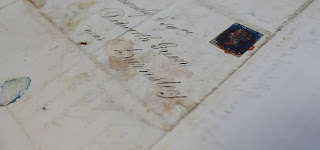
| Letter: This shows the front of a Reception Order which shows the way these documents were folded to create an envelope |
![]() |
|
Sampler:
A sampler by Mary Frances Heaton's who was a patient at the Wakefield Asylum
|
David will be sharing some of these stories with you and
talking about his experiences of researching the Wakefield Asylum archives. You
will hear more about Mary and get to know more about the MHM collection. We
would love for you to come along to this FREE talk and share in our
responsibility to better understand, protect and engage with our history.
![]() |
| David Scrimgeour, author of Proper People |
Join us Friday 20th 5pm-7pm at Wakefield One. Booking is recommended, but not essential. To book, call 01924 302700 or email.
Tuesday, May 10, 2016
Exciting news about Pontefract Museum
Pontefract
Museum is to undergo the final part of a £102,000 refurbishment programme -
which will enable it to display objects from national collections.
The second
phase of the work will see £52,000 invested in new displays themed around
medieval Pontefract, the story of liquorice and the Civil War.
The change will mean that the museum will be able to loan exhibits from national museums such as the British Museum.
Cllr Les
Shaw said: “The redevelopments taking place at the Museum are particularly
exciting as they will enable us to bring significant loans from national
museums such as the British Museum and The Royal Armouries to Pontefract for
the first time”.
Thursday, May 5, 2016
Spring Bank Holiday fun!
There is a lot going on over the Spring Bank Holiday.
Click on our planner below for highlights, or follow this link for the full museums listing.
![]() |
| Click on image to enlarge |
Friday, April 1, 2016
Historic Photo Prints available to buy
Did you know that copies of our photograph collection are available to buy?
![]() |
| Gilligan's Roundabout in Fryston c. 1950 |
You can order A4 printed copies for £7.50 (+ VAT), which can be collected from any of our museums. Alternatively, we can post them to you for £1.50 (+ VAT).
Our photographic collection is also available for commercial use. So
whether you would like to order a printed copy, or enquire about using our
images in a publication or on television, please get in touch by e-mail
or by phone on 01924 302104.
| Pontefract Fire Brigade outside their fire station (Now Pontefract Town Hall) c. 1920 |
To view our wonderful
historic photograph collection along with some of our other museum collections
visit our online collections site.
![]() |
| Royal Field Artillery, Yorkshire Brigade, on parade on Wood Street with the mayor of Wakefield, during WWI |
Wednesday, March 16, 2016
Museum Rainbow
Spring has sprung...making the world seem a more colourful place.
Taking inspiration from Twitter's #MuseumRainbow here is a colourful tour of our plastics collection
Red
A pair of candle holders made from high impact polystyrene.
Orange
An elephant shaped napkin ring from the 1940s, made from cast phenolic.
Yellow
A cruet set - salt, pepper and mustard from the 1950s/60s, made from phenol formaldehyde - Bakelite
Green
Salad servers from the 1970s, made from urea formaldehyde
Blue
A cheese dish , made from poly methyl methacrylate
Indigo
A set of dolls house furniture from the 1960s, made from cellulose acetate
Violet
An air freshener holder from 1960s, made from polythene
Richard Of York Gave Battle In Vain
You may remember this rhyme to remember the colours of the rainbow from school - this describes the outcome of the Battle of Wakefield in 1460 which took place at Sandal Castle. The duke of York lost his head in this battle.
Taking inspiration from Twitter's #MuseumRainbow here is a colourful tour of our plastics collection
Red
A pair of candle holders made from high impact polystyrene.
Orange
An elephant shaped napkin ring from the 1940s, made from cast phenolic.
Yellow
Green
Salad servers from the 1970s, made from urea formaldehyde
Blue
A cheese dish , made from poly methyl methacrylate
Indigo
A set of dolls house furniture from the 1960s, made from cellulose acetate
Violet
An air freshener holder from 1960s, made from polythene
Richard Of York Gave Battle In Vain
You may remember this rhyme to remember the colours of the rainbow from school - this describes the outcome of the Battle of Wakefield in 1460 which took place at Sandal Castle. The duke of York lost his head in this battle.
Wednesday, February 3, 2016
A remarkable woman: Stephanie Park
We have recently added a fantastic set of objects to our
collection related to the life of a remarkable local woman, the late Stephanie
Park.
Stephanie Park née Hopley (1940-2012) was a nurse and midwife from Wakefield, who became a disability pioneer when she had her left leg amputated following a car accident. Stephanie took up shooting, competing for Great Britain and winning many prizes. Later, she gave up much of her time to coaching others and helped to establish the disability advice telephone line, DIAL. She also served as secretary of the Yorkshire branch of the British Sports Association for the Disabled (now part of Activity Alliance / English Federation of Disability Sport).
After losing her leg, Stephanie took up sport, adopting shooting as her preferred discipline. This certificate below from the National Small Bore Rifle Association officially gave her permission to compete from her wheelchair.
Stephanie came first in her event at the Disability Air Rifle World Championships held at Appledoorn, the Netherlands in 1987. She received this Delftsche Huys beer stein as part of her prize:
Stephanie Park née Hopley (1940-2012) was a nurse and midwife from Wakefield, who became a disability pioneer when she had her left leg amputated following a car accident. Stephanie took up shooting, competing for Great Britain and winning many prizes. Later, she gave up much of her time to coaching others and helped to establish the disability advice telephone line, DIAL. She also served as secretary of the Yorkshire branch of the British Sports Association for the Disabled (now part of Activity Alliance / English Federation of Disability Sport).
We are very grateful to her proud son, Daniel, for kindly
donating his mother’s archive to us. Stephanie was an inspiration to Daniel,
who wanted to make sure that disabled women are represented in the museum’s
collection. This is just a selection of objects to give a flavour of the
collection and of Stephanie’s many achievements.
![]() |
| Stephanie qualified as a midwife in 1963. Her midwife's medallion was made by the jewellers Thomas Fattorini Ltd and features Juno Lucina, a Roman goddess of childbirth |
![]() |
|
|
![]() |
|
This brass chalice for first place was the first trophy Stephanie
won in her shooting career in 1985
|
Stephanie came first in her event at the Disability Air Rifle World Championships held at Appledoorn, the Netherlands in 1987. She received this Delftsche Huys beer stein as part of her prize:
This is a target shot from the National Small Bore Rifle Association Championship in Cardiff, 1989, where Stephanie Park won 1st place in the 10 metre air rifle event. At the Cardiff 1989 Open Shoot non-disabled and disabled athletes competed on an equal basis.Stephanie was very proud of this achievement, getting all 10 shots through the central ring. Her target shot is one of the 100 Objects in our 100 Years of Collecting Online Exhibition.
Stephanie also gave up her time to coach and support other disabled athletes and was an adviser to the Sport Aid Foundation. Many of the athletes she helped went on to compete in the London Paralympics of 2012.
This trophy was awarded posthumously as recognition for all Stephanie’s efforts for disability sport:
Subscribe to:
Posts (Atom)


