Thursday, September 10, 2020

Heritage Open Days: Behind the scenes at the museum store

The Wakefield Museums & Castles collection contains more than 111,000 objects that tell the story of our district from the distant past to the present day. Today, we can only display a small proportion of the collection at any one time. But even if they're not on show, all the objects are kept safe for future use. To celebrate Heritage Open Days 2020, we thought we'd give you a sneak peek behind the scenes at the museum store, sharing some highlights of the collection and how we care for them.


A century of collecting


Our collection has been in development for over a century and continues to grow today. The first museum in Pontefract was established by volunteers at Pontefract Castle in the 19th century. In Wakefield, Holmfield House in Clarence Park opened its doors as the city's first museum and art gallery in 1923. And by the 1930s, objects were also being collected in Castleford, originally by the local library. 

An advertisement for Pontefract's first museum in 1892
Pontefract's first museum opened at the castle on 29th April 1892 with 256 objects.

Younger and older visitors exploring a jam-packed exhibition of paintings and framed illustrations on the walls
Visitors enjoying an exhibition at Holmfield House, 1930s


In 2020, our social history and archaeology collections are a treasure trove of fascinating stories that form the basis of our main museum galleries, our special exhibitions, and many displays in our communities across the district. We regularly update our displays to showcase as many different objects as possible. Those that are not currently on display are looked after at the museum store.

From the very small...

A small wooden pig-shaped Stanhope viewer
This tiny pig shaped Stanhope viewer contains six early 20th century images of Castleford and measures just 16 x 21 x 10mm!

Demonstration of viewing the images in the pig Stanhope viewer


... to the very large! 

A bright red old fire engine inside the Museum Store
Dennis Big Four fire engine

The Dennis Fire Engine being used by the City of Wakefield fire brigade. The firefighters are in full protective equipment of the time, including gas masks.
The engine was used by the City of Wakefield fire bridge, 1935-1954, before being acquired by the museum in 1968.

And the very old...

An Ancient Egyptian clay mould in the shape of an eye
Ancient Egyptian clay mould for jewellery manufacture, c. 1200-1400 BC


... to the very new.
Child's bowl and cup set decorated with cartoon of Peppa Pig
Child's Peppa Pig bowl and cup set, 2018


All shapes and sizes


In the collections store, we organise objects according to a variety of criteria, including size, shape, material or theme. This makes the best use of our space, allows us to meet the varied conservation needs of different kinds of objects, and helps us to find things more easily. Our objects are packed using inert materials that won't cause their condition to deteriorate and will help protect them from dust and dirt, changes to the environment, or damage by movement and vibration.

Here's a whistle stop tour!

Rows and rows of boxed objects on shelves at the store
These archive boxes contain our photographic and ephemera (paper based) collections, organised by theme.

An open ephemera box showing old theatre programmes
Ephemera is kept flat in conservation grade polyester sleeves and supported by acid free cardboard.

Several old typewriters on shelves at the store
A selection of typewriters in one of our small social history aisles

Larger boxed objects on shelves at the store
Most small social history objects are wrapped in acid free tissue and boxed.

Plastic draws full of various objects in the plastics collection
These drawers contain some of our large plastics collection. Plastic requires specialised care and, unlike other objects, these need air circulation and so are not stored in sealed boxes. We store plastics according to their type (e.g. PVC) and they are supported on inert Plastazote. 


A series of old tennis rackets mounted on wire mesh
Storing suitable objects on wall mounted wire mesh allows us to save shelf space for bulkier items.

A series of walking sticks and canes mounted on wire mesh
More than you can shake a walking stick at


A series of large old tools mounted on wire mesh
The right tool for the job

Shelves full of items from our furniture collection at the store
Our large social history racking includes our furniture collection.

Shelves full of boxes at the store

Shelves full of archaeology collection boxes
Our archaeology aisles contain many thousands of finds from local excavations.

Shelves full of large archaeology and stonework pieces
Larger archaeology such as stonework is kept on wooden pallets on stronger shelving, which can support heavy objects. 

A case full of various-sized cannon balls
Like these cannon balls!


Hive of activity


As well as our weird and wonderful objects, there's often a few members of the collections team to be found at the store - our natural habitat! This is where we add new objects to the collection and prepare for exhibitions, amongst many other tasks.

Every object is given a unique identification number on our collections database. After a new acquisition has been accepted into the collection, we create a record that tells us what it is and what it looks like, how and when we acquired it, and what's special or interesting about it. During the object's lifetime in the collection, its record is updated to document when it is exhibited or used, any change in its condition or any conservation work, or if we find out any new information about it. 

Once we have catalogued the object, it will be marked with its unique number. We use materials that won't damage the object and write the label somewhere where we can find it but that won't be visible on display. All labelling is semi-permanent - we don't want the number to come off so that we can't match it to its record but we also don't want to permanently change the object's appearance.

Cataloguing kit, including the SHIC guide (social history & industrial classification), purple latex free gloves, a zip lock bag, pencil, and computer
Cataloguing kit


After labelling, the object goes for photography. Good images help us to identify objects in future and keep a track of their condition. It also means that we can share our collections online - whether in our searchable databases, on our social media, or here on this blog!

An object set up ready to be photographed
A new acquisition ready for its close up!


Finally, the object is carefully packed and put away, making sure to record the location on its catalogue record so that we can find it in future, for example if we want to include it in an exhibition.

When we're choosing objects for exhibitions, we need to check their condition to make sure that it won't cause them any damage. Sometimes, we need to send items for conservation before we can display them. 

We often use the space at store to practise our exhibition layouts and test what will fit in our cases and which arrangements look best. 

An array of Sykes and Slazenger objects

An array of diaries and handwritten notes


We hope you've enjoyed this special Heritage Open Days glimpse into our store. For more behind the scenes content and collections stories, stay tuned to the blog and our social media. 

And if this has whet your appetite, you'll find some of our collections available to browse online.


Visit our Heritage Open Days: Hidden Histories of Wakefield Museums & Castles page for more from our weird and wonderful collections and sites.

Friday, August 28, 2020

Oh I do like to be beside the seaside!

If you're hoping for some sunshine and planning on heading to the coast this bank holiday weekend, you're following in the footsteps of a long line of Brits. By the mid 20th century, more day trippers and holiday makers than ever before were flocking to Britain's beaches. The provision of public holidays and paid annual leave meant more people could treat themselves to a break. 


We've been looking through our collections for some inspiration for a bank holiday adventure.


Where to go


First things first, deciding where you want to visit! During the heyday of the great British seaside holiday in the mid 20th century, most people travelled by public transport. Employers and community groups often organised special excursions, whilst rail companies offered summer timetables with extra services to ferry workers to the coast. Tourist boards at seaside resorts often worked with the rail companies, running joint publicity campaigns to tempt travellers onto trains to the beach. They produced travel guides with information on train times, attractions and accommodation. 

Holiday Haunts brochure from 1958 by British Rail, showing people playing and enjoying the seaside
Resorts and hotels on the Yorkshire coast feature in this brochure by British Rail.

Poster of the Prince of Wales WMC Annual Children's outing to Scarborough, Sunday 19th June 1960.
Holmes Printers produced this poster advertising a train trip to the seaside from Pontefract.

Black and white photo of a row of buses waiting to take Fryston miners' families to the beach. Lots of people are waiting to get on.
Local amateur photographer, Jack Hulme captured this shot of buses taking Fryston miners' families to the beach.

The travel poster was the rail companies' primary marketing tool. They appointed top artists to produce eye-catching designs that showed off the seaside in all its splendour as a fun family day out. Their works are now considered iconic. Pontefract-born Charles Pears was one of the famous artists commissioned to paint packed piers and bustling beaches. 


Southend on Sea poster illustrated by Charles Pears, showing people enjoying the seaside
1934 poster design by Charles Pears
© TfL from the London Transport Museum collection, http://www.ltmuseum.co.uk 

You can see more poster designs by Charles Pears in our Art UK Curation - we celebrate his career by bringing together some of our favourite works from collections across the UK.

In honour of Pontefract's famous son, we commissioned graphic designer, Georgina Westley, to produce a modern travel poster for the town inspired by Charles Pears. See the poster and read about the design process in Georgina's recent guest blog post, Drawing Pontefract.


What to pack


So you've picked your preferred resort and booked your train tickets. It's time to pack those holiday essentials. You'll need your beachwear - perhaps inspired by the fashionable bathing belles adorning Pears' posters. By the 1950s, beach censors no longer policed the length of bathing suits. The modesty protecting skirts and long sleeves of the previous century had been replaced by halter fastenings, sweetheart necklines, dropped waists and figure flattering ruching.

A vintage red and grey swimming costume

Retro swim and beachwear from the 1950s-70s
Swim and beach wear, 1950s-1970s

Once you've selected your attire, don't forget your bucket and spade- and you'll want your camera for snapshots of your sandcastles!

Multicoloured rubber seaside buckets
Rubber seaside buckets, 1980s

A portable Brownie 127 Kodak camera
Brownie 127 camera, Kodak, 1950s

On the beach


Hopefully you can claim yourself a prime spot on the sand to lay out the picnic blanket and set up camp for the day, like the Gill family at Bridlington in the 1930s.

The Gill family enjoying the seaside, wearing smart clothes and covered up a lot more than we tend to be at the seaside these days!

Or perhaps you'd prefer to sunbathe on a deckchair like these 1950s holiday makers.

Rows of sunbathing beachgoers and people sat on deckchairs

Later on, you might go for a walk along the seashore...

Two women and a man linked arms walking along the beachfront, they are smartly dressed

... or even be brave enough to have a paddle!
A family in the sea with water up to their ankles, with their clothes hoisted up so they don't get wet

You should have plenty to write about in your postcards home.

A smartly-dressed woman wearing a headscarf writing a postcard on the beach

Before you leave


Make sure you take home a reminder of your trip with a souvenir or two from the seaside gift shops. 

Various trinkets and souvenirs from holidays in the past

In the mid 20th century, many tourists making their way back to the Five Towns from a trip to the coast may have had purchases in their suitcases that were closer to home than they realised. These mementos of Bridlington were actually made by Bagley and Co Ltd at their Knottingley glassworks.

A glass seashell souvenir made by BagleysA small glass vase souvenir made by Bagleys for Bridlington
Bagley's made similar souvenirs for several resorts, including this nautical novelty for Great Yarmouth. The floral design was hand painted. Why not have a go yourself with our latest Colour our Collections sheet?

A green glass boat souvenir from Great Yarmouth made by Bagleys

A stylised colouring sheet of the glass boat souvenir
Click here to download your colouring sheet


Let us know if you're going in search of the sea air over the long weekend. We'd love to know what you get up to- especially if you're inspired by any of our collections! 

Or if you're staying at home this bank holiday, why not pass the time with our digital jigsaw and enjoy Georgina's beautiful poster design.

Thursday, August 13, 2020

Drawing Pontefract

We are very pleased to share this special guest blog post by graphic designer, Georgina Westley about her recent exciting commission for Pontefract Museum.


www.georginawestley.co.uk


Georgina's stylised drawing of Pontefract centre

Back in 2019 I was commissioned to create a piece of travel poster art for the town of Pontefract. This artwork was to be part of an exhibition celebrating the local artist Charles Pears, who hailed from Pontefract. Charles (born 1873) was a British painter, illustrator and poster artist, who during his illustrious career created artwork for London Underground and British Railways.

Copies of Charles Pears' illustrated poster books
Charles Pears’ artwork of Paignton features in one of the books I use for inspiration and education.

The exhibition was planned to start in May 2020 but due to the Covid19 pandemic this exhibition has been postponed and the museum hope it will now take place in May 2021 (tbc). So to fill a little gap, those curating the show thought it might be interesting to give you a bit of an insight into who I am, why I was commissioned and how I go about creating this style of artwork.

A black and white photo of Georgina laughing

My name is Georgina Westley (born 1976) and I have been working as a graphic designer for many years, but it was about 7 years ago that I created my first travel poster. At the time I had been enjoying playing about with linocuts (mostly aeroplanes) and my sister-in-law Beth asked if I could create her some artwork of Emley Moor mast. I felt that a linocut print would look too heavy and I’d always admired the travel poster artwork of the 1920s/30s era so I decided to give it a go.

Beth posing with one of Georgina's artworks
My sister-in-law Beth with her framed artwork. What started as a quiet gift can now be found in many homes around the country.

Beth was really happy with it and passed on lots of positive feedback from her friends, who wanted to know if they could buy one. Around that time, my husband was made redundant, which - whilst horrid at the time - was the push I needed to get my artwork out there, seek new places to draw and begin selling online. I now have over 80 prints in my collection and an inexhaustible list of places and hobbies to get started on.

I love my job, so I was really honoured when Pontefract Museum got in touch to commission me to create a modern day travel poster to commemorate Charles Pears. My brother and his family live in Yorkshire - in fact they used to live in Pontefract - so even though I’m a *whispers* southerner, I am familiar with many of the beautiful towns and villages of Yorkshire.

The museum staff went on a recce for me and took a great selection of photos of the main square and I chose the photo below to form the basis of the artwork.
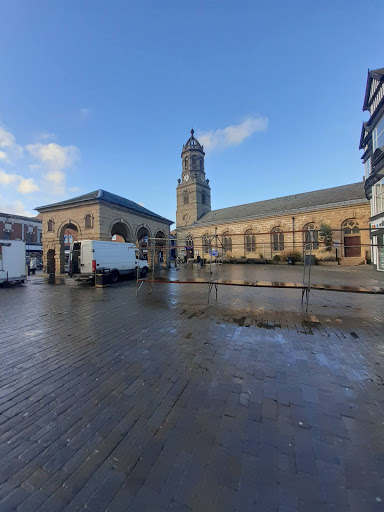
The market square at Pontefract
Great photo to work from but those empty market stalls will have to go.

I think it’s good to be able to see the original photo as it helps you see what I have left out, what I have put in, the colours I have changed, the exaggerated shadows, and where I have forced the perspective to make it as dynamic as possible. You will also notice the big fluffy cloud that I drew to lead the eye and mimic the angle of the church. However, my brother commented that due to the cooling towers at Ferrybridge there was often a big white cloud framing the town, so that was a nice bit of serendipity.

Georgina's finished artwork of Pontefract market square in the style of Charles Pears
The finished artwork

Working with Pontefract Museum was thoroughly enjoyable. They gave me such a good brief in the first place, I was able to pretty much hit the mark on the first proof. The only changes made after this stage was a lightening up of the cobbles to make it feel more positive, a few pesky pigeons and the addition of flags to introduce a bit of colour. I hope at least some of you noticed the liquorice colours I chose for those flags.

A framed version of the Pontefract artwork
Framed and ready to hang

I am looking forward to visiting the Charles Pears exhibition when it hopefully resumes and am hoping to come and give a little talk as part of the event so keep an eye out for that if you fancy hearing more. But for now, let me leave you with a few other pieces of artwork from Yorkshire - I’ve cropped them to make it a little harder.

Various stylised drawings of different landmarks in Yorkshire
The shapes and shades of Yorkshire. Do you know where these are?

For more information on my work, to buy prints or to contact me please visit:


Many thanks to Georgina for her post and the wonderful poster design. If you would like to find out more about Charles Pears and see some examples of his work, check out our online exhibition on Art UK Curations - we've brought together some of our favourite pieces from collections around the UK.