Showing posts sorted by relevance for query sykes. Sort by date Show all posts

Sunday, July 12, 2020

Making a Racket

On what should’ve been Wimbledon finals weekend, we thought it was the perfect time to serve up some aces from our Playmakers collection of locally made sports products. Did you know that many a Wimbledon legend’s racket was made in Horbury? Find out about our proud tradition of sports manufacturing and how local innovation made its mark on the courts of SW19.


Breaking into the game

In 1870 a saddler’s apprentice from Horbury risked all his life savings to buy his own business. It was a gamble that would pay off handsomely. After 10 years in saddlery, William Sykes turned his leather working skills to making footballs in the start of a venture that would see Sykes become chairman of a major international company, and turn Horbury into a centre of high tech, high quality sports manufacturing, home in its heyday to possibly the largest sports equipment factory in the world.

William Sykes Ltd soon expanded from football into other sports, beginning with cricket and tennis. In 1896, having outgrown his original premises, Sykes proudly opened the Yorkshire Athletic Manufactory. By 1903 the new factory’s production lines included 21 different models of racket.

Wooden tennis racket with a wooden grip, small racket head size and convex wedge
Handicap racket, William Sykes Ltd, c. 1880-1920. The wooden grip, small racket head size and convex wedge are characteristic of rackets from the turn of the century.

The star of the tennis range was the company’s premium racket, the EDB, named for and produced to the instructions of Ernest Douglas Black. Known as Edmund, Black had competed in Great Britain’s first ever Davis Cup tie, playing the competition founder, Dwight Davis of the USA, in Boston in 1900. The EDB was one of the earliest in a long line of Sykes products to be endorsed by elite sports people. Further tennis stars would follow suit in future.


Close-up of the 'EDB Special' emblem on the racket
EDB Special racket, William Sykes Ltd

Expansion 

Business continued to thrive after William Sykes Snr’s death in 1910, his two sons overseeing further expansion. In 1926 the company acquired the London-based tennis firm, Jefferies, extending their racket range further.


Wooden Raleigh Super Racket, with a rounded square racket head
Raleigh Super racket, late 1920s. This racket from shortly after the acquisition of Jefferies is marked with both companies’ names.

Advertising poster for 'Choose a Sykes Model', with images of the EDB, the Blue Riband, the Ruby and the Alpha rackets, and the taglines 'Senior Service' and 'Simply Splendid - none better'
Advertising poster for the William Sykes Ltd racket range. The company is now located in Horbury & London.

By 1933, as attendance at Wimbledon exceeded 200,000 and TV cameras were allowed at the All England Club for the first time, Sykes were able to meet rising demand from tennis fans with production now running to 50,000 rackets a year. With business booming, it was necessary to move into bigger premises again. Production at Albion Mill began in 1936 with an ever increasing range. In fact, Sykes supplied everything you needed for a match, from the balls to the net and posts.


Page from a catalogue advertising different types of tennis balls made by SykesPage from a catalogue listing different types of Tennis Posts made by Sykes


Rallying the troops

Only shortly after the publication of the summer 1939 catalogue, the outbreak of the Second World War in September disrupted Sykes’ production as the company turned almost all of its capacity to the war effort, its leather and woodworking expertise in particular proving vital. The 1000 strong workforce at Horbury produced a dizzying array of equipment from bayonets and ammunition boxes to sand goggles and skis. Among the many and varied products supplied to the War Office were snow shoes, made using the same steam bending technique as the wooden frame of a tennis racket.

A snowshoe made out of a wooden tennis racket
An example of a snow shoe

Sykes’ competitors, Slazenger, were also affected by the war, with their London based factories suffering serious bomb damage. In 1942 the two former rivals joined forces. The merger of Sykes and Slazenger married the massive manufacturing capacity at Horbury with Slazenger’s brand power, not least its long standing association with the Wimbledon championships. Although the first products made after the merger kept the Sykes logo, the Slazenger name soon took over. Shortly after the war, Slazenger moved all of its production to Yorkshire. Its long established and prestigious Challenge and Demon rackets were among the many ranges now made in Horbury. Indeed, the only Slazenger products not made at the factory were tennis balls, and these were produced down the road at Barnsley.


A Demon Slazenger racket, wooden and with white, gold and red detailing
Slazenger made Demon brand rackets from 1880 – 1966.

A wooden Slazenger challenge racket from around 1975
Slazenger Challenge, c. 1975


Innovation and domination


In 1959 Slazenger was bought by Dunlop. Throughout the 1960s, the vast majority of professional tennis players opted for Dunlop Slazenger rackets to propel them to top of their game.

Front page from the 1962 Dunlop Gazette, featuring a factory worker making rackets by hand
The June 1962 edition of the Dunlop Gazette staff magazine included an in-depth look at the Horbury factory.


By the 1970s though, sales of wooden rackets were in decline, with players favouring new, lightweight materials like aluminium and carbon fibre. In response, Dunlop turned to its new state of the art Research and Development Centre, opened in Horbury in 1978. Its team of expert engineers were tasked with revolutionising the tennis racket and re-establishing Dunlop as the go-to brand for amateurs and Wimbledon champions alike.

Their pioneering solution was an injection moulded racket using a material known as Grafil, a hard-wearing compound of graphite and nylon. Melted Grafil was injected into racket moulds around a metal core. The core had a lower melting point than Grafil and, once the outside frame was cooled and set, the metal was heated and melted out of the mould to leave behind a hollow frame.

The result was a racket that was both robust and lightweight - 50% stronger and 12% more powerful than traditional wooden frames. The Dunlop Max 200G was ground breaking. No surprise then that it received several prestigious engineering awards and attracted such giants of the game as Steffi Graf and Martina Navratilova. Graf played with the 200G when she won her first Grand Slam title at the French Open in 1987. In total she won 22 major singles titles and she is the only player to have achieved a calendar Golden Slam, winning all four major titles and an Olympic gold medal in the same year. Her triumphs kept the 200G in the news into the 1990s.

The pioneering Dunlop Max 200G racket, made out of Grafil. It is purple with green detailing, and the Dunlop logo on the strings
Dunlop Max 200G

In 1983, John McEnroe switched to the 200G. The racket’s association with his star quality saw sales rocket from 20,000 to 200,000. By 1988 there were no wooden rackets in use at Wimbledon.


I used to think that I might’ve been stringing one of John McEnroe’s rackets. I was so proud of that. It made Wimbledon exciting for me. When he used to smash his rackets, I would think of how much trouble had gone into making it!
Lynne Holroyd, former Slazenger employee


End of an era


After more than a century at the cutting edge of sports manufacturing, the Horbury factory finally closed its doors in 1986. Tennis racket production continued at new premises in Wakefield until 1992 when production moved abroad. Today, the Slazenger Sports Club is the surviving legacy of the company. Founded in 1950, the Sports and Social club became the hub of the Slazenger community. Mrs Slazenger officially opened the pavilion and sports ground, with the tennis courts being christened by none other than Fred Perry.

Fred Perry playing at Slazenger Sports and Social Club in front of a large crowd

Fred Perry signing autographs
Fred Perry playing at the Slazenger Sports and Social Club and signing autographs, 1950

Wednesday, July 21, 2021

“History opening up”: Transcribing the Sykes Visitor Book

In 2019, Wakefield Museums & Castles acquired a very special object: a Visitor Book from William Sykes Ltd in Horbury, Wakefield.

The woven front cover of the Sykes' visitor book. It has clearly been well used

William Sykes Ltd was a sporting goods manufacturer based in Horbury, Wakefield. In 1870, William Sykes used all his life savings to buy his own saddlery. After 10 years in business, he turned his leather working skills to making footballs and soon expanded into making goods for a wide range of different sports. William Sykes Ltd went from strength to strength and was soon selling equipment all over the world and supplying major tournaments like the FA Cup. William Sykes Ltd eventually merged with rival firms, Slazenger and Dunlop, but Horbury remained the centre of production until the factory’s closure in 1986. Find out more about William Sykes Ltd.

In 2021, Anne Dawson, one of our wonderful volunteers, took on the challenge of transcribing the Visitor Book and researching the names within it. After 6 weeks, and 12 pages, Anne shares what she has found so far…

Have you ever been asked to sign a Visitor Book?  Maybe you have been to another office for a meeting.  Perhaps it was that lovely little B&B where you flicked back a few pages to see what everyone else had written before adding your "great breakfast" to the comments section.

You probably didn't think that a hundred years later, someone would be trying to decipher your name and working out where you were from.

The Sykes Factory was a major manufacturer of leather footballs, expanding to golf and cricket and other sports - at one point making 21 models of tennis racket. During World War II, it switched production to the war effort. It merged with Slazenger it 1942 and in 1959 was bought by Dunlop. 

A winter sports advert for Sykes for the 1939-40 season, depicting some of the many pieces of sporting equipment made at the factory

When I started to look at the Visitor Book, which started in 1930, I expected to see a list of (indecipherable) names, their hometown and the odd comment.

What I found was a truly fascinating historical document.  The first thing that struck me was that people had come from all over the world - South Africa, Australia, Canada. There were place names which we don't use now, like Bombay and Malaya... And the people......

The names on the page became real living people again.  The first page dated 1931 has a visit from H.R.H. George, Duke of Kent.  But you sort of expect royalty to visit factories - there are often plaques to visits from Dukes and Princesses, so that wasn't unusual.

One page of the Sykes' visitor book full of people's names and signatures

Then names that I recognised started to appear. Len Hutton, who is described as one of the greatest cricketers of all time, and Dan Maskell, who I knew as a commentator, but he also played and coached tennis. Whole teams came to visit, including the Australian Rugby League Touring Club, Bristol City Football Club and the New Zealand Cricket team. Sometimes the visitors seem to have no connection to sports, such as a group from Castrop Rauxell, a mining town in Germany that was twinned with Wakefield in 1949.   

As well as signing their names, some visitors also made annotations in the book. Bob Andrews put an arrow up to the visitor above him with the words "what a great act to follow" – that previous visitor was Don Bradman, one of the most famous cricket batsman of his time. Sykes had a partnership with Bradman, who visited the factory in November 1934 and again in June 1948. They produced a ‘Don Bradman’ series of cricket bats and Bradman used a Sykes cricket bat to hit every one of his record achievements – something Sykes were keen to promote!

A double-page advert for Sykes' cricket equipment, featuring Don Bradman

I think what really made me feel I was looking at history though was the comment made on 10 August 1945, when Japan offered to surrender to the Allies during World War II. The comment reads: "10th August 1945!  What a day!... we are going to start business again. I was lucky enough to be here that day and I'll never forget it..."  Unfortunately in his excitement, his name is illegible.

Comments and notes left in the Sykes' visitor book in the 1930s and 40s

So next time you are asked to sign a Visitor Book, think of the person in the future trying to decipher your name and write legibly!

With thanks to Anne for all her hard work in transcribing the Visitor Book. If you're interested in volunteering with our collections, please get in touch with Leah Mellors, Collections & Exhibitions Manager, on lmellors@wakefield.gov.uk.

For more information on William Sykes Ltd, click here.

Tuesday, November 15, 2016

Playmakers

Playmakers exhibition runs , Wakefield Museum, 26th November 2016- 1st July 2017

Did you know that the football that won England the World Cup in 1966 was made in Horbury? Or that Steffi Graf and John McEnroe played their tennis with a state of the art Horbury-developed racket?


A Slazenger Challenge football for the 1966 World Cup and some of the tools used to make it
Dunlop Max 200G tennis racket used by Steffi Graf at Eastbourne in 1985
On loan from Jim Warner
 
For more than a century, Horbury was a centre of high tech, high quality sports manufacturing, home in its heyday to possibly the largest sports equipment factory in the world. Our upcoming exhibition at Wakefield Museum celebrates this important local industry. Playmakers will tell the story of how a local saddler’s apprentice became the chairman of a leading international company.


In 1870, William Sykes used all his life savings to buy his own saddlery. After 10 years in business, he turned his leather working skills to making footballs. The Victorian era was a golden age for sport with more and more people participating and professional governing bodies forming. Sykes was quick to tap into this captive market and expanded into making goods for a wide range of different sports. William Sykes Ltd went from strength to strength and was soon selling equipment all over the world and supplying major tournaments like the FA Cup.
Front cover of the House of Sykes, a promotional booklet produced to celebrate the company’s proud history
 
The William Sykes Ltd factory at Albion Mill, Horbury
William Sykes Ltd eventually merged with rival firms, Slazenger and Dunlop but Horbury remained the centre of production and innovation until the factory’s closure in 1986. In 1978 the Mayor of Wakefield opened a new Research and Development centre where many pioneering technologies and products were masterminded, including a new golf ball and revolutionary injection-moulded tennis racket.
To explore the full story, visit the Playmakers exhibition and follow our giant timeline charting all the key milestones in the history of William Sykes Ltd and Dunlop Slazenger. Along the way, you’ll see historic equipment and iconic products, and meet famous sports stars who used Horbury goods. You’ll also be able to try your hand at recreating a classic Sykes football and have the chance to live out your sporting dreams: why not don a 1966 England kit or dress up as John McEnroe and have your picture taken with your adoring fans? Don’t forget to share your snaps with us on Facebook and Twitter!
We’ve chosen a few star objects from the exhibition to whet your appetite. Visit Wakefield Museum from 26th November to see these and much more!
 
Bowls and carrying case, William Sykes Ltd, early 20th Century
 
Billiards balls, William Sykes Ltd, early 20th Century
 

Boxing gloves, William Sykes Ltd, 1930s
On loan from Miles Smith
Snow shoes for the military, Second World War
 

Don Bradman Autograph cricket bat, William Sykes Ltd/Slazenger, 1940s

Quiver of arrows, Slazenger, 1959
On loan from Roger Byard


Monday, May 10, 2021

New to our collection: First World War bandolier

We are always looking for objects with a strong local story to add to our collection. Although our museums have been sadly closed for most of the last year, behind the scenes we have still been busy acquiring exciting items. One recent addition is this top notch example of Horbury leatherwork from the First World War (1914 – 1918). It shows another way that the town contributed to the war effort.


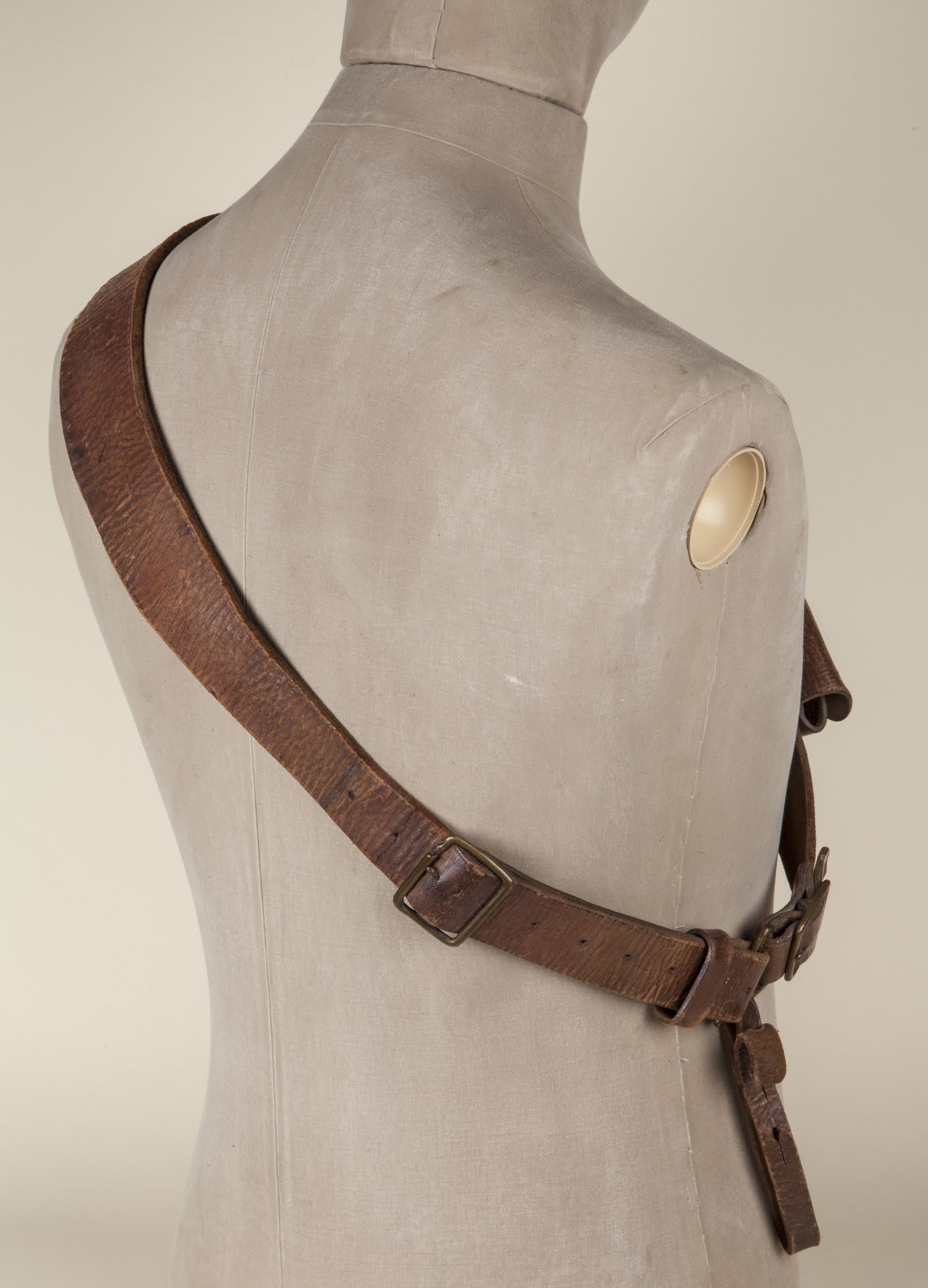
A leather bandolier on a mannequin. It is worn over one shoulder around the body.

Bandolier, 1916, made by William Sykes Ltd. in Horbury


A bandolier is an ammunition belt, worn by soldiers over the shoulder and across the chest to carry extra bullets. This example is composed of a leather strap with a buckle and has five rifle bullet pouches sewn into it. 

Back of the bandolier, demonstrating how the object is secured around the body like a belt
Side of the leather bandolier


It is a 1903 pattern used by British soldiers during the First World War.

3 soldiers wearing bandoliers. Two are seated, and one is stood. They are in full uniform.
Soldiers wearing bandoliers in the Queen's Own Yorkshire Dragoons. They are P.H. Charlesworth, A. Beilby and Mr Cooper, 1914 - 1918

A black and white photo of a soldier in the Royal Artillery wearing a bandolier and carrying a cane
Soldier in the Royal Artillery with a bandolier, 1914 - 1918

The bandolier is stamped with the name Sykes and the year 1916. Sykes refers to the local company, William Sykes Ltd. At the time, the company was on its way to becoming one of the largest sports manufacturers in the world. Skilled leather and wood workers made all manner of bats, balls, rackets, pads and gloves for every kind of player, amateur and professional, all from Sykes’ Yorkshire Athletic Manufactory in Horbury.

They also adapted their skills to make equipment for the military. As early as the Boer War (1899 – 1902), Sykes fulfilled orders for the War Office. As well as sports equipment for basic training, they made kit such as this bandolier and other leather strapping worn by soldiers.

By the Second World War (1939 - 1945), the Sykes workforce of a thousand local people produced an array of equipment, from bayonets and ammunition boxes to sand goggles and skis. The factory made over a million sets of wooden rifle furniture at a peak rate of 11,000 sets a week.

A sepia photograph of a dozen workers, male and female, making rifle furniture
A sepia photograph of several women seated making rifle furniture
Workers making rifle furniture at Sykes' Albion Mill in the Second World War

The bandolier is the first example of William Sykes Ltd's First World War work that we’ve ever seen and acquired. It will become part of our Playmakers collection, which represents and celebrates the incredible contribution to international sport made by skilled workers in Horbury from the late 1800s to late 1900s.  


The Playmakers logo


Sykes produced a vast range of goods for a huge variety of different sports. When the company later became part of the Dunlop Slazenger group, Horbury remained the centre of production and innovation. Thousands of people enjoyed playing sports using Horbury-made goods. Equipment developed locally starred on the world stage at major sporting events. Many elite sports people chose pioneering Horbury products to help propel them to the top of their game.


For more of our collections highlights, click here.


Thursday, August 14, 2025

Chloe: what I did on my work placement with Wakefield Museums and Castles

Chloe recently did a work placement with us as part of her university course. She's kindly written this guest blog about her experience. 

Read on to discover some of the interesting objects she catalogued for us!

During my work placement I was based in the museum store. I catalogued a small collection of items from the Sykes / Slazenger factory. The Sykes / Slazenger factory is mainly known for manufacturing sports items and equipment.

When I first started my work placement I was given a tour of the museum store. I was shown some of the objects and items they have and told about their significance. I was then shown the objects I would cataloguing throughout the eight weeks of my placement. I was also shown the history file. This contains everything needed to be kept with the collection, like the forms to say what needs to be catalogued or just used for reference. It also says how they got the items as well as the ownership of the items.

A table featuring a pile of photographs, photo album, racket head press, tennis racket and rifle furniture
The objects I catalogued

The items I was to catalogue were:

  • a pile of black and white photographs

  • a photo album with more black and white photographs

  • a head press (this was used to help make sure the tennis racket kept its shape)

  • a tennis racket with a head press

  • some rifle furniture (the wooden parts of a rifle) produced in the Sykes / Slazenger factory during the Second World War

The photographs

After looking through the objects, I decided I would start by cataloguing the black and white photographs. I started by putting the photographs into groups. I wanted to keep and catalogue the ones that were similar together.

A lot of the photographs were quite similar in nature. Cataloguing them was difficult, as it was hard to tell the difference between them.

Some of the photographs were pictures of some of the different manufacturing processes. These included how a tennis racket or a golf club was made. Others were of people using the machine, or just of the machines themselves.

This was very similar when I had catalogued the photo album. Some of the photographs were similar or the same to the ones I had already catalogued.

A man in an overcoat closely studying a golf club in the Sykes factory
 This photograph shows a man looking over a finished golf club. He is making sure that everything has been done correctly. He is also putting on the final touches to the golf club.

Cataloguing the 3D objects

Cataloguing the rifle parts, tennis racket, head presses and the film reel was different. These objects have depth, whereas the photographs do not.

When measuring the length of the objects, I had to use a tape measure. They were quite long and it would have been difficult to do so without. I also had to look closely at the objects to make sure the condition they were in was fine. 

I was also looking to see if there was anything that was engraved or marked on to the objects.

A vintage wooden racket with a head press attached
The racket, still in its head press

The Sykes factory started to manufacture the wooden rifle parts during the Second World War. They would have slowed down the manufacturing of the sports items they produced, along with some of the machines in the photographs.

Various parts to construct a rifle made out of smooth polished wood
Pieces of wooden rifle furniture made by Sykes

There were some books amongst the items within the collection I was able to use for referencing. This was useful as I was able to match the photographs to the pictures of the machines within the books. 

There were some small pieces of paper that also had the name and description of what the machine was used for and how it worked. I was able to match the pieces of paper to the photographs as some of the machines had their names engraved on the front.

A book titled Sykes and the War and a printed thesis
'Sykes and the War' and a thesis I used to research the objects

I had lastly catalogued some letters within the collection. They were in correspondence with the Sykes / Slazenger factory (more importantly the people within the factory). The majority of them had the dates in which they were sent. This made it easier for me to catalogue them in time order.

A lot of the letters were in response to Briggs receiving the British Empire Medal that was awarded by the King. This was due to his hard work in the war effort. Briggs sent letters back saying that it was a joint effort with the people he was working with and only done with the support of others.

This small collection I have catalogued is a part of a bigger collection Wakefield Museums and Castles has. There is loads more to find out about other sports items and equipment that were made at the factory. There's also lots to learn about the history behind the factory and how they stepped in to help with the war effort.

Tuesday, September 26, 2023

Wakefield's Sporting Heritage

When it comes to sporting heritage, Wakefield District has lots to celebrate… even more than you might think!

We've dug out some sporty showpieces from our collection, many of which also feature in our 100 Years of Collecting Online Exhibition.

We are Rugby League

The Wakefield district is often defined by Rugby League. It both unites and divides our communities.

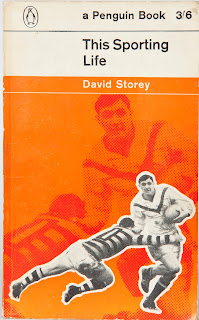
David Storey encapsulates this in his classic 1960 gritty northern novel, This Sporting Life:

Front cover of This Sporting Life, with a rugby player tackling an opponent
Our copy of This Sporting Life, on display at Wakefield Museum

The story follows a Wakefield Trinity player as he navigates his sporting career and his love life. In 1963 a film version starring Richard Harris was released to rave reviews. 

Belle Vue stadium features as a key location in the film and many residents remember being paid to attend as extras in the stands.

Most local people are close followers of one of the big three teams: Wakefield Trinity, Castleford Tigers and Featherstone Rovers. 

We have some fantastic objects telling the stories of the clubs, covering their historic victories and record-breaking achievements.

Iconic objects include this thick woollen jersey worn by Wakefield Trinity’s Harper Oliver Hamshaw way back in the 1880s: 

A thick woollen button-up jersey, navy blue with a red horizontal stripe across the chest and the arms.
Harper Oliver Hamshaw's rugby jersey

This was a time when Trinity shaped the creation of professional rugby league by paying their star player, three-quarter back, Edward ‘Teddy’ Bartram, a salary of £52. This made him the first professional rugby league player.

Professional sport would be nothing without the supporters! 

Telling local fans' stories is just as important as that of the players. This rosette was proudly worn by a Featherstone Rovers supporter when Fev reached the Rugby League Challenge Cup Final in 1974:

A blue and white rosette with 'Featherstone R', 'Wembley' and a picture of the trophy on it
A fan's Featherstone Rovers rosette from the 1974 Rugby League Challenge Cup Final


Local players didn't only capture hearts and minds - they smashed records. 

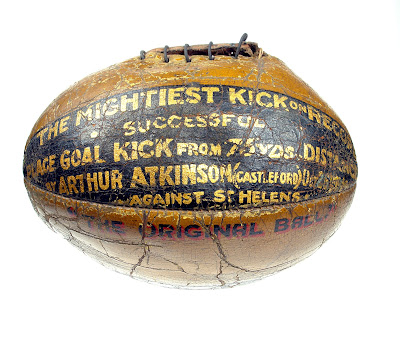
This rugby ball was used by Arthur ‘Brus’ Atkinson to make a record goal kick of 75 yards in Castleford's victory against St. Helens, on 26 October 1929. 

The record still stands 94 years later!

An old hand-stitched rugby ball with the details of Atkinson's achievement written on it
Arthur Atkinson's record-breaking rugby ball


But - it's not just rugby league Wakefield makes waves in!


Super Sharp Shooter: Stephanie Park

Stephanie Park nee Hopley (1940-2012) was a nurse and midwife in Wakefield. After losing a leg following an accident, she took up competitive shooting. Stephanie went on to become the World Disabled Champion in target shooting in 1987 and the winner of the Cardiff Open Shoot in 1989. This was the first sports event in which disabled and non-disabled competitors took part equally. 

She was also a world champion athlete in field sports and archery.

Stephanie in action, aiming her rifle while in her wheelchair. She has short, dark curly hair and is wearing a leather jacket and jeans.
Stephanie in action

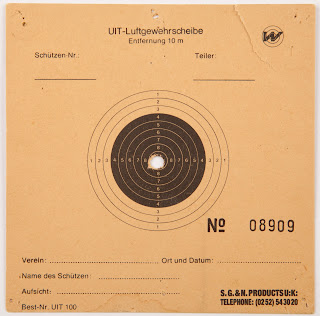
She hit all 10 shots through the central ring of this target shot at the 1989 National Small Bore Rifle Association Championship, and rightfully kept it as a souvenir! It features in our 100 Years of Collecting Online Exhibition:

A square cardboard target shot with all 10 shots through the central ring
Stephanie's keepsake target shot from the 1989 National Small Bore Rifle Association Championship 

Stephanie was also a disability rights campaigner and community leader. Her proud son Daniel kindly donated her archive to our collection in 2014.

Click here to read more about Stephanie's incredible life and career. 


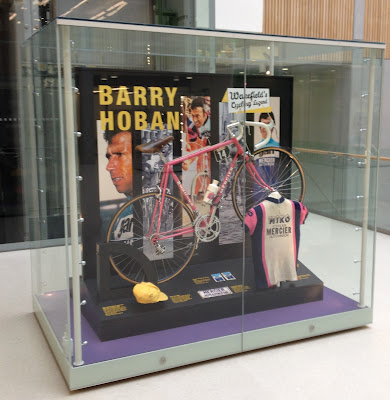
Tour de Force: Barry Hoban

Barry Hoban is a former professional cyclist from Wakefield who rode during the late 1960s and early 1970s. 

He holds the record for the most Tour de Frances completed by a British rider – having finished 11 of the 12 he started between 1965 and 1978. 

He was also the first Briton to win two consecutive stages of the Tour, a feat not matched until 2008!


Square glass display case featuring photos and objects relating to Barry Hoban's career, including a pink road bike and pink, white and blue jersey
A display from 2014 showcasing Barry Hoban, featuring one of his bikes and jerseys

A Supporting Role: Sykes & Slazenger

As well as our sporting stars and top teams, Wakefield District has a very proud heritage of sports manufacturing.

In 1870 a saddler’s apprentice from Horbury founded William Sykes Ltd. Soon he was the chairman of a thriving international business. Sykes produced equipment for a huge variety of sports, from billiards to boxing, crown green bowling to croquet. 

Advertising poster for 'Choose a Sykes Model', with images of the EDB, the Blue Riband, the Ruby and the Alpha rackets, and the taglines 'Senior Service' and 'Simply Splendid - none better'
A vintage Sykes advert from the 1930s

Sykes eventually became part of the Dunlop Slazenger empire, pioneering ground breaking new products and technologies. For more than a century, Horbury was a centre of excellence and innovation in sports production, supplying top competitions like the FA Cup and Challenge Cup.

When Australian legend Don Bradman maintained a test cricket batting average of 99.9 over his career (1928 – 1948), he did so using cricket bats made in Horbury. The Don Bradman endorsed signature cricket bat became a very popular and long running brand of bat for Sykes, and continued after the company merged with Slazenger:

Old wooden cricket bat, engraved with 'Sykes, Don Bradman - Autograph' and Bradman's signature
A Don Bradman signature cricket bat


When England won the World Cup in 1966, they did so kicking a ball made here in Horbury. We've got one of the footballs made for the Final on display at Wakefield Museum:

Bright orange hand-stitched Slazenger Challenge 4-Star football
One of the Slazenger 4-Star Challenge footballs made for the 1966 World Cup

In 1988 German Tennis ace Steffi Graf became the first (and still only) player to win a Golden Grand Slam (she won each of the four Grand Slam tournaments and an Olympic Gold medal all in one year). 

She did so using a tennis racket designed and made in Horbury - The Dunlop 200G Max:

A purple tennis racket with green and brown details and the Dunlop logo
A Dunlop 200G Max racket, the type used by Steffi Graf to win her Golden Slam

So, yes - we're pretty proud of our sporting heritage!

Find out more:

 
Staff Pick - Wakefield Trinity and Me