Wednesday, August 18, 2021

Sandal Castle: From noble beginnings to picturesque ruins

In recent years, over £700,000 has been invested in Sandal Castle as part of a project to share and preserve its fascinating heritage for current and future visitors. Essential conservation work on the ruins has helped to stabilise the stonework and protect it from the elements, whilst maintenance on the wooden walkways and bridges has improved access. Last year, we also installed new interpretation panels. Vibrant illustrations commissioned from Yorkshire based artists bring the castle's turbulent past and picturesque present to life. 


Visitors at Sandal Castle standing in the archways waving to each other


A brief history by Nick Ellwood

An illustrated information panel at Sandal Castle


First built in the early 12th century, Sandal Castle has a long history. Award-winning York based illustrator, Nick Ellwood, introduces the key eras in this comic book style panel. The artwork takes us from noble beginnings under the de Warenne family, when the castle developed from a wooden motte and bailey style to a stone keep and courtyard design; through trouble in both the Wars of the Roses and the English Civil Wars; to a space for exploring and relaxing today. 

Nick's other work can be seen in newspapers, on book jackets and across the museum and heritage sector. In his work Nick celebrates and explores both stories from today and from the past, observing and questioning people’s behaviour, actions, characteristics and quirks. Clients include The Guardian, English Heritage, Random House Publishing, The National Coal Mining Museum England, The Thackray Medical Museum Leeds, Arts Council England and the BBC.  Nick currently teaches illustration at York St John University and regularly exhibits across the UK.
www.nickellwood.co.uk


The Battle of Wakefield by Tomekah George

An illustrated information panel about the Battle of Wakefield

This board looks out towards the scene of the Battle of Wakefield, a crucial part of the War of the Roses. Whilst today the scene is peaceful, on 30th December 1460, this was the site of a brutal battle in which Richard Duke of York was defeated and killed by the Lancastrians. Illustrator, designer and animator Tomekah George has captured the carnage of the battle.

Tomekah specialises in bold collage and colourful illustration. She creates content for clients all over the world, from the USA to London, Manchester and more. Since graduating from an illustration degree in 2018, she’s worked on books, animations, digital illustrations and products, as well as being shortlisted in nationwide competitions and regularly taking part in exhibitions. She’s particularly interested in working on stories that promote a positive message or draw attention to sensitive topics such as inequality and representation, an interest that develops from a working-class upbringing, which influences her style and approach. Her work is emotive, colourful & warm at heart.


A day in the life of a medieval castle by Liz Kay

An illustrated information panel at Sandal Castle

In the early 1480s, Richard III ordered improvement work at Sandal Castle to make it more comfortable and defensible as a permanent base in the north of England. This was a rare period of investment in the castle, which was largely left to decline from the mid 14th century. Liz Kay's illustration depicts the castle in 1485 after the improvements were completed. It offers visitors a glimpse into the bustling castle courtyard, kitchens, gatehouse and Great Hall. 

An artist's interpretation of daily life at Sandal Castle in its heyday. The Great Hall, the Gatehouse and the Barbican are highlighted, and the courtyard is full of people and horses.
Liz Kay has been working for over ten years as an illustrator whose work has been used across children’s books, murals, maps, animation, magazines & newspapers. Liz lives and works in Wakefield, and loves to work on projects that involve aspects of her hometown. This project to show a snapshot of Sandal Castle in 1485 allowed her to explore her interest in the everyday lives of people throughout history and incorporate her passion for maps, architecture, calligraphy and period costume.  


A castle in ruins by Richard Bell

An illustrated information panel in front of part of the ruin of Sandal Castle

From October 1645, having been besieged three times during the English Civil Wars, Sandal Castle lay in ruins. Over the centuries, it became a place to take in spectacular panoramic views over the Calder Valley and towards Wakefield city centre. The castle has been excavated by archaeologists several times since 1893. Natural history illustrator, Richard Bell, here turns his hand to depicting the castle ruins as we can enjoy them today and gives a taste of what the different remains would have looked like in their heyday. The panel also highlights some of the key archaeological discoveries.

A drawing of the keep of Sandal Castle at its peak.
The Keep would once have stood four storeys high.

Drawings of small, cylindrical ointment pots
The discovery of ointment pots suggests that the kitchen was used as a field hospital during the English Civil Wars.

Richard Bell studied natural history illustration at the Royal College of Art. He writes a nature diary for The Dalesman magazine and his local publications include Walks in Robin Hood’s Yorkshire, All Sorts of Walks in Liquorice Country and a guide to Sandal Castle. His work features in the permanent collections of The Hepworth Wakefield and The National Coal Mining Museum for England.


See for yourself

Visitors to Sandal Castle on a sunny day


If you live locally and would like to see the fabulous illustrations in person and tread in the footsteps of kings, you can find the latest visitor information for Sandal Castle at Experience Wakefield.

Wednesday, July 21, 2021

“History opening up”: Transcribing the Sykes Visitor Book

In 2019, Wakefield Museums & Castles acquired a very special object: a Visitor Book from William Sykes Ltd in Horbury, Wakefield.

The woven front cover of the Sykes' visitor book. It has clearly been well used

William Sykes Ltd was a sporting goods manufacturer based in Horbury, Wakefield. In 1870, William Sykes used all his life savings to buy his own saddlery. After 10 years in business, he turned his leather working skills to making footballs and soon expanded into making goods for a wide range of different sports. William Sykes Ltd went from strength to strength and was soon selling equipment all over the world and supplying major tournaments like the FA Cup. William Sykes Ltd eventually merged with rival firms, Slazenger and Dunlop, but Horbury remained the centre of production until the factory’s closure in 1986. Find out more about William Sykes Ltd.

In 2021, Anne Dawson, one of our wonderful volunteers, took on the challenge of transcribing the Visitor Book and researching the names within it. After 6 weeks, and 12 pages, Anne shares what she has found so far…

Have you ever been asked to sign a Visitor Book?  Maybe you have been to another office for a meeting.  Perhaps it was that lovely little B&B where you flicked back a few pages to see what everyone else had written before adding your "great breakfast" to the comments section.

You probably didn't think that a hundred years later, someone would be trying to decipher your name and working out where you were from.

The Sykes Factory was a major manufacturer of leather footballs, expanding to golf and cricket and other sports - at one point making 21 models of tennis racket. During World War II, it switched production to the war effort. It merged with Slazenger it 1942 and in 1959 was bought by Dunlop. 

A winter sports advert for Sykes for the 1939-40 season, depicting some of the many pieces of sporting equipment made at the factory

When I started to look at the Visitor Book, which started in 1930, I expected to see a list of (indecipherable) names, their hometown and the odd comment.

What I found was a truly fascinating historical document.  The first thing that struck me was that people had come from all over the world - South Africa, Australia, Canada. There were place names which we don't use now, like Bombay and Malaya... And the people......

The names on the page became real living people again.  The first page dated 1931 has a visit from H.R.H. George, Duke of Kent.  But you sort of expect royalty to visit factories - there are often plaques to visits from Dukes and Princesses, so that wasn't unusual.

One page of the Sykes' visitor book full of people's names and signatures

Then names that I recognised started to appear. Len Hutton, who is described as one of the greatest cricketers of all time, and Dan Maskell, who I knew as a commentator, but he also played and coached tennis. Whole teams came to visit, including the Australian Rugby League Touring Club, Bristol City Football Club and the New Zealand Cricket team. Sometimes the visitors seem to have no connection to sports, such as a group from Castrop Rauxell, a mining town in Germany that was twinned with Wakefield in 1949.   

As well as signing their names, some visitors also made annotations in the book. Bob Andrews put an arrow up to the visitor above him with the words "what a great act to follow" – that previous visitor was Don Bradman, one of the most famous cricket batsman of his time. Sykes had a partnership with Bradman, who visited the factory in November 1934 and again in June 1948. They produced a ‘Don Bradman’ series of cricket bats and Bradman used a Sykes cricket bat to hit every one of his record achievements – something Sykes were keen to promote!

A double-page advert for Sykes' cricket equipment, featuring Don Bradman

I think what really made me feel I was looking at history though was the comment made on 10 August 1945, when Japan offered to surrender to the Allies during World War II. The comment reads: "10th August 1945!  What a day!... we are going to start business again. I was lucky enough to be here that day and I'll never forget it..."  Unfortunately in his excitement, his name is illegible.

Comments and notes left in the Sykes' visitor book in the 1930s and 40s

So next time you are asked to sign a Visitor Book, think of the person in the future trying to decipher your name and write legibly!

With thanks to Anne for all her hard work in transcribing the Visitor Book. If you're interested in volunteering with our collections, please get in touch with Leah Mellors, Collections & Exhibitions Manager, on lmellors@wakefield.gov.uk.

For more information on William Sykes Ltd, click here.

Tuesday, July 20, 2021

Volunteer with us!

Our volunteers are vital in supporting our work. We have a range of exciting opportunities for you to get involved, both with the public and behind the scenes.

All our opportunities have flexible commitment requirements and aim to provide a rewarding and enriching experience.

If you're passionate about culture and heritage and have some free time to offer, why not volunteer with us and be part of something extraordinary? Take a look at our current opportunities:


Collections Move Volunteer

We are looking for volunteers to
assist us with a large-scale project to move our collections into a new storage facility. 

The project will involve helping our team to carefully pack objects, move them to the new extension, and keep accurate records of movement, ensuring that all objects remain safe at all times. 

This is an exciting opportunity to work within a friendly and supportive team on a major project, getting hands-on with a variety of objects and contributing to the important behind-the-scenes work of our museum service.

This opportunity is based at our museum store in Ossett. The museum store is a COVID-secure site. 

For more information about this opportunity, please email Leah Mellors, Collections & Exhibitions Manager, on lmellors@wakefield.gov.uk.  


Exhibition Invigilation Volunteer

We are looking for Exhibition Invigilation Volunteers to invigilate ‘Bracing Air, Abundant Amusements: The Travel Posters of Charles Pears’, our new exhibition at Pontefract Museum. 

You will welcome visitors to the exhibition space, provide information about the objects on display, and help our Visitor Experience Assistants to monitor the security of the exhibition, which includes a number of loaned objects from national museums. You will help us to ensure that every visitor to the exhibition feels welcome, learns something new, and has an enjoyable visit.

This opportunity is based at Pontefract Museum, 5 Salter Row, Pontefract, WF8 1BA. Pontefract Museum is a COVID-secure site. 

For more information about this opportunity, please email Leah Mellors, Collections & Exhibitions Manager, on lmellors@wakefield.gov.uk.  

Charles Pears exhibition, with thank to the Royal Society of Marine Artists


Thursday, July 8, 2021

We’re recruiting! Could you be our new Learning Officer?

Are you passionate about culture and heritage?
Can you develop and deliver engaging stories using museum objects?
Would you like to create memorable experiences and learning opportunities for all ages?

If so, then this job may be for you.


We are looking for a dynamic individual to develop, embed and expand our Learning and Engagement offer within the operations of Wakefield Museums and Castles. As one of two Learning Officers, you will be working across both formal and informal learning. The role will see you taking the lead on co-ordinating the informal learning offer, including families, adults, reminiscence and the Early Years programme. 


We would welcome applications from people with experience in developing, organising, delivering and evaluating learning content. The role requires you to research and create innovative, participatory learning and engagement opportunities across our sites and in the wider community.  

The Learning Officer will play an essential part in engaging and connecting people of all ages with the varied and fascinating heritage of the Wakefield district, drawing on our diverse collections.


The closing date for applications is Friday 30th July 2021 (Midnight)

Interviews will be held on Thursday 19th & Friday 20th August 2021


Should you wish to discuss this post, please contact Louise Bragan, Senior Officer: Programming and Learning

lbragan@wakefield.gov.uk


Thursday, June 3, 2021

Bracing Air, Abundant Amusements: The Travel Posters of Charles Pears

Blog post from 2021. This exhibition has now closed, however there are lots of lovely photos and information about Charles Pears in this post!

We are very excited that Pontefract Museum has now reopened with a major new exhibition of artwork by Pontefract-born artist, Charles Pears (1873-1958). Bracing Air, Abundant Amusements: The Travel Posters of Charles Pears is the first retrospective of Pears’ work in his hometown. The exhibition focuses particularly on his prolific career as a commercial artist and will transport you back 100 years to the golden age of rail tourism, the British seaside holiday and poster design. 


National and leading art collections have kindly lent posters and original artworks to the show, including some that might even have been seen on platforms at Pontefract’s three rail stations in the 1930s. The exhibition also includes expert commentary from a leading authority on 20th century posters, as well as an exclusive new poster artwork for Pontefract. 


A marine master


The exhibition takes its title from the slogan of a poster promoting the 'Bracing Air' and 'Abundant Amusements' that holiday-makers and day-trippers could look forward to in Southend-on-Sea in 1927. Pears provided the artwork for the poster, showing yachts on the Essex waters. He was an enthusiastic sailor himself and had established a reputation as a leading marine artist, having served as an official Naval war artist during the First World War. 

Pears would go on to capture the Second World War on canvas too and later became the first president of the Royal Society of Marine Artists. He eventually retired to spend more time at sea and settled in Cornwall, where he painted his self-portrait, kindly lent to the exhibition from the Russell-Cotes Art Gallery and Museum, Bournemouth. It is the first time it has been exhibited in Pears' hometown, where he had first honed his artistic talent whilst growing up.

A self-portrait of Charles Pears out in a boat, wearing a captain's hat and smoking a pipe. He is an older, white gentleman.
Self portrait, 1944-46 by Charles Pears (1873-1958)
PHOTOGRAPH REPRODUCED WITH THE KIND PERMISSION OF THE RUSSELL-COTES ART GALLERY & MUSEUM, BOURNEMOUTH


Poster perfect


Pears went to school in East Hardwick and attended Pontefract College. As a young man, he moved to London and began his career as a cartoonist and illustrator, becoming a regular contributor to Punch and illustrating famous titles by authors like Lewis Carroll and Charles Dickens. 

A display case full of books illustrated by Charles Pears
Pears-illustrated books from the Wakefield Museums & Castles collection on display in the exhibition

An iconic illustration of the Mad Hatter's Tea Party from Alice and Wonderland drawn by Pears
Illustration in a 1907 edition of Alice in Wonderland, from the Wakefield Museums & Castles collection

In the 1920s and 1930s Pears perfected his trade as one of the travel industry’s go-to poster artists and enjoyed a successful commercial career. At this time, new public holidays and paid annual leave meant that people were enjoying more leisure time and heading off on holidays and day-trips. 

Most holiday-makers at the time travelled by train, taking advantage of summer timetables and special fares. In only the early days of radio and before television, the poster was the most effective means of mass communication and became the rail companies’ primary marketing tool. They turned to leading artists like Pears to produce the most appealing representations of resorts.

Bracing Air, Abundant Amusements includes many examples of Pears' most vibrant posters, alongside some of the original artworks. 

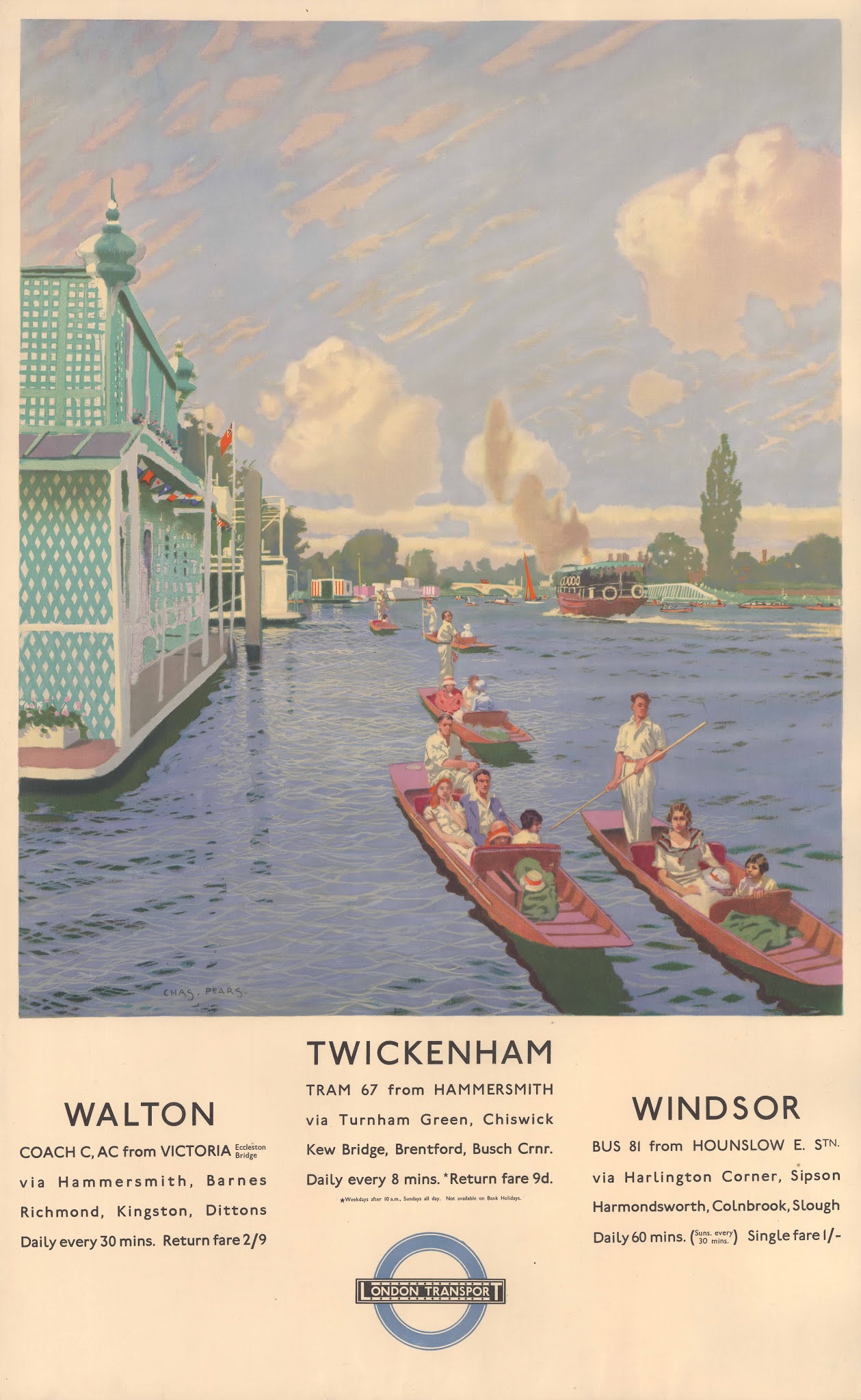
A poster for Twickenham, Walton and Windsor, showing people punting on the river

Twickenham, Walton and Windsor, Charles Pears, 1935

© TfL from the London Transport Museum collection

http://www.ltmuseum.co.uk/


The exhibition at Pontefract Museum
Spring on the River Thames, the original artwork for the poster, is on show in the exhibition.

Pick of the painters


It was Frank Pick, the Publicity Manager at London Underground, who initially recognised the potential of the travel poster. Pears was one of the first artists Pick worked with on an initiative to promote travel by public transport in leisure time as well as for commuting. As a marine specialist, Pears’ posters often promoted daytrips away from the hustle and bustle of the city along the picturesque banks of the River Thames. 

Between the wars, London Transport also ran special excursion services to Southend, the nearest beach resort to the capital. Pears produced no fewer than 14 different poster artworks for Southend, showing boats on the waves, water sports, local landmarks and all the attractions on offer. Visitors can see two examples in the exhibition, including the original oil painting for this sun-soaked scene.

Pears' illustrated poster for Southend on Sea, showing people playing in the sea in 1930s bathing costumes

Southend-on-Sea, Charles Pears, 1934

© TfL from the London Transport Museum collection

http://www.ltmuseum.co.uk/


Inspired by Frank Pick’s successful poster campaigns in London, railway companies also began to invest in the best artists for their adverts. After Britain’s many individual rail lines were grouped into the ‘Big Four’ in 1923, the newly formed regional companies each established advertising departments. They were competing with each other to attract tourists to the resorts on their lines, and only the most persuasive artworks would do. As an expert sailor and marine artist, Charles Pears was in high demand to provide seascapes that would tempt holiday-makers to the coast. 

This relaxing representation of Filey must have been an appealing image for passengers at Pontefract, which was served by LNER at the time. For the price of a rail ticket, they could escape the daily grind and get away from it at all on the East Coast. 

Pears' illustration of a young woman relaxing on the coast at Filey

Poster, LNER 'Filey for the Family' by Charles Pears, 1930

Science Museum Group

© The Board of Trustees of the Science Museum


A fun family day out


Certainly, at this time more people than ever before were flocking to the seaside with their buckets and spades. Families made sandcastles, wrote postcards and returned home with plenty of snapshots and souvenirs. As well as admiring Pears' posters, visitors to Pontefract Museum can also enjoy a trip down memory lane with retro holiday essentials and mid-century beach attire from the Wakefield Museums & Castles collection.

Retro bucket and spade, postcards and camera

Retro swim and beachwear

Elsewhere in the museum, you can admire even more of Charles Pears' skill and artistry. He enjoyed a prolific career and we weren't able to display all of his many designs in the exhibition but our slideshow includes posters for destinations all over the country and beyond. 

Inspired by Pears' example, graphic designer Georgina Westley has created a stunning new poster artwork for Pontefract. Adding a modern twist to Pears' style, she has produced a colourful celebration of his hometown today. Visit the exhibition to see the iconic view of the Buttercross and St Giles' Church in a new light!

There's also plenty for little ones to enjoy. Look out for the special family-friendly object labels and pick up your Take and Make activity bag, packed with seaside themed crafts inspired by the posters on display. 


Bracing Air, Abundant Amusements: The Travel Posters of Charles Pears is at Pontefract Museum, 24th May 2021 – 25th February 2022. 


The exhibition was made possible with a grant from the Weston Loan Programme with Art Fund.


To enjoy more of Charles Pears' work, check out our Curation on ArtUK for an overview of his celebrated career. 

Read more about Georgina Westley's poster in this special guest blog post

Monday, May 10, 2021

New to our collection: First World War bandolier

We are always looking for objects with a strong local story to add to our collection. Although our museums have been sadly closed for most of the last year, behind the scenes we have still been busy acquiring exciting items. One recent addition is this top notch example of Horbury leatherwork from the First World War (1914 – 1918). It shows another way that the town contributed to the war effort.


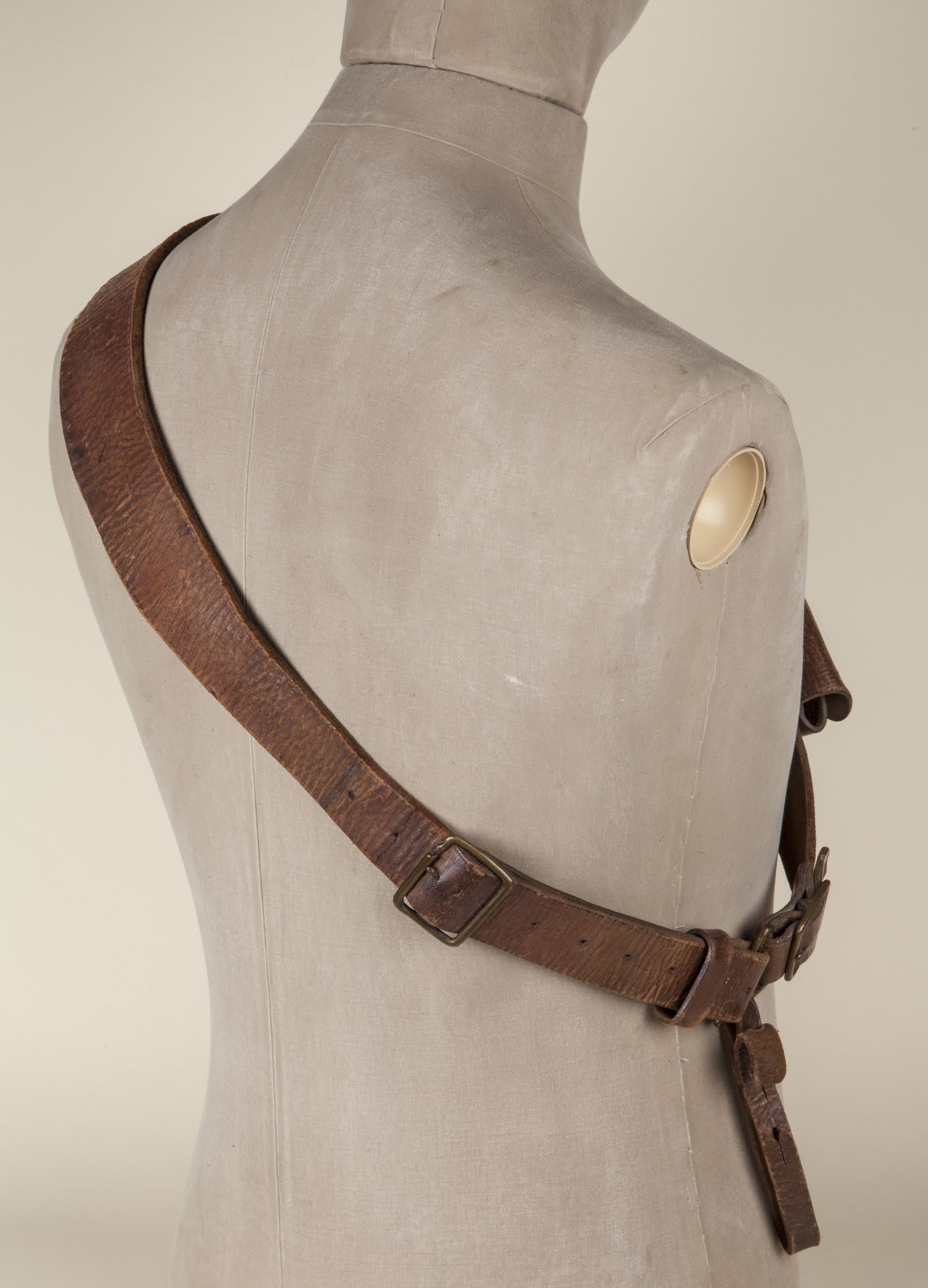
A leather bandolier on a mannequin. It is worn over one shoulder around the body.

Bandolier, 1916, made by William Sykes Ltd. in Horbury


A bandolier is an ammunition belt, worn by soldiers over the shoulder and across the chest to carry extra bullets. This example is composed of a leather strap with a buckle and has five rifle bullet pouches sewn into it. 

Back of the bandolier, demonstrating how the object is secured around the body like a belt
Side of the leather bandolier


It is a 1903 pattern used by British soldiers during the First World War.

3 soldiers wearing bandoliers. Two are seated, and one is stood. They are in full uniform.
Soldiers wearing bandoliers in the Queen's Own Yorkshire Dragoons. They are P.H. Charlesworth, A. Beilby and Mr Cooper, 1914 - 1918

A black and white photo of a soldier in the Royal Artillery wearing a bandolier and carrying a cane
Soldier in the Royal Artillery with a bandolier, 1914 - 1918

The bandolier is stamped with the name Sykes and the year 1916. Sykes refers to the local company, William Sykes Ltd. At the time, the company was on its way to becoming one of the largest sports manufacturers in the world. Skilled leather and wood workers made all manner of bats, balls, rackets, pads and gloves for every kind of player, amateur and professional, all from Sykes’ Yorkshire Athletic Manufactory in Horbury.

They also adapted their skills to make equipment for the military. As early as the Boer War (1899 – 1902), Sykes fulfilled orders for the War Office. As well as sports equipment for basic training, they made kit such as this bandolier and other leather strapping worn by soldiers.

By the Second World War (1939 - 1945), the Sykes workforce of a thousand local people produced an array of equipment, from bayonets and ammunition boxes to sand goggles and skis. The factory made over a million sets of wooden rifle furniture at a peak rate of 11,000 sets a week.

A sepia photograph of a dozen workers, male and female, making rifle furniture
A sepia photograph of several women seated making rifle furniture
Workers making rifle furniture at Sykes' Albion Mill in the Second World War

The bandolier is the first example of William Sykes Ltd's First World War work that we’ve ever seen and acquired. It will become part of our Playmakers collection, which represents and celebrates the incredible contribution to international sport made by skilled workers in Horbury from the late 1800s to late 1900s.  


The Playmakers logo


Sykes produced a vast range of goods for a huge variety of different sports. When the company later became part of the Dunlop Slazenger group, Horbury remained the centre of production and innovation. Thousands of people enjoyed playing sports using Horbury-made goods. Equipment developed locally starred on the world stage at major sporting events. Many elite sports people chose pioneering Horbury products to help propel them to the top of their game.


For more of our collections highlights, click here.


Monday, January 25, 2021

Rachel List: We're All In This Together

At the end of 2020, we were privileged to install a new exhibition at Pontefract Museum, the first ever solo show by local lockdown artist, Rachel List. Sadly, Covid-19 restrictions meant we weren't able to welcome visitors to the exhibition in person at the time so we brought Rachel’s colourful and poignant work to you online instead.

Now two years on from the first lockdown you are at last be able to enjoy Rachel's exhibition in person at the museum. Newly updated, it features some of her most-loved mural designs and a newly commissioned work. As well as admiring her paintings, you can also watch Rachel star in two short films, one on her work during Covid and another on what lockdowns have meant for her. See the show at Pontefract Museum until 29th October 2022.


Rachel List in her paint-covered clothes sat below her mural 'We're all in this together' with her arms outstretched. The mural is of two hands holding a paper-chain of people painted in rainbow colours.

When lockdown began, like many of us, Pontefract artist, Rachel could no longer go out to work. She normally spends her days painting murals in people’s homes, which was not allowed under the restrictions. But even though she was unable to do her day job, Rachel still had an urge to make art.

‘For me work is not just work, I’ve got that drive to create.' 

Rachel List

So she took her brushes with her on her daily exercise and started painting her murals outside instead, livening up walls around Pontefract while most of us were still sleeping. Her bright, colourful works brilliantly capture the spirit of that first lockdown when we clapped for the NHS.

‘A lot of us had been furloughed and were sitting at home feeling pretty useless … and it just seemed important to show support.’

Rachel's paint-covered clothes and paint pallets on paper plates on display at Pontefract Museum

Rachel painting the 'we're all in this together' mural

As a museum service we also want to collect objects that capture and tell the stories of Covid and lockdown in our communities. But of course we can't collect a huge mural on a pub wall. So we are immensely grateful to Rachel for recreating some of her work in a more manageable format for the exhibition. These paintings will also become a permanent part of the museum collection, preserved to tell the story of Pontefract’s lockdown for future generations.


A mural of an NHS nurse, wearing a face mask and boxing gloves, and crying rainbow tears

A mural of an NHS doctor or nurse in full PPE with rainbow wings

A wooden pallete painted with a hand painting a rainbow and the words 'we're all in this together'

A mural of an eye crying rainbow tears with the words "we turned our tears into a rainbow!

A nurse dressed in 1950s-style uniform, carrying a bucket of paint and a paintbrush, with the NHS logo freshly painted on the wall beside her

A mural of Captain Tom during his iconic walk, with rainbow balloons attached to his walker, and the painter nurse from the mural above beside him

‘It’s all about how something good can come out of a bad thing. There will be a rainbow after the storm.’
Rachel List


Films produced by Voices and Video - www.voicesandvideo.co.uk

To see Rachel's murals in their original locations and enjoy more of her work, why not explore our StoryMap:


Do you have a favourite Rachel List mural? Join in the conversation on social media using the hashtag #RachelList:

Twitter @WFMuseums, @Rachellist9
Facebook @PontefractMuseum 
Instagram @wakefieldmuseums, @rachthepachel