Showing posts sorted by relevance for query waterton. Sort by date Show all posts

Tuesday, November 3, 2020

Black History Month: Charles Waterton and slavery

Charles Waterton, the pioneering naturalist, explorer and conservationist of Walton Hall near Wakefield, also spent seven years as a manager of sugar plantations and enslaved people in Guiana in South America.

In 2019 Wakefield Museums & Castles began a research project to learn more about Waterton’s involvement with the practice of slavery. This final post in our 2020 Black History Month series outlines what we know so far and our plans for further research and changes to our galleries.


Content warning: this article discusses the Transatlantic Slave Trade. It contains some outdated terms and attitudes when quoting from historical sources.

Updated on 13 October 2023

Portrait of Charles Waterton, a middle-aged white man with short hair, in smart clothes. He is seated at a desk, with a taxidermy red bird perched on his finger, some books on the desk and a taxidermied cat's head on top of the books.
Charles Waterton by Charles Willson Peale in 1824. By this time Waterton had stopped working on plantations and returned to Europe, never to return to South America.


In the 1790s, Britain took over the control of Guiana from the Dutch. The land in the new colony was perfect for growing sugar and so had the potential to make lots of money for British investors. The Waterton family were among the many British people who rushed to buy land there, from wealthy merchants to poorer families. These sugar plantations exploited enslaved people to maximise profits.

The Waterton family and slavery

Waterton’s father and uncle each owned a plantation in Guiana:

              La Jalousie & Fellowship bought by Charles’ uncle, Christopher in 1797. In 1835 it had 292 enslaved persons.

              Walton Hall plantation bought by Charles’ father in 1805. It was sold in 1817 with 287 enslaved persons.

In his book, Essays on Natural History, Charles Waterton writes about how his family became involved in sugar and slavery:

"Our family found its way to the New World in the following manner: - My father's sister [Anne] was remarkably handsome. As she was one day walking in the streets of Wakefield, a gentleman, by name [Michael] Daly, from Demerara, met her accidentally, and fell desperately in love with her: they were married in due course of time, although the family was very much averse to the match. Soon after this, my father's younger brother [Christopher], who had no hopes at home on account of the penal laws, followed his sister to Demerara, and settled there."

Source: Waterton, Charles; Natural History Essays

The penal laws restricted Catholic involvement in government and business. Waterton and his family were Catholics. Despite his aristocratic home and heritage, Waterton was unable to use his title as a Lord. He also couldn’t work as a judge, officer in the army, or become an MP.

Charles Waterton’s involvement with slavery

Aged 22, Waterton was sent to administer the plantations and the enslaved workforce on behalf of his family. He did this job for seven years (1805 – 1812). He probably received a salary for this work. It is likely he was sent out in order to avoid paying someone outside of the family.

Charles’ father died in 1805, shortly after his arrival in Guiana. The will of Thomas Waterton, Charles’ father, now is in the John Goodchild collection with West Yorkshire Archive Services, reveals that Charles inherited the family home in Walton but did not inherit the family estates and the ‘slaves thereon’ in Guiana. Waterton managed the plantations on behalf of younger family members until they came of age to manage them themselves.

An illustration of the grand Walton Hall in its grounds
Walton Hall near Wakefield in 1830. Waterton’s father remodelled the house in the 1760s, long before he invested in slavery and sugar.

In 1833 Waterton was challenged over his family’s involvement with slavery. He wrote: 

"I never possessed a slave in my life, or any part of a plantation. From 1807 to 1812, at intervals, I administered the estate of an uncle, and others; during the period, the yellow fever and tertian ague kept giving me frequent hints that there was not much pleasure to be expected from being ‘surrounded by slaves and attendants’"

Waterton, Charles; Mag of Nat Hist.  July 7 1833. P.394

 Waterton finished working as a planation manager in 1812 and began his first ‘wandering’ in South America:

"In the month of April, 1812, my father (Thomas) and uncle (Christopher) being dead, I delivered over the estates to those concerned in them, and never more put foot upon them. In my subsequent visits to Guiana, having no other object in view than that of natural history, I merely stayed a day or two in the town of Stabroek (now called George Town), to procure what necessaries I wanted; and then I hastened up into the forest of the interior, as the Wanderings will show."


A painting of Waterton riding a caiman, surrounded by exotic animals, with Daddy Quashi and members of an Amerinidian tribe pulling on the baited rope
Waterton riding a caiman out of the Essequibo River in Demerara by Captain Edwin Jones, 1820s. Daddy Quashi, a formerly enslaved man, can be seen pulling on the baited rope with members of an Amerindian tribe.

Waterton on slavery

Waterton never campaigned to end slavery but he did speak out against it. In his book, Wanderings in South America, he writes against the practice but defends the treatment of enslaved people by plantation managers:

"slavery can never be defended; he whose heart is not of iron can never wish to be able to defend it: while he heaves a sigh for the poor negro in captivity, he wishes from his soul that the traffic had been stifled in its birth; but unfortunately, the governments of Europe nourished it, and now that they are exerting themselves to do away with the evil, and ensure liberty to the sons of Africa, the situation of the plantation slaves is depicted as truly deplorable, and their condition wretched. It is not so. A Briton’s heart, proverbially kind and generous, is not changed by climate, or its streams of compassion dried up by the scorching heat of a Demerara sun; he cheers his Negroes in labour, comforts them in sickness. Is kind to them in old age, never forgets that they are fellow creatures."

Source: Waterton, Charles; Wanderings in South America

In 1807 the transportation of enslaved people from Africa was abolished in the British Empire after a nationwide campaign. However, it did not end the practice of slavery in the colonies and the anti-slavery campaign focused on the treatment of slaves within the plantations. Waterton did not like this argument and wrote of kind treatment towards enslaved people. However, we do not know what conditions were actually like on the plantations he managed.

We do know that he taught taxidermy to John Edmonstone, who was enslaved to Charles Edmonstone, Waterton’s friend and future father in law, and that some formerly enslaved people accompanied Waterton on his famous expeditions in the rainforest.

When Britain finally abolished slavery in 1833, those that owned enslaved people received compensation from the government. The loan needed to pay the compensation was so big it was only paid off in 2015. As Waterton himself had not owned a plantation or any shares in enslaved people, he did not receive compensation, but some family members on his uncle’s side did.

Slavery and Wakefield Museum

Since 2020, Wakefield Museums & Castles have completed research into the Waterton family’s involvement in slavery. We have updated this article to reflect this and new interpretation has been installed at Wakefield Museum telling this important part of the Waterton story. This can also be accessed on our Charles Waterton and Slavery page. We are grateful to Wakefield Council’s Global Majority Race Equality Network (formerly the BAME Staff Forum) and the Black Family Forum for their contribution to the information.

We continue to explore the Wakefield district’s links to slavery and are committed to telling this story in our sites and programmes, including as we work towards a new Wakefield Library & Museum.

Related posts

John Edmonstone

Eliza, Anne and Helen Edmonstone

Sugar nippers not shackles: slavery in local history collections


Friday, June 7, 2024

Robert Waterton of Pontefract Castle

You’ve probably heard of Charles Waterton of Walton Hall. But have you heard of Pontefract Castle’s 14th century Robert Waterton?

Charles Waterton

Most people in the district will associate the name Waterton with Charles Waterton of Walton Hall.  Waterton was a naturalist, plantation manager and explorer. 

He’s best known for his conservation work, building the world’s first nature reserve at Walton Hall in the 1820s. This was the subject of our A World of Good exhibition in 2021 - 2022.

Painting of Charles Waterton, dressed in a navy blue velvet jacket, cream/gold waistcoat and white ruffled shirt with a navy cravat. He is a white man with short dark brown hair, and has a serious expression on his face. He has a taxidermied red bird resting on his finger, and the head of a taxidermied cat sat atop a book
Charles Waterton painted by Charles Willson Peale in 1824. On display at the National Portrait Gallery.

But there were many more Watertons before Charles. The Watertons can trace back their ancestry for hundreds of years in the Wakefield area. 

Introducing: Robert Waterton, one of Charles Waterton's historically important ancestors.

Robert Waterton (1360 - 1425)

Robert Waterton was appointed to the post of Master Forester of Pontefract Castle in 1391.  He also served in the household of Henry Bolingbroke. 

In 1391 Pontefract Castle was a Lancastrian castle owned by John of Gaunt, Henry Bolingbroke’s father. Upon John’s death and the confiscation of the castle by Richard II, Robert Waterton remained loyal to Bolingbroke. 

He became Constable and Steward of Pontefract Castle. Waterton was later also appointed Master of the King’s Horses in 1399 when Bolingbroke returned from his banishment. Henry Bolingbroke became King Henry IV and took back all the possessions Richard II had confiscated from him.


Henry the fourth as a middle aged man, with curly brown hair and beard, wearing a crown, blue robe and holding a sword
Illuminated initial letter showing Henry IV from the records of the Duchy of Lancaster (Wikimedia Commons)

The new king needed to be sure that Richard II was kept safe and securely out of the way. 

Where better to send him, then, than to Pontefract Castle and his long-term supporter Robert Waterton?

Whilst staunchly loyal to Henry, Waterton was no fool. He gave up his own lodgings at the castle to accommodate the deposed Richard. He didn’t want to lock him in a dark cell somewhere just in case Richard returned to the throne..!

A gilded, larger-than-life portrait of Richard II, sat on his throne in full royal regalia.
Richard II, probably painted between 1385 and 1390. (Wikimedia Commons)
 

Richard II died at Pontefract Castle on 14 February 1400. Waterton was called to parliament to give evidence attesting to his death. He is also mentioned in William Shakespeare's 'Richard II'.

Later Watertons of Pontefract Castle

In later years, Pontefract Castle was responsible for many other famous prisoners. These included Charles Duc of Orleans.

The Waterton family continued to enjoy royal backing under Henry IV, Henry V and Henry VI. They racked up a prestigious list of titles up until the reign of Henry VIII.

When Henry VIII broke with the Catholic Church in the 1530s, the head of the Waterton family (another Robert) stayed true to his Catholic faith.

Henry VIII was so enraged with Robert. He wrote to him stating: “Waterton, I will take thy estate, but I will save thy life. Henry Rex”. The Watertons lost much of their land and money.

Despite this, the Watertons remained Catholic right through to Charles Waterton. Charles was widely known as a keen supporter of the Catholic faith. 

Want to discover more about the history of Pontefract Castle? View our interactive painting!

Friday, August 28, 2015

The Extraordinary Life of Charles Waterton

Charles Waterton is being brought to life by three fantastic local illustrators.

A comic book version (or graphic novel, or sequential art if you prefer) of the life of Wakefield’s famous pioneering naturalist, writer and explorer, Charles Waterton of Walton Hall is currently in production.

It is a major part of the Nightingale Festival, celebrating the life of the naturalist who passed away 150 years ago this year.

The comic is in three parts, each part illustrated by a different local artist:

Charles Waterton Part One: The Early Years follows Waterton as a young boy, first climbing trees and gathering bird eggs at his home of Walton Hall, through his schoolboy adventures and mishaps avoiding prefects and schoolmasters wielding rods of correction, to his first travels to Spain where he narrowly avoided death at the hands of the Black Vomit plaque.

Part One is drawn by John Welding. John Welding has been drawing comics in one form or another for the last 25 years.

He started in the Eighties drawing for small press publications and fanzines and in the Nineties he penned and self-published a range of comics, the most acclaimed being his autobiographical Goathland Diary Comic series.

Work in progress. John Welding adds ink to pages from the Early Years.  Image courtesy of John Welding's blog

Work in progress. John Welding adds ink to pages from the Early Years.  Image courtesy of John Welding's blog
  

Charles Waterton Part Two: The Quest for Adventure is based on Charles Waterton’s celebrated book Wanderings in South America. The story follows Waterton’s quest to learn more about the deadly poison Wourali (now called curare) used by the local South American Amerindian tribes to tip their blow pipe darts, and his encounter with a twelve foot caiman that is now the centrepiece of Wakefield Museum’s displays.

Part Two is drawn by Staz Johnson. Staz is a comic book artist and penciller, best known for his work on DC Comics' Robin and Catwoman series. He has worked for 2000 AD, Dark Horse and Marvel comics to name a few. He grew up in Walton and lives in Horbury.

A thumbnail draft image from Staz Johnson's Quest for Adventure story

Charles Waterton Part Three: The Defence of Nature follows Charles Waterton’s attempts to build the world’s first nature park in the grounds of his home. Nobody had ever done this before and he had to deal with hungry poachers and polluting soap factories not to mention his own son who spent much of the family fortune on gambling and rings (more about this in December).

The opening panel from Richard Bell's The Defence of Nature comic

Part three is drawn by Richard Bell. Richard Bell was born at Walton Hall (then a maternity hospital) in 1951 and he studied natural history illustration at the Royal College of Art. His first book, A Sketchbook of the Natural History of Wakefield, includes a comic strip feature about Charles Waterton and the world’s first nature reserve. Richard Bell’s acrylic on canvas painting Waterton’s World is in the permanent collection of the Hepworth Gallery, Wakefield. He writes a nature diary for the Dalesman magazine and his local publications include Walks in the Rhubarb Triangle and Waterton’s Park, a trail guide to the history of Walton Park.


John Welding and John Whitaker will be running a workshop about the production of the comic for 8-12 year olds as part of Wakefield's Lit Fest. It is a free but bookable event on 26 September 3.30 to 5pm.

John Welding will also be running two bookable sessions for us as part of the Big Draw in October - a family event on Tuesday 27 October, and an adult event on the evening of Wednesday 28 October.  Watch this space for booking details coming soon!


Big Draw event - create a mini-explorer with John Welding! More details to follow
  
A special exhibition called the Extraordinary Life of Charles Waterton (30th September – 7th November) will open at Wakefield Museum, charting the development of the comic and displaying some of the finished original artwork.


The comic itself will be available in a limited edition print from the end of October.


Monday, October 19, 2020

Black History Month: Eliza, Anne and Helen Edmonstone

For Black History Month 2020, Wakefield Museums & Castles are exploring four stories related to British slave ownership in the early 1800s. In the second post of the series, we are looking at the extraordinary lives of three mixed race sisters.


Eliza, Anne and Helen Edmonstone were born (1807, 1812 and 1813) into the messy mix of colonialism, violence and indigenous tribes of British Guiana, and later married into the family of an eccentric Wakefield naturalist. Their story begins in the world of slavery and ends in environmental activism and the creation of the world’s first nature reserve.

The Edmonstone sisters must have made quite an impression when they came to Wakefield in the late 1820s. They were described as tall, dark and beautiful maidens but the darkness of their skin also marked them as outsiders. On a visit in 1845, the famous naturalist Charles Darwin described them as ‘Mulatresses’, his only comment on them (an abhorrent racial slur today) forged purely by their skin colour and their mixed race heritage.


Early life in colonial South America


Eliza, Anne and Helen were born in hot, humid and remote British Guiana in South America, three of four sisters and two brothers. Their Scottish father was a wood merchant named Charles Edmonstone and their mother was descended from Amazonian royalty, ‘Princess’ Minda, the daughter of an Arawak chief from a powerful indigenous tribe.

Their home, Warrow’s Point on the Mibiri Creek, was an 11 day trek up the Demerara River from the coast line plantations, the ports and markets, and the decadence of the capital Georgetown. The Edmonstones’ domestic life was a curious set up. Two families of freed slaves lived in the garden (one of whom was John Edmonstone) and they were taught how to read and write by a Scotsman called Old Glen, a former sailor, soldier, plantation owner and preacher who lived in a hut at the end of the garden. The family regularly entertained military generals, politicians, tribal leaders and even enslaved people. It was here that their father became close friends with Anne’s future husband, Charles Waterton of Walton Hall. 

An illustration of Edmonstone's "wood cutting establishment"

Mr Edmonstone’s Wood Cutting Establishment

Mibiri Creek, Demerara River

Thomas Staunton St Clair, sketched around 1808

A Residence in the West Indies and America (London 1834, Vol 2)

Copyright unknown


This multi-cultural home put the family at the centre of many tensions within colonial life. Charles Edmonstone’s family connections to the indigenous tribes put him in a unique position. He was employed by the British Government to track down enslaved people, who often made camps within the rainforest. This role brought violence and former slaves were sometimes killed by the hunters. The idea of hunting down those that had escaped their bondage is repugnant but was very common throughout the British colonies.

Despite his role as hunter, Edmonstone also insisted that all recaptured enslaved people be pardoned and never returned to their ‘owners’. Instead they were exiled to neighbouring islands. Edmonstone had the title of Burgher – captain and Protector of the Indians during his time in Guiana and was vocal in his belief that the indigenous people should have better treatment and protection.


A Scottish proposal


In 1817 the family left the colour, chaos and colonialism of Guiana for cold and grey Scotland. They were now wealthy and, having bought back the ancestral home, Cardross Park near Glasgow, attempting to insert themselves into Scottish high society. It must have been a huge culture shock for the children and their mother.

Ten years later, Charles Waterton, who had now completed four adventures in the Americas and been busily creating a museum in his house and the world’s first nature park in his grounds, came to Cardross Park to visit his old friend with a proposal to marry Anne. He had written the previous month stating that he had not ‘the courage enough to look for a wife’.

He would have found the Edmonstones in a poor state. The whole family struggled with the British climate - the sisters suffered from back aches, leg aches and headaches; their father’s health was deteriorating; and their mother was painfully thin and reliant on laudanum. Waterton’s proposal may have come as a relief to the mounting debts and uncertainty, for within two years the sisters were orphans.


To Bruges


Waterton’s family were strict Catholics so Eliza and Anne were sent to the English Convent in Bruges to be converted to Catholicism. They regularly wrote to their younger sister, Helen, in Scotland during their two year regimented stay in Bruges. Wakefield Museums and Castles holds several of their letters. They write with affection for their new surroundings:

‘It is just, my dearest Helen, that I should now answer the many letters you have written to me and endeavour at the same time to give you an account of the Many happy days I have spent in this Dear Convent .’ 

Anne Edmonstone to Helen, October 1827

As the wedding day grew closer, Anne expressed her nervousness and fear for marrying. Although she states she is ‘confident of his love’, in the month before her wedding she writes:

‘The time of my marriage approaches very quickly. I tremble when I think of it. One happiness is that it will be very private’

Anne Edmonstone to Eliza, 20 April 1829

A letter from Anne Edmonstone to Eliza
Wakefield Museums & Castles collection


The couple married at 5:30am on 18th May 1829 at the convent. She was only 17 and Waterton was 47. There is a plaque commemorating the marriage at the convent today.


A tragic loss

Whilst the newlyweds departed for a honeymoon across Belgium, France and Italy, Eliza travelled to Walton Hall to meet Charles Waterton’s sister, Helen Carr.

‘I found Walton Lake beyond description and Mr and Mrs Carr a charming couple (to use our dear Father’s expression) lay aside your fears Annie Dear. I am certain you will like her at first sight. She spoke in the kindest manner and she longed very much for you arrival in England.

Eliza Edmonstone to Anne Waterton, nee Edmonstone, 23 June 1829

Eliza  and Helen soon settled into the surroundings of Walton Hall.

An illustration of Walton Hall and its impressive grounds

Walton Hall as it looked when Eliza and Helen arrived in 1831. Drawn by Waterton’s friend Captain Jones.

By the autumn of 1829 Helen was at the English Convent, Eliza had returned to Scotland, and Anne had settled into life at Walton Hall and entered a pregnancy that would end in tragedy. She gave birth to a boy, Edmund, on 19 April 1830. Anne died on 27 April. She was 18, a wife for less than a year, a mother for eight days.

‘Her Dear baby, “Edmund Waterton” is alive and well –she requested that you might be informed that she died – ‘most happy’ She had a deep seated conviction that she should die and this did not at all dis-compose her.’

J.G.Morris to Sister Marian Nyren at the English Convent, Bruges, 27th April, 1830


Family life at Walton Hall and beyond

Waterton requested to be made responsible for Eliza and Helen and within a few months had formed a new family unit of two sisters, a brother and a son, which would endure for the next 35 years.

I feel a great comfort in thinking that you are with him, that you will soothe his grief by your Sisterly and affectionate conduct.

Marian Nyren to Eliza Edmonstone, June 25th Bruges, 1830

 They were extremely close and rarely separated:

My sisters and I keep Spanish hours. We breakfast at eight, dine at one, and take tea and coffee at six….we are so close we are like three branches on a single stem’

Charles Waterton to Norman Moore, 1864


A modern-day drawing of Eliza and Helen with baby Edmund

Eliza and Helen with baby Edmund

Extract from The Extraordinary Life of Charles Waterton, A comicbook adventure, Part Three, The Defence of Nature, 2015

Drawn by Richard Bell

Being the older sister, Eliza was in a position of responsibility - she managed the house and supervised Edmund’s education until he went away for school. She wrote the letters to Charles when he was away, with a note added by Helen. When Charles took a local polluting soap making business to court for pollution, it was a property owned by Eliza that settled the argument.

Both sisters suffered from ill health, possibly from the climate. Eliza had bad knees and lungs, Helen had kidney problems, and both suffered debilitating headaches. Waterton took them on European tours in search of cures, to various French and German spa towns and warmer climates. As with most journeys with Waterton, they had to endure mishaps like getting shipwrecked off the coast of Italy.


Lost to history


In his later years, Waterton obviously trusted his sisters with his legacy much more than he did his own son. Edmund was resentful, particularly of Eliza’s position in the family. Waterton changed his will late in his life to give Walton Hall and its contents to Eliza and Helen. When Waterton died in 1865, Edmund took the sisters to court. They avoided a confrontation by agreeing to leave Walton Hall for a house in Scarborough but they never settled in one place. Eliza died in Ostend in 1870 aged 63 and Helen died in 1879 in Bruges aged 66. Neither sister married.

As Charles Darwin’s comments show, the colour of Eliza and Helen’s skin marked them out at the time as exotic outsiders. Another visitor to Walton Hall compared the sisters to the Native Americans he had seen in Canada. An unspecified incident occurred with Eliza in 1854, which nearly led to the two sisters leaving Walton Hall for good. Could the distress caused have been related to her mixed race heritage?

These few descriptions of the sisters is all that we have. They did have their portraits painted but they are lost, as are the meticulous diaries they kept. We are forced instead to rely on their relationship with Waterton for an understanding of their lives.


Over the next fortnight, we will be sharing two further articles focusing on the connections between Charles Waterton of Walton Hall and the practice of slavery in the early 1800s.

Previous post

Wednesday, September 26, 2012

Portrait with a cat's head!

Charles Waterton (1782 - 1865) is one of Wakefield's most fascinating characters, and will be featured in the new museum.

He was a pioneer.  He studied the wildlife and people of the South American rainforests, his tales of capturing specimens such as the caiman crocodile (pictured above on the banner) reading like 'Boys' Own'  adventures.  He was still climbing trees into his 80s!

Waterton perfected a new way to preserve animals for display, performed experiments on rainforest poisons which have been important  in modern medicine and founded the world's first nature reserve - at Walton Hall, Wakefield.

Charles Waterton is such an important subject for Wakefield Museum, that we were absolutely delighted to receive some new donations relating to him recently.

Mr Benjamin Weeks from Switzerland (the great, great, great grandson of Charles Waterton) has recently donated an oil painting of Charles Waterton painted by a student of the Royal Academy. This painting is based on the original 1824 portrait by Charles Willson Peale which is currently on display in the National Portrait Gallery.  It shows Waterton posing with the preserved head of a cat!


Museum Registrar, Leanne Dodds taking in the new donations
Mr Weeks also donated 28 pieces of Waterton family porcelain, 9 of which have the Waterton family crest on them and may have been used in Walton Hall when Charles Waterton lived there. The items belonged to Mr Weeks’ late mother Mrs Pamela Weeks nee Waterton who was Charles’ great, great granddaughter.

The family have previously donated 4 of Charles’ ‘Wanderings’ notebooks written during his time in South America, a number of photographs and prints of Walton Hall, a poem about Charles written on his death and a wall clock owned by Charles Waterton.

Friday, January 16, 2015

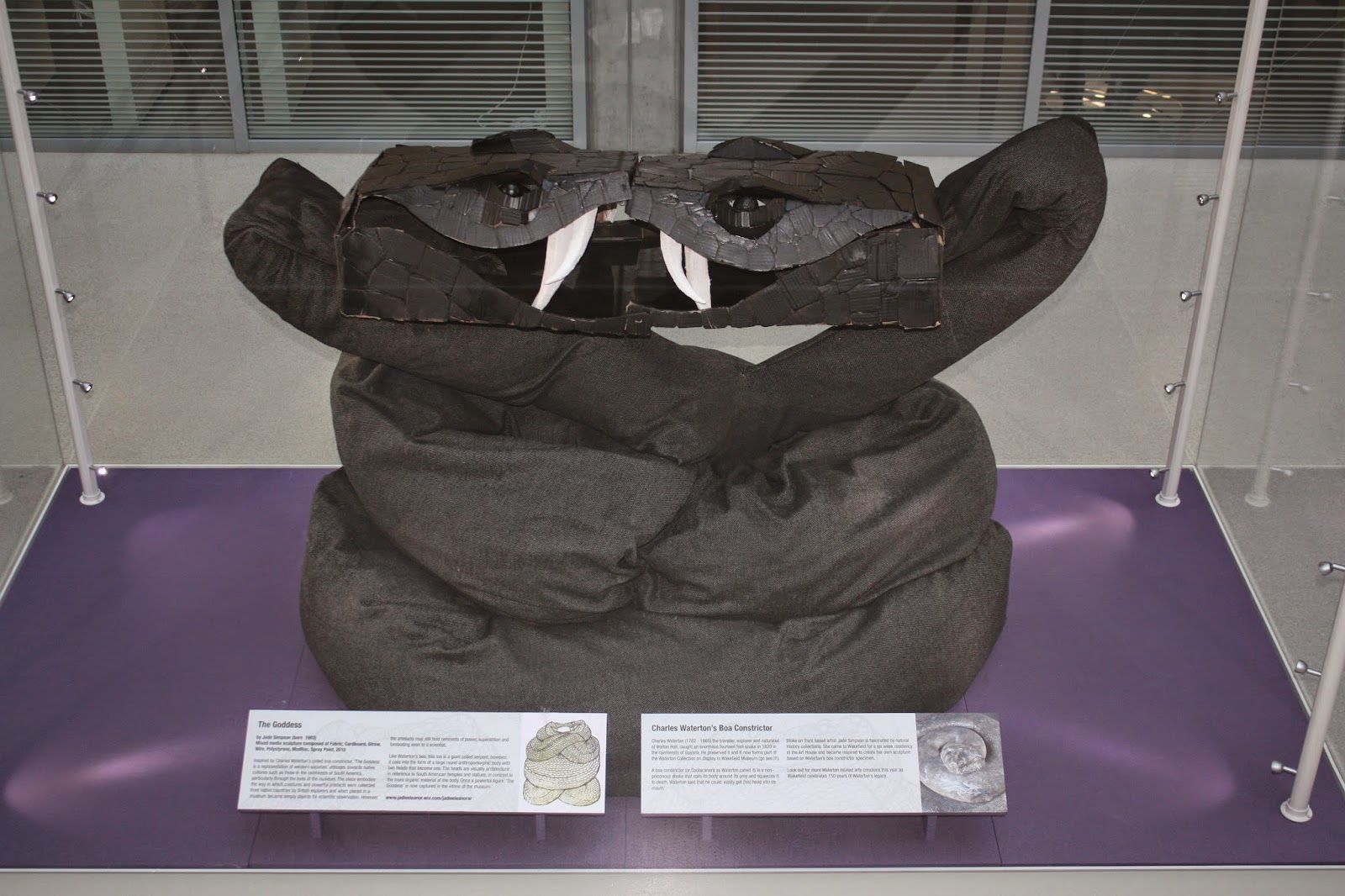
The Goddess - New installation at Wakefield Museum

The Goddess

A new atrium case display at Wakefield One

by Jade Simpson (born  1993)
Mixed media sculpture composed of Fabric, Cardboard, Straw, Wire, Polystyrene, ModRoc, Spray Paint, 2015

Inspired by Charles Waterton’s coiled boa constrictor, ‘The Goddess’ is a representation of western societies’ attitudes towards native cultures such as those in the rainforests of South America, particularly through the eyes of the museum. The piece embodies the way in which creatures and powerful artefacts were collected from native countries by British explorers and when placed in a museum became simply objects for scientific observation. However, the artefacts may still hold remnants of power, superstition and foreboding even to a scientist. 

Like Waterton’s boa, this too is a giant coiled serpent, however, it coils into the form of a large round anthropomorphic body with two heads that become one. The heads are visually architectural in reference to South American temples and statues, in contrast to the more organic material of the body. Once a powerful figure, ‘The Goddess’ is now captured in the vitrine of the museum.’

For more information about Jade and her work visit: jadieeleanor


 Charles Waterton’s Boa Constrictor


Charles Waterton (1782 - 1865) the traveller, explorer and naturalist of Walton Hall, caught an enormous fourteen foot snake in 1820 in the rainforests of Guyana. He preserved it and it now forms part of the Waterton Collection on display in Wakefield Museum (go see it!).

A boa constrictor (or Coulacanara as Waterton called it) is a non-poisonous snake that coils its body around its prey and squeezes it to death. Waterton said that he could ‘easily get (his) head into its mouth’.

Stoke on Trent based artist Jade Simpson is fascinated by natural History collections. She came to Wakefield for a six week residency at the Art House and became inspired to create her own sculpture based on Waterton’s boa constrictor specimen.

Look out for more Waterton related arty creations this year as Wakefield celebrates 150 years of Waterton’s legacy. 

Tuesday, March 25, 2014

Charles Waterton's Creations #MuseumWeek #MuseumMastermind

As part of Twitter's #MuseumWeek #MuseumMastermind we have been asking what Charles Waterton's creations are made from.

Here are the answers, plus some more information about Charles Waterton's taxidermy methods.

The Creations

Waterton was keen on preserving wildlife as 'stuffed' specimens, but he would also construct his own creations using bits from a variety of birds and animals and then give them very odd titles that often had a satirical motive.

John Bull and the National Debt


A porcupine in a tortoiseshell with an almost human face is so weighed down by the National Debt of £800 million that it is overcome by six devils.

The six devils include an angler fish augmented with snake skin; a small caiman with spines made from either bird claws or spurs from the legs of cockerels or pheasants; spiny finned fish mixed with a toads lower half.


The Nondescript


Made from the skin of a howler monkey Waterton sometimes pretended this was a new species of animal he had discovered or a caricature of a customs officer who had charged him import duty on the animal skins.

Charles Waterton's Taxidermy

"Allow me to inform you that there are no stuffed animals in this house" Waterton declared to a visitor to his museum in 1856.
  
He went on to demonstrate that his specimens were all hollow by pulling off the head of a preserved polecat and revealing that there was nothing inside.

Waterton's unusual method relied on the use of the chemical Mercuric Chloride which both prevented insect attack and set the skin hard.

He began the process by scraping away much of the inside of the skin. He then set up the animal roughly into the correct position.

Progressively he returned to the specimen each day, making minor adjustments until he considered that it was sufficiently lifelike.

As far as it is possible to judge, Waterton's specimens do appear to have been better than others preserved in the nineteenth century.

He certainly believed it to be so.  He particularly stressed that you should observe the live bird carefully to ensure the stance or form of the museum specimen was correct. Unfortunately his method was difficult and slow and it has seldom been copied.


For more information about the man himself see Charles Waterton

Friday, October 9, 2020

Black History Month: John Edmonstone

For Black History Month 2020, Wakefield Museums & Castles are exploring four stories related to British slave ownership in the early 1800s. This week, we are focusing on the life of John Edmonstone (179? - 1833?): Taxidermist, teacher, slave.


The lives of individual enslaved people are difficult to learn about - their stories are underrepresented in schools and in society as a whole. Documented stories of individuals are also few and far between. They were treated as property, used for the service and profit of others. John Edmonstone, named by the man who enslaved him, is a rare story. His life began in enslavement in South America and ended as a respected teacher and skilled taxidermist in Edinburgh.

The first known reference to John is in ‘Wanderings in South America,’ a famous book written in 1825 by Charles Waterton of Walton Hall near Wakefield. During a third expedition to Demerara in British Guiana in 1820, he returned to Mibiri Creek, ‘the former habitation of my worthy friend Mr Edmonstone’. His ‘worthy friend’ was Charles Edmonstone, a close friend and future father in law. Charles Edmonstone owned a wood cutting business that used an enslaved workforce, including John Edmonstone.

An illustration of "Mr Edmonstone's Wood Cutting Establishment"

Mr Edmonstone’s Wood Cutting Establishment

Mibiri Creek, Demerara River

Thomas Staunton St Clair, sketched around 1808

A Residence in the West Indies and America (London 1834, Vol 2)

Copyright unknown


Waterton was highly skilled at preserving birds for display in his museum in Wakefield. The skins he acquired had to be preserved very quickly in the heat of South America and he needed help to do it. He writes:

"It was upon this hill in former days that I first tried to teach John, the black slave of my friend Mr. Edmonstone, the proper way to do birds. But John had poor abilities, and it required much time and patience to drive anything into him. Some years after this his master took him to Scotland, where, becoming free, John left him, and got employed in the Glasgow, and then the Edinburgh Museum.”

Waterton, Charles, Wanderings in South America, the north-west of the United States, and the Antilles in the years 1812, 1816, 1820 and 1824, London, 1825, pp 153 - 154

Waterton was a difficult man, known to have a quick temper, was very argumentative and rarely praised people  - John was no exception. Although Waterton described him as having ‘poor abilities,’ it’s very likely that John accompanied him on numerous expeditions into the rainforests of Guiana and learned valuable taxidermy skills.

Waterton stated that, once freed, John began an independent life in Scotland. The Edinburgh Post Office Directory for 1824 – 1825 lists John Edmonston (missing an ‘e’) as a bird-stuffer, living at 37, Lothian Street. This address is close to Edinburgh University and he had found employment teaching students how to preserve birds. One of his students would become one of the world’s greatest naturalists – Charles Darwin.

Darwin and his brother lodged a few doors away. In his autobiography he confirms Edmonstone’s connections with Waterton:

'a negro lived in Edinburgh, who had travelled with Waterton, and gained his livelihood by stuffing birds, which he did excellently: he gave me lessons for payment, and I used often to sit with him, for he was a very pleasant and intelligent man.’

Darwin, Francis, Editor, The life and letters of Charles Darwin, including an autobiographical chapter, 3 vols. London, 1887, Vol 1, p.40.

Edmonstone’s lessons cost Darwin ‘one guinea, for an hour every day for two months’. For that bargain price he learned skills that would last him a lifetime. It’s possible those 40 or so sessions inspired the impressionable young student to quit medicine and become a naturalist. Five years later, in 1831, Darwin undertook his historic voyage on board the HMS Beagle, on which he first began to form his theory on natural selection. The Galápagos finches, used to support his theory on the transmutation of species, were preserved using the techniques that Edmonstone had taught him.

Drawing of John Edmonstone teaching a teenage Charles Darwin

Artist impression of John Edmonston teaching a teenage Charles Darwin in Edinburgh, 1825

Copyright unknown

Edmonstone was a celebrated taxidermist in his day; along with teaching, some his work was bought by Edinburgh’s zoolological museum. The museum register shows the acquisition of a 15ft skin of a boa constrictor in 1822 – 23, presented by a Mr Edmonston. In October 1823 the weekly report books state that two swallows, one water ouzel and one chaffinch were bought from John Edmonston, and fishes in 1825.

A large taxidermied boa constrictor

Waterton’s boa constrictor on display at Wakefield Museum

Was the boa preserved by John Edmonstone similar?

Very little more is known about him. The Edinburgh Post Office Directory lists him living in 1832-33 at 6, South St David’s Street, Edinburgh. It is shameful that most stories of enslaved people are only known through the writing of those in a position of white privilege. We do not have John’s point of view of his enslavement or even whether he had any choice in joining Waterton on his expeditions. All we know is that after he gained his freedom, he became a highly respected teacher and craftsman in the art of taxidermy (soon to become a Victorian obsession) and a mentor to one of the most important thinkers of the 1800s.

Today he is regarded as one of the '100 Great Black Britons'.

Throughout October we will be sharing three further articles focusing on the connections between Charles Waterton of Walton Hall and the practice of slavery in the early 1800s. 

Find out more:

https://play.acast.com/s/notwhatyouthought/johnedmonstonetheformerslavewhotaughtdarwin

https://www.jstor.org/stable/531678?seq=1#metadata_info_tab_contents

https://www.nhm.ac.uk/our-science/collections/zoology-collections/bird-skin-collections/bird-skin-collection-hms-beagle.html

https://100greatblackbritons.com/

https://www.blackhistorymonth.org.uk/

Friday, October 28, 2022

Black History Month 2022 - Update to Charles Waterton & slavery blog

In the final of our blog series for this year's Black History Month, we're looking at how ongoing research has led to an update to our Charles Waterton and slavery blog from 2 years ago.

Following the discovery of the will of Thomas Waterton, Charles' father, in the John Goodchild Collection at West Yorkshire Archives, we now have more information about Waterton's involvement in the family's plantation and with the enslaved workforce in Guiana. 

The update is as follows:

Aged 22, Waterton was sent to administer the plantations and the enslaved workforce on behalf of his family. He did this job for seven years (1805 – 1812). He might have received a salary for this work, but it is likely he was sent out in order to avoid paying someone outside of the family.

Charles’ father died in 1805, shortly after his arrival in Guiana. The will of Thomas Waterton, Charles’ father, which is in the John Goodchild collection with West Yorkshire Archive Services, reveals that Charles inherited the family home in Walton but did not inherit the family estates and the ‘slaves thereon’ in Guiana. Waterton managed the plantations on behalf of younger family members until they came of age to manage them themselves.

Thomas Waterton's will from 1805. It is a large, handwritten document on parchment paper
The Will of Thomas Waterton
Image courtesy of West Yorkshire Archives


For the other blog posts in our Black History Month 2022 series, see:


Thursday, March 5, 2015

Aviary in the Atrium Commission


May 2nd 1865. On this night at 11 o’clock two nightingales were singing melodiously in the Park at Walton Hall. Extract from the Diary of Charles Waterton, 1865

This is the last entry in the notebook of Charles Waterton, the Wakefield naturalist, explorer and pioneering conservationist. He died on 27 May 1865 aged 82. 2015 will mark 150 years since he passed away – and the near 150 years taken to catch up with his progressive ideas for nature conservation!

From May 2015 for a year Wakefield will mark this anniversary to celebrate Waterton’s incredible life and commemorate his legacy.


Wakefield Museums have been successful in securing funding from Arts Council England for a project to commission an artist or cultural organisation to create an installation in showcases at Wakefield One.  Wakefield’s new flagship civic building opened in 2012, it accommodates a range of Council services including a new museum and library. Audiences to the building are diverse, ranging from library and museum visitors, to users of the council services point.

We are looking for an artist to create a beautifully engaging display taking inspiration from:

150 Nightingales or 150 Birds in Waterton’s Life

This display should wow, thrill and surprise our visitors.   Take this opportunity to amaze us with ideas that allow people to engage with this subject.  Consider thinking ‘outside’ the atrium case this could be physical objects, sound or digital (there are some constraints in the building but we are willing to consider anything!).


Resources available:

Up to two Atrium showcases: Freestanding and glazed on all four sides and top with four internal lighting columns in each corner. Display dimensions (interior measurements) are (h x w x d) 1944mm x 2227mm x 1477mm and 1944mm x 1477mm x 1477mm 

Staff: curator for assistance with subject matter

Reference material:  A range of reference material relating to Charles Waterton.

For more information about Charles Waterton:

-          Visit Wakefield Museum  Waterton Gallery

-          Visit Wakefield Museum Web Pages

Project budget: up to £3500

Project timetable:  Display to open week commencing 20 June 2015 and will be on display for 6 – 9 months.

This budget covers fee and delivery of the following:

  • The  formation of a visually interesting and engaging  display as part of the Nightingale Festival using  inspiration from ‘150 Nightingales or 150 Birds in Waterton’s Life’.
  • Graphic interpretation explaining the installation (text writing, proof reading, image selection and sourcing, graphic design and production)
  • Text and images  for marketing material (marketing material will be created by Wakefield Council)
  • Regular updates of progress to exhibition manager
  • Delivery of one supporting event for an Artwalk.  5pm – 8pm 29 July 2015, 30 September or 25 November (date to be confirmed)

Content, graphic design and display techniques to be signed off by Wakefield Council museum team.

How to apply:

If you are interested in submitting a proposal for the atrium commission please provide the following information:
  • An outline of your idea, and how it relates to ‘150 Nightingales or 150 Birds in Waterton’s Life’.  Please include an image / sketch of your proposal may look in the space.
  • A breakdown of budget (including a clear indication of your fee).
  • A delivery timeline, featuring key dates for, text writing, graphic design and production, installation
  • A list of sub-contractors and or suppliers used to deliver the brief
  • Outline of what you would deliver at the Artwalk event.


Email to mayaharrison@wakefield.gov.uk  by 5pm on Tuesday 7 April.  [Selections will take place by 13 April 2015. Display to be in place week commencing 20 June 2015]

If you require further information about the project please contact Maya Harrison,  mayaharrison@wakefield.gov.uk, 01924 305350.