Friday, September 1, 2023

The story of Jack and Marie

Our Collections Volunteer Sue has recently transcribed a collection of over 40 letters from the Second World War. 

She uncovered a beautiful story of love and resilience during very difficult times.

Read on as Sue pieces the letters together to tell the story of Jack and Marie.

A photograph of two men and two women on a pier, probably at the end of the second world war. Jack is a taller man in uniform, and Marie is smartly dressed with her auburn hair up
We believe Jack is the man in uniform, and Marie is the woman to his right

Introducing Jack and Marie

Jack and Marie were a young couple, very much in love. 

They got married in May 1939, and moved into a house together on the Lupset Estate in 1940. This estate was developed by Wakefield Corporation in the 1920-30s. 

At the time it was much admired as the largest local government housing scheme in Europe. Jack and Marie were very proud of their home.

A black and white postcard showing an aerial view of Lupset Council Housing Estate in the 1930s. Townley Road can be seen running through from right to left.
The Lupset Estate in the 1930s - photo copyright of Wakefield Libraries

Their married bliss was soon interrupted by the outbreak of war. In May 1941 Jack was called up. He trained in North Wales and was posted to the Middle East.

Jack was homesick and missed Marie very much. He wrote to her every weekend, sometimes more often. Marie kept his letters.

In 2016 Wakefield Museums and Castles purchased a collection of over 40 letters written between 1941 and 1943. 

These were Jack's letters to Marie, lovingly kept. 

We don't have Marie's responses, but we can learn a lot about what she must have been telling Jack about life back home in wartime Wakefield from his letters.

Jack's letters

Like all wartime letters, Jack's were censored. They contained little information about locations and manoeuvres in case they fell into enemy hands. 

However, this isn’t what Jack wanted to write home about anyway! 

Much of each letter was taken up with reminiscences of his life with Marie in Wakefield, and how much he loved her and was missing her.

On the first anniversary of his call up he wrote a moving description of the morning he left her, echoing the experiences of many a conscript:

Jack's letter on the first anniversary of his call-up - transcribed below
"It tells me that almost twelve months ago, months of pain suspence [sic] and darkness, I had the utter misfortune to be ripped from the arms of a girl in a million."
Jack’s letters contain fascinating snippets about his life in the army. 

His replies to Marie’s letters also talk to the living conditions and cultural attitudes of 1940s Wakefield.

Life in the army

In August 1941, soon after arriving in the Middle East, Jack was injured in an accident. He broke his toe, which failed to mend properly causing him to limp slightly. Because of this he was rated ‘unfit to serve’ at the front, where he would have earned promotion. Instead, he had to settle for a more mundane (but much safer) post behind the lines.

Jack was assigned to duties in the stores, collecting, stocking and distributing uniforms, ammunition, and other equipment. He also opened and ran a canteen which also acted as a shop.

The horrors, death and destruction of the Second World War are rightfully widely reported.

Jack's letters give detailed insight into another, sometimes overlooked element - the sheer 'monotony' of war:
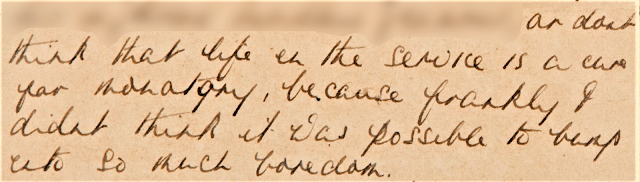
A letter from Jack referring to his boredom - transcribed below
"Don't think that life in the service is a cure for monotony, because frankly I didn't think it was possible to bump into so much boredom." 
Some of Jack's letters suggest he was a bit fed up with his life in the army. He and his fellow soldiers were at the beck and call of their senior officers. 

His letters record the following unenviable tasks:
  • They were required to thoroughly spring clean their billet each week, making a special effort before a visit by a VIP;
  • One time they were marched to the beach for a 'dip in the ocean' at 6 in the morning
  • They were sent without notice on a long journey on Boxing Day 1942, hangovers notwithstanding;
  • Another time, Jack was left to mind the stores for 3 days and nights, with a long to-do list, while the Quartermaster was away.
Thankfully for Jack, there were some better moments. 

High points included visits to the cinema – Jack recommends several popular favourites to Marie, and especially enjoyed watching Carmen Miranda in ‘Weekend in Havana’. He also fondly records trips down-town with his mates Montey and Kenny.

Christmas 1942 was a ‘jolly’ time - the men were granted a day off! Jack organised and sold tickets at an extra 2/3 (2 shillings and threepence, or 12p) for a full traditional meal of turkey with pork stuffing and apple sauce, baked potatoes, cabbage, parsnips, Christmas pudding and sauce, mince pie, and fruit and nuts.

The height of joy was the arrival of the post - especially when it contained a letter from Marie. 

Frequent delays in the erratic postal service were much bemoaned, and Jack began keeping a (handwritten) spreadsheet to record the despatch and arrival times of their letters. 

Looking after family - from afar

Jack would have dearly loved to go home on leave. 

However, when he was given a precious week off in October 1942, he used it to go and find his brother Harry who was stationed not far away:

A letter from Jack telling how he was going to find his brother soon - transcribed below

"I am making an all out, all in bid to locate our Harry, whom you will know by now, that he is only about 50 miles from here. 
He told me in his last letter that he could fix me up with a bed and some food so in that line I have nothing to fear, the biggest proposition being, getting there, it will mean hitch hiking, as there is no bus service."
Jack was sending part of his army pay home to Marie to support her. 

He was careful with his money and didn’t draw much of his pay, leaving 10 shillings (50p) a week to accumulate against “a rainy day”. 

While he was in hospital in 1941 his pay was docked to 1/3 (6p) a day, or 8/9 (44p) per week. In September 1942, he discovered that, although he had resumed full duties in March, the army was still paying him the reduced rate. They restored his back pay but underestimated the amount he had saved, so he no longer trusted the army to look after his money. 

He arranged to send £10 from his savings to Marie, plus some of his back pay. 
By April 1943 his pay had risen to 6/4 (32p) a day, of which he sent around half home to Marie.

The Middle East

Jack generally did not enjoy his living conditions in the Middle East. 

Mosquitos were a constant problem, and he also met scorpions, ‘great big’ spiders and ants. The climate could be very hot with endless blue skies, or surprisingly cold with storms, wind and even snow. The desert had “blinding dust”.

Despite this, he clearly appreciated being billeted next to the “beautiful blue Mediterranean [Sea]
”. 

A letter from Jack talking about the Mediterranean Sea - transcribed below

"As I look to my right I have in front of me the Mediterranean Sea looking dark, oily, and full of mystery. What a great change this sea provides, it was yesterday that a few of us boys, remarked how beautiful this sea looked. 
The sun was beating down onto the almost stagnant surface, transforming into a bed of myriad coloured diamonds..."
He also writes that “I thought Palestine was beautiful in parts, but honestly I take my hat off to the scenery [Syria] can produce.” 

Olive groves, pomegranate trees, banana plants and especially date palms all produced magnificent fruit which was piled up in the local shops and sold very cheaply.

His encounters with the local people were limited but were always a source of interesting observations. 

He noted the poverty – people going out without socks or shoes in the cold and rain, when boots cost £2/10/- (£2.50) and a man’s wages were just 3s 4d (17p) a day. Infrastructure was sadly lacking and there was no public transport. 

There were a wide variety of shops, from ones selling jewellery, clothes and handbags, to those selling ice cream and ‘excellent’ rice puddings. At one point Jack says he wants to buy Marie some jewellery, but doesn’t know which to get her.

After the first year Jack started taking Arabic lessons and could chat with the boys in town.

Marie's story - back home in Wakefield

Jack comments frequently in reply to the news Marie sends to him. Through this we can learn about Marie’s life in wartime Wakefield.

By winter 1942 she was unfortunately in poor health and struggling financially. She moves back in with her parents for a spell. She lost her job, but in February 1943 she got a new job at Clayton Hospital.

Marie also took in lodgers, including a family from London with whom she became very friendly.

She was good friends with her neighbours on either side, Mary and Vi, and a photo found with the letters show a group of 4 girls on a day out at the seaside:
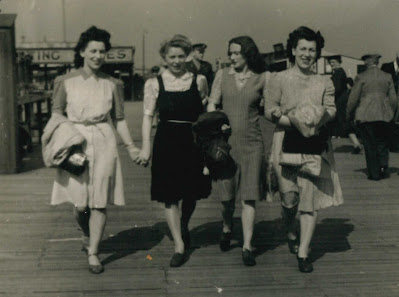
Four young women walking hand-in-hand along a pier, all smartly dressed, from the 1940s
Marie (we think she's second from the left) with her friends at the seaside

From the letters we also get glimpses of their life together before the war. Jack worked as a painter and decorator, like Marie’s brother Harold. 

Maybe this was how they met?

Until January 1943 Marie was working at Webster Bros. This may have been in the grocery store on the corner of Cheapside and Westgate, which had a pie shop above, or possibly in the café in Cross Square.

A black and white photograph of Cross Square, Wakefield, with Wakefield Cathedral centre
Cross Square, Wakefield, in the 1940s.
Webster Bros is on the right, towards the Cathedral.

After she lost her job, Marie almost signed up to the Women’s Auxiliary Air Force (WAAF). She told Jack that she had been challenged by a recruiter who accused her of occupying a “hiding place” and told her that if she didn’t volunteer she would be forced into the service.

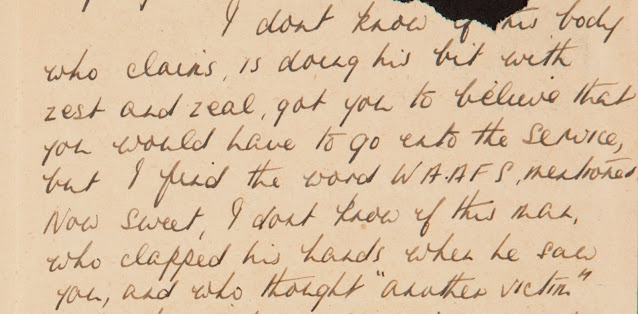
Jack was horrified. His reply to her reassured her that this was untrue, and pleaded with her not to become another victim”:

A letter from Jack replying to Marie's near recruitment experience - transcribed below
"I don't know of this body who claims, is doing his bit with zest and zeal, got you to believe that you would have to go into the service, but I find the word W.A.A.F.S mentioned. Now sweet, I don't know of this man, who clapped his hands when he saw you, and who thought "another victim" "
In reality, Marie seems very resilient. Like many women, she took advantage of the opportunity the war presented to assert some independence. She went out to work despite some reservations from Jack. 

She took the initiative in writing about her difficulties in dealing with their long separation, which Jack then echoed.

Jack was particularly keen to hear news about what family and friends were up to. 

He was dismayed at the way the “wicked war” had deeply affected his younger brother Albert:

A letter from Jack reflecting on his brother's experience - transcribed below
"It's a bad show Marie, I don't know, life in the service seems to have an uncanny way of pulling a chap down like this..."
Jack even tried match-making between Albert and Marie’s friend Mary from afar!

After the war

Thankfully for this story, there was a happy ending. 

Jack returned home to Marie when the war ended. Sometime in the mid-1950s they moved from the Lupset estate but appear to have stayed in the Wakefield area. No children have been traced.

They stayed together and grew old together. 

Jack died in 2002 aged 89, and Marie in 2011 aged 94.

We'll let Jack sign off:

A sign-off from Jack that reads 'goodnight angel, your always, forever thinking of you, sweetheart Jack', surrounded by kisses


Looking for more local wartime stories? 

Thursday, August 24, 2023

Ken Hanson: A Mining Deputy's Story

Lindsey Hanson from the Wakefield Word Writers' Group has interviewed a very important person indeed - her dad!

Ken Hanson was a Deputy at Ackton Hall Colliery and Kellingley Colliery.

She has written up their discussion in this guest blog. 

Ken recalls the everyday work and responsibilities of a Mining Deputy, the good friends he made and one he sadly lost along the way.

Please note: this blog post discusses mining accidents.

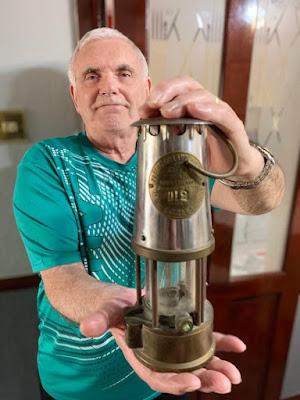
Ken sat at home with a selection of his former mining objects on the table
Ken Hanson with some of his mining career memorabilia

Ken:

I was just fifteen when I left school and wasn't sure what I wanted to do to start with. You didn't have many choices back then with jobs in my neck of the woods, even with decent grades from school. 


After a brief stint at mechanics, a Moulder in a place called Resil in Pontefract, and then six months as a Bus Conductor, I started working at Ackton Hall Colliery. 


I worked in several pits in the region over the time I was a miner, starting as a General Worker, then a Face Worker, before eventually making my way up to Deputy Grade One.


Training was essential, as it wasn't just coal you had to think about when going down the mine. There were so many safety aspects and regulations you had to be aware of, and to know your first aid in case of accidents. We had what is known as morphine safes down the pits too. 


A Deputy would be specially trained in delivering morphine should a serious accident happen. 


Ken holding up his oil lamp
Ken with his safety lamp.
Only colliery officials had one of these and it lasted for the full shift.
Methane gas would go through the filters and alter the size of the flame, alerting the officials to how much methane was in the area. 


What was the most important part of the job? 

Ken: As a Deputy you oversaw health and safety every shift you were on. 


You would go down on your own first (this was known as a 'pre-shift') making sure everything was ok before the men would come down onto the job, making sure there was no methane gas about and everything was ok for them to start work. 


We had fans down the pit too, these were our main ventilation, so it was essential they were running correctly (these were also monitored from the surface). 


It was a big responsibility resting on your shoulders. All the rest of the men going down the mine after you were trusting you that everything was okay - dads, sons, brothers, best mates.  


How were you able to communicate if needed?

Ken: Once you were down there you could ring other places to contact the surface if needs be. These phones were mainly at gate ends and the controls inbye of the gate. 

Everyone who went down the mine were given two discs called checks. Everyone had their own different check number. One was left with the onsetter on the pit top, and you kept the other one for when you came back out to give to the onsetter then. 

That way the management knew if anyone was still down the mine.

A rounded metal disc with a hole punched out to loop onto a chain, with 3612 Kell. engraved on it
Ken's pit check (number 3612) from his time working at the Kellingley Colliery.

Did you ever encounter an accident? How did you deal with them?

Ken: I was once on shift and a mate of mine was working near a dinting machine, the machine caught the belt that was used to transport muck onto the gate belt. It pushed my mate into the girder at the side trapping him. 

You had to act quickly. Sadly he was seriously injured; the lads got him out, but his leg was in a bad way. He had a hole in the top of his leg, he was taken out as quickly as they could, but sadly he ended up losing his leg. It was very rare for things like this to happen.

It was on one of my afternoon shifts where everything was going as it usually would and we would go down the mine, but we noticed the shearer was fast under the face chocks. 

The day shift lads had drilled some holes in front of the shearer, and I went over behind the machine and was preparing to fire some shots to free the machine when the roof above me collapsed and buried me. 

I was buried for four hours. I was doubled up, but I could breathe okay. 

My left arm was visible to the men digging me out. My index finger was hanging off and one of my mates shouted: “Ken, if I pull the finger off you will get a bit of compensation!”

“****** that.” I said (that’s mates for you) 

So they sewed it back on.

No matter how much training you do have, you're never trained for that type of thing. 

I am grateful to my mates for getting me out that day. I know how lucky I am to be alive. 

I told the boss not to let the wife know as I knew she would worry. Even after all that, I still was home from the hospital at the normal time I would have been home. 

Five weeks later I was back at work, the first shift back I was allowed to go down on my own to see how I would go. No problem.

I was transferred to Kellingley pit after Ackton Hall was closed down - quite a few men also went there. 

One of my good mates transferred with me. He was a real comic, a great guy and a great mate. 

I didn’t work many shifts with him as Kellingley was such a big mine. 

It’s still difficult to talk about. 

It was an horrendous and upsetting day, the day I found out he had lost his life. He had been tragically killed in an accident while on his shift.


What was it truly like down there?  


The pit itself seems an eerie place for those who haven't been down, but you get used to it. 


It never really smelt much down there, but when you were going down in the pit cage that had three levels with 120 men on, and there’d always be one who would start eating garlic on purpose on the bottom level and it stunk the cage out, all in a bit of fun though. 


If you turned your lamp off when underground, it was completely black. 

You tried to ignore being claustrophobic, it was mind over matter. 


You’d eat your snap (lunch) down there too. You would have to do your business down there as well; remember, they were long shifts. 


As for uniforms, we had orange workwear the pit supplied, and you could get clean ones every week. 


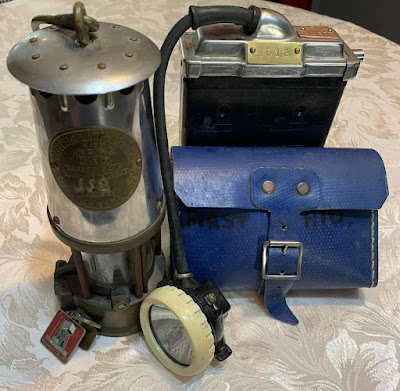
Everyone who went down the pit had to wear a lamp that fitted onto the helmet. The battery for this was worn on your belt.  This went alongside a self-rescuer which carried a mask in case of a fire. The mask went into the mouth and a clip was worn over the nose. 

Luckily, I never had to use one. 


A tall cylindrical oil lamp, a black battery-powered lamp with the lamp on the end of a thick cable, and small blue leather satchel with 'first aid' written on it
Ken's oil lamp, lamp and battery to fit to his helmet, and blue first aid bag.

A white peaked safety helmet, clearly well used, with a safety lamp and battery attached
A miner's safety helmet with an Edison clip-on lamp and battery attached from our collection.
It features in our 100 Years of Collecting Online Exhibition.


Deputies and some first aiders also carried a first aid bag. These contained basic tackle, plasters and bandages. 


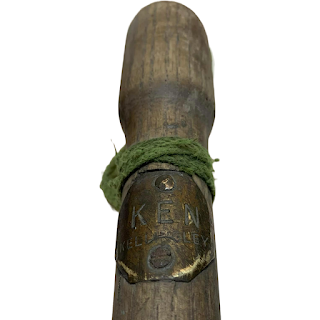
Most deputies carried a stick. This was handy when you walked over uneven ground as you can imagine it was pretty rough walking at times! 


I also had my stick marked with twelve-inch measures, so you could get a rough idea of the depth of things without getting my tape out. 


A long cylindrical wooden stick with marks every inch for 12 inches
Ken's deputy stick, laid out on the table for scale.
There are 12 inch measure lines down the length of the stick. 

The top of the wooden deputy stick, with a metal badge attached engraved with 'Ken - Kellingley'
The personalised top of Ken's deputy stick 

You couldn’t have an ordinary battery watch down there, it was too dangerous with gases being down there, you had to have a normal wind up one. 


Deputies carried what was known as oil lamps, these were used for checking methane gas. If 'one and a quarter' was detected, we had to leave the district immediately.  


Did it feel like you were part of a community?

Ken: Banter was good down there, good for morale. 

You made mates working quickly down the mines. I made mates for life, still plenty about. I met my best mate to this day there, he was and still is always cracking jokes and making everyone laugh. 

I have lots of good memories, I wish it hadn’t ended so quickly and it was sad to see the pits closed. 

The pits closing was like losing a lot of mates. 

I have no regrets about the choices I made and the work I did in my time as a Deputy. It had its moments, but I wouldn’t change a thing other than losing my mate at Kellingley. 

What can I say? It kept me fit, I had and still have great mates, it was part of an era and time that I lived through and enjoyed. 

Happy days.

Friday, August 18, 2023

100 Years of Collecting - A Trip to the Seaside

We're celebrating our centenary year throughout 2023 with new displays, digital content and events. 

As part of the celebrations, we created an interactive online exhibition starring 100 objects that represent our 100 Years of Collecting.

Each month, we’ll be looking at some of the objects in more detail and sharing other treasures from the collection in special themed blog posts.

It's been a bit of a dreary August - so we're taking you on a virtual trip to the seaside through our collection!

Mr Punch Glove Puppet

This little fellow is full of nostalgia for many local people!

A Mr Punch glove puppet, with ceramic head and slightly crazed expression, white hat with Mr Punch embroidered on it, and a long red gown


He's part of a mid-20th century Punch and Judy puppet set that belonged to Featherstone legend, Albert Massey.

Albert was a surface worker with the coal board. In his spare time he often performed Punch and Judy puppet shows.

Black and white photo of Albert Massey as an older man at a park
Albert Massey in the 1960s

Albert’s puppets and props were donated to the museum collection in the 1980s. The Mr Punch puppet representing Albert's story is one of our 100 Years of Collecting star objects.

As well as Punch and Judy themselves, the set also includes several of Mr Punch’s various enemies - the Policeman, the clown and the crocodile - who all often found themselves at the wrong end of Punch’s stick.


                           Old crocodile hand puppet attached to a long green glove

Old clown hand puppet, with a ceramic painted face and traditional clown-style gown

Albert performed in local venues such as Pontefract Park - but Punch and Judy shows will always be associated with the golden age of the British seaside holiday. 

Seaside Holidays

From the Victorian era onwards, red and white striped puppet show booths popped up on beaches and piers up and down the country. 

Here's a group of holidaymakers and daytrippers being entertained by a puppet show at Scarborough beach in the 1950s:

A black and white photo of a large crowd of children sat on the sand, watching a puppet show
Some of these children look like they're enjoying the show more than others...

This photo is one of many captured by another local legend, Jack Hulme from Fryston. 

Hulme was a former colliery worker and hairdresser, and became an enthusiastic amateur photographer. He mostly photographed scenes from everyday life in Fryston and created an extraordinary record of industrial Yorkshire. 

Hulme’s charming action shot of a boy jumping over a makeshift hurdle is another of our 100 Years of Collecting star objects:

A young child jumping over a makeshift hurdle of bricks and a plank, in the street in Fryston

By the mid 20th century, more people than ever before were heading to the coast. 

Public holidays and paid annual leave meant workers and their families could afford to take a seaside break. 

Employers and community groups often organised special excursions and laid on transport to the beach, such as these trips from Fryston. 

Jack Hulme joined them, and of course captured the trips in his photos:

Rows of buses stretching into the distance, and a group of people walking away from them on their way to the seaside

Rows of people sat in deckchairs at the seaside, with 3 double decker buses in the background
The Fryston daytrippers - with 3 of the 10 buses they travelled over on in the background!

Rail companies also arranged extra services to seaside destinations during the summer. 

This posters advertising train times from Pontefract to the east coast was produced by Holmes Printers in Pontefract, for the Prince of Wales Colliery. 

Coal miners and their families packed onto the trains, ready for a day out with their buckets and spades.

Print poster advertising the Prince of Wales Colliery's annual outing to Bridlington on Sunday 23 June 1963. Includes train times and fares

Seaside souvenirs

No trip to the seaside would be complete without picking up a souvenir or two!

Ironically, these mementos of the east coast were actually made back over here, in Knottingley, by Bagley & Co Ltd: 


            A small blue glass vase with flower decoration, and the word Bridlington

A green glass boat trinket with floral decoration and Great Yarmouth painted on it


Bagley’s started as a bottle factory but became known for its innovative decorative coloured glass in the 1930s. 

The company’s iconic Andromeda bowl design also features in our 100 Years of Collecting:

A yellow shallow glass bowl with a figurine of Andromeda standing upright in the centre

What objects, photos or memories do you have of seaside trips from yesteryear? We'd love to hear from you!
Post in the comments, or email us at museums@wakfield.gov.uk. 

Thursday, August 10, 2023

"Well, who would have thought it?" - Organising the first Wakefield Pride

It's Wakefield Pride on Sunday 13 August!

Did you know that the first ever Wakefield Pride was in 2005?

Michael was one of the organisers. He kindly did an oral history interview with us in 2017 for our Rainbow Trails project. 

In this clip, Michael tells us about organising the first ever Wakefield Pride. He remembers how the team turned it around from an impending disaster into a 'resounding success'!


Click here for a full accessible transcript of the recording

We've also got a range of posters and wristbands from previous Wakefield Prides in the collection. 

These items were kindly donated by (a different) Michael, one of our brilliant Visitor Experience Assistants:

Very colourful poster for Wakefield Pride 2010 featuring photos and names of key acts and performers. As well as Blanche and MarkyMark, there was Angie Brown vs the Sleazesisters, S Club 3, Big Soul and Miss Sordid
Poster from the 2010 Wakefield Pride on Sunday 8 August.
Blanche and MarkyMark were key features once again 5 years on!

Poster for the Wakefield Pride 2010 after party, with a photo of a packed Pride crowd and Miss Sordid and Markymark at the bottom
Poster for the 2010 Pride After Party at the New Union - hosted by MarkyMark and Miss Sordid

Multicoloured rainbow wristband with 'Wakefield Pride 2010' on in black letters
Michael's wristband from Wakefield Pride 2010

We also have items kindly donated by Steve Ogilvie, also known as Madam Connie, one of our finest local drag queens! 

They include this Wakefield Pride 10th Anniversary wristband:
 
Rainbow wristband with 'Wakefield Pride 10th Anniversary' on in white letters

Steve also kindly donated one of Connie's sickening sequinned dresses, and a stunning red wig, which is currently on display in Moving Stories at Wakefield Museum

Madam Connie's wig also proudly features in our 100 Years of Collecting Online Exhibition.

Click here for more about Madam Connie's story, and her costume designer Sue Riley

We wish everyone a happy Pride, and hope we get better weather than the first one had in 2005!

What is Oral History? Find out here in an article written by University of York placement student Lydia

Tuesday, July 25, 2023

Castleford Community Cases - New Displays at Castleford Museum

Castleford Museum’s latest exhibition honours inspiring local women from the worlds of education, art, politics and sport. 

Four new family-friendly and interactive displays showcase historic pioneers and the stars of the future!

Making their Mark display, with different styles of colourful painted pottery

Making their mark reveals how the influential art teacher Alice Gostick sparked a passion for pottery painting across the country. 

Following her example, talented craftswomen led Castleford’s proud tradition of hand decorating ceramics. 

The display focuses on the intricate work of five painters: Eva Arundel, Mrs England, Vera Ward, Ida Woodward, and Alice herself. 

The women’s beautiful pots are a rainbow of colour and pattern, each signed with their own unique maker’s mark.

A large fabric hand stitched and drawn banner. Large text:Fryston Branch, N. U. M, Can, shall and must! Oppose Pit Butchery.
Fryston Flying Pickets banner, on display in Joining ranks. 

Joining ranks pays tribute to the women who rallied together during the 1984-85 miners’ strike. Discover how they protected communities and often changed their lives in the process.

The display features key objects such as the hard-hitting ‘A-Z of a Miner’s Wife’ poster sold in aid of the Normanton and Altofts Miners’ Support group, which is kindly lent by the National Coal Mining Museum

It sits alongside a banner, handmade for two of Fryston’s flying picketers by their sister, and proudly adorned with Women Against Pit Closures stickers. The banner was donated to the Wakefield Museums & Castles collection in 2018 and is displayed here for the first time.  


Black satin fitted blazer with silver collar and pockets
Meg's fabulous black and silver Lee Bender jacket, on display in Degrees of style

Degrees of style tells the story of a miner’s daughter turned stylish socialite, who reinvented her life. Fashion follower Meg returned to education later in life and swapped glamorous parties for university and a career in design. 

Meg’s story is told by a close friend and the display centres on one of her prized fashion staples, a distinctive black and silver jacket by Lee Bender at Bus Stop, worn on the local 1980s dinner party circuit. 

You can also try on a range of vintage jackets for size!  


Castleford Academy girls rugby league team photo
Castleford Academy girls rugby league team

Raising champions features some of the many girls’ rugby league cups and medals in Castleford Academy’s impressive trophy cabinet. Marvel at the school’s honours board, hear from former students who have made it to the sport’s highest level, and see the current stars in action. 

Former students who have made it to the sport’s highest level share their stories in their own words and explain what rugby league means to them, whilst training footage shows the Academy’s current stars in action. 

Young visitors inspired to follow in their footsteps can find out how to get started in the game, and take their celebration selfie with our museum trophy!

Share your story  

We also want to hear your stories! We are especially keen to hear about any women who were involved in the miners’ strike or worked in the pottery industry. Story sheets are available in the Museum for you to fill in with details of the amazing women in your lives.


The hand-painted coffee set by Alice Gostick and the Fryton Flying Pickets banner both also feature in our 100 Years of Collecting Online Exhibition.

Monday, July 17, 2023

Celebrate Summer with us!

Looking for free things to do in Wakefield, Pontefract and Castleford these summer holidays?

We’ve got something for all the family across our sites!


Two young visitors in medieval fancy dress at Pontefract Castle

Super Summer at Pontefract Castle


Join us for a different fun theme every week at Pontefract Castle!


With free entry, wide open spaces, dark dungeons and heaps of history, there’s something for everyone.

  • Be a Victorian Historian: Monday 31 July - Saturday 5 August

  • Medieval Melee: Monday 7 August  - Saturday 12 August

  • A Week of Tomfoolery: Monday 14 August  - Saturday 19 August

  • Castle Attack and Defence: Monday 21 August - Saturday 26 August

  • Unexpected Discoveries: Monday 28 August - Saturday 2 September


Activities, crafts and games 10am to 3pm each day

Free and no booking required


Click here for Visitor and Access Information for Pontefract Castle


Friday, July 7, 2023

100 Years and Counting!

Decorative asset and logo for W M and C 100 - 100 Years of Collecting

2023 marks the centenary of the Wakefield Museums & Castles collection. We have been collecting objects and telling stories for 100 years!

We are celebrating our centenary throughout 2023 and into 2024 with new displays, digital content and events. 

We're launching the celebrations with a new Online Exhibition showcasing 100 objects that represent our 100 years of collecting. Click here to explore! 

But first, let's go back to the the very beginning...

10 July 1923 - Our first official objects 

The first ever entry in our accession books (the early handwritten records of all objects entering the collection) was on 10 July 1923. It was for 'One Mahogany Cabinet' containing 'Mosses' and 'Lichens', as well as 'Three Madonna Pictures from Board' 'and 14 cases of Birds'. 

An eclectic selection that paved the way for the 100 years of wonderful and weird objects to come!

Handwritten accession book entry for July 1923. In addition to the objects on July 10, a large oil painting of 'The Village Christening' was accessioned on July 12 and 'four etchings and two watercolours' on July 27.
The first ever entry in our accession books on 10 July 1923

A large, tall mahogany cabinet, with double doors and three large drawers below these
The mahogany cabinet in question, our first ever officially accessioned object

Wakefield's first civic museum and art gallery

The doors of Wakefield’s first civic museum and art gallery opened at Holmfield House in Thornes Park in 1923. 

The first curator, Harold Parkin, had gathered a small but impressive collection for display. It included bullets and cannon balls found at Sandal Castle, Ancient Roman coins, and a night watchman’s Waits badge. There were also donations and loans of furniture, paintings and armour.

More on the first Wakefield Museum

Holmfield House situated in Thornes Park, a pretty but relatively small building surrounded by plants and shrubs
Holmfield House, circa 1940s.

Two women and two young boys, all very smartly dressed, viewing a photography exhibition. Lots of framed photographs are hung together very closely, completely covering the walls. We do things a bit differently today!
Visitors to a photography exhibition at Holmfield House in the 1930s - we do things a bit differently today!

From then - to now

Since then, our collection has grown and grown! We’ve opened new museums and moved between different sites. 

In 1934, Wakefield Corporation opened a dedicated art gallery on Wentworth Terrace. It was open until 2009. Today, the fine art collection is managed and cared for by The Hepworth Wakefield. 

In 1956 Wakefield Museum left Holmfield House for the former Mechanics Institute on Wood Street, where the displays included popular recreated room scenes from history. 

In 2012, we moved to the city’s newest civic building, Wakefield One, where you can find us today!

The exterior of Pontefract Museum, an art nouveau building that used to be a library, built in 1904
The beautiful art nouveau building housing Pontefract Museum

Pontefract and Castleford

In 1974 Wakefield Council began caring for and developing the collections from Pontefract Museum and Castleford Library. 

Pontefract Museum moved to our current home in the former Carnegie Library in 1978. We’re very proud to continue to care for the beautiful art nouveau building. 

In 2013, we opened Castleford Forum Library & Museum, sharing the history of the town’s origins as Roman Lagentium, its proud industrial past and present, as well as changing displays produced with our local communities.


From 1 to over 100,000 objects

We now look after over 112,000 objects that tell the story of our district from the distant past to the present day. We programme exhibitions and displays at Castleford, Pontefract and Wakefield Museums, Pontefract Castle Visitor Centre and our Museum Hubs across the district. 

Any objects that are not currently on display are cared for at our Museum Store, ready for future exhibitions and research. 


Online Exhibition - 100 Years of Collecting


Front page of our 100 Years of Collecting Online Exhibition. Click the image to go to the exhibition page.

Check back on our blog over the coming weeks and months for more about our centenary, and object highlights compiled by our team and volunteers! 

You can also follow the project on social media with the hashtag #WMC100.